
Friday, June 28, 2024

Prophecies of St. Irenaeus

From Against the Heresies:
He [The Antichrist] shall sit in the Temple of God as if he were Christ, and leading astray those who worship him. For when he is come, and of his own accord concentrates in his own person the apostasy, and accomplishes whatever he shall do according to his own will and choice, sitting also in the Temple of God so that his dupes may adore him as the Christ...By means of the events which shall occur in the time of Antichrist it is shown that he, being an apostate and a robber, is anxious to be adored as God; and that although a mere slave, he wishes to be proclaimed as a king. For he being endued with all the power of the devil, shall come, not as a righteous king, not as a legitimate king obedient to God but as an impious, unjust, and lawless one; as an iniquitous and murderous apostate; as a robber, concentrating in himself a satanic apostasy, and setting aside idols to persuade men that he himself is God....The disciples of the apostles say (from oral tradition) that they (Elias and Enoch) whose living bodies were taken up from this world have been placed in an earthly paradise where they will remain until the end of the world...At the time of his reign Antichrist will command that Jerusalem be rebuilt in its splendor and will make it a great and populous city, second to none in the world and will order his palace to be built there. (Read more.)
~ Saint Irenaeus of Lyons


More HERE.

Thursday, June 27, 2024

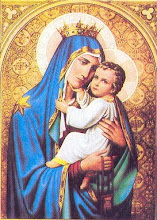
Our Lady of Perpetual Help

It is the feast of Our Mother of Perpetual Help.
In dangers, in hardships, in every doubt,
think of Mary, call out to Mary.
Keep her in your mouth, keep her in your heart.
Follow the example of her life
and you will obtain the favour of her prayer.

~St. Bernard

A history of the feast.
As our Queen, she cradles the royal Child Jesus in her left arm while her right hand gently clasps the Savior’s little hands. A single sandal dangles from one of His bare feet in anticipation of the welcome He would give to the nails that would pierce them. Yet, the face of Jesus is more mature than His little frame should allow. It is the way of the icon. The icon painter follows a regimen that is laid out by a long tradition of masters. The idea is to teach divine truth in the work of art. In the image of Our Lady of Perpetual Help, Mary is central. On account of its similarity with Saint Luke’s painting of Our Lady and Child (the Moslem Turks ripped the original to pieces when they took over Constantinople in 1453) icon scholars believe that the original painting of Our Lady of Perpetual Help was based on a copy of Saint Luke’s painting. Our Lady is looking out straight ahead in the picture. Her eyes seem to be pleading for her Son, whom she knew was to die a terrible death in atonement for sin. The Child Jesus is turned toward one of the angels, Michael, who holds forth a cross like a standard; the other angel, Gabriel, carries the spear. Some interpret the face of Our Lord as expressing fear. I think that they are right. 
The central figure in eastern iconography, be it the Theotokos, the Hagia Sophia (the Son of God as Wisdom), or a saint, looms larger than the other figures in the painting, if there are any. There is in fact disproportion between the central figure, whose face is always luminous, rather than illumined, and whoever else is honored in the icon. With Our Lady of Perpetual Help, Our Lord is smaller than would be the case if the artist intended to draw a “picture.” What one immediately sees in looking at an icon is that the sanctity of the person drawn comes from within. To be sure, westerners must be educated when it comes to viewing an icon; the image is not meant to be gazed at for created beauty, but read for enlightenment of Faith. Icons reveal divine mystery more than just what appears to the physical eye. 
The history of this painting, its origin, its journeys, its miracles, its survival of persecution, its popularity, and its life in Rome for the past six centuries, is wonderful. No one knows who painted it. That is because it was the work of an eastern Catholic artist and icons are never signed. It is believed to have been composed in the thirteenth century in Crete. Notice, I chose to use the word composed rather than drawn. As I said, icons are meant to be read. Sharing the scene with Our Lady, whose title Mother of God is written beside her in abbreviated Greek letters, and Jesus, are the two angels, Michael and Gabriel, who are also named in abbreviated Greek characters The painting was a treasure cherished by the faithful of the Greek island who came to venerate it where it hung above the main altar of a cathedral, perhaps in the capital city of Candia. 
Near the end of the fifteenth century, a wealthy Venetian merchant managed to steal the painting and, hiding it in his possessions, he took it to Italy where he planned to sell it. However, while he was on business in Rome he became very ill. When it appeared that he would not recover, he somewhat repented for having taken the icon and, apparently, made a resolution to bestow it to a church. As he was dying he revealed to a friend where he had hid the work. Strangely, however, and no doubt providentially (for its original home in Crete was soon after overrun by the Turks), he asked his friend to give the image to any church in Rome. That is how the icon arrived at the Augustinian Church of Saint Matthew in the Eternal City. However, that did not happen right away. After the death of the “good thief” his friend showed the painting to his wife. The woman would not part with it. Her husband proved to be a wimp and he failed to fulfill the request of his dying friend out of fear of upsetting his wife. His wife’s father also got involved, encouraging his daughter to keep it, for it was truly an exquisite work of art and would be worth a lot of money. It took an apparition of Our Lady to this woman’s daughter and mother to convince her that she must let the holy icon go. Our Lady said to the little girl: “Go and tell your mother and your grandfather: Our Lady of Perpetual Help bids you to take her away from your house; otherwise, you will all die.” There you have it, Mary herself chose the title Our Lady of Perpetual Help! The devil tried again and again, even using a sceptical neighbor, to prevent the icon from leaving the merchant’s house. But he was vanquished in the end and the image was eventually enshrined in the humble Church of Saint Thomas, near the Basilica of Saint Mary Major on the Esquiline hill. (Read more.)


More HERE.

Saturday, June 22, 2024

Two English Martyrs


 Father Mark's post on St. Thomas More and St. John Fisher is so beautiful, anything I could say would be redundant. To quote:
Men of Fire and of Light
We remember today two martyrs, one a bishop and the other a husband, father, lawyer, statesman, and philosopher: Saints John Fisher and Thomas More. Both were men of fire and of light. Both fought manfully and suffered the martyrdom of John the Baptist, the Friend of the Bridegroom of whom Our Lord said, “He was a burning and shining lamp, and you were willing to rejoice for a while in his light” (Jn 5:35).
The Sun Snatched from the Universe
Saint John Fisher was alone among all the bishops of the realm to stand against Henry VIII in the “great affair” of his divorce and against the Act of Supremacy by which the King repudiated the jurisdiction of the Pope over the Church in England. The Church in England was to become the Church of England. Protestantization would follow and, above all, the suppression of the Holy Sacrifice of the Mass offered according to the rite of the Church of Rome. Concerning Holy Mass, Bishop John Fisher had written: “He who goes about to take the Holy Sacrifice of the Mass from the Church, plots no less a calamity than if he tried to snatch the sun from the universe.”

The following excerpts are from St. Thomas More's A Dialogue of Comfort Against Tribulation:
If we reflect on these things and remember them well, we shall not murmur or complain in time of tribulation. Instead, we shall first take our pain patiently and see it as something of worth. Then we shall grow in goodness and see ourselves as quite worthy of tribulation. And then we shall realize that God has sent it for our own good, and so be moved to thank God for it....
Let us, then, never hope for our life to be long. We should keep it while we can, because God has so commanded, but if God so arranges that in his good graces we may go, let us be glad of it, and long to go to him. And then shall the hope of heaven comfort our heavy hearts, and out of our transitory tribulation shall we go to everlasting glory....

Friday, June 21, 2024

The Test of Love

Light of the World by William Holman Hunt

I begged Our Lord to teach you the secret of sanctity and happiness in the
sanctification of the present moment--peacefully. The present moment contains all grace for our sanctification, and it is the only thing that matters.

Keep your eyes ever on the Divine Guest within, Whose love is directing all that concerns you every moment, even the annoying little things that cause irritation. Be generous with Him, and let your joy be in sacrifice. It was His joy. He came from Heaven to prove it to us, and love can find no other real test....

Sweet and peaceful conformity to God's Will is the test of love. It is often crucifying to self-love and self-will, but suffering was the chosen portion of Our Lord, and the faithful lover should want no other.

~Fragrance from Alabaster
by Mother Aloysius of the Blessed Sacrament, OCD
Related Posts with Thumbnails