
Showing posts with label Epiphany. Show all posts

Thursday, July 9, 2026

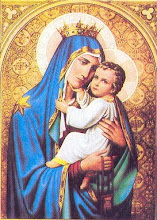
Mt. Carmel Novena, Day 3-- "Star of the Sea"

"I made that in the heavens there should rise light that never faileth...I compassed the circuit of heaven...and have walked in the waves of the sea." Ecclesiasticus 24:6,8

"And seeing the star, they rejoiced with exceeding great joy." St Matthew 2:10

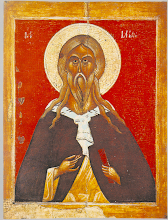
During his first crusade to free captive Jerusalem, St Louis IX the King of France was sailing with his retinue when a fierce storm overwhelmed the vessel. They were not far from the shores of Palestine when through the tempest the bells from the chapel of the hermits on Mt. Carmel could be heard. The holy king fell to his knees, imploring the Blessed Virgin to spare his family and his companions from drowning. The ship did not founder; the storm ceased. King Louis, with a heart full of gratitude, decided to visit the "Brothers of Our Lady" on Mt. Carmel, where they lived in prayer and penance in imitation of the Prophet Elias. So impressed was he with their austerity and devotion, that he arranged for some of them to go to France, thus bringing the Carmelite order to that country where it flourished for centuries. The fact that many of the Brothers went to Europe preserved the Carmelite Order from extinction, since those hermits living on Mt. Carmel were eventually massacred by the Moslems.

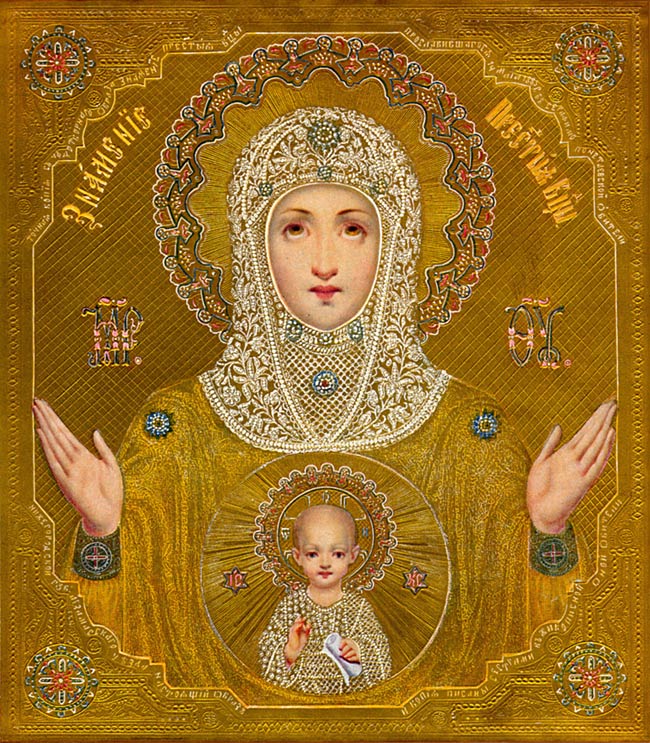
Our Lady is the star whose light pierces the darkest clouds to guide the ship of the Church, as well as the ship of the soul, through the most tumultuous storms. The ancient icons of the Virgin often show her adorned with a star; the title "Star
of the Sea" is very old, a symbol of royalty and power, of help and mediation. The hymn Ave Maris Stella ("Hail, Star of the Sea") has often been sung in times of crisis, as mentioned in the lives of many saints; we know that on the path to Heaven even the holiest souls feel overwhelmed and discouraged in times of darkness and persecution.

In the words of the Franciscan Wonder-Worker St Anthony of Padua: "We are far from God, tossed at every moment by storms. We lie at the very jaws of spiritual death, and so we cry out, 'Hail Mary!' ''

Star of the Sea, pray for us!

Novena Prayer to Our Lady of Mt. Carmel:

O most beautiful Flower of Mt Carmel, fruitful vine, splendor of Heaven, Blessed Mother of the Son of God, Immaculate Virgin, assist me in this my necessity. O Star of the Sea, help me and show me herein you are my Mother.

O Holy Mary, Mother of God, Queen of Heaven and earth, I humbly beseech you from the bottom of my heart, to succor me in this my necessity, there are none that can withstand your power.

O show me herein you are my Mother.

Mary, conceived without sin, pray for us that have recourse to thee. (3 times)

Sweet Mother, I place this cause in your hands. (3 times) AMEN.

Monday, May 25, 2026

History of the Time After Pentecost


From Dom Gueranger:

This section of the Liturgical Year, which comprises a little more or a little less than six months, according as Easter is early or late, has always had the character it holds at present. But, although it only admits detached solemnities and Feasts, the influence of the moveable portion of the Cycle is still observable. It may have as many as twenty-eight, or as few as twenty-three weeks. This variation depends not only upon the Easter Feast, which may occur on any of the days between the 22nd of March and 25th of April, inclusively; but, also, on the date of the first Sunday of Advent, the opening of a new Ecclesiastical Year, and which is always the Sunday nearest the Kalends of December.

In the Roman Liturgy, the Sundays of this series go under the name of Sundays after Pentecost. As we shall show in the next Chapter, that title is the most suitable that could have been given, and is found in the oldest Sacramentaries and Antiphonaries; but it was not universally adopted by even all those Churches which followed the Roman Rite; in progress of time, however, that title was the general one. To mention some of the previous early names:—in the Comes of Alcuin, which takes us back to the 8th Century, we find the first section of these Sundays called Sundays after Pentecost; the second is named Weeks after the Feast of the Apostles (post Natale Apostolorum); the third goes under the title of Weeks after Saint Laurence (post Sancti Laurentii); the fourth has the appellation of Weeks of the Seventh Month (September); and, lastly, the fifth is termed Weeks after Saint Michael (post Sancti Angeli), and lasts till Advent. As late as the 16th Century, many Missals of the Western Churches gave us these several sections of the Time after Pentecost, but some of the titles varied according to the special Saints honored in the respective dioceses, and which were taken as the date-marks of this period of the Year. The Roman Missal, published by order of Saint Pius the Fifth, has gradually been adopted in all our Latin Churches, and has restored the ancient denomination to the Ecclesiastical Season we have just entered upon; so that the only name under which it is now known amongst us is, The Time after Pentecost (post Pentecosten). (Read more.)

Tuesday, January 13, 2026

We Have Seen the True Light

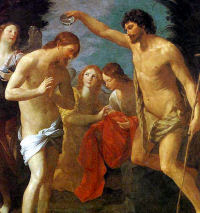
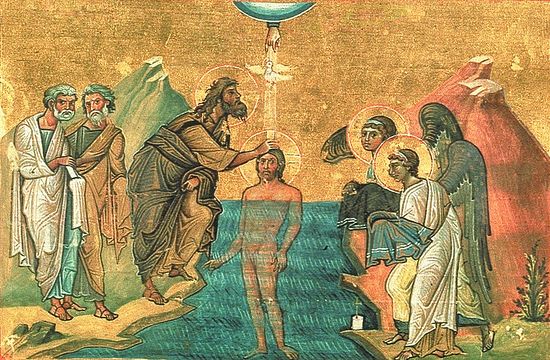
Baptism of Christ by Grigory Gaagarin
The Baptism of the Lord. From Vultus Christi:
Very few Catholics grasp the reality of their divine sonship by adoption. For too many, the great baptismal grace that is divine adoption remains something notional. something vague and, as it were, something obscure in the back of one’s mind. This is why, in every age, God raises up saints, and doctors, and mystics to call us back to what makes Christianity different from every other religion, philosophy, ethical system, and mystical meandering on the planet: divine sonship by adoption. We are, by grace, what Jesus is by nature. All the Fathers taught this. The Doctors scrutinised it and marveled at the divine condescension. Mother Mectilde seized upon this in the 17th century and wrote about it in her letters. Saint Thérèse, Blessed Abbot Marmion, Blessed Elisabeth of the Trinity, and the Venerable Itala Mela, all of these were raised up in modern times to say to souls: You are not mere seekers after wisdom, you are not slaves in submission to a remote divinity, you are not keepers of a moral order; you are sons in the Son. This is so stupendous a mystery that many put it aside and prefer to concentrate on things less unsettling.

We bring Thee offerings, O Lord, for the appearing of Thy new born Son, humbly beseeching Thee that, as He is the author of our gifts, so also He may mercifully receive them. (Secret of the Mass) (Read more.)
(Image source.)

Sunday, January 11, 2026

Baptism of the Lord

Today in America. From Catholic Culture:
And Jesus being baptized, forthwith came out of the water; and lo, the heavens were opened to Him and He saw the Spirit of God descending as a dove, and coming upon Him. And behold a voice from heaven saying, "This is My beloved Son, in Whom I am well pleased."
Jesus stoops so low as to mingle with the multitude of sinners, and forthwith the heavens are opened to magnify Him — He acknowledges Himself worthy of the strokes of divine justice, and behold, the Father declares that He takes all His delight in Him: Humiliavit semetipsom... propter quod et Deus exaltavit illum.
It is at this moment that the mission of Jesus, as One sent by God, is declared authentic. The Father's testimony accredits, so to speak, His Son before the world, and hence this testimony relates to one of the characters of Christ's work as regards ourselves. The mission of Jesus has a double aspect: it bears at the same time the character of redemption and of sanctification. It is to redeem souls, and, this done, to infuse life into them. That is the whole work of the Savior.Christ in His Mysteries by Dom Columba Marmion (Read more.)

Wednesday, January 7, 2026

Birthday of La Pucelle

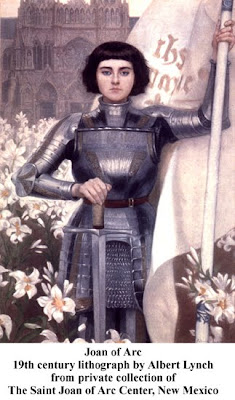
The great feast of Epiphany coincides with the birthday of Saint Joan of Arc, who called herself La Pucelle, "The Maid." Here is a link to some of her most famous quotations, in addition to those included below.
Je me attens a Dieu, mon createur, de tout; je layme (l'ayme) de tout mon cuer.
"I place trust in God, my creator, in all things; I love Him with all my heart."

Je suis cy envoiée de par Dieu, le roy du ciel.
"I am sent here by God, the King of Heaven".

Je me attens a mon juge, cest (c'est) le roy du ciel et de la terre.
"I trust in my Judge, who is the King of Heaven and Earth".

Birthday of St. Bernadette

Another French saint born on the Epiphany is Saint Bernadette (1844-1879). During the 1858 apparitions, Our Lady said to fourteen-year-old Bernadette: "I cannot promise to make you happy in this world, only in the next." St. Bernadette had a life of suffering indeed, but it was suffering infused with love. Her childhood was spent in destitution and she was afflicted with a lifetime of bad health. The apparitions intensified her trials. Her spirit was never broken, which is no small victory. As one article says:
What, apart from this bare chronology, can we know about Bernadette Soubirous? One thing is certain: she strove with all her might to fulfill the vocation announced to her by the Virgin at Massabielle-----to do penance, to pray and suffer for sinners. And she did suffer. The Mother Superior at Nevers testified, "It took her an hour to find a bearable position, during which her face changed and she became as if dead. Even when asleep, the faintest movement of her leg made her cry out. Such sharp cries that her companions in the dormitory could not sleep. She shrank to nothing." In fact, she had tuberculosis. Bernadette did not 'enjoy' suffering, though she spoke of it as 'my job'. And she once said, "I pray to St. Bernard, but I do not imitate him. St. Bernard liked suffering, but I avoid it if I can."
Apart from her physical pain, she bore much personal grief. Her mother died early, at forty-one. Her sister Toinette's first child, also named Bernadette, died in February of 1871, to be followed by her father a month later. In fact all five of Toinette's babies died and Bernadette wrote to her: "I like to imagine that dear little group praying in Heaven for us poor exiles on this miserable earth."
Bernadette suffered, too, from the interrogations of religious historians who tried to make her offer elaborate theological explanations for her visions. But she replied, "It is best for people to speak and write very simply. It is more moving to read the Passion than to have it explained."
In the last stages of her final illness, she requested to be left only with the crucifix sent to her by Pope Pius IX. When she became too weak to hold it, she had it fastened to her breast. After her death she was first beatified in 1925 and then canonized as St. Bernadette in 1933.
St. Bernadette suffered greatly at school and later in the convent at the hands of Sister Vauzous, whose jealousy and revulsion for the simple peasant was so great she was unable to contain it. How sad that the saint's greatest tormentor was not a pagan but her own sister in Christ! Too often, we Christians make life miserable for each other; it usually boils down to jealousy, envy and the refusal to forgive. As one biographical account relates:
Acting under the quite unfounded notion that Bernadette's visions and all the attendant publicity might have made the young woman vain or self-important, Sister Marie Therese Vauzous, now novice-mistress at Nevers, was very severe with her former pupil. Although she made life difficult for Bernadette, the little novice met all tests with perfect humility. She cheerfully performed the menial tasks assigned to her, at first in the convent kitchen, although this work must have taxed her strength. Later, when it was noted that her sympathetic manner made her a favorite with sick people, she was appointed assistant infirmarian. Her step and touch were light, and her very presence brought comfort. But during these years, Bernadette was suffering from the chronic disease which was slowly draining her life away. She was finally given work in the sacristy, where cleverness with the needle made her work admired and cherished. She displayed a real gift for design and color in embroidering the sacred vestments. To all tasks she brought a pure grace of spirit and an utter willingness to serve. (Read more.)
Through St. Bernadette's patient endurance many miracles, cures, and conversions occurred. She allowed herself to be an instrument of God, and God used her offering of herself to bring joy and faith to others. We are not all called to suffer in the same degree as a victim soul like Bernadette, but we can each participate in the redemption of the world by uniting our trials with those of Jesus on the cross.

Tuesday, January 6, 2026

Epiphany of the Lord

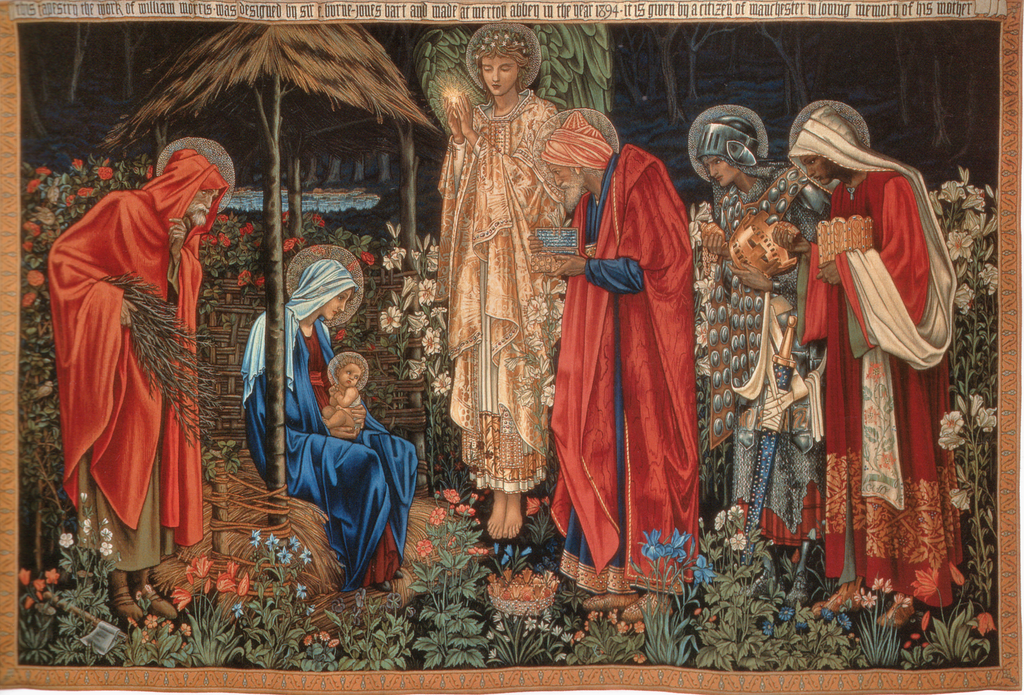
 Arise, be enlightened, O Jerusalem: for thy light us come....And the gentiles shall walk in thy light, and kings in the brightness of thy rising....All they from Saba shall come, bringing gold and frankincense, and showing forth praise to the Lord. (Isaias 60, 1-6)
Here is a quote on the Epiphany from Fr. Gabriel of St. Mary Magdalen's Divine Intimacy:
A star often appears in the heaven of our souls; it is the inspiration from God, clear and intimate, urging us to greater generosity and calling us to a life of closer union with Him. Like the Magi, we too must always follow our star with faith, promptness and selfless generosity. If we allow it to guide us, it will certainly lead us to God; it will bring us to the One whom we are seeking.
The Magi did not give up their quest, although the star- at one point- disappeared from their sight. We should follow their example and their perseverance, even when we are in interior darkness. This is a trial of faith which is overcome only by the exercise of pure, naked faith. I know that He wills it, I know that God is calling, and this suffices for me: Scio cui credidi et certus sum (2 Timothy 1:12); I know whom I have believed. No matter what happens, I shall trust Him. (Divine Intimacy, pp. 122-123)

Abbot Gueranger discusses the mystery of the Magi, HERE
.


(Artwork:
Journey of the Magi, 1902 by James Tissot)

Epiphany: the Festival of Adoration

From Fr. Mark:
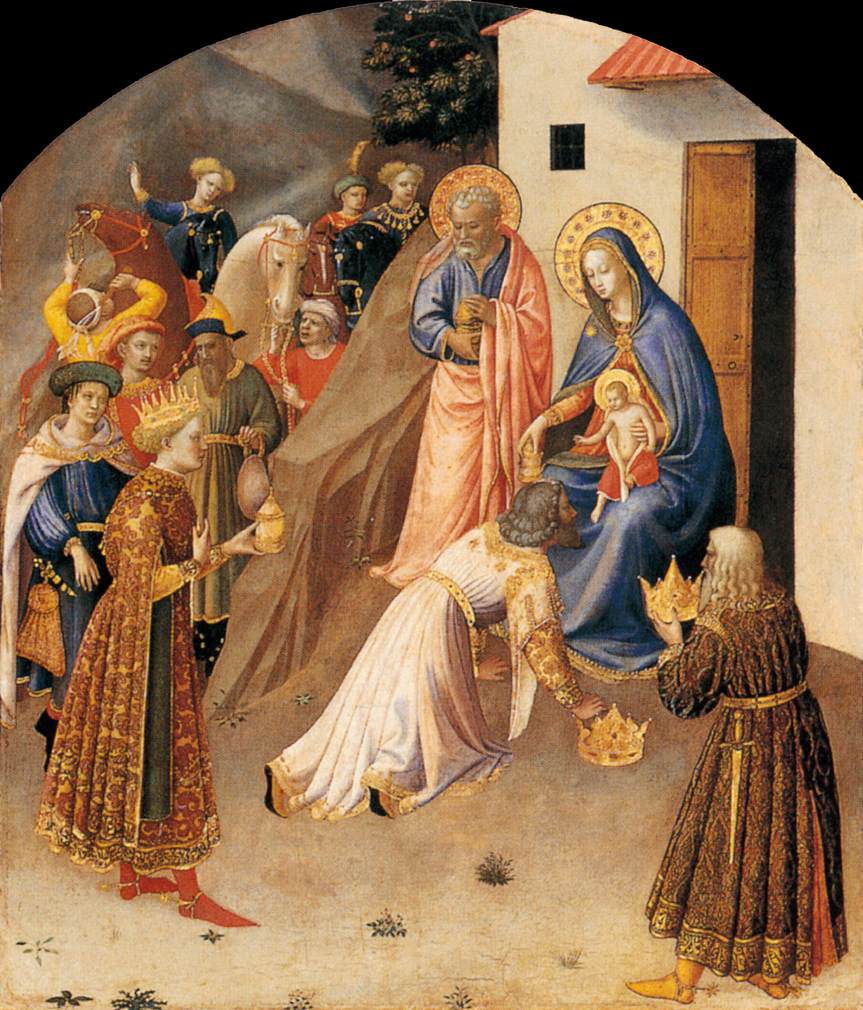
When a soul perceives the light of Christ, that soul is compelled to adore. Thus do we hear in the Holy Gospel: “And entering into the house, they found the child with Mary his mother, and falling down they adored him.” (Matthew 2:11).

There are, if you will, three moments in the grace of adoration. The first of these is the perception of the light. To see the light of Christ one must enter into the house that is the Church; from the outside, it appears, to some, small and, perhaps, confining. But when one enters the house of the Church, one discovers, from within, that it is immensely spacious. The Church is the place of the Divine Hospitality on earth. Not only is their room in the house of the Church for all; there is also pure water for cleansing; oil for the healing of every infirmity; and a banquet made ready with the living Bread come down from heaven, and with the joy-giving chalice of Christ’s Precious Blood.

The house of the Church is Mary’s house. Therein she is Mother: Mother, not only of Christ the Head, the Infant nourished at her breast, but also of the members of the Body of Christ, from the least to the greatest, all of whom she draws to her Immaculate Heart. Mary’s Virgin Body is the radiant monstrance of the Body of Christ; she holds Him in such a way as to show Him to us. She says to every soul who enters the house of the Church, “Arise, be enlightened, for thy light has come, and the glory of the Lord has risen upon thee.” (Isaiah 60:1).

The light that illumines Mary’s house, the house of the Church, shines from the adorable Body of Christ in the Most Holy Sacrament of the Altar. How can one open one’s eyes to the radiant Body of Christ, exposed in what Mother Mectilde de Bar called the soleil (sun) of the monstrance, and not see the fufilment of the words of the prophet Malachy? “The Sun of justice shall arise, and health — meaning healing and wholeness — in his wings” (Malachy 4:2)

The second moment in the grace of adoration is to fall down as it is written in the Gospel: “and falling down they adored him” (Matthew 2:11). What is this mysterious falling down? It is a response to the brightness of the Light; it is the first movement of one who would adore. To fall down is to attempt to become level with the ground. It is the expression of a profound desire to become very little, very lowly. It is an attempt to say with one’s whole body, that one would wish to be able to pour oneself out, to break oneself open, to allow one’s essence to be spent to the last molecule, like the precious perfume that flowed from the vase of alabaster, filling the whole house with its fragrance (John 12:3). This is what Mother Mectilde of the Holy Sacrament means when she speaks of anéantissement, and when she makes it the very condition of adoration in spirit and in truth. (Read more.)

Monday, January 5, 2026

Epiphany Eve

It is the Twelfth Night. Tomorrow in Rome the Holy Father will be celebrating the Solemnity of the Epiphany of the Lord. In the U.S.A. we celebrated the great manifestation of Our Lord to the nations yesterday. In the meantime, Fish Eaters has a splendid article about Epiphany Eve.
 The Eve of the Feast of the Epiphany is the twelfth day of Christmas, and tonight is known as"Twelfth Night" (or "Twelfthnight"). It begins the celebration of Christ's revealing His Divinity in three ways, which is formally celebrated tomorrow:
  • to the Magi who, guided by the great and mysterious Star of Bethlehem, came to visit Him when He was a Baby (Matthew 2:1-19)
     
  • through His Baptism by St. John, when "the Spirit of God descending as a dove" came upon Him and there was heard a voice from Heaven saying, "This is my beloved Son, in whom I am well pleased" (Matthew 3, Mark 1, Luke 3, John 1), and all Three Persons of the Most Holy Trinity were manifest (Note: the Baptism of Our Lord is also commemorated on the 13th of January)
     
  • through His first public miracle -- that of the wedding at Cana when Our Lord turned water into wine at the request of His Mother (John 2). Just as God's first miracle before the Egyptian pharaoh, through Moses, was turning the waters of the Nile into blood, Our Lord's first miracle was turning water into wine.

In many Catholic homes (especially Italian ones), it's not Christmas Day that is for giving presents to children, but the Feast of Epiphany, when the gifts are given in a way related to the Magi. So today will have a "feel" of Christmas Eve, and because of the Epiphany's association with the Magis' gift-giving, tomorrow is often referred to colloquially as the "Little Christmas."

It is today that the Three Kings should reach the creche (heretofore, they should be kept away from it) and that Baby Jesus should be adorned with signs of royalty, such as a crown, ermine, and gold or purple cloth. Set up golden candlesticks around the manger where He lies.

Sunday, January 4, 2026

The Invisible Star of Grace

From Mother Mectilde de Bar:
...The feast of the Epiphany...signifies the manifestation of Jesus to the holy Magi Kings, who sought Him in the manger of Bethlehem to offer Him their respect and their adoration. This feast must bring us a special devotion because it corresponds more than any other to the spirit of our vocation which deputes us to adore the same Christ Jesus, whom the Magi adored, in the august Sacrament of the Altar, the mystery that contains within itself all the other mysteries of His holy life. For this reason, you can adore there [in the Most Holy Sacrament] the little Child of the manger; you can adore Him together with the Holy Kings and you can say even as they did, “We have seen his star in the east, and are come to adore him” (Matthew 2:2). The call to to the Institute [of Perpetual Adoration of the Most Holy Sacrament of the Altar] was your star, and even though you did not see a visible star, as the Magi did, you have had nonetheless the interior inspiration of grace, which is by far more secure than outward signs.

You have, then, seen His star, and you have come to adore Him. But what duration and extent must such adoration have? Every instant of our life, and with all our being. We are called  . . . [to] Perpetual Adoration. Oh, let us not bear so beautiful a name in vain; let us not be illusory adorers, let us correspond with all our capacity to this calling and to God’s choice of us to adore Him continually. Has He need of us for this, poor and miserable creatures [that we are] who can do nothing good of ourselves unless we be moved by His grace? Has He not millions of angels and heavenly spirits who ceaselessly render Him perfect adoration even in our churches, which are altogether full of them? Although we do not see them, this is the truth. All the same, He has chosen us and wants us to have the privilege of adoring Him as they do, and of being His perpetual adorers. We must, in a holy manner, glory in so lofty a vocation! But to carry out such a vocation, it is not enough to spend an hour or some in His presence in choir.

Our adoration must be perpetual because the same God whom we adore in the Most Holy Sacrament is always present to us in every place.  We must adore Him in spirit and in truth. In spirit, by means of a holy interior recollection; in truth, by acting in such wise that all our observances become a continual adoration, and this by giving ourselves faithfully to God in all that He asks of us, because as soon as we fail in fidelity, we stop adoring.
Our Institute was created uniquely to make perpetual adorers of us. You have been called to this; it is, therefore, up to you to realise its grace and holiness by becoming authentic adorers who adore in spirit and in truth. Yes, such must be your care and diligence in adoring this God of majesty in spirit and in truth, so as to correspond to His choice of you. In spirit, by the certainty of your faith, believing all that He is in Himself, even without understanding it. His divine greatnesses and perfections deserve your homage, your respect, your adoration. In truth, by adoring Him with your whole being, in such wise that there be nothing in you that you do not wish to hand over and sacrifice to Him in order to adore Him as perfectly as possible according to your capacity and with all your heart. (Read more.)

Tuesday, December 16, 2025

Christmas Novena

The novena in honor of the Divine Infant begins today. Let us pray for the unborn, and for all the children in the world, especially those who are suffering abuse or neglect.

INFANT OF PRAGUE NINE DAY NOVENA
 
[You may state your special intention for the Novena at the start
on the first day, or ask it anew each day.]


ORIGINAL PRAYER OF VEN. CYRIL TO THE MIRACULOUS INFANT JESUS OF PRAGUE 

JESUS, unto Thee I flee,
Through Thy mother praying Thee
in my need to succor me.

Truly, I believe of Thee
God Thou art with strength to shield me;
Full of trust, I hope of Thee
Thou Thy grace wilt give to me.

All my heart I give to Thee,
Therefore, do my sins repent me;
From them breaking, I beseech Thee,
Jesus, from their bonds to free me.

Firm my purpose is to mend me;
Never more will I offend Thee.

Wholly unto Thee I give me,
Patiently to suffer for Thee,
Thee to serve eternally.
And my neighbor like to me
I will love for love of Thee.

Little Jesus, I beseech Thee,
In my need to succor me,
That with Joseph and Mary
And the Angels, I may Thee
Once enjoy eternally. Amen.


FIRST DAY:
 
Happily familiar to Catholics the world over is the little Infant of Prague. The dear and charming statues of Him, copied from the miraculous image in the capital of harassed Czechoslovakia, belong now to the whole of Catholicity. Today they can be found everywhere. Christ is a king, the King. 

This fact we celebrate in the majestic, glorious Feast of Christ the King. But Christ is the King not only of power and might. He is the King not alone of terrible love, ruling from His Cross, the conquering monarch entering into the glory of His Heavenly kingdom. 

He is also the Infant King, the king of Bethlehem and of the nursery in Nazareth . . . the king too small to defend Himself save by flight into Egypt . . . the king small enough to hide in the Host or in a human breast. 

So before the little Infant of Prague we say:
 
THE PRAYER OF CHRIST THE KING
 
SECOND DAY:
 
Fundamental to Christianity and basic to our faith and hope is the fact that the Son of God, the second Person of the Blessed trinity, became a Baby. 

This was the wonder that exalted the early Christians and repelled the pagan monarchs.
Suddenly the best of good news broke over the horizon. The remote God was as near as Bethlehem. The great God had become as small as a baby. The hands that fashioned the universe were infant hands. The all-creative voice that had cried the stupendous "Fiat lux," broke into the cries of babyhood. 

"We can pick up our God in our arms and hold Him as we hold a child." The thought made early Christians joyous as they took Him as their guest in the Eucharist. 

To the pagan world the idea was repellent. A king must be powerful, aloof, threatening, crowned with awesome majesty. He must be reached through messengers and surrounded by the restraining pomp of courts. 

So God became a Baby. Christianity was born with the birth of an Infant King. Christ's birth was a rebirth for human souls. 

Before the Infant King we say: 

THE PRAYER OF CHRIST THE KING
 
THIRD DAY:
 
It was given to Wise Men to see the kingdom of Infancy. A million, million Christians have prayerfully and happily followed the Magi as they traveled from pagandom onto the very center of the Church. 
 
Exultantly Catholics have seen these men, the wisest of their times, pierce the thin veil of babyhood and know that a Child could be a king, and God could in His quest of hearts assume the most heartwarming disguise. 

Wise as only the holy are wise, they saw the majesty in humility and the strength in love. Before the Infant King they placed their royal treasures. 

How like they were to those holy souls who in far-off Prague placed about the Infant King the trappings of royalty. The three Wise Men gave Him jewels to stud into a crown, and gold to beat into fine thread for His royal raiment, and the perfumes that were burned only in the braziers that sent clouds of sacrificial incense upward to God. 

History repeats itself in glad insistence. The gifts that were laid at the feet of the Infant of Bethlehem, modern faith has duplicated for the Infant of Prague. 

We join the Magi in saying:
 
THE PRAYER OF CHRIST THE KING
 
FOURTH DAY:

Our age likes to think of itself as wise and grown up and sophisticated. Often we see our age for what it is, old and tired and faltering to an atomic grave. 

It was the wisest of all teachers, Christ Himself, Who reminded us that unless we become as little children we shall not enter the Kingdom of Heaven. 

Nicodemus was puzzled by the whole idea of rebirth, infancy, childhood. Christ explained to him, on that secret night of his abashed visit, the rebirth through Baptism. All His life Christ explained to the tired old world of His age the importance of the virtues that keep the world young. 

Sin makes men old. Virtue keeps them immortally young. Sin speeds us to quick death. 
Virtue wings us to endless life. "Suffer the little children to come unto me . . . for such is the Kingdom of God" . . . men and women of childlike faith in their Father in Heaven . . . men and women unwearied by the dull pounding of sin . . . 

How wise the Church to encourage us, of this weary old generation, to kneel before the holy Infant and learn once more the beauties of childhood and the virtues of a heart that never grows old. 

Before the young King, the Infant God, we say:
 
THE PRAYER OF CHRIST THE KING
 
FIFTH DAY:
 
"Unless you . . . become as little children . . ." 

Who among us does not turn back to the happy days of childhood? The incredible moment of our first Holy Communion . . . the day when in Confirmation we became temples of the Holy Spirit . . . the years when mother and father were all in all to us and carried every burden and guarded us against all dangers. 

Those were the days without worry or burden, without the demands of each day pressing hard upon us. The world was new and beautiful, and God was very near. We walked with our guardian Angel. We knew the Saints by their favorite names. 

Sin had not put its lines on our soul. We loved purely, and we acted on warm, generous impulses. Why regret childhood? Saints grow old; but they are the happy children of God's tenderest protecting care, whatever their weight of years or mantle of responsibility. We might ask God to give us back the childhood of our souls, our simple faith, our untarnished love, our clear vision of the supernatural, our trust in our fellow men, our glimpses of Heaven all around us. 

All this we ask of the Infant of Prague in:
 
THE PRAYER OF CHRIST THE KING
 
SIXTH DAY:
In an age that depends upon adult cleverness, it is like God to work miracles before the statue of a little child. 

The statue of the Infant of Prague has been a wonder-working statue. In itself it is, as all statues are, stone or plaster or wood. In its symbolism it is deep and precious and meaningful. 

So it has been that near the feet of the Baby King the sick have found their health, the troubled their peace, the weary their rest, the doubting their faith, the despairing their hope. 

Strangely enough it has been toward temporal affairs, the affairs that are constantly bungled and mismanaged by the wise adults of earth that the miracles have flowed most frequently. Why not? God has used the wisdom of the simple to confound the wise, as He used the Babe of Bethlehem to upset the wiles of Herod and brought into ancient Egypt the eternal Word of God, His Infant Son. 

Miracles there will always be, but only for the trusting hearts. In a cynical world, only a humble heart shall be so blessed. So asking for simple faith, which is always the fountain of the greatest miracles, we say: 

THE PRAYER OF CHRIST THE KING
 
SEVENTH DAY:

Before the Infant Christ was born into the world, childhood was not a precious thing. Life was cheap, and the attitude of the pagan world toward new life was contemptuous. Only those who were strong enough to enforce their demands had any rights. 

Then came the Infant Christ, and for the first time childhood became precious. Every baby born into the world by God's hope and design was His child and heir. Christianity saw in strong, pure, religious youth the guarantee of strong, pure, religious nations. 

Marriage was founded no longer chiefly upon the lust of man and woman, a love that was to ripen into the living symbol of love --- the newborn baby. The child completed upon earth the trinity of the home--- itself an incarnate spirit of love --- as the Holy Spirit of love completed the Trinity in Heaven. 

Today, our nation and almost all of the nations of the world have once more spurned the precious gift of life and infancy, in its blood-lust for abortion and fetal experimentation.They violate their own dignity and know not what it is they truly do. We need the Infant of Prague and His innocence more than we ever have. 

As we look upon the Infant of Prague, we are glad that God became weak so that we could learn tenderness and mercy to the weak. We are glad that the Infant in the holy house gave marriage its high dignity and the home its beautiful sanctity.
Conscious of the dignity of of childhood, we say:
 
THE PRAYER OF CHRIST THE KING
EIGHTH DAY:

Children give us an amazing opportunity to show our generosity. The decent adult cannot fail to feel a strong impulse toward giving when he sees the smile and the outstretched hands of an infant. 

Infancy becomes and excuse for human generosity. Certainly infancy has the power to waken even in the most selfish breasts the desire to give. Christmas proves this power --- Christmas that centers around the Child in the manger and the children in our homes.
Those holy souls who bedecked the Infant of Prague manifested beautifully this response of human generosity to childhood. 

They clothed the Infant as we love to clothe a child in rich robes. They placed upon His Infant head a jeweled crown. 

Then they did in symbol what God had done in reality: They placed in the tiny hands of the Infant Christ the world, of which He is Creator and over which He rules, and the scepter, symbol of His dominion over all mankind. So does God impress on a worldly-wise and selfish world, the need of simple, generous love. And He commands our love in the guise of a baby.
Out of generous hearts we speak:
 
THE PRAYER OF CHRIST THE KING 

NINTH DAY:

Christ is our King; of that there is no doubt. Though He was battered and broken, He could stand in the presence of Pilate, representative of Rome's powerful monarch, and accept the governor's wondering question about His royalty.
"You say ----- and rightly ----- that I am king." 

No other king was ever more truly king in his own right than was Christ. As St. John points out in his glorious opening verses, the world is His, for He made it. 

When He established the unending Kingdom of His Church, He took over the world, knowing that the Church would see kingdoms and empires, republics and democracies rise and fall while it went its calm way. 

But most important He is King because a million, million men and women have freely and gladly accepted Him. He is the King of hearts, the Monarch of souls, the Ruler of men's lives, the Master of their destinies. He is the Sovereign Who never disappoints, the Emperor Who walks at the side of His humblest subject. 

He Who said: "I will be with you all days even to the consummation of the world," has chosen to keep His promise to us in our day in the guise of an infant, if only to confound our worldliness. 

Before the Infant King we say:
 
THE PRAYER OF CHRIST THE KING

Sunday, January 8, 2023

Mysteries of the Epiphany

The Wedding at Cana
From Fr. Mark:
The Five Mysteries of the Epiphany correspond to the five great Epiphany Gospels given us by the Church (in the traditional calendar and Liturgy) on the day of the Epiphany, 6 January; on the feast of the Baptism of the Lord, 13 January; and on the Second, Third, and Fourth Sundays after Epiphany. Each of these Gospels presents a particular manifestation of the Divinity of Our Lord Jesus Christ.
1. Matthew 2:1-12, Our Lord makes himself known to the Magi by means of a star, and receives their adoration in Bethlehem.
And behold the star which they had seen in the east, went before them, until it came and stood over where the child was. And seeing the star they rejoiced with exceeding great joy. And entering into the house, they found the child with Mary his mother, and falling down they adored him. (Mt 2:9-11)
2. John 1:29-34 — At His Baptism in the Jordan by John, the Holy Ghost descends in the form of a dove, and the voice of the Father reveals Jesus as His Beloved Son, in whom He is well pleased.
Now it came to pass, when all the people were baptized, that Jesus also being baptized and praying, heaven was opened; And the Holy Ghost descended in a bodily shape, as a dove upon him; and a voice came from heaven: Thou art my beloved Son; in thee I am well pleased. (Lk 3:21-22)
3. John 2:1-11 — At the wedding feast in Cana of Galilee, Jesus, at His Mother’s bidding, changes water into wine.
And the wine failing, the mother of Jesus saith to him: They have no wine. And Jesus saith to her: Woman, what is that to me and to thee? my hour is not yet come. His mother saith to the waiters: Whatsoever he shall say to you, do ye. (Jn 2:3-5)
4. Matthew 8:1-13 — Jesus, with a word, cleanses a leper.
And behold a leper came and adored him, saying: Lord, if thou wilt, thou canst make me clean. And Jesus stretching forth his hand, touched him, saying: I will, be thou made clean. And forthwith his leprosy was cleansed. (Mt 8:2-3)
5. Matthew 8:23-27 — Jesus calms the raging sea.
And behold a great tempest arose in the sea, so that the boat was covered with waves, but he was asleep. And they came to him, and awaked him, saying: Lord, save us, we perish. And Jesus saith to them: Why are you fearful, O ye of little faith? Then rising up he commanded the winds, and the sea, and there came a great calm. (Mt 8:24-25)
 (Read more.)

More HERE.

Monday, December 28, 2020

Epiphany Novena

From Fish Eaters:

Novena to the Magi in anticipation of the Epiphany
This Novena is especially prayed beginning on 28 December (the Feast of the Holy Innocents) and ending on 5 January (the Vigil of the Epiphany).

28 December:
O holy Magi! You were living in continual expectation of the rising of the Star of Jacob, which would announce the birth of the true Sun of justice; obtain for us an increase of faith and charity, and the grace to live in continual hope of beholding one day the light of heavenly glory and eternal joy. Glory be to the Father and to the Son and to the Holy Ghost, as it was in the beginning, is now, and ever shall be, world without end.

29 December:
O holy Magi! who at the first appearance of the wondrous star left your native country to go and seek the newborn King of the Jews; obtain for us the grace of corresponding with alacrity to every divine inspiration. Glory be to the Father and to the Son and to the Holy Ghost, as it was in the beginning, is now, and ever shall be, world without end.

30 December:
O holy Magi! who regarded neither the severity of the season, nor the inconveniences of the journey that you might find the newborn Messiah; obtain for us the grace not to allow ourselves to be discouraged by any of the difficulties which may meet us on the way of salvation. Glory be to the Father and to the Son and to the Holy Ghost, as it was in the beginning, is now, and ever shall be, world without end.

31 December:
O holy Magi, who, when deserted by the star in the city of Jerusalem, sought humbly, and without human respect, from the rulers of the Church, the place where you might discover the object of your journey; obtain for us grace to have recourse, in faith and humility, in all our doubts and perplexities to the counsel of our superiors, who hold the place of God on earth. Glory be to the Father and to the Son and to the Holy Ghost, as it was in the beginning, is now, and ever shall be, world without end.

1 January:
O holy Magi, who were gladdened by the reappearance of the star which led you to Bethlehem; obtain for us from God the grace, that, remaining always faithful to Him in afflictions, we may be consoled in time by His grace, and in eternity by His glory. Glory be to the Father and to the Son and to the Holy Ghost, as it was in the beginning, is now, and ever shall be, world without end.

2 January:
O holy Magi, who, entering full of faith into the stable of Bethlehem, prostrated yourselves on the earth, to adore the newborn King of the Jews, though he was surrounded only by signs of poverty and weakness; obtain from the Lord for us a lively faith in the real presence of Jesus in the blessed Sacrament, the true spirit of poverty, and a Christ-like charity for the poor and suffering. Glory be to the Father and to the Son and to the Holy Ghost, as it was in the beginning, is now, and ever shall be, world without end.

3 January:
O holy Magi, who offered to Jesus Christ gold, incense, and myrrh, thereby recognizing Him to be at once King, God, and Man; obtain from the Lord for us the grace never to present ourselves before Him with empty hands; but that we may continually offer to Him the gold of charity, the incense of prayer, and the myrrh of penance and mortification. Glory be to the Father and to the Son and to the Holy Ghost, as it was in the beginning, is now, and ever shall be, world without end.

4 January:
O holy Magi, who, when warned by an angel not to return to Herod, traveled back to your country be another road; obtain for us from the Lord, the grace that, after having found Him in true repentance, we may avoid all danger of losing Him again. Glory be to the Father and to the Son and to the Holy Ghost, as it was in the beginning, is now, and ever shall be, world without end.

5 January:
O holy Magi, who were first among the Gentiles called to the knowledge of Jesus Christ, and who persevered in the faith till your deaths, obtain for us of the Lord the grace of living always in conformity to our baptismal vows, ever leading to a life of faith; that like you we may attain to the beatific vision of that God Who now is the object of our faith. Glory be to the Father and to the Son and to the Holy Ghost, as it was in the beginning, is now, and ever shall be, world without end..

Friday, January 10, 2020

The Shrine of the Magi

From The Reliquarian:
The relics of the three kings remained in Milan until the twelfth century when the city of Milan rebelled against the Holy Roman Emperor, Frederick I, also known as Frederick Barbarossa. In need of assistance against the Milanese, the emperor appealed to Rainald von Dassel, Archbishop of Cologne, who recaptured Milan and delivered the city to the emperor. In gratitude, and “at the Archbishop’s great entreaty,” the emperor transferred the relics to the Archbishop in 1164. The Archbishop, “with great solemnity and in procession,” carried the bodies of the three kings from Milan to Cologne, where they were placed in the church of Saint Peter. “And all the people of the country roundabout, with all the reverence they might, received these relics, and there in the city of Cologne they are kept and beholden of all manner of nations unto this day.” The Historia concludes, “Thus endeth the legend of these three blessed kings—Melchior, Balthazar, and Jasper.”14 (Read more.)

Friday, January 4, 2019

St. Elizabeth Ann Seton

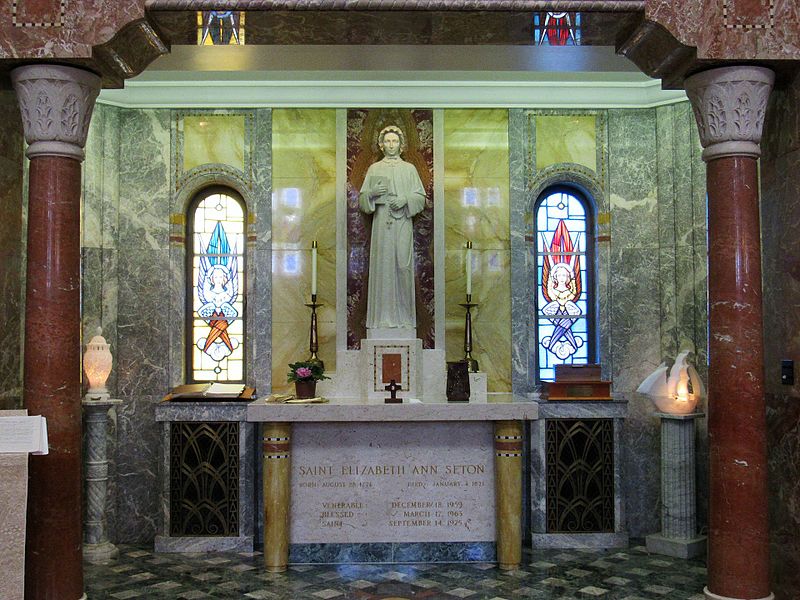
The Tomb of St. Elizabeth at the basilica in Emmitsburg, MD
From Vultus Christi:
Elizabeth Ann Seton was, more than anything else, a Eucharistic soul. She was converted by the Eucharist. Her first instructions in the Catholic faith emanated from the silence of the tabernacle. As she went forward, following the Lamb of God wheresoever it pleased Him to lead her, Eucharistic adoration marked her spiritual journey more and more until, in the final years of her life, she was often seen in ecstatic adoration of the Real Presence.

Paradoxically, it is this thoroughly American saint, who, by her devotion to the Mother of God, her attachment to the Mystery of the Eucharist, and her obedience to the Chair of Peter, offers the antidote to the errors of “Americanism,” condemned by Pope Leo XIII in 1899.
The underlying principle of these new opinions, declared the Pope, is that, in order to more easily attract those who differ from her, the Church should shape her teachings more in accord with the spirit of the age and relax some of her ancient severity and make some concessions to new opinions. Many think that these concessions should be made not only in regard to ways of living, but even in regard to doctrines which belong to the deposit of the faith. They contend that it would be opportune, in order to gain those who differ from us, to omit certain points of her teaching which are of lesser importance, and to tone down the meaning which the Church has always attached to them. It does not need many words, beloved son, to prove the falsity of these ideas if the nature and origin of the doctrine which the Church proposes are recalled to mind.
(Read more.)

Monday, January 8, 2018

Mysteries of the Epiphany

From Vultus Christi:
The Five Mysteries of the Epiphany correspond to the five great Epiphany Gospels given us by the Church (in the traditional calendar and Liturgy) on the day of the Epiphany, 6 January; on the feast of the Baptism of the Lord, 13 January; and on the Second, Third, and Fourth Sundays after Epiphany. Each of these Gospels presents a particular manifestation of the Divinity of Our Lord Jesus Christ.
1. Matthew 2:1-12, Our Lord makes himself known to the Magi by means of a star, and receives their adoration in Bethlehem.
And behold the star which they had seen in the east, went before them, until it came and stood over where the child was. And seeing the star they rejoiced with exceeding great joy. And entering into the house, they found the child with Mary his mother, and falling down they adored him. (Mt 2:9-11)
2. John 1:29-34 -- At His Baptism in the Jordan by John, the Holy Ghost descends in the form of a dove, and the voice of the Father reveals Jesus as His Beloved Son, in whom He is well pleased.
Now it came to pass, when all the people were baptized, that Jesus also being baptized and praying, heaven was opened; And the Holy Ghost descended in a bodily shape, as a dove upon him; and a voice came from heaven: Thou art my beloved Son; in thee I am well pleased. (Lk 3:21-22)
3. John 2:1-11 -- At the wedding feast in Cana of Galilee, Jesus, at His Mother's bidding, changes water into wine.
And the wine failing, the mother of Jesus saith to him: They have no wine. And Jesus saith to her: Woman, what is that to me and to thee? my hour is not yet come. His mother saith to the waiters: Whatsoever he shall say to you, do ye. (Jn 2:3-5)
4. Matthew 8:1-13 -- Jesus, with a word, cleanses a leper.
And behold a leper came and adored him, saying: Lord, if thou wilt, thou canst make me clean. And Jesus stretching forth his hand, touched him, saying: I will, be thou made clean. And forthwith his leprosy was cleansed. (Mt 8:2-3)
5. Matthew 8:23-27 -- Jesus calms the raging sea.
And behold a great tempest arose in the sea, so that the boat was covered with waves, but he was asleep. And they came to him, and awaked him, saying: Lord, save us, we perish. And Jesus saith to them: Why are you fearful, O ye of little faith? Then rising up he commanded the winds, and the sea, and there came a great calm. (Mt 8:24-25)
(Read entire post.)

Wednesday, January 11, 2012

The Triumph of Grace

From Vultus Christi:
My Little Jesus draws me to Himself at about the age of five years, or at about the age three or four. In the beginning, there was a little bit of imagination and a fair amount of emotion. It has been a long time now that the emotional has disappeared almost entirely; very often, it is desert, bleak and arid. What holds me in this way is the Word of God become a child, out of love for His Father and for us; or else it is the Saviour and Physician of souls; it is the God of my heart, the Friend, the Spouse and above all the adorable Little Brother. But it is always the Holy Humanity united to the Word, and so my worship goes to the Word become a child. When He presents to my spirit His infinite grandeurs and my nothingness, His holiness, my faults and my miseries, I adore Him in making myself very small. If He allows me to glimpse the charms of His childhood, His heart so humble and so meek, His infinitely touching holy littleness, the astonishing simplicity of a little brother (and so He does ordinarily), it is the heart that responds to Him, saying to Him the same protestations of love endlessly again and again, and from time to time, making itself very little before Him who is so great. This has lasted lo all these forty years and I never weary of always repeating to Him the same things. Since then, I have never aspired after another way; my Beloved Little Jesus is enough for me. And why would I have sought anything else, since, “all good things came to me along with Him” (Wis 7:11). I should never know how to retell Him my gratitude enough. (Read entire post.)

Sunday, January 8, 2012

Epiphany at Carmel

Here are some photos sent to me by my friends the Carmelite nuns in Rochester, NY.

High altar. Notice the choir grate over on the left.

High altar.

Choir altar and creche.

Choir creche

Creche inside the monastic quarters

Lovely Hummels, a gift to the monastery from a generous benefactor
Related Posts with Thumbnails