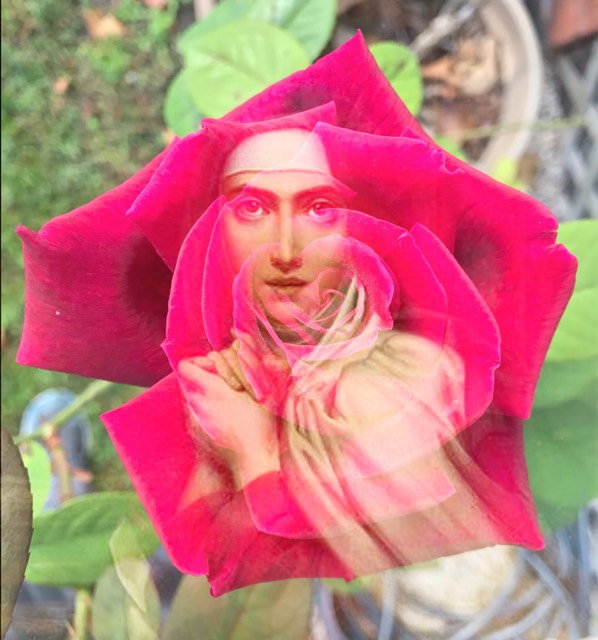
A couple years ago, around the feast of St. Maria Goretti, I came upon an article
and had a debate on Facebook with fellow Catholics, all ladies of deep
faith. I think there are major misunderstandings about why the Church
has from the earliest times held up virgin martyrs for our veneration. From
Our Sunday Visitor:
It’s
worth repeating: It is not a sin to be raped, but the Dicastery for the
Causes of Saints continues to behave as if it is....If women who die at
the hands of a would-be rapist are martyrs, why are we only celebrating
the ones who died “intact”?...If
we keep holding these assault victims up as models of chastity rather
than victims of crimes, we impress upon faithful young women that
keeping the Sixth Commandment is fundamentally about keeping men from
breaking it....The girls who answered “yes” to the CDC survey are in our
pews, in our confirmation classes and in our own homes. They are
listening to how we talk about Maria Goretti and Isabel Cristina and all
those who came between. They deserve better than to be told their value
lies in their virginity. They deserve better than the suggestion that
they would be better off dead. (Read more.)
True, girls
and young women, virgins or not, from a human point of view, are
definitely better off alive. Similarly, those
Christians who were tortured to death because they refused to offer
incense to pagan gods, would have been better off alive. St. Joan of Arc
would have been better off staying home and embroidering with her
mother than being burned alive at the stake. St. Isaac Jogues would have
been better off teaching theology at the Sorbonne rather than being
scalded alive and sodomized by the Iroquois. But sometimes, people need
to take a stand, especially when called to do so for the love of God. Because martyrdom is a gift.
I
think many young women today surrender their virginity not to a
rapist but to a boyfriend or lover, out of infatuation or out of peer
pressure. It was that way during the Roman Empire and it is that way
now. Even in Roman times, they were not always threatened with rape;
their attackers could have raped them at any time. Rather, the attackers wanted
them to happily go along with it; they wanted to seduce them. The fact
that some women have preferred death to giving into seduction and the
ways of the world is a charismatic gift. Martyrdom is a gift. Virgin
martyrdom is a gift. Just being a perpetual virgin, or a celibate of any
kind, is a gift. Not everyone is called to it but when someone is, they
know it is beyond their strength and a gift from God. When someone is called by God to be a martyr it means they
refuse to cooperate with evil on any level, even to save themselves.
They are saying to the evil person: you may kill me, you may rape me,
you may kill and rape me, but you are not getting even a moment of my
cooperation. We all have moments when our safety or well-being is
secondary, when someone or something more precious than our lives is in
danger. That is where grace builds on nature. But only God can give
someone the grace to give up their lives for Him. It is a
charismatic gift.
The article
criticizes the Dicastery's mention of the intact hymens of St. Maria and another modern virgin martyr Blessed Isabel Cristina, insisting that
the hymen should not even come into the investigation. Such
intimate examination has long been a part of police procedure when a
woman or girl is murdered, to see if the perpetrator should be charged
with rape as well as with murder. When the Dicastery records the
physical virginity of a victim it is as possible proof that the person
lived a chaste lifestyle. It is certainly not complete proof since a
pure and innocent girl might lose her virginity through being molested
or even in an accident, through no fault of her own. Also, someone with
an intact hymen might have impure habits and a filthy mind and not be
holy at all. But along with the accumulated evidence of the young lady's
piety, such as witness testimonies of her outward acts of faith, hope
and charity, evidence of physical virginity plays a part in proving the
sanctity of the victim.
However, the
value of the virgin martyr is not on the hymen but on a soul saying
"no" and taking a stand against
evil no matter what the consequences. To do so requires
supernatural strength. But yes, the Church has canonized saints who were
slaves and who were
probably raped such as St Felicity and St Josephine Bahkita. In the
great Roman persecutions, it was against Roman law to put a virgin to
death. Young Christian girls were regularly raped before being executed.
We do not know how many of the virgin-martyrs had to suffer such
brutality before being martyred. The surviving historical records do not
tell us.
Someone said to me that St. Maria Goretti resisted
her attacker because she knew if she was raped that she would be "trash"
in her town. Well, sorry, but St. Maria was already regarded as "trash"
in her community, which is why Alessandro saw her as an easy target.
Some people theorize he may already have have been molesting her in some
way. After all, they lived in the same house. We know he was making
lewd suggestions. After her First Communion St. Maria was determined to
say no. Because Alessandro did not just went to rape her. If he wanted
to rape her he could have done so at any time, but he never did. He
never did, even when she was lying there helpless.
What Alessandro
wanted was a cooperative little plaything. He wanted someone to
willingly act out his favorite porn images which he had upstairs in this
room. That is where his rage and frustration came from. If Maria had
capitulated, we know she would have been acting out of terror. But that
brave little girl, who had nothing and was nothing in her community,
refused to comply with his demands. She asserted her personhood and her
dignity over Alessandro's dehumanizing lust. Maria knew that through her
baptism she was a child of God; she had been bound to Christ through
the Sacraments of the Church, including Confession and the Holy
Eucharist. Those sacraments meant everything to her, more than fear of
death.
So ultimately, it was not about resisting
rape. It was resisting being his long term sex toy which is what
Alessandro really wanted. Maria knew if she gave in once there would be
no end to it. He wanted her cooperation, like the master of anyone in
sexual servitude. Alessandro wanted her complete submission and willing
participation. She did not give it. Looking back, we can say it would
not have been a sin for her, since she was a frightened child, and would
have been acting under duress. But Maria refused to cooperate, even
when threatened. Because in Maria's mind she would have been committing a
sin, as she said after it happened: "He did it because I would not
sin." That is why she is a martyr.







 Posts
Posts