Friday, August 7, 2026
St. Albert of Trapani
Also known as St. Albert of Sicily. Today in the Carmelite Order water is blessed known as "St Albert's Water." Sr. Mary, the late departed extern sister at the Carmel of Loretto, PA., kept a generous supply of jars filled with St Albert's water in the pantry near the Turn. Sometimes the water would be there for so long that the jars began to look like small aquariums of interesting life forms. But people would take them home anyway, because of the connection to the Carmelite priest who was a man of prayer and a worker of miracles. And the miracles never cease....
Thursday, July 30, 2026
Port-Royal, Jansenism, and St. Thérèse: The Hidden Heresy That Still Haunts Catholicism
| Madame de Montpeyroux, abbess of Port-Royal Abbey |
From Sensus Fidelium:
One of the greatest spiritual battles in Catholic history was not fought over the Trinity, the Eucharist, or even the papacy. It was fought over the character of God Himself.
Is God primarily a loving Father eager to save?
Or is He chiefly a stern Judge searching for reasons to condemn?
That question gave rise to one of the most influential, and spiritually devastating, movements in Church history: Jansenism.
Although officially condemned by multiple popes, its spirit survived for centuries. It shaped convents, seminaries, confessionals, and even family life. Its influence was so pervasive in France that St. Thérèse of Lisieux spent much of her short life offering what amounts to the Church’s greatest practical answer to it.
Ironically, the story begins not with obvious heretics, but with one of the most admired convents in Europe. (Read more.)
![]() |
| St. Thérèse of the Child Jesus |
Wednesday, July 29, 2026
St. Martha's Day
St. Martha of Bethany. It is ironic to me that she who tamed a dragon would also be the patroness of housewives. To quote from Aleteia:
Once there, Martha was immediately sought after for her association with Jesus. According to tradition, she performed many miraculous feats, including the slaying of a dragon along the Rhone river. The Golden Legend provides all the details.
At that time, in the forest along the Rhone between Aries and Avignon, there was a dragon that was half animal and half fish, larger than an ox, longer than a horse, with teeth as sharp as horns and a pair of bucklers on either side of his body. This beast lurked in the river, killing all those who tried to sail by and sinking their vessels … The people asked Martha for help, and she went after the dragon. She found him in the forest in the act of devouring a man, sprinkled him with blessed water, and had a cross held up in front of him. The brute was subdued at once and stood still like a sheep while Martha tied him up with her girdle, and the people killed him then and there with stones and lances.
St. Martha's Day
Tuesday, July 28, 2026
Blessed John Soreth
John Soreth was born at Caen in Normandy and entered Carmel as a young man. He pursued a doctorate of theology in Paris and served as regent of studies and provincial of the province. He was prior general from 1451 until his death at Angers in 1471. He restored observance within the Order and promoted its reform, wrote a famous commentary on the Rule, issued new Constitutions in 1462, and promoted the growth of the nuns and the Third Order.
Monday, July 27, 2026
Saint Titus Brandsma
Here he is in his prison uniform. Saint Titus was a towering intellect as well as a man of humor, wit and sanctity. He stood up to the Nazis; they put him in Dachau and performed experiments upon him. Before he died, he handed his rosary to the prison nurse and she was converted. He is a saint for our time.Although neo-paganism no longer wants love, history teaches us that, in spite of everything, we will conquer this neo-paganism with love. We shall not give up on love. Love will gain back for us the hearts of these pagans.
~ Bl. Titus Brandsma, from the Carmelite Proper of the Liturgy of the Hours
Friday, July 24, 2026
The Blessed Martyrs of Guadalajara
There were many atrocities perpetrated upon priests and religious in Spain during the bloody Civil War of the 1930's. In 1936, three Carmelite nuns were shot. Today is their feast, and here is their story:Sr Maria Pilar of St Francis Borgia, the eldest of the martyrs at 58, was born Jacoba Martinez García in 1877. Her elder sister was a Carmelite nun but as a teenager, Jacoba said she didn’t believe it was possible that God might also want her to be a nun, since she herself did not want it! It seems she changed her mind when she attended the Profession of her sister and she entered the monastery of St Joseph in Guadalajara at the age of 20. She had a great devotion to the Eucharist and referred to the Blessed Sacrament as “El Vivo”, the Living One. When war broke out, she was aware of the danger to which the community was exposed and was heard to say “If they martyr us, we will go singing, like the Compiègne martyrs.”
Sr Maria Angeles of St Joseph was born Marciana Valtierra Tordesillas in 1905 and was aware of a religious vocation from childhood. Her entry into the convent was delayed until she was 24, as she had to care for her widowed father and an aunt. When her aunt died, her father gave her permission to enter Carmel. In the process for beatification, the sisters testifying agreed that they could not remember Sr Maria Angeles committing a single fault in her Carmelite life. She was devoted to being faithful in small things and once said “We must see if we can be faithful enough for God to grant us the grace of martyrdom.” Again, she once said, “How marvellous to be martyrs but I am not worthy of that grace.” There are two prayers written by Sr Maria Angeles which express her desire for martyrdom.
The youngest of the martyrs, Sr Teresa of the Child Jesus and of St John of the Cross was born Eusebia García in 1909. Like Maria Angeles, she was devoted to God from a very young age. She was influenced by reading the autobiography of St Thérèse of Lisieux, whose name she would adopt in Carmel, and like Thérèse she wanted to enter Carmel from the age of 14. She was granted permission to enter at 16. Also like Thérèse, she had to overcome a difficult temperament. Her sisters in Carmel testified that she tried hard to correct her faults and to be charitable. Like Sr Maria Pilar, she had a great devotion to praying before the Blessed Sacrament, which she fondly called ‘sunbathing’. She also made known her desire for martyrdom.
From the outbreak of the civil war, the Carmelite nuns of Guadalajara suffered from disturbances, with children throwing stones at the monastery and passers-by shouting insults. The sisters had not been politically involved in events in any way; they did not even vote in the elections of 1936. They suffered solely because they were nuns. On July 22nd1936, militia arrived in Guadalajara. The Carmelite sisters feared that their monastery might be set on fire and so decided to leave it, going out two by two in modest secular clothes to find various safe houses. The next day, some of the community who had taken refuge in a hotel, left it to join some of their other sisters in a boarding house. The landlady was frightened as she now had 12 religious sheltering there, and told them only three could stay. Sr Teresa suggested that three of them could go to the house of a lady she knew nearby.
Sr Maria Pilar, Maria Angeles and Teresa left the house together and ran down the street. This, in addition to their modest dress, attracted attention and a woman standing with a group of militia was heard to say, “Go on, they are nuns!” When the sisters arrived at the house, they found no one at home and so stayed in the doorway. The militia had followed them and opened fire. Sr Maria Angeles died instantly, while Sr Maria Pilar was badly wounded. She was taken to a Red Cross hospital where she died some hours later, repeating “Father, forgive them, they do not know what they are doing.” Sr Teresa escaped the first hail of bullets but was apprehended by militia soon afterwards. They pretended to look after her but led her to a cemetery where they demanded that she shout “Long live Communism! Long live Russia!” Instead, she shouted “Viva Christo Rey!”(Long live Christ the King!) and was shot. (Read more.)
(More HERE, via The Inn at the End of the World)
"Soeur Espagne, sainte Espagne... tu as choisi!
Onze évêques, seize-mille prêtres massacrés... et pas une apostasie!"
~ Paul Claudel, "Aux martyrs espagnols"
Thursday, July 23, 2026
Mater Gratiae
Since the time of St. Luke, thousands of pictures and statues of the Blessed Virgin Mary have been carved, painted, or fashioned in some way, by all kinds of different people from around the world. Some of these pictures become famous, usually due to some form of miraculous intervention. One such picture is Our Lady of the Bowed Head, from Vienna, Austria.A Carmelite Monk, Venerable Dominic of Jesus and Mary, found one in 1610. He was looking over an old broken down house which he wanted to convert into a Carmelite Monastery. Fr. Dominic walked around the outside of the house and passed by a pile of garbage, but paid no attention to it. But as he entered the house and started looking over the rooms, suddenly he felt the urge to go back to the pile of garbage. Lighting his lantern, the good priest took a closer look at the heap of garbage. Suddenly his eyes fell upon an old oil painting of the Blessed Virgin Mary..."Who would throw a beautiful picture of Our Lady in the garbage," he wondered. Then Fr. Dominic apologized to Mary, "I am sorry, dear Mother, that someone has treated thy image in such a terrible manner. I will take it back to the monastery with me and fix it up, and I will give thee the homage which thou so rightly deserve." After returning to the monastery, Dominic cleaned the picture and repainted the damaged parts. Now he could hang the picture up in his cell and give Mary the devotion and attention which she deserved. He prayed to the Madonna with great confidence, asking her for many graces and blessings.One evening when he had just finished sweeping his cell, Fr. Dominic noticed that the picture of Our Lady had some dust on it. He was crushed, "Oh, I’m terribly sorry my dearest Mother!" He exclaimed. "I humbly beg thy pardon for forgetting to dust thy picture." Then taking out his handkerchief he began to dust the picture saying, "O purest and holiest of Virgins, nothing in the whole world is worthy to touch thy holy face. Dear Mother, I only have this coarse, old handkerchief and I beg of thee to please accept my good will in dusting thy image." Fr. Dominic continued dusting the picture of Mary, when suddenly the face of Our Lady came to life! She smiled at the holy priest and nodded her head as a sign of thanksgiving. Dominic was afraid that what he was seeing was a trick of the devil. But Our Lady cleared up his doubts saying, "Fear not, my son, for your request is granted! (Dominic had earlier requested a favor of her.) Your prayer will be answered and will be part of the reward, which you will receive for the love that you have for my Son Jesus and myself. Now Dominic I want you to ask me with all confidence, what favor you would like me to give you." The holy monk then fell upon his knees. "O my dear Mother, I offer myself entirely to thee and to thy dear Son Jesus, and I desire to do anything that thou and Jesus will ask of me. O my Lady, I know that the soul of a benefactor is suffering in Purgatory. Wouldst thou please be so kind as to deliver this soul from the fires of Purgatory?""Dominic, my son," Our Lady encouraged, "I will deliver this soul from Purgatory, if you will make many sacrifices and will have many Masses offered for this soul." Then the apparition of Mary faded away.The good monk hurried to do as Our Lady had asked. Some time later, when all had been completed, he again knelt before the miraculous painting of Our Lady. Suddenly Mary appeared to him again, but this time she appeared with the soul of the special benefactor, whom she had delivered from Purgatory. The benefactor was grateful, "Thank you, Fr. Dominic, for helping to release my soul from the fires of Purgatory with your prayers and sacrifices.""Dominic," Our Lady encouraged, "I would like you to ask me for more favors and blessings. I am the Mother of God and I delight in helping my children to obtain graces for their salvation." Fr. Dominic thought for a moment and then spoke, "Dear Mother, wouldst thou please be so kind as to listen mercifully to the prayers of all those who will honor thy image and ask for thy help." Our Lady replied, "All those who ask for my protection and honor this picture with devotion will obtain an answer to their prayers and will receive many graces. Moreover, I will pay special attention to the prayers which are offered to me, for the relief of the souls in Purgatory."The vision of Our Lady soon disappeared and Fr. Dominic thought about what he should do: "Our Lady made her promises to all who would honor and pray to her, before this miraculous image. Therefore, I can no longer keep this holy picture in my cell, I must have it put in a church, where the people can honor it."He then took the picture and had it placed in the Oratory of St. Charles, which was attached to the Church of Santa Maria de la Scale. Many people came to pray before the picture of Our Lady and it became a source of many graces and blessings. The holy image remained at the Oratory until Fr. Dominic’s death, which occurred in Vienna, on February 16, 1630. Some copies of the miraculous picture were painted and soon they were honored in many places. (Read entire article.)
Mater Gratiae
Monday, July 20, 2026
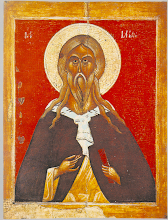
St. Elias the Prophet, Leader and Father of Carmelites
"Elias the prophet stood up, as a fire, and his word burnt like a torch....Blessed are they that saw thee, and were honored with thy friendship." (Ecclesiasticus 48: 1, 11)
"Elias indeed shall come, and restore all things." (Matthew 17:11)The greatest of the Old Testament prophets is Elias (Elijah.) The life of St. Elias can best be described by two phrases which he often used: "As the Lord liveth, in Whose sight I stand" (3 Kings 17:1), and "With zeal have I been zealous for the Lord God of Hosts." (3 Kings 19:10) Whatever his exterior activities, the prophet remained aware of the constant presence of God. He possessed an unflagging desire to serve his Lord, even in moments of darkness and discouragement. (3 Kings 19: 4, 14)
Elias, called "the Thesbite," first manifested himself during the three year drought and famine by which the God of Israel punished His erring people, who had been led into
idolatry by King Ahab and Queen Jezebel. (3 Kings 17:1) Described as "a hairy man" (4 Kings 1:8), he usually could be found praying in remote desert and mountain retreats. It was in the solitude of Mt. Horeb that he experienced the majesty of God, not in fire or earthquake, but in the serenity of a "whistling of gentle air." (3 Kings 19:12) His usual haunt seems to have been Mt. Carmel, where he had the famous contest with the 450 prophets of Baal. (3 Kings 18:19) He defeated them by calling down fire from Heaven (3 Kings 18:38), setting the precedent for those who wish to follow in his footsteps as "Carmelites," whose role is to pray for the fire of graces, especially in times of crisis for the Church.It was also on Mt. Carmel that Elias, deep in prayer, sent his servant to scan the horizon for rain. Finally, after looking seven times, the servant reported "a little cloud...like a man's foot arising out of the sea." (3 Kings 18: 43-44) Tradition holds that Elias knew the cloud to be a sign of the coming of the Immaculate Virgin Mary, Mother of the Redeemer. "Henceforward, Carmel was sacred in the eyes of all who looked beyond this world." (Dom Gueranger's The Liturgical Year, Vol. XIII)
St Elias came to have many disciples called the "sons of the prophets." (4 Kings 2:5) This group was seen as being the origin of the Carmelite order, since for generations to come, holy men and hermits would seek to live a life of solitude and prayer in imitation of Elias and the "sons of the prophets." Elias chose Eliseus (Elisha) to be his successor. (3 Kings 19:19) In a remarkable and moving scene, Elias is mysteriously assumed into heaven, riding in a fiery chariot. Before the dramatic departure, Eliseus begged Elias for a double portion of his spirit (4 Kings 2:9)
As Elias is carried away in the whirlwind, he bequeaths to Eliseus his mantle, along with his "double spirit." (4 Kings 2:13) Eliseus continued the work of fighting idolatry, working many miracles which surpassed those of his master. Can the mantle of Elias be seen as prefiguring the brown scapular, which symbolizes the spirit of prayer and penance, the spirit not only of Elias, but of Mary?
The history of Elias the prophet does not end with his assumption, for he makes an appearance in the New Testament as well. He and Moses converse with Jesus at His Transfiguration on Mt. Tabor (Matthew 17:3), as witnesses of the divinity of the Son of God. Afterwards, the Apostles question Our Lord about Elias. "Why then do the scribes say that Elias must come first?" (Matthew 17:10) They refer to the prophecy of Malachias: "Behold, I will send you Elias the prophet before the coming of the great and dreadful day of the Lord." (Malachias 4:5) Jesus assures them that Elias has preceded him in person of the John the Baptist (Matthew 17:12), who had the "spirit and power of Elias." (Luke 1:17)
However, Our Lord makes it clear that "Elias indeed shall come and restore all things." (Matthew 17:11) According to the scripture scholar Fr. Herman Kramer: "'John the Baptist did not usher in the great and dreadful day of the Lord,' as was foretold of Elias. That day will be the destruction of Antichrist...." (Fr Herman Kramer, The Book of Destiny, 1975)
Most of the early fathers of the Church identify Elias as one of the "two witnesses" in Chapter 11 of the Apocalypse, who do battle with the Antichrist. The two witnesses are martyred by the son of perdition, but their resurrection and ascension into Heaven ushers in the final defeat of "the beast." (see Apocalypse 11) The exact manner in which such cryptic prophecies will be fulfilled remains to be seen. It is interesting, however, that Carmelites have always used red vestments on July 20 in honor of the martyrdom of Elias that is to come.
Our Lady of Mount Carmel and the Holy Prophet Elias
God choose in his providence that the Queen of Heaven and Earth was to make her last apparition at Lourdes on the feast of Our Lady of Mount Carmel, July 16th 1858, and in the last public vision of Fatima, Our Lady also appeared as Our Lady of Mt Carmel on October 13, 1917. At Fatima she was holding the Rosary and the scapular out to a subdued and frightened crowd as they beheld the Miracle of the Sun. Many in the crowd were terrified because they thought during the time it was the end of the world.
Lourdes and Fatima belong to a long line of Approved Marian Apparitions leading back to the founding of the Carmelite Order on Mt Carmel by the Prophet Elijah. Here Elijah battled 450 priests of Baal in a public spiritual contest which led to their defeat and ruin. He challenged the people to stop hobbling first on one foot and then on the other but to choose who is God in Israel Yahweh or Baal. According to the story, which can be found in the First Book of Kings, chapter 18, Elijah’s sacrifice was consumed by fire from heaven and proved to the people that Yahweh was the true God. Is it possible God is sending his Mother the Queen of prophets to help us defeat the prophets of Baal resurrected in our own time.
In the book of Malachi Elijah's return is prophesied to take place "before the coming of the great and terrible day of the Lord." He is a forerunner in both advents of the Messiah. It seems that Heaven has confirmed Our Lady at Fatima in the same mission of the prophet Elijah. Our Lady at Fatima appearing in her Carmelite habit with a similar fire from Heaven during the miracle of the sun. The stupendous Fatima Miracle is the Greatest Supernatural Event of the 20th Century and does not belong [just] to faith or science; it is an Historical Event!
The Miracle of the Sun authenticated Fatima as supernatural in origin and also is a prefigurement or warning of a future catastrophe if the simple requests made at Fatima by our Lady are not heeded. (Read more.)
Sunday, July 19, 2026
The Mantle of Elias

Prophet of fire
Prophet of rain
You depart
In the whirlwind
Of glory.
I clasp
Your mantle
As it falls behind.
With your double-spirit
I am possessed.
May I now perceive
The thunder and
Immensity
Of silence divine;
The promise
Of a wisp of cloud
Rising
Out of the sea.
~a Carmelite tertiary
Friday, July 17, 2026
Gertrud von le Fort and the Martyrs of Compiègne

I have long been an admirer of Gertrud von le Fort and her novel Song at the Scaffold, about the Blessed Martyrs of Compiègne. Baroness von le Fort's short but powerful depiction of the sixteen Carmelite nuns guillotined in 1795 during the Reign of Terror was the inspiration for the play by Bernanos and the opera by Poulenc, Dialogues des Carmelites. To Quell the Terror by William Bush is an excellent historical treatise on the martyrdom of the Carmelites. It is not widely known that Queen Marie-Antoinette provided a dowry for a poor, pious girl named Mademoiselle Lidoine, so that she could enter the Carmel of Compiègne. Mademoiselle Lidoine became the Mother Prioress of the heroic Martyrs of Compiègne, who like Marie-Antoinette, died on the guillotine during the French Revolution.
There is more HERE from The Inn At The End of the World.
Here is the final scene from Poulenc's opera:
Thursday, July 16, 2026
Our Lady's Scapular
In the last forty years many of the sacramentals of the Church, such as the scapular, have been either forgotten or misinterpreted. I have seen some very sophisticated Catholics on the internet mock the scapular as being superstitious. It requires a certain child-like piety to understand such things; an understanding of the history of the devotion does not hurt either. Here is an explanation of the origins of the scapular:This monastic scapular, like the whole monastic habit and indeed the liturgical vestments of the priest, developed from the ordinary clothing of the laity. And, just as the stole is the special sign of the priestly dignity and power, the scapular is now the sign of the monk. In the West, in the case of St. Benedict, the scapular was at first nothing else than a working garment or apron such as was then worn by agricultural labourers. Thus, in the Rule of St. Benedict, it was expressly termed "scapulare propter opera" (c. xxv in P.L. LXXVI, 771). From this developed the special monastic garment, to which a hood could be fastened at the back. In fact, the original scapular of the Dominican Order was so made that it acted also as a covering for the head, and thus as a hood. The scapular of the West corresponded to the analabus of the East.Since many of the religious orders had a version of the monastic scapular, lay people who were affiliated with those orders wished to a tangible sign of their dedication. In the beginning, tertiaries were permitted to don the habit of the order with which they were affiliated. Later, since a religious habit was not always conducive to the duties of secular life the small scapulars were worn instead, as the following relates:
Like the large scapulars the first and oldest small scapulars originated to a certain extent in the real monastic scapular. Pious lay persons of either sex attached themselves to the Servites for instance; many of those who were in a position to do so attached themselves to the third order with vows, but in the case of many others either this was impossible or the idea of doing so had as yet not occurred to them. In this manner developed, shortly after the foundation of the Servite Order, the Confraternity of the Servi B. Mariae Virginis. Similarly originated the Confraternity of Our Lady of Mount Carmel; that this existed in 1280 is proved by the still extant "Libro degli ordinamenti de la compagnia di Santa Maria del Carmine scritto nel 1280" (edited by Giulio Piccini at Bologna, 1867, in "Scelta di Curiosità letterarie"). The members of these confraternities were called the confratres and consores of the respective orders; they had special rules and participated in the spiritual goods of the order to which then belonged. It is probable also that many of those who could not be promoted to the third order or who were special benefactors of the first order received the habit of the order or a large scapular similar to that of the oblates, which they might wear when dying and in which they might be buried. It was only later and gradually that the idea developed of giving to everyone connected with the order the real scapular of the order in miniature as their badge to be always worn day and night over or under their ordinary clothing.The scapulars, especially the brown scapular of the Carmelites, became so popular among the Christian people that even those who did belong to a religious order began to wear them. The brown scapular became the most highly indulgenced so that children were enrolled in the scapular confraternity around the time they made their first Holy Communion. Fr. Kieran Kavanaugh, OCD, discusses the facts surrounding the Carmelite scapular:
If we look for the earliest references to the scapular, we find them in the Carmelite constitutions of 1281 in which it was prescribed that all Carmelite friars should wear their tunics and scapulars to bed under penalty of a serious fault. It was also prescribed that the white mantle be made in such a way that the scapular would not be hidden. But the reason for these prescriptions was not a Marian one. At the time, the scapular was seen as signifying the "yoke of Christ." This yoke of Christ in turn pointed to obedience. And that explains the strictness of the legislation. Taking off the scapular was like taking off the yoke of Christ, or rebelling against authority. Only gradually did the scapular take on a Marian tone and grow until it reached such a point that it became identified with Carmelite piety toward Our Lady. In fact the feast of Our Lady of Mount Carmel began to be called the scapular feast. Devotion to Mary expressed by wearing the brown scapular seems to be resilient and resists the attempts made in various periods of history to diminish its value. The faithful keep coming back to it. From the official teaching of the Church, we can gather that the scapular of Carmel is one of the most highly recommended Marian devotions. This is true through the centuries, and into our own times with popes Paul VI and John Paul II.Fr. Kieran goes on to explore how sacramental aspects of the brown scapular developed:
One of the early Carmelites in his enthusiasm went so far as to call the scapular a "sacrament." Actually the category into which the scapular fits is that of a sacramental. Sacramentals are sacred signs. The scapular is not a natural sign in the sense that smoke is the sign of fire. Smoke is intrinsically connected with fire. Where there's smoke there's fire, the saying goes.
The scapular is what is called a conventional sign. In the case of a conventional sign, the meaning is assigned to the object from outside. Thus a wedding ring is a sign or pledge of mutual love and enduring fidelity between two spouses. In this kind of sign, which is a conventional sign, there has to be an intervention from outside that establishes the connection between the object and what it represents. In the case of sacramentals, it is the Church that determines the connection.
Sacramentals also signify effects obtained through the intercession of the Church, especially spiritual graces. The sacramentals -- as holy pictures or icons, statues, medals, holy water, blessed palm and the scapular -- are means that dispose one to receive the chief effect of the sacraments themselves, and this is closer union with Jesus.
St. Teresa of Avila for example speaks in her life about holy water and the power she experienced that this sacramental has against the devil. She mentions as well how this power comes not through the object in itself but through the prayer through the prayer of the Church. Along with the sacraments, sacramentals sanctify almost every aspect of human life with divine grace. The passion, death, and resurrection of Christ is the source of the power of the sacramentals as it is of the sacraments themselves.
Such everyday things as water and words, oil and anointing, cloth and beeswax, paintings and songs are ingredients of the sacraments and sacramentals. The Son of God became the Son of Mary. What could be more down-to-earth, more human, indeed more unpretentious, plain, and simple? (Read more.)
Over time this rich Marian heritage of Carmel has become, through the spread of the Holy Scapular devotion, a treasure for the whole Church. By its simplicity, its anthropological value and its relationship to Mary's role in regard to the Church and humanity, this devotion was so deeply and widely accepted by the People of God that it came to be expressed in the memorial of 16 July on the liturgical calendar of the universal Church....
The sign of the Scapular points to an effective synthesis of Marian spirituality, which nourishes the devotion of believers and makes them sensitive to the Virgin Mother's loving presence in their lives. The Scapular is essentially a "habit". Those who receive it are associated more or less closely with the Order of Carmel and dedicate themselves to the service of Our Lady for the good of the whole Church.... Those who wear the Scapular are thus brought into the land of Carmel, so that they may "eat its fruits and its good things" (cf. Jer 2: 7), and experience the loving and motherly presence of Mary in their daily commitment to be clothed in Jesus Christ and to manifest him in their life for the good of the Church and the whole of humanity....
Therefore two truths are evoked by the sign of the Scapular: on the one hand, the constant protection of the Blessed Virgin, not only on life's journey, but also at the moment of passing into the fullness of eternal glory; on the other, the awareness that devotion to her cannot be limited to prayers and tributes in her honour on certain occasions, but must become a "habit", that is, a permanent orientation of one's own Christian conduct, woven of prayer and interior life, through frequent reception of the sacraments and the concrete practice of the spiritual and corporal works of mercy. In this way the Scapular becomes a sign of the "covenant" and reciprocal communion between Mary and the faithful: indeed, it concretely translates the gift of his Mother, which Jesus gave on the Cross to John and, through him, to all of us, and the entrustment of the beloved Apostle and of us to her, who became our spiritual Mother.
...A splendid example of this Marian spirituality, which inwardly moulds individuals and conforms them to Christ, the firstborn of many brethren, is the witness to holiness and wisdom given by so many Carmelite saints, all of whom grew up in the shadow and under the protection of their Mother.
I too have worn the Scapular of Carmel over my heart for a long time!
Wednesday, July 15, 2026
Mt. Carmel Novena, Day 9 -- "Queen and Beauty of Carmel"
The essence of the mystery of Carmel is the cultivation of the interior life, to find God in the Heaven of one's soul amid the vicissitudes of this earthly pilgrimage. As Our Lord said, "The Kingdom of God is within you." (Luke 17:21) The twin goals of the Carmelite order, according to medieval authors, were to offer to God a heart free from all stain of actual sin, and to experience, even in this world, the supernal joys of union with God. These goals, of course, are beyond human strength, and completely impossible to obtain on our own. God, therefore, has given us His Mother to be our guide up the mountain of perfection. While all are not called to the contemplative life, all the baptized are called to pray and strive for holiness.The land that was desolate and impassable shall be glad, and the wilderness shall rejoice, and flourish like the lily. It shall bud forth and blossom, and shall rejoice with joy and praise: the glory of Libanus is given to it: the beauty of Carmel and Saron, they shall see the glory of the Lord, and the beauty of our God. ~Isaias 35:1
In the words of Fr. Gabriel of St Mary Magdalen in his book Divine Intimacy:
The Blessed Virgin is a Mother who clothes us with grace and takes our supernatural life under her protection, in order to bring it to its full flowering in eternal life....Devotion to Our Lady of Mt Carmel indicates a strong call to the interior life, which, in a very special way, is Mary's life....Only the soul that is wholly detached and in complete control of its passions can, like Mary, be a solitary, silent 'garden' where God will find His delights. This is the grace we ask of Our Lady today when we choose her to be the Queen and mistress of our interior life.
Here is the Sub Tuum Praesidium, one of the most ancient prayers to Our Lady, found scribbled in the catacombs during some lost moment of terror:
We fly to thy protection. O Holy Mother of God. Despise not our petitions in our necessities, but deliver us always from all dangers, O ever glorious and blessed Virgin.
Queen, Beauty of Carmel, pray for us!
Laus Deo Virginique Matris!
Novena Prayer to Our Lady of Mt. Carmel:
O most beautiful Flower of Mt Carmel, fruitful vine, splendor of Heaven, Blessed Mother of the Son of God, Immaculate Virgin, assist me in this my necessity. O Star of the Sea, help me and show me herein you are my Mother.
O Holy Mary, Mother of God, Queen of Heaven and earth, I humbly beseech you from the bottom of my heart, to succor me in this my necessity, there are none that can withstand your power.
O show me herein you are my Mother.
Mary, conceived without sin, pray for us that have recourse to thee. (3 times)
Sweet Mother, I place this cause in your hands. (3 times) AMEN.
Tuesday, July 14, 2026
Mt. Carmel Novena, Day 8 -- "Mother of Mercy"
"Let us go therefore with confidence to the throne of grace: that we may obtain mercy, and find grace in seasonable aid." Hebrews 4:16
"I will penetrate to all the lower parts of the earth, and will behold all that sleep, and will enlighten all that hope in the Lord." Ecclesiasticus 24: 45
According to legend, in the early 14th century, Pope John XXII published the Sabbatine Bull, based upon an apparition of the Blessed Virgin Mary which he had allegedly received in 1316, before his elevation to the papacy. As the story goes, the pope quoted the words of Our Lady to her children who die wearing the brown scapular of Mt Carmel and go to Purgatory: "I, their Mother, will graciously go down to them on the Saturday after their death, and all whom I find in Purgatory I will deliver and will bring to the mountain of life eternal." While the original documentation is lost and disputed, the Sabbatine privilege was confirmed by later pontiffs. According to The Catholic Encyclopedia:
We reproduce here the whole passage dealing with the Sabbatine privilege, as it appears in the summary approved by the Congregation of Indulgences on 4 July, 1908. It is noteworthy that the Bull of John XXII, which was still mentioned in the previous summary approved on 1 December, 1866, is no longer referred to (cf. "Rescript. authent. S.C. Indulg.", Ratisbon, 1885, p. 475). Among the privileges, which are mentioned after the indulgences, the following occurs in the first place: "The privilege of Pope John XXII, commonly [vulgo] known as the Sabbatine, which was approved and confirmed by Clement VII ("Ex clementi", 12 August 1530), St. Pius V ("Superna dispositione", 18 Feb., 1566), Gregory XIII ("Ut laudes", 18 Sept., 1577), and others, and also by the Holy Roman General Inquisition under Paul V on 20 January, 1613, in a Decree to the following effect:What a consolation that Our Lady's help and mediation extends to us beyond the grave, especially when we wear the badge which St Simon Stock in the 13th century is said to have called a privilegium. By wearing the scapular, we mark ourselves as "vassals" of Our Queen, and she binds herself to protect us always.
It is permitted to the Carmelite Fathers to preach that the Christian people may piously believe in the help which the souls of brothers and members, who have departed this life in charity, have worn in life the scapular, have ever observed chastity, have recited the Little Hours [of the Blessed Virgin], or, if they cannot read, have observed the fast days of the Church, and have abstained from flesh meat on Wednesdays and Saturdays (except when Christmas falls on such days), may derive after death -- especially on Saturdays, the day consecrated by the Church to the Blessed Virgin -- through the unceasing intercession of Mary, her pious petitions, her merits, and her special protection.With this explanation and interpretation, the Sabbatine privilege no longer presents any difficulties, and Benedict XIV adds his desire that the faithful should rely on it (Opera omnia, IX, Venice, 1767, pp. 197 sqq.). Even apart from the Bull and the tradition or legend concerning the apparition and promise of the Mother of God the interpretation of the Decree cannot be contested.
From the ancient Carmelite hymn, Salve, Mater Misericordiae: "Hail, happy Mother...He Who sits at the right hand of the Father, and rules Heaven and earth forever, came in thy womb to dwell."
Mother of Mercy, pray for us!
Novena Prayer to Our Lady of Mt. Carmel:
O most beautiful Flower of Mt Carmel, fruitful vine, splendor of Heaven, Blessed Mother of the Son of God, Immaculate Virgin, assist me in this my necessity. O Star of the Sea, help me and show me herein you are my Mother.
O Holy Mary, Mother of God, Queen of Heaven and earth, I humbly beseech you from the bottom of my heart, to succor me in this my necessity, there are none that can withstand your power.
O show me herein you are my Mother.
Mary, conceived without sin, pray for us that have recourse to thee. (3 times)
Sweet Mother, I place this cause in your hands. (3 times) AMEN.
Monday, July 13, 2026
Mt. Carmel Novena, Day 7 -- Fatima
"And a great sign appeared in the heavens, a woman clothed with the sun, with the moon at her feet, and on her head a crown of twelve stars." Apocalypse 12:1 During her final apparition at Fatima in October 1917, the Blessed Virgin Mary was dressed as Our Lady of Mt. Carmel, holding the brown scapular; she was obviously encouraging everyone to wear the garment of grace, just as she urged everyone to pray the rosary on a daily basis. 750 years before, Our Lady had given the scapular to St Simon Stock, telling him: "Whosoever shall die wearing this scapular shall not suffer eternal fire."
On July 13, 1917, Our Lady at Fatima showed the three little children the Vision of Hell; it was the first part of the controversial "Secret of Fatima," and in some ways, the most terrible aspect of it, for hell is a place where anyone can go if they break God's law and do not repent. The children were so frightened by the vision that afterwards all earthly sufferings seemed like nothing. I think someone once said that Our Lord in the Gospels warns His disciples about hell "where the worm dieth not, and the flame is not extinguished" (Mark 9 :44) more often than He promises them Heaven, "for straight is the way and narrow is the gate that leads to life, and few there are that find it." (Matthew 7:14)
Along with the scapular and rosary, Our Lady asked that we perform the duties of our state in life; she knew that in future times how difficult it would become to fulfill one's most basic obligations to God and to other people, and yet the fulfillment of those duties often is the difference between heaven and hell. Yet, as the saints testify, many have been saved because they clung to some small token of devotion to Our Lady in spite of everything, and the Mother of Mercy interceded for them. As the angel at Fatima instructed the three children to pray:
O my Jesus, forgive us our sins, save us from the fires of hell, lead all souls to heaven, especially those who are in most need of thy mercy!
Novena Prayer to Our Lady of Mt. Carmel:
O most beautiful Flower of Mt Carmel, fruitful vine, splendor of Heaven, Blessed Mother of the Son of God, Immaculate Virgin, assist me in this my necessity. O Star of the Sea, help me and show me herein you are my Mother.
O Holy Mary, Mother of God, Queen of Heaven and earth, I humbly beseech you from the bottom of my heart, to succor me in this my necessity, there are none that can withstand your power.
O show me herein you are my Mother.
Mary, conceived without sin, pray for us that have recourse to thee. (3 times)
Sweet Mother, I place this cause in your hands. (3 times) AMEN.
Sunday, July 12, 2026
Mt. Carmel Novena, Day 6 -- "The Mystical Rose"
Carmel means "garden of God." Mt Carmel in ancient times was covered with flowers, and so became a figure of feminine beauty. "Thy head is like Carmel....How beautiful art thou, and how comely, my dearest, in delights." (Canticle of Canticles 7:5-6.) The rose has become a symbol of the beauty, love, joy, and sacrifice of the Blessed Virgin, just as the lily is the symbol of her purity. "Mystical Rose" is one of her titles in the Litany of Loreto. The rosary, the favored prayer of Heaven's Queen, comes from the Latin word rosarium or "rose garden." The glory of God's creation is only a shadow of the spiritual realities which we cannot see, but which we can mystically possess even in the present darkness.
Mystical Rose, pray for us!
Novena Prayer to Our Lady of Mt. Carmel:
O most beautiful Flower of Mt Carmel, fruitful vine, splendor of Heaven, Blessed Mother of the Son of God, Immaculate Virgin, assist me in this my necessity. O Star of the Sea, help me and show me herein you are my Mother.
O Holy Mary, Mother of God, Queen of Heaven and earth, I humbly beseech you from the bottom of my heart, to succor me in this my necessity, there are none that can withstand your power.
O show me herein you are my Mother.
Mary, conceived without sin, pray for us that have recourse to thee. (3 times)
Sweet Mother, I place this cause in your hands. (3 times) AMEN.
Saturday, July 11, 2026
Mt. Carmel Novena, Day 5-- "The Morning Star"
"And he that shall overcome, and keep my works unto the end, I will give him power over the nations....and I will give him the morning star." Apocalypse 2: 26,28
Our Lady has long been hailed as Stella Matutina, "the Morning Star," for she heralded the end to the long darkness of original sin which preceded the coming of the Savior. In our world and in our lives, there is still darkness, there are nights which seem implacable and never-ending, but the length and darkness of the night only makes the Star shine brighter. We are daily confronted with the night of unbelief and the darkness of paganism which exist in the world; no material darkness can equal the spiritual night of faithlessness. Then there is the darkness of sin, the darkness of slavery to sin, which creates such a blindness that reason and logic are rendered futile. The Mother of God never ceases her intercession, and is the Advocate of Sinners.
As for those who have been freed from the bonds of mortal sin through repentance and confession, the struggle against the world, the flesh and the devil continues to rage, often creating a sort of darkness. This can be part of the "dark night" of which St John of the Cross wrote so eloquently, which is the purification of those souls who have given themselves to God, who are striving to love and serve Him. The night can include the abandonment and betrayal by friends and family, the loss of loved ones, the continuation of impossible and annoying situations, the sense of being forsaken even by God, the feeling that one's prayers are not being answered, dryness and lack of devotion when one does pray. All one can do is keep praying and persevering in the practice of the Catholic faith, looking to Our Lady who tells us that the night will not last forever.
St John of the Cross insists that it is only in such darkness that we truly become united with God. In The Ascent of Mount Carmel, the saint writes:
O guiding night!
Star of the Morning, pray for us!
Novena Prayer to Our Lady of Mt. Carmel:
O most beautiful Flower of Mt Carmel, fruitful vine, splendor of Heaven, Blessed Mother of the Son of God, Immaculate Virgin, assist me in this my necessity. O Star of the Sea, help me and show me herein you are my Mother.
O Holy Mary, Mother of God, Queen of Heaven and earth, I humbly beseech you from the bottom of my heart, to succor me in this my necessity, there are none that can withstand your power.
O show me herein you are my Mother.
Mary, conceived without sin, pray for us that have recourse to thee. (3 times)
Sweet Mother, I place this cause in your hands. (3 times) AMEN.
Friday, July 10, 2026
Mt. Carmel Novena, Day 4-- "Mother of Fair Love"
"I am the Mother of fair love, and of fear, and of knowledge, and of holy hope. In me is all grace of the way and of the truth, in me is all hope of life and of virtue." Ecclesiasticus 24: 24-25 In the Roman rite there are many beautiful votive Masses in honor of Our Lady. One of them is "Mother of Fairest Love." I once heard it celebrated around the feast of Our Lady of Mt Carmel, and in the homily the priest quoted St. John of the Cross saying that if one wants to have a great love, all one must do is desire a great love, in order to possess it. When our hearts feel cold and dry, and it seems we have no love of God within us, much less love of neighbor, then we can love with the Heart of Mary. Her love can supply for what we lack, and this can happen just by willing it, since love is not a feeling, but an act of the will, a decision.
In the words of St. Louis Grignion de Montfort in True Devotion: "Mary is the sanctuary and repose of the Holy Trinity, where God dwells more magnificently and more divinely than any other place in the universe, not excepting his dwelling between the Cherubim and Seraphim." Before receiving the Eucharist, the saint counsels: "You must implore that good Mother to lend you her heart, that you may receive her Son there with the same dispositions as her own....You will ask her for her heart by these tender words: 'I take thee for my all. Give me thy heart, O Mary.'"
Novena Prayer to Our Lady of Mt. Carmel:
O most beautiful Flower of Mt Carmel, fruitful vine, splendor of Heaven, Blessed Mother of the Son of God, Immaculate Virgin, assist me in this my necessity. O Star of the Sea, help me and show me herein you are my Mother.
O Holy Mary, Mother of God, Queen of Heaven and earth, I humbly beseech you from the bottom of my heart, to succor me in this my necessity, there are none that can withstand your power.
O show me herein you are my Mother.
Mary, conceived without sin, pray for us that have recourse to thee. (3 times)
Sweet Mother, I place this cause in your hands. (3 times) AMEN.
Thursday, July 9, 2026
Mt. Carmel Novena, Day 3-- "Star of the Sea"
"I made that in the heavens there should rise light that never faileth...I compassed the circuit of heaven...and have walked in the waves of the sea." Ecclesiasticus 24:6,8 "And seeing the star, they rejoiced with exceeding great joy." St Matthew 2:10
During his first crusade to free captive Jerusalem, St Louis IX the King of France was sailing with his retinue when a fierce storm overwhelmed the vessel. They were not far from the shores of Palestine when through the tempest the bells from the chapel of the hermits on Mt. Carmel could be heard. The holy king fell to his knees, imploring the Blessed Virgin to spare his family and his companions from drowning. The ship did not founder; the storm ceased. King Louis, with a heart full of gratitude, decided to visit the "Brothers of Our Lady" on Mt. Carmel, where they lived in prayer and penance in imitation of the Prophet Elias. So impressed was he with their austerity and devotion, that he arranged for some of them to go to France, thus bringing the Carmelite order to that country where it flourished for centuries. The fact that many of the Brothers went to Europe preserved the Carmelite Order from extinction, since those hermits living on Mt. Carmel were eventually massacred by the Moslems.
Our Lady is the star whose light pierces the darkest clouds to guide the ship of the Church, as well as the ship of the soul, through the most tumultuous storms. The ancient icons of the Virgin often show her adorned with a star; the title "Star of the Sea" is very old, a symbol of royalty and power, of help and mediation. The hymn Ave Maris Stella ("Hail, Star of the Sea") has often been sung in times of crisis, as mentioned in the lives of many saints; we know that on the path to Heaven even the holiest souls feel overwhelmed and discouraged in times of darkness and persecution.
In the words of the Franciscan Wonder-Worker St Anthony of Padua: "We are far from God, tossed at every moment by storms. We lie at the very jaws of spiritual death, and so we cry out, 'Hail Mary!' ''
Star of the Sea, pray for us!
Novena Prayer to Our Lady of Mt. Carmel:
O most beautiful Flower of Mt Carmel, fruitful vine, splendor of Heaven, Blessed Mother of the Son of God, Immaculate Virgin, assist me in this my necessity. O Star of the Sea, help me and show me herein you are my Mother.
O Holy Mary, Mother of God, Queen of Heaven and earth, I humbly beseech you from the bottom of my heart, to succor me in this my necessity, there are none that can withstand your power.
O show me herein you are my Mother.
Mary, conceived without sin, pray for us that have recourse to thee. (3 times)
Sweet Mother, I place this cause in your hands. (3 times) AMEN.