Showing posts with label The Year of Faith. Show all posts

Saturday, November 22, 2025

St. Cecilia


While in Rome, my mother bought me a small statue of Saint Cecilia, the Roman martyr from the turn of the early third century. It is based on the life-size one in her basilica, sculpted after her incorrupt body was exhumed in the sixteenth century. She is lying on her side in her dressing gown with her neck half-severed. Cecilia was killed in her bathroom, and the executioner who hacked at her neck was put off by her calm dignity. It took her three days to die. The prelude to her ordeal was an attempt to scald her, which was why she was found near the bath - one of those huge Roman baths. For Cecilia belonged to one of the ancient Roman families and possessed great wealth. She was young, beautiful, and desired, but she died because she refused to renounce her Savior.

While journeying through life it is easy to understand why so many of the martyrs were very young. When people are young they do not understand what it is to lose life. Sacrifices are easier when you do not fully grasp what is being renounced. There is a special valor, a reckless courage, possessed by young soldiers which old soldiers do not always have. And yet Christians of every age are called to be soldiers of Christ and martyrs in spirit if not in body. The fortitude that seemed so effortless in my grandparents in their old age I see now was no small thing.

As Abbot Gueranger wrote in The Liturgical Year, Vol XV :
The lesson will not be lost if we come to understand this much: had the first Christians feared, they would have betrayed us, and the word of life would never have come down to us; if we fear, we shall betray future generations, for we are expected to transmit to them the deposit we have received from our fathers.
Those who had faith and courage, whether it was Saint Cecilia in her agony, or my grandmothers in their nursing homes, where they spent many years before they died, have passed on to me a priceless gift.

Monday, June 16, 2025

Hidden in the Sacred Heart of Jesus

From Vultus Christi:
Devotion to the Sacred Heart, thus understood, is a manifestation in the Church of the Holy Spirit, "helping us in our weakness; for we do not know how to pray as we ought" (Rom 8:26).5 The Sacred Heart is, in the life of the Church, the organ by which "the Spirit intercedes for the saints according to the will of God" (Rom 8:27).
Cardinal Ratzinger wrote: "We see who Jesus is if we see him at prayer. The Christian confession of faith comes from participating in the prayer of Jesus, from being drawn into his prayer and being privileged to behold it; it interprets the experience of Jesus' prayer, and its interpretation of Jesus is correct because it springs from a sharing in what is most personal and intimate to him".6

This is the prayer of the Sacred Heart, the prayer that filled the days and nights of Jesus' earthly life, the prayer that suffused his sufferings and ascended from the Cross at the hour of his death, the prayer that with him descended into the depths of the earth, the prayer that continues uninterrupted in the glory of his risen and ascended life, the prayer that is ceaseless in the Sacrament of the Altar....

The prayer of the Heart of Christ at the hour of his sacrifice passes entirely into the heart of the Church, where it is prolonged and actualized "from the rising of the sun to its setting" (Mal 1:11) in the Liturgy of the Hours and in the mystery of the Eucharist.

Cardinal Ratzinger asks if, after the once-for-all Pasch of Jesus, anything more is needed. "After the tearing of the Temple curtain and the opening up of the heart of God in the pierced heart of the Crucified, do we still need sacred space, sacred time, mediating symbols? Yes, we do need them, precisely so that, through the 'image', through the sign, we learn to see the openness of heaven. We need them to give us the capacity to know the mystery of God in the pierced heart of the Crucified".14

It is through the liturgy, first and above all, that we pass over into the prayer of the Sacred Heart, the word to the Father forever inscribed in his pierced side.

Monday, January 8, 2018

Mysteries of the Epiphany

From Vultus Christi:
The Five Mysteries of the Epiphany correspond to the five great Epiphany Gospels given us by the Church (in the traditional calendar and Liturgy) on the day of the Epiphany, 6 January; on the feast of the Baptism of the Lord, 13 January; and on the Second, Third, and Fourth Sundays after Epiphany. Each of these Gospels presents a particular manifestation of the Divinity of Our Lord Jesus Christ.
1. Matthew 2:1-12, Our Lord makes himself known to the Magi by means of a star, and receives their adoration in Bethlehem.
And behold the star which they had seen in the east, went before them, until it came and stood over where the child was. And seeing the star they rejoiced with exceeding great joy. And entering into the house, they found the child with Mary his mother, and falling down they adored him. (Mt 2:9-11)
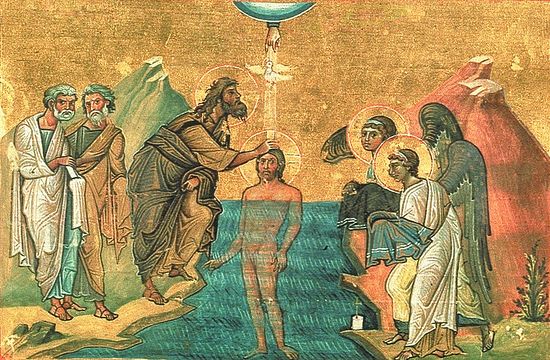
2. John 1:29-34 -- At His Baptism in the Jordan by John, the Holy Ghost descends in the form of a dove, and the voice of the Father reveals Jesus as His Beloved Son, in whom He is well pleased.
Now it came to pass, when all the people were baptized, that Jesus also being baptized and praying, heaven was opened; And the Holy Ghost descended in a bodily shape, as a dove upon him; and a voice came from heaven: Thou art my beloved Son; in thee I am well pleased. (Lk 3:21-22)
3. John 2:1-11 -- At the wedding feast in Cana of Galilee, Jesus, at His Mother's bidding, changes water into wine.
And the wine failing, the mother of Jesus saith to him: They have no wine. And Jesus saith to her: Woman, what is that to me and to thee? my hour is not yet come. His mother saith to the waiters: Whatsoever he shall say to you, do ye. (Jn 2:3-5)
4. Matthew 8:1-13 -- Jesus, with a word, cleanses a leper.
And behold a leper came and adored him, saying: Lord, if thou wilt, thou canst make me clean. And Jesus stretching forth his hand, touched him, saying: I will, be thou made clean. And forthwith his leprosy was cleansed. (Mt 8:2-3)
5. Matthew 8:23-27 -- Jesus calms the raging sea.
And behold a great tempest arose in the sea, so that the boat was covered with waves, but he was asleep. And they came to him, and awaked him, saying: Lord, save us, we perish. And Jesus saith to them: Why are you fearful, O ye of little faith? Then rising up he commanded the winds, and the sea, and there came a great calm. (Mt 8:24-25)
(Read entire post.)

Sunday, October 13, 2013

Something is Happening

October 13 is a special anniversary. Terry Nelson has some prayerful observations:
The Holy Father will consecrate the World to the Immaculate Heart of Mary on the anniversary of the Miracle of the Sun.  He is leading the Church in prayer and adoration.  Recall what happened in Syria after the vigil for peace.  Something is happening.

I think of the prayer of Esther...

Queen Esther, seized with mortal anguish, had recourse to the Lord. Taking off her splendid garments, she put on garments of distress and mourning. In place of her precious ointments she covered her head with dirt and ashes. She afflicted her body severely; all her festive adornments were put aside, and her hair was wholly disheveled...
We have a Pope who set aside his splendid garments, the trappings of his office... who humbles himself in prayer before the Madonna.

Something is happening. (Read more.)

Friday, September 13, 2013

The Coming Consecration

On October 13, 2013, Our Holy Father Pope Francis is going to Fatima to consecrate the world to the Immaculate Heart of Mary. Author Emmett O'Regan ties this occurrence in with many other events, past, present, prophetic and liturgical. This calls for wisdom. To quote:
As regular readers will by now already know, Pope Francis has promised to consecrate the world to the Immaculate Heart of Mary on October 13th, 2013, as part of several planned events to mark the end of the Year of Faith. This act seems a rather fitting close to a year that has already proven itself to be of major prophetic importance. Between the announcement of Pope Benedict XVI's abdication and the lightning strikes on St. Peter's Basilica that followed just hours afterwards on 11th February, to the Chelyabinsk Meteor Strike a few days later on 15th February, as well as the timing of the election of Pope Francis in relation to the "Worthy Shepherd Prophecy" of Bl. Tomasuccio de Foligno, this year has already been stacked full of both "signs in the sky" and striking prophetic coincidences in connection with them. So the timing of the appearance of Comet ISON in November of this year just after the scheduled date for the consecration of the world to the Immaculate Heart of Mary on October 13th would also appear to be of some similar prophetic significance. (Read more.)

Friday, July 5, 2013

Consecration of the Vatican to St. Michael the Archangel

 These are the two olive trees, and the two candlesticks, that stand before the Lord of the earth.~Apocalypse 11:4

 But at that time shall Michael rise up, the great prince, who standeth for the children of thy people: and a time shall come such as never was from the time that nations began even until that time. ~Daniel 12:1

Here we witness the two popes together, like Saints Peter and Paul or like Moses and Elias. From Vatican Radio:
To the joy of Vatican City State workers, Friday morning Pope Francis was joined by Pope emeritus Benedict XVI in the gardens for a ceremony during which the Holy Father blessed a statue of St Michael Archangel, at the same time consecrating the Vatican to the Archangel’s protection.

Following a brief ceremony, Pope Francis addressed those present noting how St. Michael defends the People of God from its enemy par excellence, the devil. He said even if the devil attempts to disfigure the face of the Archangel and thus the face of humanity, St Michael wins, because God acts in him and is stronger: 

In the Vatican Gardens there are several works of art. But this, which has now been added, takes on particular importance, in its location as well as the meaning it expresses. In fact it is not just celebratory work but an invitation to reflection and prayer, that fits well into the Year of Faith. Michael - which means "Who is like God" - is the champion of the primacy of God, of His transcendence and power. Michael struggles to restore divine justice and defends the People of God from his enemies, above all by the enemy par excellence, the devil. And St. Michael wins because in him, there is He God who acts. This sculpture reminds us then that evil is overcome, the accuser is unmasked, his head crushed, because salvation was accomplished once and for all in the blood of Christ. Though the devil always tries to disfigure the face of the Archangel and that of humanity, God is stronger, it is His victory and His salvation that is offered to all men. We are not alone on the journey or in the trials of life, we are accompanied and supported by the Angels of God, who offer, so to speak, their wings to help us overcome so many dangers, in order to fly high compared to those realities that can weigh down our lives or drag us down. In consecrating Vatican City State to St. Michael the Archangel, I ask him to defend us from the evil one and banish him.  
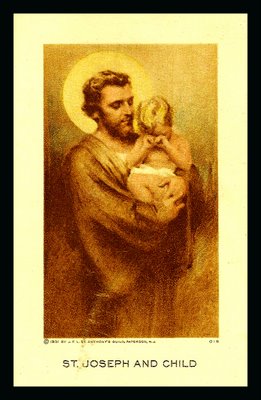
We also consecrate Vatican City State in St. Joseph, guardian of Jesus, the guardian of the Holy Family. May his presence make us stronger and more courageous in making space for God in our lives to always defeat evil with good. We ask Him to protect, take care of us, so that a life of grace grows stronger in each of us every day.
(Read article.)
 Here is the full text of Pope Francis' new encyclical "Light of Faith." To quote Our Holy Father:
There is an urgent need, then, to see once again that faith is a light, for once the flame of faith dies out, all other lights begin to dim. The light of faith is unique, since it is capable of illuminating every aspect of human existence. A light this powerful cannot come from ourselves but from a more primordial source: in a word, it must come from God. Faith is born of an encounter with the living God who calls us and reveals his love, a love which precedes us and upon which we can lean for security and for building our lives. Transformed by this love, we gain fresh vision, new eyes to see; we realize that it contains a great promise of fulfillment, and that a vision of the future opens up before us.

Saturday, May 11, 2013

Pope Francis on St. Francis

From Fr. Angelo:
I just noticed this quote from Pope Francis:
Let us all remember this: one cannot proclaim the Gospel of Jesus without the tangible witness of one’s life. Those who listen to us and observe us must be able to see in our actions what they hear from our lips, and so give glory to God! I am thinking now of some advice that Saint Francis of Assisi gave his brothers: preach the Gospel and, if necessary, use words. Preaching with your life, with your witness. Inconsistency on the part of pastors and the faithful between what they say and what they do, between word and manner of life, is undermining the Church’s credibility.
I have heard others a number of times take exception to both the attribution of the words emphasized above to St. Francis and to the soundness of the exhortation.  The argument has some merit.  The Franciscan sources do not support the attribution to St. Francis, and it is true that the words can be construed to mean that it is sufficient to be a witness to Christ by one’s life.  Efforts to evangelize are not essential.

But while St. Francis may have never said the words, they are an excellent summary of his spirituality. Pope Francis interprets the meaning of the phrase exactly.  Whoever first used the words did in fact understand St. Francis.  Perhaps it was one of the novices who were led by St. Francis through the streets of the town in their poor habits, telling them: “We are going to preach the gospel.”  After having returned to the friary without having spoken to anyone along the way, a novice asked St. Francis why they had not preached the gospel,  St. Francis simply answered, “We did.”

The Franciscan spirit is in the first place a way of life and a witness.  St. Francis was never afraid to speak out, but he was just as content to be driven out of town as he was to preach with apparent success.  He was not all that impressed by eloquence and declared to the friars that it was not the preachers who converted anyone but Christ alone and that the friars who were faithful to the Rule did more for the conversion of sinners than anyone else.  He called them his “Knights of the Round Table.” (Read entire post.)

Sunday, April 28, 2013

The Legacy of Pope Benedict

Faith and the future. From Fr. Angelo:
In his first encyclical letter, Deus Caritas Est, “On Christian Love” (December, 25, 2005), Pope Benedict began his exposition on the three theological virtues, and there distinguishes the love of God from its counterfeits in relativistic society.  Modern secular society has exalted erotic love, or desire, and has accused the Church of destroying it.   But Pope Benedict directs our attention toward Jesus Christ and His friendship and proclaims that it is the Church, and only the Church, that saves desire from being closed off from the highest values of the soul.  Desire is purified, exalted and fulfilled when man, like Christ, becomes a gift to another in an act of oblation.  This kind of love is not simply an instinct or intuition, much less is it merely spontaneous passion.  It is not a love that revolves around the ego.  This kind of love is shaped by faith in Jesus Christ and is the result of communion with Him. (Read entire post.)

Saturday, April 27, 2013

Pope Francis on Salvation

From Scott Richert:
And now Pope Francis has arrived at the crux of the matter, the part that will surprise both those who trumpet "the spirit of Vatican II" and those who denounce the council as a departure from tradition. We can only be Christians through the Church,
Because it is not possible to find Jesus outside the Church. The great Paul VI said: "Wanting to live with Jesus without the Church, following Jesus outside of the Church, loving Jesus without the Church is an absurd dichotomy." And the Mother Church that gives us Jesus gives us our identity that is not only a seal, it is a belonging. Identity means belonging. This belonging to the Church is beautiful.
This is why the missionary activity of the Church is so essential: We cannot know Christ outside of the Church. We are called to preach the Gospel to all nations, because that is the only way they can know Christ. Unless the Church is growing, preaching the Gospel and adding new members, we are not doing what we are called to do as Christians:
Think of this Mother Church that grows, grows with new children to whom She gives the identity of the faith, because you cannot believe in Jesus without the Church. Jesus Himself says in the Gospel: "But you do not believe, because you are not among my sheep." If we are not "sheep of Jesus," faith does not come to us. It is a rosewater faith, a faith without substance.
"Now this is eternal life: That they may know thee, the only true God, and Jesus Christ, whom thou hast sent" (John 17:3). Yet we can know Christ only through the Church. (Read entire article.)

Friday, April 19, 2013

Kenosis

We can never sink so low that Jesus cannot raise us up. From Fr. Mark:
The first phrase of this week's Collect merits attentive consideration: Deus, qui in Filii tui humilitate iacéntem mundum erexísti. It is by the utter humiliation of the Son that the world, cast down by the machinations of the devil and by sin, is raised up and rendered capable of communion with the Father. In the Incarnation, and in the bitter sufferings of His blessed passion, the Son emptied Himself; it is the mystery of his kenosis, that is, of His terrible abasement, His becoming, as it were, nothing, and all of this or our sakes.

Universal and Particular Import of the Liturgy
All that is said in the sacred liturgy in a universal sense can be applied in a particular sense as well. The graces the Church asks for herself universally, belong to each of her children. How necessary it is, then, to apply the texts of the liturgy to one's own life and experience, lest they remain remote and without any impact on one's here and now.

The Word Hidden and Despised
Any soul cast down and brought low by the world, the flesh, and the devil, can hope to be raised up by the humility of Christ. There is no degradation that cannot be turned into an exaltation by the effect of the Passion of Jesus Christ. The psalmist says, "My soul lies in the dust; by Thy Word revive me" (Psalm 118:25). The Word, by which the soul cast down into the dust is quickened and raised up, is none other than the Word made flesh, the Word brought, as it were, to nothing in the humiliations of His bitter passion, death, and burial. So disfiguring were the humiliations of Our Lord's passion that He became as one unrecognizable:
There is no beauty in him, nor comeliness: and we have seen him, and there was no sightliness, that we should be desirous of him: Despised, and the most abject of men, a man of sorrows, and acquainted with infirmity: and his look was as it were hidden and despised, whereupon we esteemed him not. (Isaias 53:2-3)
In the Most Holy Eucharist
The extreme humiliation of the Son in His passion, His self-emptying, and utter hiddenness, though completed in history, and swallowed up in the glory of the resurrection and ascension, remain, nonetheless, mysteriously present in the Most Holy Sacrament of the Altar. The Word made flesh hides Himself beneath the appearances of a fragile piece of bread, nearly weightless, and translucent. One cannot contemplate the Sacred Host without, at the same time, seeing the humility of the Son, by which we are raised up.

Sacrament of the Divine Humility
Mother Mectilde speaks often of the anéantissement, the ennothingment of the Son of God in the Most Holy Sacrament of the Altar. The Eucharist is the sacrament of the divine humility. It is the descent to the altar of the Word made flesh, the crucified Word, the glorious Word, risen and ascended into heaven. There, upon the altar, the substance of a little piece of bread becomes the very substance of the Body and Blood of Christ, leaving only the appearance of bread to serve as veil concealing the awful Mystery. (Read entire post.)

Wednesday, March 20, 2013

The Holy Grail of Pope Francis

Our Lady, Undoer of Knots
From Father Angelo:
The same silversmith collaborated with Cardinal Bergoglio in designing another chalice, embossed with the image of Our Lady Undoer of Knots, which the Cardinal presented to Pope Benedict shortly after he ascended to the Chair of St. Peter.

It is quite interesting that that this Argentinian pope should have a personal attraction to the German devotion.  It provides a kind of link between the two successors of St. Peter, of which there are others.

Even Our Lady of Lujan and the Undoer of Knots are connected by a common thread. The title “Undoer of Knots” is a reference to the teaching of St. Irenaeus in which he compares and contrasts Eve and Mary. In respect to the Fall and Redemption both are betrothed and yet virgins.  One union of man and woman delivers death, the other life.  In one case, faithlessness and disobedience brings destruction.  In the other, faith and obedience brings regeneration:
And thus also it was that the knot of Eve’s disobedience was loosed by the obedience of Mary. For what the virgin Eve had bound fast through unbelief, this did the virgin Mary set free through faith.
(Read more.)

Tuesday, March 19, 2013

A Bishop in White

Pope Francis at his Inaugural Mass on March 19, 2013
And we saw in an immense light that is God: ‘something similar to how people appear in a mirror when they pass in front of it' a Bishop dressed in White ‘we had the impression that it was the Holy Father'. ~Sr. Lucia, from the third part of the Secret of Fatima

The Keys of the Kingdom

 And I say to thee: That thou art Peter; and upon this rock I will build my church, and the gates of hell shall not prevail against it. And I will give to thee the keys of the kingdom of heaven. And whatsoever thou shalt bind upon earth, it shall be bound also in heaven: and whatsoever thou shalt loose upon earth, it shall be loosed also in heaven. (Matthew 16: 18-19)
"Lowly yet Chosen" just like Mary and Joseph. To quote the Catholic World Report:
From the Vatican Information Service, here are details about the symbols found on Francis’ coat of arms:
The shield has a bright blue background, at the centre top of which is a yellow radiant sun with the IHS christogram on it representing Jesus (it is also the Jesuit logo). The IHS monogram, as well as a cross that pierces the H, are in red with three black nails directly under them. Under that, to the left, is a star representing Mary, Mother of Christ and the Church. To the right of the star is a nard flower representing Joseph, Patron of the Universal Church. With these symbols the Pope demonstrates his love for the Holy Family. 

Francis’ papal motto, displayed with the coat of arms, is also the same as the one he used as a bishop; it is “miserando atque eligendo,” which in Latin means “by having mercy, by choosing him.” It is taken from a homily of the Venerable Bede on the call of St. Matthew: “Jesus saw the tax collector and by having mercy chose him as an Apostle saying to him: Follow me.” Vatican Radio explains the significance of this passage to the Holy Father: 

This homily, which focuses on divine mercy and is reproduced in the Liturgy of the Hours on the Feast of Saint Matthew, has taken on special significance in the Pope's life and spiritual journey.

In fact it was on the Feast of Saint Matthew in 1953 that a young, seventeen-year-old Jorge Bergoglio was touched by the mercy of God and felt the call to religious life in the footsteps of Saint Ignatius of Loyola.

(Read entire article.)

Monday, March 18, 2013

A Prayer for the Pope

Monsignor John T. Myler sent me a link to this wonderful prayer:
Prayer for a Pope Who is “Both …”

...both Francis of Assisi and Francis Xavier:
         both reformer and missionary,
         both visionary and evangelizer...

...both Peter and Paul:
         both in the heart of the Church
         and the court of those yet to hear and believe...

...both urbi et orbi:
         both to the See of Rome and to all the world,
         to both hemispheres - north and south... 

... both Lumen Gentium and Gaudium et Spes:
         the Vicar of Christ, Who is both
         "the light of all nations" and Who shares
         in both "our joys and our hopes",
         "our griefs and our anxieties"...

... both in continuity and in reform:
         both "father and teacher", just as the Church is
         both Mater et Magistra -
         from both Scripture and Tradition
         - the one font of Truth -
         to live both great commands:
         love of both God and neighbor.

... both priest and prophet,
    both servant and leader,
    at both altar and table, both Priest and Victim,
         both Source and Summit -
         offering sacrifice and sacrament
         for both men and women, both young and old,
         with both saints and sinners
         worshipping in both Spirit and Truth;

         calling for conversion of both heart and mind,
         to cleanse the cup both inside and out,
         both poor in spirit and rich in mercy,
         like the wise man of the Gospel
             who brings forth from the storeroom
             graces from the One
             both ever ancient and ever new...

... with keys for both the kingdom here
         and the kingdom to come,
         both still and still moving,
         by both word and deed,
         in both speaking and listening ...

... for both health and long life...

... for both courage in Jesus
    (whose Company he keeps)
         and consolation from the Mother
               also "Miserando atque eligendo" --
               both "lowly but chosen"...

... both in the burden of the Cross now carried
    and in the hope of the Resurrection to be shared;

... blessings both now and forever.  Amen.
By Monsignor John T. Myler


Saturday, March 16, 2013

Benedict and Francis: The Law and the Prophets

Nolite tangere christos meos et in prophetis meis nolite malignari. (I Par. 16:22, The Vulgate)

A superb, must-read post by Fr. Angelo. To quote:
The Catechism also teaches us that all the baptized participate in the triple office of Christ as priest, prophet and king (783).  However, priests, especially bishops who have the fullness of the priesthood and most especially the pope as the Vicar of Christ and Head of the apostolic college, have a mandate to exercise these three offices in a particular way.  These offices are the proper functions of the Holy Father and the bishops: the priest sanctifies by offering sacrifice; the prophet teaches by delivering God’s message; and the king governs by shepherding God’s people after the heart of Christ (cf.,  Jer 3:15).

But I believe there is a different but complimentary distinction that needs to accompany this tripartite distinction of office, and that is the twofold distinction of the Law and the Prophets, roughly corresponding to the dogmatic and pastoral teaching of the pope and the bishops.  The Prophetic Office actually encompasses both the teaching of the general principles of the faith (the law/dogma) and its practical application (the prophets/pastorality).  The first is protected by the guarantee of infallibility, the second is not.  And although clearly pastoral teaching must be subordinated to dogmatic teaching, neither can be dispensed with, and both involve faith, even if in some measure the latter involves human faith.

I think it is particular unhelpful and even “unhealthy” to minimize the legitimate and necessary role of the pope as prophet in the second sense, namely, in the role as Universal Shepherd (Pastor) of the Church.  Here I am not criticizing the conscientious objector, or the theologian acting in good faith, and with the urgency and necessity of a well-formed and sincere conscience, when this has to do with non-infallibly taught doctrinal and pastoral teaching that does not seem to be reconcilable with previous magisterial teaching, and when such objections are expressed directly to the magisterium itself.  Public dissent from magisterial teaching, on the other hand, causes immediate scandal to the faithful.  But the know-it-all zealotry has another deleterious effect: the cultivation of a habit of mind that reduces almost every aspect of faith to a calculation of human judgment. (Read entire post.)

Also, Francis on Francis.

Wednesday, March 13, 2013

Habemus Papam!

May God bless and protect Our Holy Father Pope Francis! This is a happy day!

Monday, February 18, 2013

Thirty Days Prayer to St. Joseph

This exercise, to be made in preparation for the feast of St. Joseph on March 19, begins today. Let us unite in praying for Our Holy Father Pope Benedict XVI as he prepares to retire, as well as for the conclave in which the new Pope will be elected. And please remember my family in your prayers as we are faced with major decisions.
Ever blessed and glorious Joseph, kind and loving father, and helpful friend of all in sorrow!  You are the good father and protector of orphans, the defender of the defenseless, the patron of those in need and sorrow.  Look kindly on my request.  My sins have drawn down on me the just displeasure of my God, and so I am surrounded with unhappiness.  To you, loving guardian of the Family of Nazareth, do I go for help and protection.

Listen, then, I beg you, with fatherly concern, to my earnest prayers, and obtain for me the favors I ask. I ask it by the infinite mercy of the eternal Son of God, which moved Him to take our nature and to be born into this world of sorrow.

I ask it by the weariness and suffering you endured when you found no shelter at the inn of Bethlehem for the holy Virgin, nor a house where the Son of God could be born.   Then, being everywhere refused, you had to allow the Queen of Heaven to give birth to the world's Redeemer in a cave.

I ask it by that painful torture you felt at the prophecy of holy Simeon, which declared the Child Jesus and His holy Mother future victims of our sins and of their great love for us. I ask it through your sorrow and pain of soul when the angel declared to you that the life of the Child Jesus was sought by His enemies.  From their evil plan you had to flee with Him and His Blessed Mother to Egypt.  I ask it by all the suffering, weariness, and labors of that long and dangerous journey.

I ask it by all your care to protect the Sacred Child and His Immaculate Mother during your second journey, when you were ordered to return to your own country.  I ask it by your peaceful life in Nazareth where you met with so many joys and sorrows. I ask it by your great distress when the adorable Child was lost to you and His Mother for three days. I ask it by your joy at finding Him in the Temple, and by the comfort you found at Nazareth, while living in the company of the Child Jesus.  I ask it by the wonderful submission He showed in His obedience to you.

I ask it by the perfect love and conformity you showed in accepting the Divine order to depart from this life, and from the company of Jesus and Mary.  I ask it by the joy which filled your soul, when the Redeemer of the world, triumphant over death and hell, entered into the possession of His kingdom and led you into it with special honors. I ask it through Mary's glorious Assumption, and through that endless happiness you have with her in the presence of God. O good father!  I beg you, by all your sufferings, sorrows, and joys, to hear me and obtain for me what I ask.

(make your request)

Obtain for all those who have asked my prayers everything that is useful to them in the plan of God.  Finally, my dear patron and father, be with me and all who are dear to me in our last moments, that we may eternally sing the praises of Jesus, Mary and Joseph.

Saturday, January 26, 2013

Espousals of the Virgin

The Immaculate Heart of Mary by Cameron Smith
From Fr. Mark:
Mediatrix of All Graces
Just as the Eternal Father gave us His Son through her [the Virgin Mary], so too does He give Him to us through His priests. Even as all the graces that come forth to us from the Heart of God pass through the hands of Mary, so too are they given us by the ministry of priests. This in such wise that, just as Mary is the treasurer of the Most Holy Trinity, priests too bear this title.
The Sacrifice of Christ
Finally, it is through her that Jesus was offered to His Father at the first and last moment of His life, when she received Him in her sacred womb, and when she accompanied Him to the sacrifice that He made of Himself on the cross; and it is by means of priests that He is immolated daily upon our altars.
Mother of the Sovereign Priest
This is why priests, being bound by so intimate an alliance and so marvelous a conformity to the Mother of the Sovereign Priest, have very particular obligations to love her, to honour her, and to clothe themselves in her virtues, in her spirit, and in her dispositions. Humble yourselves that you should find yourselves so far removed from this. Enter into the desire to tend thereto with all your heart. Offer yourselves to her, and pray her to help you mightily. (Read entire post.)

Thursday, October 18, 2012

The Gaze of Christ

From Vultus Christi:
The Face of Christ or, if you will, the Gaze of Christ, is a motif that recurs frequently in the preaching of Pope Benedict XVI, as well as in his writings. In today's Angelus Address, the Holy Father alludes to that mysterious exchange of gazes, by which a particular vocation -- and often one to the priesthood or monastic life -- is both offered and received. That exchange of gazes is, of course, but the beginning. A priestly or monastic (or religious) vocation cannot be sustained except by growing into an exchange of gazes that becomes habitual. And this habitual exchange of gazes is, in fact, the gift of contemplation.

There may be readers of Vultus Christi who have, at one time or another, recognized the gaze of Christ resting upon with with an unspeakable tenderness. This sometimes happens when one is lingering in the radiance of the Eucharistic Face of Jesus. It may also happen when one is bent over the Word of God, or praying the Psalms. Meet the gaze of Christ with your own gaze. Look at Him. Begin to live, as Blessed Elisabeth of the Trinity says, with "your eyes in His eyes." And should He call you to monastic life, communicate with us at Silverstream Priory. Do not go away sad. Say "yes" to the joy of having nought but Christ, and of preferring nothing whatsoever to His love. (Read entire post.)

Thursday, October 11, 2012

The Year of Faith

It opens today. In the words of Our Holy Father:
Recent decades have seen the advance of a spiritual “desertification”. In the Council’s time it was already possible from a few tragic pages of history to know what a life or a world without God looked like, but now we see it every day around us. This void has spread. But it is in starting from the experience of this desert, from this void, that we can again discover the joy of believing, its vital importance for us, men and women. In the desert we rediscover the value of what is essential for living; thus in today’s world there are innumerable signs, often expressed implicitly or negatively, of the thirst for God, for the ultimate meaning of life. And in the desert people of faith are needed who, with their own lives, point out the way to the Promised Land and keep hope alive. Living faith opens the heart to the grace of God which frees us from pessimism. Today, more than ever, evangelizing means witnessing to the new life, transformed by God, and thus showing the path. The first reading spoke to us of the wisdom of the wayfarer (cf. Sir 34:9-13): the journey is a metaphor for life, and the wise wayfarer is one who has learned the art of living, and can share it with his brethren – as happens to pilgrims along the Way of Saint James or similar routes which, not by chance, have again become popular in recent years. How come so many people today feel the need to make these journeys? Is it not because they find there, or at least intuit, the meaning of our existence in the world? This, then, is how we can picture the Year of Faith: a pilgrimage in the deserts of today’s world, taking with us only what is necessary: neither staff, nor bag, nor bread, nor money, nor two tunics – as the Lord said to those he was sending out on mission (cf. Lk 9:3).... (Read entire article.)
Related Posts with Thumbnails