Showing posts with label Advent. Show all posts

Tuesday, December 23, 2025

O Emmanuel

O Emmanuel, our King and Lawgiver, the Expectation and Savior of the nations! come and save us, O Lord our God!
Fr. Mark's commentary is here:
O Virgo Virginum

O Virgo Virginum, the last of the Great O Antiphons in the old English liturgy of Sarum , occurs on December 23rd. Its structure is quite different from all the other Great O Antiphons. The first part is a question addressed to the Virgin Mary; in the second part she replies with another question, and then, gives her answer.
O Virgin of virgins, how shall this be?
For neither before thee was any like thee, nor shall there be after.
Daughters of Jerusalem, why marvel ye at me?
That which ye behold is a divine mystery.

[...]
Like the six Great O Antiphons that preceded it, O Emmanuel is addressed to our Lord Jesus Christ. It seems to me that, with each succeeding day, the O of our invocation, and the Veni of our supplication has grown more confident, more intense and, in a sense, more urgent.

Afraid Never Again
Writing in 1964, Mother Marie des Douleurs Wrotnowska, the foundress of the Congregation of Benedictines of Jesus Crucified, offers us a somewhat anguished meditation on the Great Antiphon O Emmanuel. It appears to come out of an experience of weakness, fear, and uncertainty. Some would dismiss it as deeply pessimistic and too gloomy for Advent. I sense something else in it: the prayer of woman wrestling with her inner demons, as we all do, and confident nonetheless in the mystery of God-with-us. This is what she wrote:
Emmanuel. Could we have found a name more sweet? God-with-us. That is to say that nothing in our difficulties, our misunderstandings, our sorrows, even in our agony, will find us alone. We will always have Someone with us, Someone present in our very heart to give the strength and light necessary in those moments.
Also, at the same time, our Beloved is always before us. He is the All-Powerful and He wants that we should be saints, all of us. Therefore, we never again need to be afraid. We can be certain that, should it be called for, even heroism is within our reach because our Companion on the road, our daily Food, is always there. We know that He is in us and we know what He asks of us. We know to what degree of detachment and to what gift of self He calls us. We know to what point we must be found holy at the moment of our death.

 (Read more.)


 Now all is fulfilled....Ecce completa sunt omnia....(Lauds of December 23)

At the completion of the O Antiphons, we reflect on the acrostic ERO CRAS, which means "Tomorrow I shall come" or "Tomorrow I shall be."


Monday, December 22, 2025

O Rex Gentium

O King of nations, and their desired One, and the cornerstone that makes both one; come and save man whom thou formed out of earth.
Here is an excerpt of Fr. Mark's excellent commentary:
By calling the Messiah the “Desired of all nations,” Scripture and the Sacred Liturgy recognize the aspirations of every nation and culture towards the good, the true, and the beautiful, as aspirations towards Christ. In every culture there are traces of a mysterious preparation for the Gospel. Every time a human being seeks the splendour of the truth, the radiance of beauty, the purity of goodness, he seeks the Face of Christ, the “Desired of all nations.” When the missionary Church proclaims Our Lord Jesus Christ, she is proclaiming the “Desired of all nations.”
To Proclaim Jesus Christ
Without knowing His adorable Name, without having seen His Face, without having been told of His Heart opened by the soldier’s lance, the nations of the earth desire Christ and wait for Him, insofar as they desire and wait for truth, beauty, and goodness. The missionary task of Christians is to preach the Name of Jesus, to point to His Face, and to bear witness to His pierced Heart, saying, “Here is the truth, here is the goodness, here is the beauty you desire: Jesus Christ, the Son of God, born of the Virgin Mary, crucified, risen from the dead, ascended into glory, and coming again.”

In an important “Doctrinal Note On Some Aspects of Evangelization,” the Congregation for the Doctrine of the Faith reaffirmed the Church’s commitment to the missionary mandate received from Our Lord. First, the document identified the problem:
There is today . . . a growing confusion which leads many to leave the missionary command of the Lord unheard and ineffective (cf. Mt 28:19). Often it is maintained that any attempt to convince others on religious matters is a limitation of their freedom. From this perspective, it would only be legitimate to present one’s own ideas and to invite people to act according to their consciences, without aiming at their conversion to Christ and to the Catholic faith. It is enough, so they say, to help people to become more human or more faithful to their own religion; it is enough to build communities which strive for justice, freedom, peace and solidarity. Furthermore, some maintain that Christ should not be proclaimed to those who do not know him, nor should joining the Church be promoted, since it would also be possible to be saved without explicit knowledge of Christ and without formal incorporation in the Church.

(Read more.)

Sunday, December 21, 2025

O Oriens


O Orient! Splendor of eternal light, and the Sun of justice! come and enlighten them that sit in darkness and in the shadow of death.
There is no need to be afraid, in five more days Our Lord will come to us. (Benedictus Antiphon for December 21)

Fr. Mark explains the reason why the Mass was traditionally said facing east, ad orientem.
Oriens: the word is familiar because every morning the Church sings: “Per viscera misericordiae Dei nostri — literally, through the inmost heart, the secret places of the mercy of our God — in quibus visitavit nos Oriens ex alto — in which the Orient from on high has visited us” (Lk 1:79). Oriens was the name of the ancient Roman sun god, the source of warmth, energy, and light. At the same time, Oriens means the rising sun, the victory of light over the shadows of the night. From the earliest times, Christians at prayer have turned towards the East. Christ is the Dayspring, the rising sun who dawns upon us from high “to give light to those in darkness and in the shadow of death” (Luke 1:9). The eastward orientation of churches and altars is a way of expressing the great cry of every Eucharist: “Let our hearts be lifted high. We hold them towards the Lord.”

When, in the celebration of the liturgy, the priest faces the “liturgical east,” he is “guiding the people in pilgrimage towards the Kingdom” and with them, keeping watch for the return of the Lord. “This Jesus, who was taken up from you into heaven, will come in the same way as you saw him go into heaven” (Acts 1:11). Pope Benedict XVI has reminded us that a powerful witness is given in the prayer of a priest and people who stand together facing eastward and giving voice to the same hope. “The Spirit and the Bride say, ‘Come.’ And let him who hears say, ‘Come’” (Revelation 22:17).  (Read more.)

Saturday, December 20, 2025

O Clavis David

O Key of David and scepter of the House of Israel! who opens and no man shuts, who shuts and no man opens; come, lead the captive from prison, sitting in darkness and the shadow of death.
Here is some commentary from Fr. Mark:
 The antiphon draws its invocation from the twenty-second chapter of Isaiah. The Lord says to Shebna, the master of the household of King Hezekiah, “And it shall come to pass in that day, that I will call my servant Eliakim the son of Helkias, and I will clothe him with thy robe, and will strengthen him with thy girdle, and will give thy power into his hand: and he shall be as a father to the inhabitants of Jerusalem, and to the house of Juda. And I will lay the key of the house of David upon his shoulder: and he shall open, and none shall shut: and he shall shut and none shall open. And I will fasten him as a peg in a sure place, and he shall be for a throne of glory to the house of his father” (Is 22:20-23).

Friday, December 19, 2025

O Radix Jesse


O Root of Jesse, who stands as the ensign of the people; before whom kings shall fall silent; to whom the nations shall pray: come and deliver us, do not delay.
Here is commentary from Fr. Mark:
O Root of Jesse

The image of the Root of Jesse comes from the eleventh chapter of Isaiah where he says, “And there shall come forth a rod out of the root of Jesse, and a flower shall rise up out of His root” (Is 11:1). It is the passage that enumerates the gifts of the Holy Ghost; from the Vulgate, the Catholic tradition counts seven gifts. “And the spirit of the Lord shall rest upon Him: the spirit of wisdom, and of understanding, the spirit of counsel, and of fortitude, the spirit of knowledge, and of godliness. And He shall be filled with the spirit of the fear of the Lord” (Is 11:2-3). This means that when we cry out, “Come,” to the Root of Jesse who is Christ, we are, in the same prayer, invoking the Holy Ghost who, in His sevenfold gift, comes to us with the Son.

The Tree of the Cross

Isaiah goes on to say in the tenth verse of the same chapter: “On that day the root of Jesse shall stand as a signal to the peoples; the nations shall inquire of Him.” The Root of Jesse is given, not only to Israel, but as a signal to the nations, a standard around which all peoples will rally. In fulfillment of Isaiah’s prophecy, Jesus says of himself, “And I, when I am lifted up from the earth, will draw all men to myself” (Jn 12:32). The Root of Jesse is already the profile of the Cross: a figure of the glorious standard of the King, the Vexilla Regis of which we sing in the Vespers hymn of September 14th. Today’s O Antiphon opens onto the paschal mystery: the Root of Jesse announces that the advent of the Son is ordered to the mission of redemption that He will accomplish on the Tree of the Cross. (Read more.)


Here is a quote from the ancient Ambrosian liturgy:

Blessed is the womb of the Virgin Mary, which bore the invisible God.
There did he deign to dwell, whom seven thrones cannot hold

And she bore him as a light weight in her womb.

(from Dom Gueranger's The Liturgical Year, Vol I)

Thursday, December 18, 2025

O Adonai

O Adonai and leader of the House of Israel, who appeared to Moses in the fire of the flaming bush, and gave him the law on Sinai, come and redeem us by thy outstretched arm.

A quote from Vultus Christi:
Again today the great cry goes up, a cry wrung from the depths of our being, a cry framed between two expressive words: O and Veni. The musical treatment of both words is the same: do-fa-mi. The interval do-fa is a stretching heavenward. We hardly reach the dominant fa of our confidence when we fall to the precarious mi, an unstable note in the second mode, one that suggests just how fragile we are. The mi is suspended: we have cast our prayer upward into the heavens. The uncertainty of the mi obliges us to hope against hope, to believe without seeing, to abandon our prayer once we have thrown it into the heavens, trusting that the hand of God will receive it and take it to heart.
ADONAI
Yesterday we called to the Christ, naming Him Wisdom, Sapientia; today we call Him ADONAI, Sacred Lord, Master of All, Majesty. Today we have the most Jewish of the O Antiphons: ADONAI, Moses, and Sinai — the Lord God, the man of God, and the mountain of God are named in a single brief prayer. ADONAI is used frequently in the Hebrew scriptures. The Jews use it in place of the holy and unutterable name, the name that it is forbidden to pronounce. You see, then, the significance of this name given to Christ. Christ is the “angel of God” who appeared to Moses in a flame of fire out of the midst of a bush (cf. Ex 3:2). “And, lo, the bush was burning, yet it was not consumed. And Moses said, ‘I will turn aside and see this great sight, why the bush is not burnt” (Ex 3:2-3). (Read more.)

Wednesday, December 17, 2025

The Great Antiphons: O Sapientia

Today the "O Antiphons" begin at Vespers. The antiphon for today is O Sapientia.
O Wisdom coming forth from the mouth of the Most High God, Your lordship is over all that is, stretching from the beginning to the end, You who order all things with might and with sweetness, come teach us the path of prudence.
Fr. Mark had a beautiful meditation on the meaning of true wisdom. To quote:
We call upon Christ as Holy Wisdom, the eternal Wisdom of the Father, and we make a very specific petition: “Come, teach us the way of prudence.” What is prudence? It is the habit of using our reason, in every circumstance, to discern what is our true good and of choosing the means to achieve it. Saint Thomas calls prudence “right reason in action.” Prudence is an austere virtue because it means that we will not allow our decisions, our course of action, or our reactions to be determined by our emotions.
When we allow our choices to be determined by fear–fear of loss, fear of rejection, fear of making a mistake, fear of failure, fear of the future, or any other fear–we are not being prudent. When we allow our choices to be determined by an unwise love, a disordered love, we are not being prudent. When we choose impulsively, we are not being prudent. When we delay choosing and put off acting, we are not being prudent. Prudence has to do with choosing wisely so as to act wisely. And so today, we cry out to Wisdom, begging to be taught the way of prudence. (Read more.)

Tuesday, December 16, 2025

Christmas Novena

The novena in honor of the Divine Infant begins today. Let us pray for the unborn, and for all the children in the world, especially those who are suffering abuse or neglect.

INFANT OF PRAGUE NINE DAY NOVENA
 
[You may state your special intention for the Novena at the start
on the first day, or ask it anew each day.]


ORIGINAL PRAYER OF VEN. CYRIL TO THE MIRACULOUS INFANT JESUS OF PRAGUE 

JESUS, unto Thee I flee,
Through Thy mother praying Thee
in my need to succor me.

Truly, I believe of Thee
God Thou art with strength to shield me;
Full of trust, I hope of Thee
Thou Thy grace wilt give to me.

All my heart I give to Thee,
Therefore, do my sins repent me;
From them breaking, I beseech Thee,
Jesus, from their bonds to free me.

Firm my purpose is to mend me;
Never more will I offend Thee.

Wholly unto Thee I give me,
Patiently to suffer for Thee,
Thee to serve eternally.
And my neighbor like to me
I will love for love of Thee.

Little Jesus, I beseech Thee,
In my need to succor me,
That with Joseph and Mary
And the Angels, I may Thee
Once enjoy eternally. Amen.


FIRST DAY:
 
Happily familiar to Catholics the world over is the little Infant of Prague. The dear and charming statues of Him, copied from the miraculous image in the capital of harassed Czechoslovakia, belong now to the whole of Catholicity. Today they can be found everywhere. Christ is a king, the King. 

This fact we celebrate in the majestic, glorious Feast of Christ the King. But Christ is the King not only of power and might. He is the King not alone of terrible love, ruling from His Cross, the conquering monarch entering into the glory of His Heavenly kingdom. 

He is also the Infant King, the king of Bethlehem and of the nursery in Nazareth . . . the king too small to defend Himself save by flight into Egypt . . . the king small enough to hide in the Host or in a human breast. 

So before the little Infant of Prague we say:
 
THE PRAYER OF CHRIST THE KING
 
SECOND DAY:
 
Fundamental to Christianity and basic to our faith and hope is the fact that the Son of God, the second Person of the Blessed trinity, became a Baby. 

This was the wonder that exalted the early Christians and repelled the pagan monarchs.
Suddenly the best of good news broke over the horizon. The remote God was as near as Bethlehem. The great God had become as small as a baby. The hands that fashioned the universe were infant hands. The all-creative voice that had cried the stupendous "Fiat lux," broke into the cries of babyhood. 

"We can pick up our God in our arms and hold Him as we hold a child." The thought made early Christians joyous as they took Him as their guest in the Eucharist. 

To the pagan world the idea was repellent. A king must be powerful, aloof, threatening, crowned with awesome majesty. He must be reached through messengers and surrounded by the restraining pomp of courts. 

So God became a Baby. Christianity was born with the birth of an Infant King. Christ's birth was a rebirth for human souls. 

Before the Infant King we say: 

THE PRAYER OF CHRIST THE KING
 
THIRD DAY:
 
It was given to Wise Men to see the kingdom of Infancy. A million, million Christians have prayerfully and happily followed the Magi as they traveled from pagandom onto the very center of the Church. 
 
Exultantly Catholics have seen these men, the wisest of their times, pierce the thin veil of babyhood and know that a Child could be a king, and God could in His quest of hearts assume the most heartwarming disguise. 

Wise as only the holy are wise, they saw the majesty in humility and the strength in love. Before the Infant King they placed their royal treasures. 

How like they were to those holy souls who in far-off Prague placed about the Infant King the trappings of royalty. The three Wise Men gave Him jewels to stud into a crown, and gold to beat into fine thread for His royal raiment, and the perfumes that were burned only in the braziers that sent clouds of sacrificial incense upward to God. 

History repeats itself in glad insistence. The gifts that were laid at the feet of the Infant of Bethlehem, modern faith has duplicated for the Infant of Prague. 

We join the Magi in saying:
 
THE PRAYER OF CHRIST THE KING
 
FOURTH DAY:

Our age likes to think of itself as wise and grown up and sophisticated. Often we see our age for what it is, old and tired and faltering to an atomic grave. 

It was the wisest of all teachers, Christ Himself, Who reminded us that unless we become as little children we shall not enter the Kingdom of Heaven. 

Nicodemus was puzzled by the whole idea of rebirth, infancy, childhood. Christ explained to him, on that secret night of his abashed visit, the rebirth through Baptism. All His life Christ explained to the tired old world of His age the importance of the virtues that keep the world young. 

Sin makes men old. Virtue keeps them immortally young. Sin speeds us to quick death. 
Virtue wings us to endless life. "Suffer the little children to come unto me . . . for such is the Kingdom of God" . . . men and women of childlike faith in their Father in Heaven . . . men and women unwearied by the dull pounding of sin . . . 

How wise the Church to encourage us, of this weary old generation, to kneel before the holy Infant and learn once more the beauties of childhood and the virtues of a heart that never grows old. 

Before the young King, the Infant God, we say:
 
THE PRAYER OF CHRIST THE KING
 
FIFTH DAY:
 
"Unless you . . . become as little children . . ." 

Who among us does not turn back to the happy days of childhood? The incredible moment of our first Holy Communion . . . the day when in Confirmation we became temples of the Holy Spirit . . . the years when mother and father were all in all to us and carried every burden and guarded us against all dangers. 

Those were the days without worry or burden, without the demands of each day pressing hard upon us. The world was new and beautiful, and God was very near. We walked with our guardian Angel. We knew the Saints by their favorite names. 

Sin had not put its lines on our soul. We loved purely, and we acted on warm, generous impulses. Why regret childhood? Saints grow old; but they are the happy children of God's tenderest protecting care, whatever their weight of years or mantle of responsibility. We might ask God to give us back the childhood of our souls, our simple faith, our untarnished love, our clear vision of the supernatural, our trust in our fellow men, our glimpses of Heaven all around us. 

All this we ask of the Infant of Prague in:
 
THE PRAYER OF CHRIST THE KING
 
SIXTH DAY:
In an age that depends upon adult cleverness, it is like God to work miracles before the statue of a little child. 

The statue of the Infant of Prague has been a wonder-working statue. In itself it is, as all statues are, stone or plaster or wood. In its symbolism it is deep and precious and meaningful. 

So it has been that near the feet of the Baby King the sick have found their health, the troubled their peace, the weary their rest, the doubting their faith, the despairing their hope. 

Strangely enough it has been toward temporal affairs, the affairs that are constantly bungled and mismanaged by the wise adults of earth that the miracles have flowed most frequently. Why not? God has used the wisdom of the simple to confound the wise, as He used the Babe of Bethlehem to upset the wiles of Herod and brought into ancient Egypt the eternal Word of God, His Infant Son. 

Miracles there will always be, but only for the trusting hearts. In a cynical world, only a humble heart shall be so blessed. So asking for simple faith, which is always the fountain of the greatest miracles, we say: 

THE PRAYER OF CHRIST THE KING
 
SEVENTH DAY:

Before the Infant Christ was born into the world, childhood was not a precious thing. Life was cheap, and the attitude of the pagan world toward new life was contemptuous. Only those who were strong enough to enforce their demands had any rights. 

Then came the Infant Christ, and for the first time childhood became precious. Every baby born into the world by God's hope and design was His child and heir. Christianity saw in strong, pure, religious youth the guarantee of strong, pure, religious nations. 

Marriage was founded no longer chiefly upon the lust of man and woman, a love that was to ripen into the living symbol of love --- the newborn baby. The child completed upon earth the trinity of the home--- itself an incarnate spirit of love --- as the Holy Spirit of love completed the Trinity in Heaven. 

Today, our nation and almost all of the nations of the world have once more spurned the precious gift of life and infancy, in its blood-lust for abortion and fetal experimentation.They violate their own dignity and know not what it is they truly do. We need the Infant of Prague and His innocence more than we ever have. 

As we look upon the Infant of Prague, we are glad that God became weak so that we could learn tenderness and mercy to the weak. We are glad that the Infant in the holy house gave marriage its high dignity and the home its beautiful sanctity.
Conscious of the dignity of of childhood, we say:
 
THE PRAYER OF CHRIST THE KING
EIGHTH DAY:

Children give us an amazing opportunity to show our generosity. The decent adult cannot fail to feel a strong impulse toward giving when he sees the smile and the outstretched hands of an infant. 

Infancy becomes and excuse for human generosity. Certainly infancy has the power to waken even in the most selfish breasts the desire to give. Christmas proves this power --- Christmas that centers around the Child in the manger and the children in our homes.
Those holy souls who bedecked the Infant of Prague manifested beautifully this response of human generosity to childhood. 

They clothed the Infant as we love to clothe a child in rich robes. They placed upon His Infant head a jeweled crown. 

Then they did in symbol what God had done in reality: They placed in the tiny hands of the Infant Christ the world, of which He is Creator and over which He rules, and the scepter, symbol of His dominion over all mankind. So does God impress on a worldly-wise and selfish world, the need of simple, generous love. And He commands our love in the guise of a baby.
Out of generous hearts we speak:
 
THE PRAYER OF CHRIST THE KING 

NINTH DAY:

Christ is our King; of that there is no doubt. Though He was battered and broken, He could stand in the presence of Pilate, representative of Rome's powerful monarch, and accept the governor's wondering question about His royalty.
"You say ----- and rightly ----- that I am king." 

No other king was ever more truly king in his own right than was Christ. As St. John points out in his glorious opening verses, the world is His, for He made it. 

When He established the unending Kingdom of His Church, He took over the world, knowing that the Church would see kingdoms and empires, republics and democracies rise and fall while it went its calm way. 

But most important He is King because a million, million men and women have freely and gladly accepted Him. He is the King of hearts, the Monarch of souls, the Ruler of men's lives, the Master of their destinies. He is the Sovereign Who never disappoints, the Emperor Who walks at the side of His humblest subject. 

He Who said: "I will be with you all days even to the consummation of the world," has chosen to keep His promise to us in our day in the guise of an infant, if only to confound our worldliness. 

Before the Infant King we say:
 
THE PRAYER OF CHRIST THE KING

Sunday, December 14, 2025

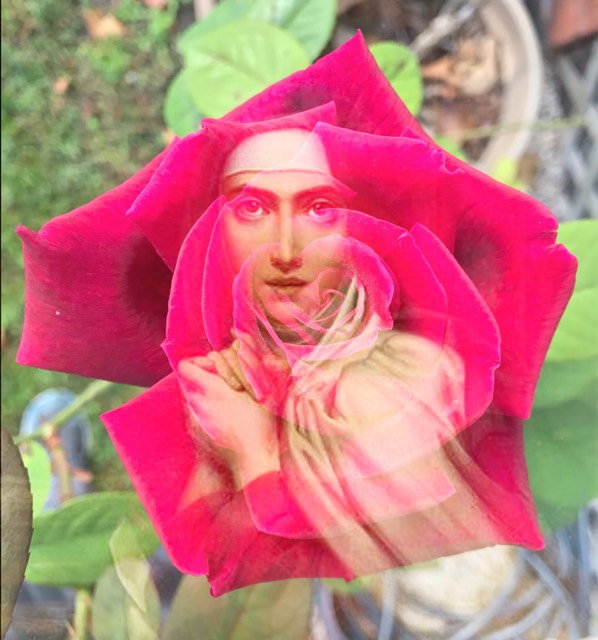
Gaudete Sunday

Image source
It is Gaudete Sunday, called Rose Sunday. Let us rejoice, for the Lord is near. As Fr. Mark says:
Today’s Introit is one of the few drawn from Saint Paul. It is an exhortation to joy, but its mood is quiet and reflective. “Joy to you in the Lord at all times; once again I wish you joy. Give proof to all of your courtesy. The Lord is near. Nothing must make you anxious; in every need, make your requests known to God, praying and beseeching Him, and giving Him thanks as well” (Phil 4:4-6). What the Latin gives as, “gaudete,” and the English as “rejoice,” is astonishingly rich in Saint Paul’s Greek. Any one translation would be inadequate. Paul says, “chaírete.” It is the very same word used by the angel Gabriel to greet the Virgin of Nazareth. “Chaire, kecharitoménè!” “Joy to you, O full of grace!” (Lk 1:28). The word is untranslatable. Just when we think we have seized its meaning once and for all, another door opens inside it. “Chaírete” was the ordinary greeting of the Greeks. It embraces health, salvation, loveliness, grace, and joy, all at once. In the mouth and in the ear of Christians, the taste of the word is indescribable. “Grace to you, and loveliness, and joy in the Lord; again I wish you grace, and loveliness, and joy” (Phil 4:4). Paul’s greeting is not so much an imperative — a command to be joyful — as it is the imparting of a gift in the Lord. “What I wish for you, what I send you, what I give you in the Lord is grace, and loveliness, and joy.”


From Dom Gueranger in The Liturgical Year, Vol.I:

 Nothing is more just than that we rejoice in the Lord. Both the Prophet and the Apostle excite us to desire the Savior: both of them promise us Peace. Therefore, let us not be solicitous: The Lord is nigh; nigh to his Church, and nigh to each of our souls. Who can be near so burning a fire, and yet be cold? Do we not feel that he is coming to us, in spite of all these obstacles? He will let nothing be a barrier between himself and us, neither his own infinite high majesty, nor our exceeding lowliness, nor our many sins. Yet a little while, and he will be with us. Let us go out to meet him by these prayers and supplications and thanksgiving which the Apostle recommends to us. Let our zeal to unite ourselves with our holy mother the Church become more than ever fervent: now every day her prayers will increase in intense earnestness, and her longings after Him, who is her light and her love, will grow more ardent. (Read more.)

Friday, December 12, 2025

Our Lady of Guadalupe

Here are the words of the Mother of God to the Aztec, Saint Juan Diego:
Hear and let it penetrate into your heart, my dear little son: let nothing discourage you, nothing depress you: let nothing alter your heart or your countenance. Also do not fear any illness or vexation, anxiety or pain. Am I not here who am your Mother? Are you not under my shadow and protection? Am I not your fountain of life? Are you not in the folds of my mantle, in the crossing of my arms? Is there anything else that you need?
Fr. Angelo also has a magnificent discussion on such a sublime feast day for our country:
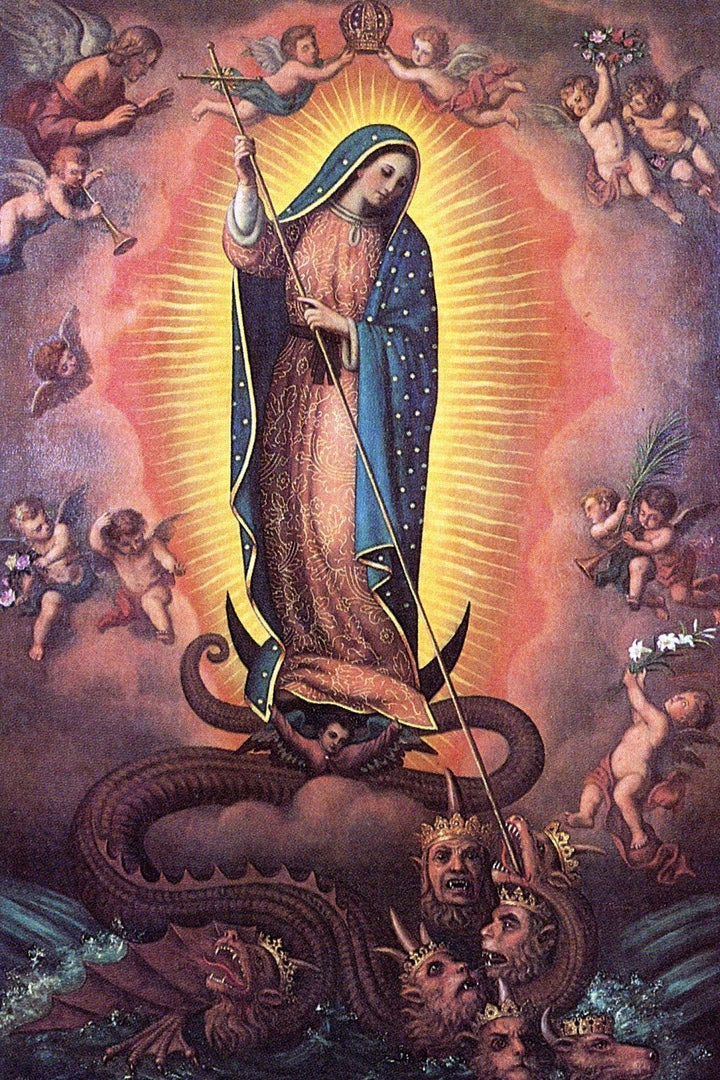
The iconography of heaven referenced in my post for the Immaculate Conception, particularly as it relates to the Miraculous Medal, finds an antecedent in the miraculous image of Our Lady of Guadalupe that was painted on St. Juan Diego’s tilma by the Virgin Herself. She is clothed with the sun and is standing on the moon. Though the artists rendition above includes the serpentine imagery from Apocalypse 12, the actual image on the tilma has no depiction of the serpent. One might think that any reference to Genesis 3:15 is only indirect by way of the allusion through the commonality of The Woman. But not so. In fact, the heavenly iconography of Guadalupe passes from the prophecy of Genesis and the vision of St. John right into the history that it was intended to address. The image itself is a miracle that manifests and perpetuates the Virgin’s presence. We see what Juan Diego saw. Once Our Lady’s command to build a temple was obeyed the image came to rest on Tepeyac Hill, where formerly, before the conquest of Mexico by Cortes, there had been a shrine to the Aztec goddess Coatlicue....
Think about this: Juan Diego was given a mission to be Our Lady’s instrument to crush the serpent’s head in New Spain. He simply obeyed in trust and total abandonment. All he really needed to do was take the message to the bishop. The result was that the image was produced miraculously and then placed where our Lady wanted it, right over the serpent’s head, over the mockery of truth, life, beauty and motherhood.
Here are the words of Pope John Paul II on the final struggle:
We are today before the greatest combat that mankind has ever seen. I do not believe that the Christian community has completely understood it. We are today before the final struggle between the Church and the Anti-Church, between the Gospel and the Anti-Gospel.

Monday, December 8, 2025

The Immaculate Conception and the Popes

On December 8, 1854, Pope Pius IX in Ineffabilis Deus solemnly defined the dogma of the Immaculate Conception. Here are the majestic words of the Vicar of Christ which echoed throughout the galleries and domes of St. Peter's in Rome:
...By the authority of Jesus Christ Our Lord, of the Blessed Apostles Peter and Paul, and by our own: We declare, pronounce, and define that the...most Blessed Virgin Mary, in the first instant of her Conception, by a singular grace and privilege granted by Almighty God, in view of the merits of Jesus Christ, the Savior of the human race, was preserved free from all stain of original sin, is a doctrine revealed by God and therefore to be believed firmly and constantly by all the faithful.
The Holy Father explained the consequences of rejecting the dogma in very strong terms.
...If anyone shall dare- God forbid- to think otherwise...let him know that he is condemned by his own judgment; that he has suffered shipwreck in the faith; that he is separated from the unity of the Church....
The pontiff hoped that the declaration of the dogma would bring many blessings to the Church, which in the mid-19th century was already beleaguered by modernism.
We have complete confidence that this most Blessed Virgin will ensure by her powerful patronage that all errors will be dissipated...Under her guidance...nothing is to be feared, nothing is hopeless.
Although the doctrine of the Immaculate Conception had been believed and taught since apostolic times, at least implicitly, it was during the turbulent modern era that Pope Pius IX saw the necessity of declaring it a matter of faith. Why? Fifty years later, Pope St. Pius X in his encyclical Ad Diem Laetissimum (1904) explains that belief in the Immaculate Conception is a remedy for the ills which flow from modernist, secular thinking.
What in fact is the starting point of the enemies of religion in spreading great and grievous errors by which the faith of so many is shaken? They begin by denying that man has fallen by sin...they regard as mere fables original sin and the evils that are its consequence.
St. Pius affirmed that belief in the Immaculate Conception will restore belief in original sin and in the need for Christ and His Church in order to be saved. "Thus Rationalism and Materialism will be torn up by the roots and destroyed...." He goes on to speak of the disobedience to authority, so prevalent in modern times, which leads to anarchy.
Now the evil which is equally fatal to society at large and to Christianity is dispelled by the dogma of the Immaculate Conception by which we are impelled to recognize in the Church that power to which not only must the will be subject but also the mind.
The holiness of God demanded that His Mother be conceived without original sin. That this honor would be conferred upon a member of our race was foreshadowed in the Old Testament. Pope St. Pius mentions several prophetic incidents:
Adam, the father of mankind looked to Mary crushing the serpent's head...; Noe thought of her when shut up in the ark of saftey...; Moses was amazed at the sight of the bush which burned but was not consumed...; Elias as he looked at the little cloud that rose out of the sea.
Carmelite tradition has also long asserted that Elias had a prophetic glimpse of the Immaculate Virgin in the cloud from the sea. It is one reason why Carmelites long defended the belief in the Immaculate Conception. She who was hailed "full of grace" by the angel Gabriel experienced that fullness from the first moment of her existence. The evil one never had any part of her. How powerful is her prayer with God! As Pius IX concluded in Ineffabilis Deus: "What she asks, she obtains. Her pleas never can be unheard."

(All quotations from Papal Teachings: Our Lady. Monks of Solemnes, St. Paul Editions, 1961)

(Artwork: "The Immaculate Conception" by Velasquez)

Solemnity of the Immaculate Conception

Fr. Angelo has a magnificent post about our Queen. To quote:
This interpretation of the doctrine of the Immaculate Conception is confirmed and strengthened with the support of the Church’s understanding of Apocalypse 12, another militant passage in which the Woman is pitted against the serpent (this time in the form of a red dragon). In this passage Our Lady is clothed with sun, stands on the moon and is crowned with twelve stars. In some images of the Immaculate Conception of the Imagery of Genesis 3 and Apocalypse 12 are combined, both strengthening the symbolism and using the one passage to interpret the other (as Ruben’s renders it above). This imagery of Apocalypse 12 indicates both a state of militancy and triumph. Our Lady is both suffering here on earth and glorified in heaven. This is because She is the personification of the Church, which is both militant and triumphant. Those of us who still suffer already share in the victory of those who have passed through the veil. This is particularly true in the way in which we participate in the victory of the Woman. (Read more.)

Sunday, December 7, 2025

Second Sunday of Advent

a statue of jesus carrying the cross with a lamb on a rock next to it 

Here is a meditation from Dom Gueranger:

The Roman Church makes the Station today in the basilica of Holy-Cross-in-Jerusalem. It was in this venerable church that Constantine deposited a large piece of the true Cross, together with the title which was fastened to it by Pilate's order, and which proclaimed the kingly character of the Saviour of the world. These precious relics are still kept there; and, thus enriched with such a treasure, the basilica of Holy-Cross-in-Jerusalem is looked upon, in the Roman liturgy, as Jerusalem itself, as is evident from the allusions made in the several Masses of the Stations held in that basilica. In the language of the sacred Scriptures and of the Church, Jerusalem is the image of the faithful soul; and the Office and Mass of this Sunday have been drawn up on this idea, as the one of the day. We regret not to be able here to develop the sublime beauty of this figure; and must proceed at once to the passage, which the Church has selected from the prophet Isaias. There she tells her children how well founded are her hopes in the merciful and peaceful reign of the Messias. But first let us adore this Divine Messias:

Come, let us adore the King, our Lord, Who is to come.

Saturday, December 6, 2025

St. Nicholas the Wonder-Worker

 Russian artist Ilya Repin shows St. Nicholas delivering an innocent man from execution.
Saint Nicholas of Myra, the "Wonder-worker," was in some ways the Padre Pio of the fourth century. If people of some distant century were to read of the extraordinary miracles of Saint Pio, they would surely think them to be legendary, except that so many of his healings are documented. Saint Nicholas did not have the advantage of modern medical science to affirm the healings worked by God through him, but he has the devotion of the Church of the East and the West, and has long been venerated as patron of children, mariners, prisoners, miners and brides. He is the patron saint of brides because he gave dowries to poor girls to save them from prostitution. St. Nicholas is an Advent guide, leading us to the Christ Child. According to Don Marco:
To my mind, the most important thing to remember about Saint Nicholas is the spirit of godly fear and adoration with which he stood before the Holy Altar at the moment of the Divine Liturgy. Everything else in his life — including the countless miracles attributed to him — flowed from the Holy Mysteries. The Divine Liturgy served by Saint Nicholas must have been like the Mass of Padre Pio. While the holy gifts were being carried in procession to the altar, the people sang of Our Lord’s Eucharistic advent among them: “We who mystically represent the Cherubim, who sing to the life-giving Trinity the thrice holy hymn, let us now lay aside all earthly cares, that we may receive the King of all who comes escorted invisibly by Angelic hosts. alleluia, alleluia, alleluia.”

Saint Nicholas and the other saints of Advent surround the Eucharistic Advent of the Lord just as they will surround Him with the angels in the glory of His Advent at the end of time. How important it is to acknowledge the saints of Advent, to seek their intercession, to rejoice in their lives. Those who would banish the saints from the celebration of the Advent liturgy are misled and mistaken. The mission of the saints of Advent is to prepare us for the coming of Christ: for His final advent as King and Judge, yes, but also for His humble daily advent hidden under the species of bread and wine. In no way do the saints detract from the intensity of the Advent season. Each of them is given us as a companion and intercessor, charged with making ready our hearts for the advent of the Bridegroom-King.
Here is one of the earliest paintings of St. Nicholas in flight, by Bicci di Lorenzo, in which the saint is giving guidance and aid to sailors on a stormy sea. A mermaid, symbol of the pagan and preternatural world, swims in the opposite direction.


Friday, December 5, 2025

The Perpetual Virginity of Mary

During Advent we contemplate the mysteries surrounding the Birth of the Savior. We await His coming with the Virgin Mary, whose journey to Bethlehem becomes our own. We will never fully comprehend the mystery of the Incarnation and yet through faith we may grasp the unfathomable. So much of what the Church teaches has been distorted in our times. The teaching on Our Lady's perpetual virginity is often misunderstood, as Fr. Mark explains:
Even in the minds of many of the faithful, enfeebled by a forty year dearth of popular orthodox catechesis, a tragic confusion holds sway concerning the privileges of the Blessed Virgin Mary and, in particular, her virginity before, during, and after childbirth. There are many, alas, who, affected by various mutations of creeping Nestorianism and Arianism, have no grasp of what it means to call the Blessed Virgin Mary, Mother of God. Those who do not confess the privileges of the Blessed Virgin Mary, honouring them and celebrating them, fall inevitably into one or another of the classic Christological heresies.
Fr. Mark further discusses this beautiful and ancient teaching, as follows:
Ever since the Council of Ephesus in 431, icons of the Mother of God have been marked by three stars: one on her forehead, and one on each shoulder, The three stars signify her perpetual virginity: before, during, and after the birth of her Son....

Ancient liturgical texts reflect the language of the first great Christological councils of the Church. It was crucial, in the context of the prevailing heresies, to invoke Mary as Theotokos, Mother of God, or as Ever-Virgin. It was feared that by referring to Mary as a woman called simply by her ordinary name, something of the mystery of Christ, True God and True Man, might be obscured or compromised. The liturgy in both East and West reflects this ancient preference. While, in preaching and in works of devotion, we often hear the name of Mary without her theological titles, the liturgy calls her Sancta Dei Genetrix (Holy God-bearer) and Semper Virgo (Ever-Virgin).

The most ancient prayer to the Virgin Mother is the Sub tuum praesidium, found on an Egyptian papyrus from the 3rd century. It does not include the name “Mary,” but invokes her as Holy God-bearer (Sancta Dei Genetrix) and Virgin glorious and blessed, (Virgo gloriosa et benedicta).

The liturgy through the ages is consistent in confessing that God Himself is the author of Mary’s perpetual virginity. The same thought is carried over into the ancient rites for the Consecration of Virgins. Virginity, before being something offered to God, is a gift received from Him. It is a gift wholly ordered to union with Christ. Christ is the Spouse of Virgins; He is, at the same time, the blessed Fruit of a virginity received from God and offered back to Him. The liturgy does not separate virginity from motherhood. The virginity given by God is characterized not by sterility, but by an astonishing fecundity.

More on this de fide teaching in the Catechism:
The deepening of faith in the virginal motherhood led the Church to confess Mary's real and perpetual virginity even in the act of giving birth to the Son of God made man. In fact, Christ's birth "did not diminish his mother's virginal integrity but sanctified it." And so the liturgy of the Church celebrates Mary as Aeiparthenos, the "Ever-virgin."
Here are some beautiful quotes from Fathers of Church:
Believe in the Son of God, the Word before all the ages, who was...in these last days, for your sake, made son of Man, born of the Virgin Mary in an indescribable and stainless way, -for there is no stain where God is and whence salvation comes.... (St. Gregory of Nazianzen, Oration on Holy Baptism, 40:45; 381 AD)
According to the condition of the body (Jesus) was in the womb, He nursed at His mother's breast, He lay in the manger, but superior to that condition, the Virgin conceived and the Virgin bore, so that you might believe that He was God who restored nature, though He was man who, in accord with nature, was born of a human being. (St. Ambrose of Milan, Mystery of the Lord's Incarnation, 6:54; 382 AD)
Who is this gate (Ezekiel 44:1-4), if not Mary? Is it not closed because she is a virgin? Mary is the gate through which Christ entered this world, when He was brought forth in the virginal birth and the manner of His birth did not break the seals of virginity. (St. Ambrose of Milan, The Consecration of a Virgin and the Perpetual Virginity of Mary, 8:52; c. 391 AD)

Tuesday, December 2, 2025

History of Advent

 We must look upon Advent in two different lights: first, as a time of preparation, properly so called, for the birth of our Saviour, by works of penance; and secondly, as a series of ecclesiastical Offices drawn up for the same purpose. We find, as far back as the fifth century, the custom of giving exhortations to the people in order to prepare them for the feast of Christmas. We have two sermons of Saint Maximus of Turin on this subject, not to speak of several others which were formerly attributed to St. Ambrose and St. Augustine, but which were probably written by St. Cesarius of Aries. If these documents do not tell us what was the duration and what the exercises of this holy season, they at least show us how ancient was the practice of distinguishing the time of Advent by special sermons. Saint Ivo of Chartres, St. Bernard, and several other doctors of the eleventh and twelfth centuries, have left us set sermons de Adventu Domini, quite distinct from their Sunday homilies on the Gospels of that season. In the capitularia of Charles the Bald, in 846, the bishops admonish that prince not to call them away from their Churches during Lent or Advent, under pretext of affairs of the State or the necessities of war, seeing that they have special duties to fulfill, and particularly that of preaching during those sacred times.
The oldest document in which we find the length and exercises of Advent mentioned with anything like clearness, is a passage in the second book of the History of the Franks by St. Gregory of Tours, where he says that St. Perpetuus, one of his predecessors, who held that see about the year 480, had decreed a fast three times a week, from the feast of St. Martin until Christmas. It would be impossible to decide whether St. Perpetuus, by his regulations, established a new custom, or merely enforced an already existing law. Let us, however, note this interval of forty, or rather of forty-three days, so expressly mentioned, and consecrated to penance, as though it were a second Lent, though less strict and severe than that which precedes Easter.
~from Dom Gueranger's The Liturgical Year, Vol. I

Sunday, November 30, 2025

Ad te levavi


It is the First Sunday of Advent. Here is the Entrance Antiphon (Introit):
Unto you have I lifted up my soul. O my God, I trust in you, let me not be put to shame; do not allow my enemies to laugh at me; for none of those who are awaiting you will be disappointed.
V. Make your ways known unto me, O Lord, and teach me your paths (Ps 24:1-4).
From Vultus Christi:
 There is movement in today’s liturgy: a great sweep upward and away from all that holds us bound and confined “in darkness and in the shadow of death” (Lk 1:79). This is the ecstatic movement of prayer, of all right worship: out of self, upward, and into “the fullness of God” (Eph 3:19). The Introit sets the tone, not only for this the first Mass of Advent, but also for the rest of the Advent season and, indeed, for the whole new liturgical year. “To Thee, my God, I lift up my soul” (Ps 24:1) or, as Ronald Knox translated it, “All my heart goes out to Thee, my God.”

The heart, in going out to God, leaves much behind and cannot look back. This is the law of prayer, this is what it makes it costly, sacrificial and, at the same time, unspeakably sweet. The things we leave behind are mere trifles but, oh, the hold they can have on us! The old self, fearful and anxious about many things, grasps at every illusory promise of security, clings to things, arranges them in great useless piles, looks on them caressingly and takes inventory of them. The loss of any thing, even the most insignificant, represents for the old self, the loss of control, the loss of power, and of comforting familiar pleasures. All of this in incompatible with the prayer that the liturgy places on our lips today: “All my heart goes out to Thee, my God” (Ps 24:1). The upward flight of today’s Introit has nothing to do with cheap pious sentiment. It is an uncompromising call to detachment, to poverty of spirit, and to an obedience that is off and running with all speed, ready for the leap of hope.

From Dom Gueranger:

This Sunday, the first of the ecclesiastical year, is called, in the chronicles and charts of the middle ages, Ad te levavi Sunday, from the first words of the Introit; or, Aspiciens a longe, from the first words of one of the responsories of Matins.

The Station is at St. Mary Major’s. It is under the auspices of Mary – in the splendid basilica which possesses the crib of Bethlehem, and is therefore called, in ancient documents, St. Mary’s ad Praesepe – that the Roman Church recommences, each year, the sacred cycle. It would have been impossible to select a place more suitable than this for saluting the approach of the divine birth, which is to gladden heaven and earth, and manifest the sublime portent of a Virgin Mother. Let us go in spirit to this august temple, and unite in the prayers which are there being offered up: they are the very ones we also use, and which we will now explain.

[* The Stations marked in the Roman missal for certain days in the year, were formerly processions, in which the whole clergy and people went to some given church, and there celebrated the Office and Mass. This usage, which dates from the earliest period of the Roman Church, and of which St. Gregory the Great was but the restorer, still exists, at least in a measure; for the Stations are still observed, though with less solemnity and concourse of people, on all the days specified in the missal.] (Read more.)

Many people struggle with loneliness during this season of the year. Here are some words from the great Benedictine Dom Hubert van Zeller: 

After sin, the three evils most to be dreaded are doubt, fear and loneliness. Of these, loneliness is the worst. Loneliness can give rise to doubt and fear, while if a man knows he is not alone he can fight his doubt, and disguise- which is half the battle- his fear. We can force ourselves to laugh at our doubts and fears, but loneliness forbids laughter. Loneliness is an echoing ache in the soul, it hollows out the heart and scoops away at our reserves. It even communicates itself to the senses, and all the outer world seems indifferent and hostile. We must have something with which to meet this evil. We must find something which will turn it into good....

This is where we need to have faith. This is where we pull ourselves up and cry "It's a mood. It will pass. It is only a mood." That désespoir des lendemains de fête will melt away in time, giving place to color and light and normality and, finally, joy. ~ Dom Hubert van Zeller's We Die Standing, pp.62-63
Related Posts with Thumbnails