Showing posts with label Our Holy Mother St. Teresa. Show all posts

Wednesday, December 24, 2025

The Three Masses of Christmas

When speaking of Holy Communion in the Way of Perfection (Ch. 34), St. Teresa of Avila said: "This is something that is happening now." In the Christmas liturgy, the Church teaches us that the birth of Jesus is not just something that happened two thousand years ago in Bethlehem. Our Lord's nativity is something that is happening now, especially through participation in the Mass, and in the liturgy of the hours which radiate from it. In The Church's Year of Grace, Fr. Pius Parsch explains that this is why the word hodie or "today" is repeated again and again in the Christmas Masses and offices. The Invitatory for December 24 proclaims: "Today you will know the Lord is coming, and in the morning you will see His glory." We are called to Midnight Mass with this antiphon: "The Lord said to me: You are my Son. Today I have begotten you." At Morning Prayer (Lauds) we say: "Today the Savior of the world is born for you." The antiphon for the Canticle of Mary closes the most joyful of feasts with the words: "Christ the Lord is born today; today the Savior has appeared...."

Dom Gueranger comments: "...This today is the Day of eternity, a Day which has neither morning nor evening, neither rising nor setting." (The Liturgical Year, Vol. II) Through the sacraments, especially through the Eucharistic sacrifice, we already belong to that Day of eternity. At Christmas Mass, we truly and mystically assist at His birth.

Christmas is celebrated with three Masses. At Midnight Mass, the angels marvel at the Word made flesh, born of the Virgin Mary. The Dawn Mass sees the shepherds hurrying to the stable to adore the newborn King. The third Mass celebrates the Eternal Word, Who is the Son begotten of the Father from all eternity.
Jesus, Who is born tonight, is born thrice. He is born of the Blessed Virgin, in the stable of Bethlehem; he is born by grace, in the hearts of the shepherds, who are the first fruits of the Christian Church; and He is born from all eternity in the bosom of the Father, in the brightness of the saints: to this triple birth, therefore, let there be the homage of a triple Sacrifice! (Dom Gueranger, The Liturgical Year, Vol. II)

Thursday, December 11, 2025

St. Maravillas of Jesus

Today is the memorial of Saint Maria Maravillas de Jesus, OCD. What fascinates me about this saint is that she led her nuns through the Second Vatican Council to a more profound living of the Carmelite charism without discarding tradition. She sought only the original inspiration of the foundress, the Holy Mother Saint Teresa, as was recommended by the council fathers.
It redounds to the good of the Church that institutes have their own particular characteristics and work. Therefore let their founders' spirit and special aims they set before them as well as their sound traditions-all of which make up the patrimony of each institute-be faithfully held in honor. (Perfectae Caritatis)

Sunday, December 7, 2025

The Virgin Mary in the Writings of Our Holy Mother St. Teresa

Here is an article which pulls it all together.
St Teresa's whole Marian experience is found scattered throughout her writings, from which we can put together a lovely mosaic of Mary. We will make use of three important traits of Teresian doctrine. a) Devotion to Mary and Marian mystical experience  From the first page of Teresa's writings the Virgin Mary appears among the most important memories of her childhood. She recalls the devotion taught her by her mother Beatriz, which found expression in the recitation of the Rosary(8). The episode of her prayer to Our Lady after the loss of her mother at the age of 13 is very moving: "in my affliction I went to an image of our Lady and begged her with many tears to be a mother to me. It seems to me that though I did this in simplicity, it has been of much help to me; for I know that I have always found favour with this sovereign lady when I have commended myself to her and in the end, she has drawn me to herself"(9). Teresa then attributes to the Virgin the grace of a constant protection and in a special way the grace of her conversion: "She has drawn me to herself." Other texts from the autobiography reveal to us the permanence of the devotion to Mary: when she turns to the Virgin in her sufferings(10), when she remembers her feasts of the Assumption and the Immaculate Conception(11) or the Holy Family(12) or her devotion to the Rosary(13). 
Very quickly the devotion to the Virgin, like other aspects of the Saint's life, passed into an experience of her mysteries, when God made Teresa enter into contact with the mystery of Christ and all that pertains to it. In Teresa's mystical experience of the mystery of Our Lady there is, as it were, a progressive penetration into the most important moments of the Virgin's life, as we find it in the Gospels. Thus, for example, we have an intuition of the mystery of the overshadowing of the Virgin and of her humble and wise attitude at the Annunciation(14). We know of at least two mystical experiences Teresa enjoyed connected with the first words of Mary's canticle, the Magnificat(15) which, according to the testimony of Mary of St Joseph, Teresa used to repeat frequently "softly, in Castilian"(16). 
She contemplates with amazement the mystery of the Incarnation: "The Lord wills to enter into the womb of his most holy Mother. Such is the Lord, he brings liberty with him, and thus he loves to make himself like us"(17). She contemplates the presentation of Jesus in the temple and finds the meaning of Simeon's words to the Virgin(18): "Do not think that when you see my Mother holding me in her arms, she enjoyed this happiness without grave torment. From the time that Simeon spoke these words to her, My Father gave her clear light whereby to see what I would have to suffer"(19). She thinks about the flight into Egypt and the hidden life of the Holy Family(20). 
She had a special intuition of the presence of Mary in the paschal mystery of her Son, on the pain of her desolation and the joy in the Lord's resurrection. Teresa loved to contemplate Mary's fortitude and her communion with Christ at the foot of the Cross(21). In Concepts of the Love of God she describes the Virgin's attitude: "She was up, and not sleeping, but suffering in her most holy soul, dying a cruel death"(22). She had entered mystically into the sorrow of the Virgin when the Lord was placed in her arms "as it is portrayed in the fifth sorrow"(23) and had experience at Easter in Salamanca in 1571 of desolation and anguish (a dark night of the spirit) which made her remember the loneliness of the Virgin at the foot of the Cross(24). On this same occasion the Lord said to her, "On my resurrection I went to our Lady who was in great need.... and I stayed long with her for she was in very great need of consolation"(25). 
On various occasions it was given to her to contemplate the glorification of the Virgin on the feast of her Assumption(26). She was conscious that the Virgin always accompanied the community at prayer with her constant intercession, as happened at St Joseph's in Avila(27) and at the Incarnation(28). 
When it was given to her to know the mystery of the Trinity she perceived the closeness of the Virgin to this mystery, and the fact that the Virgin, along with Christ and the Holy Spirit, are the ineffable gifts of the Father: "I have given you my Son and the Holy Spirit and this Virgin. What can you give to me?"(29) It can be stated that the Holy Mother had a profound mystical experience of Mary, that she enjoyed her presence. Teresa also experienced the mysteries of Mary's life. Consequently in Teresa's doctrine there runs a deep conviction that the mysteries of the Humanity of Christ and those of his Virgin Mother form part of the mystical experience of those tending to perfection(30). (Read More)
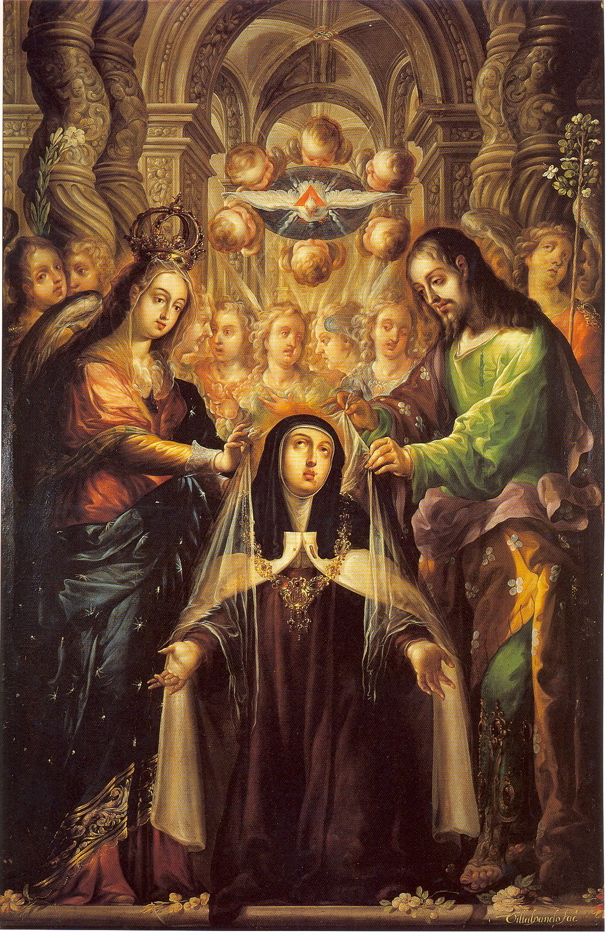
The Holy Mother St. Teresa receives a veil and necklace from Our Lady and St. Joseph

Friday, November 14, 2025

All Carmelite Saints

"With zeal have I been zealous for the Lord God of Hosts." ~3 Kings 19:10

Today the Carmelite Order commemorates the members of our Order who have ascended the mountain of perfection to their heavenly home. They sought God alone, conversing with Him in the depths of their hearts. Our Lord once said to the Holy Mother St. Teresa: "I desire that you no longer hold conversation with men, but with angels," and in many ways those words can be applied to all who follow the Carmelite way. The habits of the interior life, of recollection and mortification, must be cultivated amid our daily duties in order to create an atmosphere conducive to contemplation. In the Rule of St. Albert, the medieval hermits were told: "In silence and hope shall your strength be." (Isaias 30:15) During the theophany on Mt. Horeb, Elias the prophet experienced the Lord God, not in the earthquake, or in the fire, but in a "whistling of gentle air." (3 Kings 19:12) It is in silence and solitude that generations of Carmelites have sought to live in imitation of Elias, "meditating day and night on the law of the Lord and watching in prayer." (Rule of St. Albert)

The primary example of the saints and blessed of the Order has been Our Lady, the Queen and Beauty of Carmel, both in her hidden life at Nazareth and in her anguish at the foot of the Cross. St. Teresa enjoined her nuns to meditate on the lives of Christ's Mother, and His saints. "We need to cultivate and think upon and seek the companionship of those who, though living on earth like ourselves, have accomplished such great deeds for God." (The Interior Castle, p.172)

Speaking particularly of the hermits of old, the Holy Mother exhorts her daughters in The Way of Perfection:
Let us remember our holy fathers of the past, those hermits whose lives we aim to imitate. What sufferings they endured! What solitude, cold, hunger, and what sun and heat, without anyone to complain to but God! Do you think that they were made of steel? Well, they were as delicate as we. (The Way of Perfection, p.81)

Sunday, November 2, 2025

All Souls

The day following All Saints is the Commemoration of the Faithful Departed, All Souls Day. "It is a holy and wholesome thought to pray for the dead, that they might be loosed from their sins." (2 Maccabees 12: 46) These words reflect the Jewish origins of the practice of praying for the dead, a practice continued by the Church. On All Souls Day, every priest has the privilege of celebrating three Masses. A full plenary indulgence can be gained for a soul of the faithful departed on November 2 and on everyday of the week that follows, by fulfilling the usual conditions. As The Catechism of the Catholic Church says:
An indulgence is a remission before God of the temporal punishment due to sins whose guilt has already been forgiven, which the faithful Christian who is duly disposed gains under certain prescribed conditions through the action of the Church which, as the minister of redemption, dispenses and applies with authority the treasury of the satisfactions of Christ and the saints.

An indulgence is partial or plenary according as it removes either part or all of the temporal punishment due to sin.The faithful can gain indulgences for themselves or apply them to the dead.” (CCC, 1471)
The custom of gaining indulgences for the living and the dead goes back to the early Church. As explained by Fr. William Saunders:
From the earliest days of the Church, individuals have offered prayers and good works for the salvation of sinners. In those times, absolution was not granted until both confession and penance had been performed (and the penances were very lengthy in duration, even lasting months). Penitents oftentimes asked martyrs facing death for aid (to offer their sufferings for the atonement of the penitents’ sins) so that full reconciliation with the Church and re-admission to the sacraments could be obtained more speedily. When a martyr offered his sufferings to expiate the sins of a penitent, the Church recognized this charitable act and granted absolution. For example, St. Cyprian (d. 258) stated, "Those who have received certificates from the martyrs and are able to be assisted by their privileged position before God" may be absolved and "come to the Lord with the peace which the martyrs, as indicated in letters sent to us, desired to be given them" ("Letter to the Clergy," 18 (12), 1). In such cases, the penitents received an indulgence which satisfied their penance. Herein lies part of the basis for our belief. (Fr. William Saunders, The Catholic Herald, January 27, 2005)
However, it is not only on All Souls Day but on every day of the year that Holy Mother Church prays for her departed children. Every Mass is offered for both the living and the dead. According to the Council of Trent, the Holy Sacrifice of the Mass is the chief means of bringing succor to the souls in Purgatory. The prayers and good works of the faithful can also benefit the dead.

St. Teresa of Avila had a great love for the suffering souls, a love that was willing to bear the vicissitudes of life in order to aid them. We, too, can bear the pin pricks of inconveniences, of gossip, of calumny and misunderstanding, to gain deliverance from the chastisements of the netherworld those whom we have loved, family members, and even our enemies.

Purgatory is not inevitable, but we can undergo our purgation here on earth by our patient endurance of trials. It is not the intensity of the trial itself that expiates sin; rather it is the intensity of the love for God with which the trial is accepted. Love is what matters most.

Wednesday, October 15, 2025

Maxims of St. Teresa

The Holy Mother St. Teresa receives a veil and necklace from Our Lady and St. Joseph

Here are the spiritual maxims of the Holy Mother St. Teresa, for her nuns.
1. Untilled ground, however rich, will bring forth thistles and thorns; so also, the mind of man.
2. Speak well of all that is spiritual, such as religious, priests, and hermits.
3. Let thy words be few when in the midst of many.
4. Be modest in all thy words and works.
5. Never be obstinate, especially in things of no moment.
6. In speaking to others be always calm and cheerful.
7. Never make a jest of anything.
8. Never rebuke any one but with discretion, and humility, and self-abasement.
9. Bend thyself to the temper of whomever is speaking to thee: be merry with the mirthful, sorrowful with the sad: in a word, make thyself all things to all, to gain all.
10. Never say anything thou hast not well considered and earnestly commended to our Lord, that nothing may be spoken which shall be displeasing unto Him.
11. Never defend thyself unless there be very good reasons for it.
12. Never mention anything concerning thyself which men account praiseworthy, such as learning, goodness, birth, unless with a hope of going good thereby, and then let it be done with humility, remembering that these are gifts of God.

Feast of Our Holy Mother St. Teresa


The following is an account of the death of the Great Teresa on October 4, 1582 at Alba de Tormes, by her secretary Blessed Anne of St. Bartholomew.
Two days before she died, she asked to be given the Most Holy Sacrament, for she knew now that she was dying. On seeing that they were bringing it to her, see sat up in bed in such a spirited way that it looked as if she were going to get up, so they had to restrain her. Then she said, with great joy: "My Lord, it is time to set out...." She gave hearty thanks to God that she was a daughter of the Church and was dying as such, saying that through the merits of Christ she hoped to be saved, and she asked us all to beseech God to pardon her sins and to look, not at them, but only at His own mercy. With great humility she asked pardon of all, telling them not to take into account the things she had done and the bad example she had set them.
When the sisters saw that she was dying, they begged her to say something to them that would be to their profit, and she entreated them, for the love of God, to keep strictly to their Rule and Constitutions. There was nothing that she wished to add to this. Afterwards, she said little more save for repeating again and again that verse of David which says: Sacrificium Deo spiritus contribulatus; cor contritum et humiliatum, Deus, non despicies ("A sacrifice to God is an afflicted spirit, a humble and contrite heart, O God, Thou wilt not despise." Psalm 50:19, The Vulgate) Especially the phrase cor contritum-- this she kept repeating till she could say no more. Before this she had asked for Extreme Unction which she received with great devotion.

On St. Francis' Day, at nine o'clock in the evening, Our Lord took her to be with Him and left us all in such sorrow and grief that, if I had to describe it here, there would be a great deal to say. I heard a few things which the Holy Mother said before she expired, but so wonderful are they that I shall not set them down here. My superiors can relate them if they think it well to do so.


(from Msgr. Doheny's Selected Writings of St. Teresa)

Monday, October 6, 2025

Novena to Our Holy Mother St. Teresa of Jesus

A Statue Of Saint Teresa Of Avila In Cospicua, Malta Stock Photo, Picture  and Royalty Free Image. Image 22948469.
   
 
Novena to St. Teresa of Avila by St. Alphonsus of Liguori

Beginning on October 7 and ending on October 15, here is a novena in honor of the Feast of Our Holy Mother St. Teresa. Let us pray for vocations.

First Day: O most amiable Lord Jesus Christ! We thank Thee for the great gift of faith and of devotion to the Holy Sacrament, which Thou didst grant to Thy beloved Teresa; we pray Thee, by Thy merits and by those of Thy faithful spouse, to grant us the gift of a lively faith, and of a fervent devotion toward the most Holy Sacrament of the altar; where Thou, O infinite Majesty! hast obliged Thyself to abide with us even to the end of the world, and wherein Thou didst so lovingly give Thy whole Self to us.
Say one Our Father, Hail Mary and Glory be.
V. St. Teresa, pray for us:
R. That we may become worthy of the promises of Jesus Christ.
Let us pray: Graciously hear us, O God of our salvation! that as we rejoice in the commemoration of the blessed virgin Teresa, so we may be nourished by her heavenly doctrine, and draw from thence the fervour of a tender devotion; through our Lord Jesus Christ, Thy Son, Who liveth and reigneth with Thee in the unity of the Holy Spirit, God for ever and ever. Amen.

Second Day: O most merciful Lord Jesus Christ! we thank Thee for the great gift of hope which Thou didst grant to Thy beloved Teresa; we pray Thee, by Thy merits, and by those of Thy holy spouse, to give us a great confidence in Thy goodness, by reason of Thy Precious Blood, which Thou hast shed to its last drop for our salvation.
Say one Our Father, Hail Mary and Glory be.
V. St. Teresa, pray for us:
R. That we may become worthy of the promises of Jesus Christ.
Let us pray: Graciously hear us, O God of our salvation! that as we rejoice in the commemoration of the blessed virgin Teresa, so we may be nourished by her heavenly doctrine, and draw from thence the fervour of a tender devotion; through our Lord Jesus Christ, Thy Son, Who liveth and reigneth with Thee in the unity of the Holy Spirit, God for ever and ever. Amen.

Third Day: O most loving Lord Jesus Christ! we thank Thee for the great gift of love which Thou didst grant to Thy beloved Teresa; we pray Thee, by Thy merits, and by those of Thy most loving spouse, to give us the great, the crowning gift of Thy perfect love.
Say one Our Father, Hail Mary and Glory be.
V. St. Teresa, pray for us:
R. That we may become worthy of the promises of Jesus Christ.
Let us pray: Graciously hear us, O God of our salvation! that as we rejoice in the commemoration of the blessed virgin Teresa, so we may be nourished by her heavenly doctrine, and draw from thence the fervour of a tender devotion; through our Lord Jesus Christ, Thy Son, Who liveth and reigneth with Thee in the unity of the Holy Spirit, God for ever and ever. Amen.

Fourth Day: O most sweet Lord Jesus Christ! we thank Thee for the gift of great desire and resolution which Thou didst grant to Thy beloved Teresa, that she might love Thee perfectly; we pray Thee, by Thy merits, and by those of Thy most generous spouse, to give us a true desire, and a true resolution of pleasing Thee the utmost of our power.
Say one Our Father, Hail Mary and Glory be.
V. St. Teresa, pray for us:
R. That we may become worthy of the promises of Jesus Christ.
Let us pray: Graciously hear us, O God of our salvation! that as we rejoice in the commemoration of the blessed virgin Teresa, so we may be nourished by her heavenly doctrine, and draw from thence the fervour of a tender devotion; through our Lord Jesus Christ, Thy Son, Who liveth and reigneth with Thee in the unity of the Holy Spirit, God for ever and ever. Amen.

Fifth Day: O most kind Lord Jesus Christ! we thank Thee for the great gift of humility which Thou didst grant to Thy beloved Teresa; we pray Thee, by Thy merits, and by those of Thy most humble spouse, to grant us the grace of a true humility, which may make us ever find our joy in humiliation, and prefer contempt before every honour.
Say one Our Father, Hail Mary and Glory be.
V. St. Teresa, pray for us:
R. That we may become worthy of the promises of Jesus Christ.
Let us pray: Graciously hear us, O God of our salvation! that as we rejoice in the commemoration of the blessed virgin Teresa, so we may be nourished by her heavenly doctrine, and draw from thence the fervour of a tender devotion; through our Lord Jesus Christ, Thy Son, Who liveth and reigneth with Thee in the unity of the Holy Spirit, God for ever and ever. Amen.

Sixth Day: O most bountiful Lord Jesus Christ! we thank Thee for the gift of devotion towards Thy sweet mother, Mary and her holy spouse, Joseph, which Thou didst grant to Thy beloved Teresa; we pray Thee, by Thy merits, and by those of Thy most dear spouse, to give us the grace of a special and tender devotion towards Thy most holy mother, Mary, and towards Thy beloved foster-father, Joseph.
Say one Our Father, Hail Mary and Glory be.
V. St. Teresa, pray for us:
R. That we may become worthy of the promises of Jesus Christ.
Let us pray: Graciously hear us, O God of our salvation! that as we rejoice in the commemoration of the blessed virgin Teresa, so we may be nourished by her heavenly doctrine, and draw from thence the fervour of a tender devotion; through our Lord Jesus Christ, Thy Son, Who liveth and reigneth with Thee in the unity of the Holy Spirit, God for ever and ever. Amen.

Seventh Day: O most loving Lord Jesus Christ! we thank Thee for the wonderful gift of the wound in the heart which Thou didst grant to Thy beloved Teresa; we pray Thee, by Thy merits, and by those of Thy seraphic spouse, to grant us also a like wound of love, that, henceforth, we may love Thee and give our mind to the love of nothing but Thee.
Say one Our Father, Hail Mary and Glory be.
V. St. Teresa, pray for us:
R. That we may become worthy of the promises of Jesus Christ.
Let us pray: Graciously hear us, O God of our salvation! that as we rejoice in the commemoration of the blessed virgin Teresa, so we may be nourished by her heavenly doctrine, and draw from thence the fervour of a tender devotion; through our Lord Jesus Christ, Thy Son, Who liveth and reigneth with Thee in the unity of the Holy Spirit, God for ever and ever. Amen.

Eighth Day: O most beloved Lord Jesus Christ! we thank Thee for the eminent gift of the desire for death which Thou didst grant to Thy beloved Teresa; we pray Thee, by Thy merits, and by those of Thy most constant spouse, to grant us the grace of desiring death, in order to go and possess Thee eternally in the country of the blessed.
Say one Our Father, Hail Mary and Glory be.
V. St. Teresa, pray for us:
R. That we may become worthy of the promises of Jesus Christ.
Let us pray: Graciously hear us, O God of our salvation! that as we rejoice in the commemoration of the blessed virgin Teresa, so we may be nourished by her heavenly doctrine, and draw from thence the fervour of a tender devotion; through our Lord Jesus Christ, Thy Son, Who liveth and reigneth with Thee in the unity of the Holy Spirit, God for ever and ever. Amen.

Ninth Day: Lastly, O dearest Lord Jesus Christ! we thank Thee for the gift of the precious death which Thou didst grant to Thy beloved Teresa, making her sweetly to die of love; we pray Thee, by Thy merits, and by those of Thy most affectionate spouse, to grant us a good death; and if we do not die of love, yet, that we may at least die burning of love for Thee, that so dying, we may be able to go and love Thee for evermore with a more perfect love in heaven.
Say one Our Father, Hail Mary and Glory be.
V. St. Teresa, pray for us:
R. That we may become worthy of the promises of Jesus Christ.
Let us pray: Graciously hear us, O God of our salvation! that as we rejoice in the commemoration of the blessed virgin Teresa, so we may be nourished by her heavenly doctrine, and draw from thence the fervour of a tender devotion; through our Lord Jesus Christ, Thy Son, Who liveth and reigneth with Thee in the unity of the Holy Spirit, God for ever and ever. Ame

Tuesday, August 26, 2025

The Pierced Heart

Today on the Carmelite calendar it is the feast of the Transverberation of the Heart of St. Teresa of Avila. Although the Holy Mother claimed the experience was purely mystical, it was found after her death that her heart had indeed been physically pierced. A priest once told me that such a phenomenon was a stigmata, although not the same stigmata that saints like St. Pio and St Francis of Assisi experienced. Those saints bore the five wounds of Christ; St Teresa bore a single wound in her heart. In this she resembled the Sorrowful Mother, trans-pierced at the foot of the Cross. St. Teresa, and those who wish to follow her in the Carmelite way, are to model the Blessed Virgin Mary, faithful in the greatest moment of darkness which was the crucifixion. It was also the moment of redemption, in which Mary became the Mother of the Church. Through our own sufferings and heartaches, we can participate in the redemption of the world.

Here is an excerpt of Richard Crashaw's "The Flaming Heart", about the transverberation of the heart of St. Teresa:
O heart, the equal poise of love’s both parts,
Big alike with wounds and darts,
Live in these conquering leaves; live all the same,
And walk through all tongues one triumphant flame;
Live here, great heart, and love and die and kill,
And bleed and wound, and yield and conquer still.
Let this immortal life, where’er it comes,
Walk in a crowd of loves and martyrdoms;
Let mystic deaths wait on ’t, and wise souls be
The love-slain witnesses of this life of thee.
O sweet incendiary! show here thy art,
Upon this carcass of a hard cold heart,
Let all thy scatter’d shafts of light, that play
Among the leaves of thy large books of day,
Combin’d against this breast, at once break in
And take away from me my self and sin;
This gracious robbery shall thy bounty be,
And my best fortunes such fair spoils of me.
O thou undaunted daughter of desires!
By all thy dow’r of lights and fires,
By all the eagle in thee, all the dove,
By all thy lives and deaths of love,
By thy large draughts of intellectual day,
And by thy thirsts of love more large than they,
By all thy brim-fill’d bowls of fierce desire,
By thy last morning’s draught of liquid fire,
By the full kingdom of that final kiss
That seiz’d thy parting soul and seal’d thee his,
By all the heav’ns thou hast in him,
Fair sister of the seraphim!
By all of him we have in thee,
Leave nothing of my self in me:
Let me so read thy life that I
Unto all life of mine may die.

Saturday, August 9, 2025

St. Teresa Benedicta (Edith Stein)

On October 11, 1998, Pope John Paul II canonized St. Teresa Benedicta of the Cross, a Discalced Carmelite nun known in the world as Dr. Edith Stein. Edith Stein was born to a German Jewish family on October 12, 1891, the Day of Atonement on the Hebrew calendar. She grew up to become a brilliant philosopher and university professor, as well as a feminist. Her purely secular lifestyle eventually brought her to a state of melancholy. She began to search for a deeper meaning of life.

One evening, while at the home of some Catholic friends, Edith read the Life of St. Teresa of Avila, and when she finished it she said: "This is truth." Edith was baptized in 1922, and for the next decade was a dedicated teacher in Catholic schools, as well as a lecturer on women's issues. The confusion of today concerning the role of women in the home, in the Church, and in public life was also rampant in the Europe of the 1920's and 30's. Dr. Stein gave a series of lectures on such topics as "Ethos of Women's Professions" and "Vocations of Man and Woman," in which she discussed the controversy in the light of Sacred Scripture and Tradition.

At a convention of Catholic Academics in 1930, Dr. Stein said:
Many of the best women are almost overwhelmed by the double burden of family duties and professional life-- or often simply of gainful employment. Always on the go, they are harassed, nervous, and irritable. Where are they to get the needed inner peace and cheerfulness in order to offer stability, support, and guidance to others?...To have divine love as its inner form, a woman's life must be a Eucharistic life. Only in daily confidential relationship with the Lord in the tabernacle can one forget self, become free of all one's wishes and pretensions, and have a heart open to all the needs of others. ( The Collected works of Edith Stein, Vol 2, ICS Publications, 1987)
Edith presented the Blessed Virgin Mary as being the role model for all women.
Whether she is a mother in the home, or occupies a place in the limelight of public life, or lives behind quiet cloister walls, she must be the handmaid of the Lord everywhere. So had the Mother of God been in all the circumstances of her life....Were each woman an image of the Mother of God, a Spouse of Christ, an apostle of the Divine Heart, then would each fulfill her feminine vocation no matter what conditions she lived in and what worldly activity absorbed her life. (Collected Works, Vol 2)

At the age of forty-two, Edith Stein entered the Carmel of Cologne, where she made her first profession on Easter Sunday, 1935 and her final vows in April of 1938. Due to the Nazi persecution of the Jews in Germany, Sr. Teresa Benedicta of the Cross, as she was known in the cloister, was transferred to the Dutch Carmel of Echt on December 31, 1938. On Passion Sunday, 1939, she asked her superior for permission to "offer herself to the Sacred Heart of Jesus as a sacrifice of atonement for the peace of the world" and the conversion of the Jewish people. (J. Fabrerues, "The Science of the Cross," Carmelite Digest, 1994)

Soon afterwards, Holland ceased to be a refuge; it was invaded by the Germans. In July of 1942, the Dutch bishops protested the Nazi mistreatment and deportation of the Jews. The Nazis retaliated. On August 2, all Catholics of Jewish descent were arrested, including Sr. Teresa Benedicta and her sister Rosa Stein. Beaten and half-starved, the sisters were deported first to Westerbork prison prison camp in Northern Holland. Sr. Teresa was able to send a message to her superior that she was still wearing her Carmelite habit, and planned to keep wearing it as long as she could. (Fabrerues)

At the camp, St. Teresa Benedicta comforted and cared for frightened mothers and their little children. Before her arrival in Auschwitz on August 9, 1942, she managed to smuggle one last message to her mother prioress: "I am content now. One can only learn the Scientia Crucis if one truly suffers under the weight of the Cross. I was entirely convinced of this from the very first and I have said with all my heart: Hail, Cross, our only hope." (Fabrerues)

After disappearing into the hell of the death camp, it is assumed that the brave Carmelites were gassed almost immediately, but the exact date and hour of the death of St. Teresa Benedicta has never been known for certain. She was beatified as a martyr of the Catholic faith on May 1, 1987 by Pope John Paul II.


 Here is an extract from St. Teresa Benedicta's writings on prayer in Before the Face of God:

“Through him, with him, and in him in the unity of the Holy Spirit, all honor and glory is yours, Almighty Father, for ever and ever.” With these solemn words, the priest ends the Eucharistic prayer at the center of which is the mysterious event of the consecration. These words at the same time encapsulate the prayer of the church: honor and glory to the triune God through, with, and in Christ.
Although the words are directed to the Father, all glorification of the Father is at the same time glorification of the Son and of the Holy Spirit. Indeed, the prayer extols the majesty that the Father imparts to the Son and that both impart to the Holy Spirit from eternity to eternity. All praise of God is through, with, and in Christ. Through him, because only through Christ does humanity have access to the Father and because his existence as God-man and his work of salvation are the fullest glorification of the Father; with him, because all authentic prayer is the fruit of union with Christ and at the same time buttresses this union, and because in honoring the Son one honors the Father and vice versa; in him, because the praying church is Christ himself, with every individual praying member as a part of his Mystical Body, and because the Father is in the Son and the Son the reflection of the Father, who makes his majesty visible. The dual meanings of through, with, and in clearly express the God-man’s mediation. The prayer of the church is the prayer of the ever-living Christ. Its prototype is Christ’s prayer during his human life.
Thursday, July 24, 2025

The Blessed Martyrs of Guadalajara

There were many atrocities perpetrated upon priests and religious in Spain during the bloody Civil War of the 1930's. In 1936, three Carmelite nuns were shot. Today is their feast, and here is their story:
In 1936, during the Spanish Civil War, Communist troops murdered three Carmelite nuns at Guadalajara, Spain. They were: Sr. Maria of the Angels of St. Joseph (born Marciana Valtierra Tordesillas), thirty-one years oId; Sr. Maria Pilar of St. Francis Borgia (Jacoba Martinez Garcia), fifty-eight; Sr. Teresa of the Child Jesus (Eusebia Garcia y Garcia), twenty-seven.

On July 22, with soldiers roaming the city, the eighteen nuns of the Monastery of St. Joseph scattered through the streets disguised in secular clothes. Some found shelter with Catholic families, and Srs. Maria of the Angels, Maria Pilar, and Teresa, along with two other nuns, hid in the basement of the Hibernia Hotel. Two days later, the five left the hotel, two going to a nearby boarding house, the three martyrs making their way up a street. A soldier eating lunch in a parked jeep recognized them and shouted to her companions, "Shoot them! They are nuns!"

Sr. Maria of the Angels died instantly when a bullet struck her in the heart. Sr. Maria Pilar, also hit, cried out, "Viva Cristo Rey (Long live Christ the King)!" The soldiers, furious at the pious exclamation, shot her repeatedly and slashed her with a knife. She died, having lost most of her blood, saying, "My God, pardon them. They don't know what they're doing."

Sr. Teresa was not harmed, and a soldier, pretend­ing concern, gathered some of his com­panions and led Teresa to a nearby cemetery, apparently intending to rape her. As they went, she spoke out fearlessly against them, and they angrily insisted she praise communism. To each of their commands she cried, "Viva Cristo Rey!" Told to walk a few steps ahead, she spread her arms in the form of a cross and was shot in the back. (Read more.)

 (More HERE, via The Inn at the End of the World)

"Soeur Espagne, sainte Espagne... tu as choisi!
Onze évêques, seize-mille prêtres massacrés... et pas une apostasie!"


~
Paul Claudel, "Aux martyrs espagnols"

Thursday, July 17, 2025

Gertrud von le Fort and the Martyrs of Compiègne

I have long been an admirer of Gertrud von le Fort and her novel Song at the Scaffold, about the Blessed Martyrs of Compiègne. Baroness von le Fort's short but powerful depiction of the sixteen Carmelite nuns guillotined in 1795 during the Reign of Terror was the inspiration for the play by Bernanos and the opera by Poulenc, Dialogues des Carmelites. To Quell the Terror by William Bush is an excellent historical treatise on the martyrdom of the Carmelites. It is not widely known that Queen Marie-Antoinette provided a dowry for a poor, pious girl named Mademoiselle Lidoine, so that she could enter the Carmel of Compiègne. Mademoiselle Lidoine became the Mother Prioress of the heroic Martyrs of Compiègne, who like Marie-Antoinette, died on the guillotine during the French Revolution.

There is more HERE from The Inn At The End of the World.

 Here is the final scene from Poulenc's opera:

Wednesday, July 16, 2025

Our Lady's Scapular

In the last forty years many of the sacramentals of the Church, such as the scapular, have been either forgotten or misinterpreted. I have seen some very sophisticated Catholics on the internet mock the scapular as being superstitious. It requires a certain child-like piety to understand such things; an understanding of the history of the devotion does not hurt either. Here is an explanation of the origins of the scapular:
This monastic scapular, like the whole monastic habit and indeed the liturgical vestments of the priest, developed from the ordinary clothing of the laity. And, just as the stole is the special sign of the priestly dignity and power, the scapular is now the sign of the monk. In the West, in the case of St. Benedict, the scapular was at first nothing else than a working garment or apron such as was then worn by agricultural labourers. Thus, in the Rule of St. Benedict, it was expressly termed "scapulare propter opera" (c. xxv in P.L. LXXVI, 771). From this developed the special monastic garment, to which a hood could be fastened at the back. In fact, the original scapular of the Dominican Order was so made that it acted also as a covering for the head, and thus as a hood. The scapular of the West corresponded to the analabus of the East.
Since many of the religious orders had a version of the monastic scapular, lay people who were affiliated with those orders wished to a tangible sign of their dedication. In the beginning, tertiaries were permitted to don the habit of the order with which they were affiliated. Later, since a religious habit was not always conducive to the duties of secular life the small scapulars were worn instead, as the following relates:
Like the large scapulars the first and oldest small scapulars originated to a certain extent in the real monastic scapular. Pious lay persons of either sex attached themselves to the Servites for instance; many of those who were in a position to do so attached themselves to the third order with vows, but in the case of many others either this was impossible or the idea of doing so had as yet not occurred to them. In this manner developed, shortly after the foundation of the Servite Order, the Confraternity of the Servi B. Mariae Virginis. Similarly originated the Confraternity of Our Lady of Mount Carmel; that this existed in 1280 is proved by the still extant "Libro degli ordinamenti de la compagnia di Santa Maria del Carmine scritto nel 1280" (edited by Giulio Piccini at Bologna, 1867, in "Scelta di Curiosità letterarie"). The members of these confraternities were called the confratres and consores of the respective orders; they had special rules and participated in the spiritual goods of the order to which then belonged. It is probable also that many of those who could not be promoted to the third order or who were special benefactors of the first order received the habit of the order or a large scapular similar to that of the oblates, which they might wear when dying and in which they might be buried. It was only later and gradually that the idea developed of giving to everyone connected with the order the real scapular of the order in miniature as their badge to be always worn day and night over or under their ordinary clothing.
The scapulars, especially the brown scapular of the Carmelites, became so popular among the Christian people that even those who did belong to a religious order began to wear them. The brown scapular became the most highly indulgenced so that children were enrolled in the scapular confraternity around the time they made their first Holy Communion. Fr. Kieran Kavanaugh, OCD, discusses the facts surrounding the Carmelite scapular:
If we look for the earliest references to the scapular, we find them in the Carmelite constitutions of 1281 in which it was prescribed that all Carmelite friars should wear their tunics and scapulars to bed under penalty of a serious fault. It was also prescribed that the white mantle be made in such a way that the scapular would not be hidden. But the reason for these prescriptions was not a Marian one. At the time, the scapular was seen as signifying the "yoke of Christ." This yoke of Christ in turn pointed to obedience. And that explains the strictness of the legislation. Taking off the scapular was like taking off the yoke of Christ, or rebelling against authority. Only gradually did the scapular take on a Marian tone and grow until it reached such a point that it became identified with Carmelite piety toward Our Lady. In fact the feast of Our Lady of Mount Carmel began to be called the scapular feast. Devotion to Mary expressed by wearing the brown scapular seems to be resilient and resists the attempts made in various periods of history to diminish its value. The faithful keep coming back to it. From the official teaching of the Church, we can gather that the scapular of Carmel is one of the most highly recommended Marian devotions. This is true through the centuries, and into our own times with popes Paul VI and John Paul II.
Fr. Kieran goes on to explore how sacramental aspects of the brown scapular developed:
One of the early Carmelites in his enthusiasm went so far as to call the scapular a "sacrament." Actually the category into which the scapular fits is that of a sacramental. Sacramentals are sacred signs. The scapular is not a natural sign in the sense that smoke is the sign of fire. Smoke is intrinsically connected with fire. Where there's smoke there's fire, the saying goes.
The scapular is what is called a conventional sign. In the case of a conventional sign, the meaning is assigned to the object from outside. Thus a wedding ring is a sign or pledge of mutual love and enduring fidelity between two spouses. In this kind of sign, which is a conventional sign, there has to be an intervention from outside that establishes the connection between the object and what it represents. In the case of sacramentals, it is the Church that determines the connection.
Sacramentals also signify effects obtained through the intercession of the Church, especially spiritual graces. The sacramentals -- as holy pictures or icons, statues, medals, holy water, blessed palm and the scapular -- are means that dispose one to receive the chief effect of the sacraments themselves, and this is closer union with Jesus.
St. Teresa of Avila for example speaks in her life about holy water and the power she experienced that this sacramental has against the devil. She mentions as well how this power comes not through the object in itself but through the prayer through the prayer of the Church. Along with the sacraments, sacramentals sanctify almost every aspect of human life with divine grace. The passion, death, and resurrection of Christ is the source of the power of the sacramentals as it is of the sacraments themselves.
Such everyday things as water and words, oil and anointing, cloth and beeswax, paintings and songs are ingredients of the sacraments and sacramentals. The Son of God became the Son of Mary. What could be more down-to-earth, more human, indeed more unpretentious, plain, and simple? (Read more.)
 
Pope John Paul II, who was a Carmelite tertiary, wrote profoundly of the brown scapular in March 2001:
Over time this rich Marian heritage of Carmel has become, through the spread of the Holy Scapular devotion, a treasure for the whole Church. By its simplicity, its anthropological value and its relationship to Mary's role in regard to the Church and humanity, this devotion was so deeply and widely accepted by the People of God that it came to be expressed in the memorial of 16 July on the liturgical calendar of the universal Church....
The sign of the Scapular points to an effective synthesis of Marian spirituality, which nourishes the devotion of believers and makes them sensitive to the Virgin Mother's loving presence in their lives. The Scapular is essentially a "habit". Those who receive it are associated more or less closely with the Order of Carmel and dedicate themselves to the service of Our Lady for the good of the whole Church.... Those who wear the Scapular are thus brought into the land of Carmel, so that they may "eat its fruits and its good things" (cf. Jer 2: 7), and experience the loving and motherly presence of Mary in their daily commitment to be clothed in Jesus Christ and to manifest him in their life for the good of the Church and the whole of humanity....
Therefore two truths are evoked by the sign of the Scapular: on the one hand, the constant protection of the Blessed Virgin, not only on life's journey, but also at the moment of passing into the fullness of eternal glory; on the other, the awareness that devotion to her cannot be limited to prayers and tributes in her honour on certain occasions, but must become a "habit", that is, a permanent orientation of one's own Christian conduct, woven of prayer and interior life, through frequent reception of the sacraments and the concrete practice of the spiritual and corporal works of mercy. In this way the Scapular becomes a sign of the "covenant" and reciprocal communion between Mary and the faithful: indeed, it concretely translates the gift of his Mother, which Jesus gave on the Cross to John and, through him, to all of us, and the entrustment of the beloved Apostle and of us to her, who became our spiritual Mother.
...A splendid example of this Marian spirituality, which inwardly moulds individuals and conforms them to Christ, the firstborn of many brethren, is the witness to holiness and wisdom given by so many Carmelite saints, all of whom grew up in the shadow and under the protection of their Mother.
I too have worn the Scapular of Carmel over my heart for a long time!

Saturday, June 7, 2025

Blessed Anne of St. Bartholomew

Today is the feast of a Carmelite saint, Blessed Anne, the secretary and confidante of the Holy Mother St. Teresa of Avila. Here is her biography:
She entered in 1570 at the age of 21, taking the religious name Sr. Anne of St. Bartholomew and becoming the first discalced Carmelite lay sister. She made her profession on August 15th 1572 and was given the duty of infirmarian. In 1574 Anne went with St. Teresa to Valladolid and Medina del Campo. After that she became ill herself and was unable to travel for two years, but Teresa thought very highly of Anne and in 1577 she became her secretary and nurse. In the last five years of her life Teresa needed help with her large correspondence as she was often too tired or too ill to write herself, but she was able to dictate her letters. Anne had still not learnt to write, so Teresa gave her two lines of her own handwriting and told her to learn. In one afternoon Anne persevered and obeying Teresa’s directive she learned to write; this was cited as one of Teresa’s miracles in the process for her beatification, though it is true that, since Anne could read, she was already familiar with letters, which no doubt helped her learn to write. In the last years of Teresa’s life Anne wrote a great many letters for Teresa at her dictation. Teresa wanted Anne to receive the black veil and become a choir nun, but Anne begged to remain a lay sister, as she did not know how to read Latin which was required for the Divine Office and she said she would prefer to serve the community in practical ways than have the burden of administration. Teresa allowed her to remain a lay sister but predicted correctly that she would eventually become a choir nun. Anne visited many monasteries with Teresa and helped her with the foundations of Villanueva de la Jara, Palencia, Soria and Burgos. She was a dedicated nurse helping Teresa through her many health problems and attending to her lovingly in her last journeys. Teresa died in Anne’s arms at Alba de Tormes in 1582. (Read more.)

Thursday, May 29, 2025

Ascension of the Lord

(Icon of the Ascension by Andrei Rublev)

Let us look towards Heaven.
Our desires, on this Day, should be, that we may follow our Jesus to life everlasting, and overcome all the hindrances that we may have to encounter on the way thither....
A tradition, handed down from the early ages, and confirmed by the revelations of the Saints, tells us that the Ascension of our Lord took place at the hour of Noon. The Carmelites of St. Teresa's Reform honour this pious tradition by assembling in the Choir, at the hour of mid-day on the Ascension; and spend it in the contemplation of this last of Jesus' mysteries, following him, in thought and desire, to the throne of his glory.
Let us, also, follow him; but before looking on the bright Noon which smiles on his triumph, let us go back in thought to his first coming among us. It was at mid-night, in the stable of Bethlehem. That dark and silent hour was an appropriate commencement to the three and thirty years of his life on earth. He had come to accomplish a great mission: year by year, and day by day, he laboured in its fulfillment. It was nigh to its fulfillment, when men laid their sacrilegious hands upon him, and nailed him to a Cross. It was mid-day, when he was thus raised up in the air; but the Eternal Father would not permit the sun to shine on Jesus' humiliation. Darkness covered the face of the earth ; and that Day had no Noon. Three hours after, the sun re-appeared. Three days after, the Crucified rose again from the Tomb, and it was at the early dawn of light.
On this day, yea at this very hour, his work is completed. He has redeemed us, by his Blood, from our sins ; he has conquered death by his "Resurrection to life :—had he not a right to choose, for his Ascension, the hour when the sun is pouring forth his warmest and brightest beams... ~Abbot Gueranger's The Liturgical Year
Here is the Ascension hymn:
Jesu, nostra redemptio,
Amor et desiderium,
Deus Creator omnium,
Homo in fine temporum.


O Jesus, our redemption,
our love, and our desire,
God, Creator of all things,
become Man in the fullness of time.

Quae te vicit clementia,
Ut ferres nostra crimina,
Crudelem mortem patiens,,
Ut nos a morte tolleres!


What tender love, what pity
compelled Thee to bear our crimes,
to suffer a cruel death
that we, from death, might be saved?

Inferni claustra penetrans,
Tuos captivos redimens,
Victor triumpho nobili
Ad dextram Patris residens:


Into death’s dark cloister didst Thou descend,
and from it captives free didst bring;
Thy triumph won, Thou didst take Thy place,
Thou, the Victor, at the Father’s right.

Ipse te cogat pietas,
Ut mala nostra superes,
Parcendo, et voti compotes
Nos tuo vultu saties.


'Twas a tender love, a costly compassion
that pressed Thee our sorrows to bear;
granting pardon, Thou didst raise us up
to fill us full with the splendour of Thy face.

Tu esto nostrum gaudium,
Qui es futurus praemium:
Sit nostra in te gloria
Per cuncta semper saecula. 


Thou art already the joy of all our days,
Thou Who in eternity will be our prize;
let all our glory be in Thee,
forever, and always, and in the age to come.

Tuesday, October 15, 2024

St. Teresa of Avila and Our Lady

The French Carmelite Père Joseph de Saint Marie, OCD, in some of his conferences on St. Teresa and in his book Notre Dame du Mont-Carmel remarks about the fact that many of the significant events in St. Teresa's life happened on or around the feast of the Assumption. Her vision of hell, which inspired her to begin the monastic reform, occurred in the month of August, as did the foundation of St. Joseph's monastery in Avila. Two magnificent visions of Our Lady took place, in different years, on August 15. In her Life, St. Teresa describes the visions. Of the first one she writes:

...In a rapture there was pictured to me [Our Lady's] ascent into Heaven and the joy and solemnity with which she was received in the place where she now is. To explain how this happened would be impossible for me. Exceeding great was the glory which filled my spirit when it saw such glory. The fruits of the vision were wonderful and I was left with a great desire to serve Our Lady, because of her surpassing merits....

In the second apparition, which occurred on August 15, 1561, St. Teresa found herself transfigured, with Our Lady on her right and St. Joseph on her left. They clothed her in a mantle of great "whiteness and brightness," which meant she was "cleansed of [her] sins." According to St. Teresa's autobiography: "Our Lady suddenly took me by the hands and told me that I was giving her great pleasure by serving St. Joseph and that I might be sure that all I was trying to do about the convent would be accomplished and that both the Lord and they would be greatly served in it." Our Lady gave her a jeweled cross on a golden chain (similar to that of an abbess) signifying the saint's authority as a mother foundress. The vision left St. Teresa feeling "greatly comforted and full of peace." In such mystical experiences the strong Marian aspect of the Carmelite charism was once again emphasized, as a witness for those who would come after.

(All quotations from Msgr. Doheny's Selected Writings of St. Teresa)

The Holy Mother St. Teresa receives a veil and necklace from Our Lady and St. Joseph

Monday, February 19, 2024

Thirty Days Prayer to St. Joseph

Here is a devotion in honor of the most chaste spouse of Our Lady, the foster father of Our Lord Jesus Christ. Let us offer it for the Christians who are being persecuted throughout the world.
Ever blessed and glorious Joseph, kind and loving father, and helpful friend of all in sorrow!  You are the good father and protector of orphans, the defender of the defenseless, the patron of those in need and sorrow.  Look kindly on my request.  My sins have drawn down on me the just displeasure of my God, and so I am surrounded with unhappiness.  To you, loving guardian of the Family of Nazareth, do I go for help and protection.

Listen, then, I beg you, with fatherly concern, to my earnest prayers, and obtain for me the favors I ask.

I ask it by the infinite mercy of the eternal Son of God, which moved Him to take our nature and to be born into this world of sorrow.

I ask it by the weariness and suffering you endured when you found no shelter at the inn of Bethlehem for the holy Virgin, nor a house where the Son of God could be born.   Then, being everywhere refused, you had to allow the Queen of Heaven to give birth to the world's Redeemer in a cave.

I ask it by that painful torture you felt at the prophecy of holy Simeon, which declared the Child Jesus and His holy Mother future victims of our sins and of their great love for us.

I ask it through your sorrow and pain of soul when the angel declared to you that the life of the Child Jesus was sought by His enemies.  From their evil plan you had to flee with Him and His Blessed Mother to Egypt.  I ask it by all the suffering, weariness, and labors of that long and dangerous journey.

I ask it by all your care to protect the Sacred Child and His Immaculate Mother during your second journey, when you were ordered to return to your own country.  I ask it by your peaceful life in Nazareth where you met with so many joys and sorrows.

I ask it by your great distress when the adorable Child was lost to you and His Mother for three days.  I ask it by your joy at finding Him in the Temple, and by the comfort you found at Nazareth, while living in the company of the Child Jesus.  I ask it by the wonderful submission He showed in His obedience to you.

I ask it by the perfect love and conformity you showed in accepting the Divine order to depart from this life, and from the company of Jesus and Mary.  I ask it by the joy which filled your soul, when the Redeemer of the world, triumphant over death and hell, entered into the possession of His kingdom and led you into it with special honors.

I ask it through Mary's glorious Assumption, and through that endless happiness you have with her in the presence of God.

O good father!  I beg you, by all your sufferings, sorrows, and joys, to hear me and obtain for me what I ask.

(make your request)
Obtain for all those who have asked my prayers everything that is useful to them in the plan of God.  Finally, my dear patron and father, be with me and all who are dear to me in our last moments, that we may eternally sing the praises of Jesus, Mary and Joseph.

(Image source.)

Sunday, August 8, 2021

Our Holy Mother St. Teresa and Fr. Domingo Bañez

On St. Dominic's day we cannot forget how much his spiritual sons helped Our Holy Mother St. Teresa in her spiritual struggles, in her writings and in her foundations of monasteries. The friar who perhaps helped St. Teresa the most was Fr. Domingo Bañez. According to the Catholic Encyclopedia:
In another way, Bañez in his prime was rendering memorable service to the Church as director and confessor of St. Teresa (1515-82). Her own words mark him as the spiritual adviser who was most relied upon as a guide and helper, both in her interior life and in her heroic work of the Carmelite reform. "To the Father Master Fra Dominie Bañez, who is now in Valladolid as Rector of the College of St. Gregory, I confessed for six years, and, whenever I had occasion to do so, communicated with him by letter. . . . All that is written and told, she communicated to him, who is the person with whom she has had, and still has, the most frequent communications." (See "Life of St. Teresa of Jesus, by herself", tr. by David Lewis, 3d ed., London, 1904, Relation VII, 448, 450.) Of the first foundation of the reform, St. Joseph's Monastery at Avila, she wrote that Bañez alone saved it from the destruction resolved upon in an assembly of civil and religious authorities (op. cit., ch. xxxvi, 336 sqq.). He did not then know the saint, but "from that time forth he was one of her most faithful friends, strict and even severe, as became a wise director who had a great saint for his penitent." He testifies, in the process of her beatification that he was firm and sharp with her, while she herself was the more desirous of his counsel the more he humbled her, and the less he seemed to esteem her (op. cit., p., xxxvi). He looked for the proof of her love of God in her truthfulness, obedience, mortification, patience, and charity towards her persecutors, while he avowed that no one was more incredulous than himself as to her visions and revelations. In this his mastery of the spiritual life was shown to be as scientific as it was wholesome and practical. "It was easy enough to praise the writings of St. Teresa and to admit her sanctity after her death. Fra Bañez had no external help in the applause of the many, and he had to judge her book as a theologian and the saint as one of his ordinary penitents. When he wrote, he wrote like a man whose whole life was spent, as he himself tells us, in lecturing and disputing" (ibid.).
The Holy Mother had earlier gone through a great deal of persecution and calumnies from certain religious who did not understand her gifts and accused her of being either crazy or possessed by the devil. The sound judgment and discernment of directors such as Fr. Bañez helped her not only to grow in sanctity but probably saved her as a person.

Of the Saint's Autobiography, Fr. Bañez penned the following words:
Of one of her books, namely, the one in which she recorded her life and the manner of prayer whereby God had led her, I can say that she composed it to the end that her confessors might know her the better and instruct her, and also that it might encourage and animate those who learn from it the great mercy God had shown her, a great sinner as she humbly acknowledged herself to be.
Then as now, there is no replacement for a learned and holy priest. Let us pray for those priests who persevere in their vocation to shepherd and guide us.
Related Posts with Thumbnails