Showing posts with label Christmas. Show all posts

Monday, February 2, 2026

Candlemas Day

Adorn thy bridal chamber, O Sion, and receive Christ the King. Salute Mary, the gate of Heaven; for she beareth the King of Glory, Who is the new Light.... —Antiphon for feast of the Presentation of the Lord
On the fortieth day after Christmas we celebrate the Presentation of Our Lord in the Temple, where He is offered by His Mother and St Joseph to the Eternal Father for the sins of the world. Many prophecies were fulfilled that day, unknown at the time except to Mary and Joseph, Simeon and Anna, all persons of prayer and of special consecration to God. In a time of great darkness there was suddenly and quite publicly a great light, to be received only by those whose hearts were open. A small Child is the ultimate sacrifice for the redemption of humanity, but He is not alone; He is with His family. The Holy Family stand between us and utter chaos and despair. Like the Child Jesus, we do not make our offering alone, we make it with Mary and Joseph, we make it in the context of our own families.
Behold this child is set for the fall, and for the resurrection of many in Israel, and for a sign which shall be contradicted; and thy own soul a sword shall pierce, that, out of many hearts, thoughts may be revealed. --St. Luke 2:34-35
 The "Purification of Our Lady" as the feast is traditionally called, is a feast of the Virgin as well as the Virgin's Son. We marvel at the humility of Immaculate Mary who submits to the ritual of purification for all Jewish mothers, although she herself had no need to be purified. It is also known as Candlemas Day because since early times, candles have been blessed and carried in procession in honor of Christ, the Light of the World.

At Christmas, we adored Him with the shepherds at dawn; at Epiphany, we rejoiced in the brightness of His manifestations to the nations; at Candlemas, with the aged Simeon, we take Him into our arms. With the prophetic words of Simeon, the day also becomes a preparation for Lent and the Passion of Our Lord. We must offer ourselves with Jesus to the Father; we must embrace our own purification.
 

This feast day links Christmas with Lent, the joyful mysteries with the sorrowful mysteries. Mary's Heart is pierced as Simeon's prophecy is uttered, for a mother suffers for her child, especially when that Child is God. Fr Gabriel of St. Mary Magdalen, O.C.D. wrote so magnificently of this feast in his book Divine Intimacy:
O Jesus, through the hands of Mary, I wish to offer myself today with You to the eternal Father. But You are a pure, holy, and Immaculate Host, while I am defiled with misery, and sin....O Virgin Most pure, lead me along the way of a serious and thorough purification; accompany me yourself, so that my weakness will not make me faint because of the roughness of the road.

Tuesday, January 13, 2026

We Have Seen the True Light

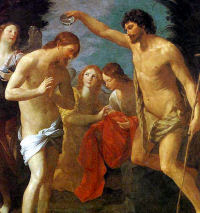
Baptism of Christ by Grigory Gaagarin
The Baptism of the Lord. From Vultus Christi:
Very few Catholics grasp the reality of their divine sonship by adoption. For too many, the great baptismal grace that is divine adoption remains something notional. something vague and, as it were, something obscure in the back of one’s mind. This is why, in every age, God raises up saints, and doctors, and mystics to call us back to what makes Christianity different from every other religion, philosophy, ethical system, and mystical meandering on the planet: divine sonship by adoption. We are, by grace, what Jesus is by nature. All the Fathers taught this. The Doctors scrutinised it and marveled at the divine condescension. Mother Mectilde seized upon this in the 17th century and wrote about it in her letters. Saint Thérèse, Blessed Abbot Marmion, Blessed Elisabeth of the Trinity, and the Venerable Itala Mela, all of these were raised up in modern times to say to souls: You are not mere seekers after wisdom, you are not slaves in submission to a remote divinity, you are not keepers of a moral order; you are sons in the Son. This is so stupendous a mystery that many put it aside and prefer to concentrate on things less unsettling.

We bring Thee offerings, O Lord, for the appearing of Thy new born Son, humbly beseeching Thee that, as He is the author of our gifts, so also He may mercifully receive them. (Secret of the Mass) (Read more.)
(Image source.)

Sunday, January 11, 2026

Baptism of the Lord

Today in America. From Catholic Culture:
And Jesus being baptized, forthwith came out of the water; and lo, the heavens were opened to Him and He saw the Spirit of God descending as a dove, and coming upon Him. And behold a voice from heaven saying, "This is My beloved Son, in Whom I am well pleased."
Jesus stoops so low as to mingle with the multitude of sinners, and forthwith the heavens are opened to magnify Him — He acknowledges Himself worthy of the strokes of divine justice, and behold, the Father declares that He takes all His delight in Him: Humiliavit semetipsom... propter quod et Deus exaltavit illum.
It is at this moment that the mission of Jesus, as One sent by God, is declared authentic. The Father's testimony accredits, so to speak, His Son before the world, and hence this testimony relates to one of the characters of Christ's work as regards ourselves. The mission of Jesus has a double aspect: it bears at the same time the character of redemption and of sanctification. It is to redeem souls, and, this done, to infuse life into them. That is the whole work of the Savior.Christ in His Mysteries by Dom Columba Marmion (Read more.)

Tuesday, January 6, 2026

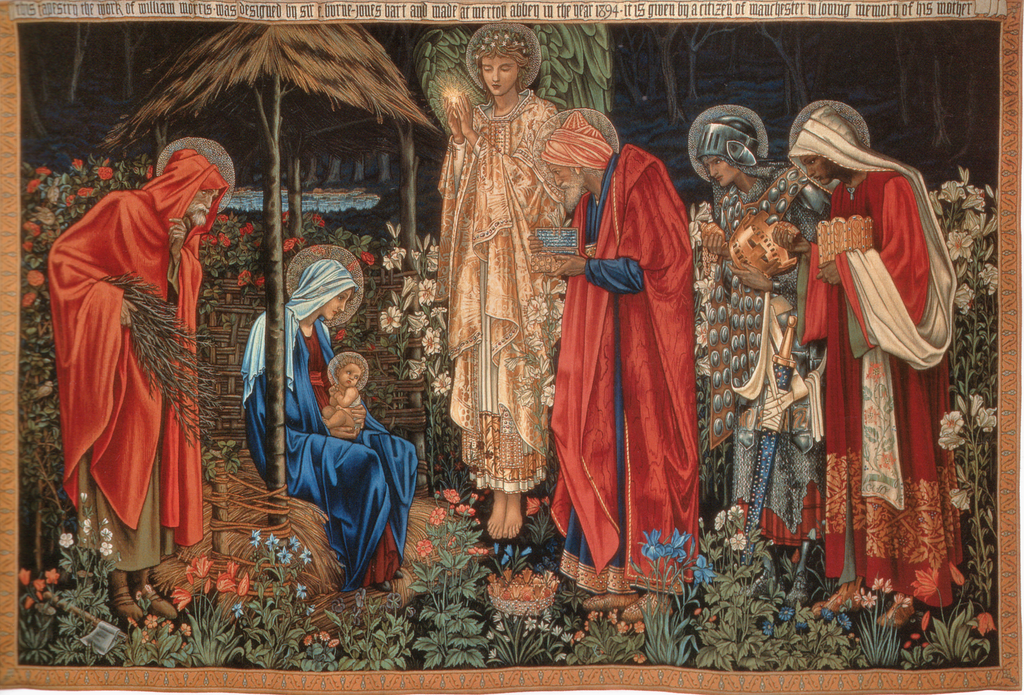
Epiphany of the Lord

 Arise, be enlightened, O Jerusalem: for thy light us come....And the gentiles shall walk in thy light, and kings in the brightness of thy rising....All they from Saba shall come, bringing gold and frankincense, and showing forth praise to the Lord. (Isaias 60, 1-6)
Here is a quote on the Epiphany from Fr. Gabriel of St. Mary Magdalen's Divine Intimacy:
A star often appears in the heaven of our souls; it is the inspiration from God, clear and intimate, urging us to greater generosity and calling us to a life of closer union with Him. Like the Magi, we too must always follow our star with faith, promptness and selfless generosity. If we allow it to guide us, it will certainly lead us to God; it will bring us to the One whom we are seeking.
The Magi did not give up their quest, although the star- at one point- disappeared from their sight. We should follow their example and their perseverance, even when we are in interior darkness. This is a trial of faith which is overcome only by the exercise of pure, naked faith. I know that He wills it, I know that God is calling, and this suffices for me: Scio cui credidi et certus sum (2 Timothy 1:12); I know whom I have believed. No matter what happens, I shall trust Him. (Divine Intimacy, pp. 122-123)

Abbot Gueranger discusses the mystery of the Magi, HERE
.


(Artwork:
Journey of the Magi, 1902 by James Tissot)

Epiphany: the Festival of Adoration

From Fr. Mark:
When a soul perceives the light of Christ, that soul is compelled to adore. Thus do we hear in the Holy Gospel: “And entering into the house, they found the child with Mary his mother, and falling down they adored him.” (Matthew 2:11).

There are, if you will, three moments in the grace of adoration. The first of these is the perception of the light. To see the light of Christ one must enter into the house that is the Church; from the outside, it appears, to some, small and, perhaps, confining. But when one enters the house of the Church, one discovers, from within, that it is immensely spacious. The Church is the place of the Divine Hospitality on earth. Not only is their room in the house of the Church for all; there is also pure water for cleansing; oil for the healing of every infirmity; and a banquet made ready with the living Bread come down from heaven, and with the joy-giving chalice of Christ’s Precious Blood.

The house of the Church is Mary’s house. Therein she is Mother: Mother, not only of Christ the Head, the Infant nourished at her breast, but also of the members of the Body of Christ, from the least to the greatest, all of whom she draws to her Immaculate Heart. Mary’s Virgin Body is the radiant monstrance of the Body of Christ; she holds Him in such a way as to show Him to us. She says to every soul who enters the house of the Church, “Arise, be enlightened, for thy light has come, and the glory of the Lord has risen upon thee.” (Isaiah 60:1).

The light that illumines Mary’s house, the house of the Church, shines from the adorable Body of Christ in the Most Holy Sacrament of the Altar. How can one open one’s eyes to the radiant Body of Christ, exposed in what Mother Mectilde de Bar called the soleil (sun) of the monstrance, and not see the fufilment of the words of the prophet Malachy? “The Sun of justice shall arise, and health — meaning healing and wholeness — in his wings” (Malachy 4:2)

The second moment in the grace of adoration is to fall down as it is written in the Gospel: “and falling down they adored him” (Matthew 2:11). What is this mysterious falling down? It is a response to the brightness of the Light; it is the first movement of one who would adore. To fall down is to attempt to become level with the ground. It is the expression of a profound desire to become very little, very lowly. It is an attempt to say with one’s whole body, that one would wish to be able to pour oneself out, to break oneself open, to allow one’s essence to be spent to the last molecule, like the precious perfume that flowed from the vase of alabaster, filling the whole house with its fragrance (John 12:3). This is what Mother Mectilde of the Holy Sacrament means when she speaks of anéantissement, and when she makes it the very condition of adoration in spirit and in truth. (Read more.)

Monday, January 5, 2026

Epiphany Eve

It is the Twelfth Night. Tomorrow in Rome the Holy Father will be celebrating the Solemnity of the Epiphany of the Lord. In the U.S.A. we celebrated the great manifestation of Our Lord to the nations yesterday. In the meantime, Fish Eaters has a splendid article about Epiphany Eve.
 The Eve of the Feast of the Epiphany is the twelfth day of Christmas, and tonight is known as"Twelfth Night" (or "Twelfthnight"). It begins the celebration of Christ's revealing His Divinity in three ways, which is formally celebrated tomorrow:
  • to the Magi who, guided by the great and mysterious Star of Bethlehem, came to visit Him when He was a Baby (Matthew 2:1-19)
     
  • through His Baptism by St. John, when "the Spirit of God descending as a dove" came upon Him and there was heard a voice from Heaven saying, "This is my beloved Son, in whom I am well pleased" (Matthew 3, Mark 1, Luke 3, John 1), and all Three Persons of the Most Holy Trinity were manifest (Note: the Baptism of Our Lord is also commemorated on the 13th of January)
     
  • through His first public miracle -- that of the wedding at Cana when Our Lord turned water into wine at the request of His Mother (John 2). Just as God's first miracle before the Egyptian pharaoh, through Moses, was turning the waters of the Nile into blood, Our Lord's first miracle was turning water into wine.

In many Catholic homes (especially Italian ones), it's not Christmas Day that is for giving presents to children, but the Feast of Epiphany, when the gifts are given in a way related to the Magi. So today will have a "feel" of Christmas Eve, and because of the Epiphany's association with the Magis' gift-giving, tomorrow is often referred to colloquially as the "Little Christmas."

It is today that the Three Kings should reach the creche (heretofore, they should be kept away from it) and that Baby Jesus should be adorned with signs of royalty, such as a crown, ermine, and gold or purple cloth. Set up golden candlesticks around the manger where He lies.

Friday, January 2, 2026

The Holy Name of Jesus

From New Advent:
We give honour to the Name of Jesus, not because we believe that there is any intrinsic power hidden in the letters composing it, but because the Name of Jesus reminds us of all the blessings we receive through our Holy Redeemer. To give thanks for these blessings we revere the Holy Name, as we honour the Passion of Christ by honouring His Cross (Colvenerius, "De festo SS. Nominis", ix). At the Holy Name of Jesus we uncover our heads, and we bend our knees; it is at the head of all our undertakings, as the Emperor Justinian says in his law-book: "In the Name of Our Lord Jesus we begin all our consultations". The Name of Jesus invoked with confidence
  • brings help in bodily needs, according to the promise of Christ: "In my name They shall take up serpents; and if they shall drink any deadly thing, it shall not hurt them: they shall lay their hands upon the sick, and they shall recover". (Mark 16:17-18) In the Name of Jesus the Apostles gave strength to the lame (Acts 3:6; 9:34) and life to the dead (Acts 9:40).
  • It gives consolation in spiritual trials. The Name of Jesus reminds the sinner of the prodigal son's father and of the Good Samaritan; it recalls to the just the suffering and death of the innocent Lamb of God.
  • It protects us against Satan and his wiles, for the Devil fears the Name of Jesus, who has conquered him on the Cross.
  • In the Name of Jesus we obtain every blessing and grace for time and eternity, for Christ has said: "If you ask the Father anything in my name he will give it you." (John 16:23) Therefore the Church concludes all her prayers by the words: "Through Our Lord Jesus Christ", etc.
So the word of St. Paul is fulfilled: "That in the name of Jesus every knee should bow, of those that are in heaven, on earth, and under the earth" (Philippians 2:10).

The devotion to the Holy Name of Jesus is linked to the Holy Face devotion, HERE.

Thursday, January 1, 2026

Octave-day of Christmas

It is the Solemnity of Mary, the Mother of God.
Your blessed and fruitful virginity is like the bush, flaming yet unburned, which Moses saw on Sinai. Pray for us, Mother of God. (Antiphon for Vespers of January 1)
We recall that on the eighth day after His birth, Our Lord shed His first drops of blood for the redemption of the world. 

Wednesday, December 31, 2025

Happy New Year!

As Saint Thérèse of the Child Jesus said, "As this year has gone, so our life will go, and soon we shall say 'it is gone.' Let us not waste our time; soon eternity will shine for us."

Tuesday, December 30, 2025

What Child is This?

From the late Father Angelus Shaughnessy:
This child is God.

Our Heavenly Father knows how hard it is for us to love somebody we cannot get our arms around. We are supremely happy because our God did become a little bundle of 7 or 8 pounds, so we could get our arms around His Divine Son, to hold Him tight and love Him right.

God is Love! Jesus is Love wrapped in flesh for keeps, forever, for all eternity...to teach us how to love. He came with the irresistible charm of a snuggling infant. His argument still challenges: I loved you first, love me back! He would do anything to get our love, to steal our hearts, even to sneak out of heaven to do so. The only thing this Baby-God would have done more to show His love happened 33 years later: those limbs now fully grown, pinned back to the wood of the cross. You see: He came into this world not to live (He already had life from all eternity) but to die -- for each one of us. He is Jesus, our Saviour.

For us who really believe this Christmas message, every other story about Him is almost easy to believe. Just think what Christmas means: God to become man, Heaven to come down to earth, eternity to invade time, God to take on the human condition (a human soul and a human body) and to keep it even after returning to heaven at His Ascension, in a glorified yet human state. (Read more.)

Monday, December 29, 2025

"The Holy Blissful Martyr"


Today is the feast of St. Thomas Becket, who was killed not by pagans but by his own Catholic brethren. To quote:
A strong man who wavered for a moment, but then learned one cannot come to terms with evil, and so became a strong churchman, a martyr, and a saint—that was Thomas Becket, archbishop of Canterbury, murdered in his cathedral on December 29, 1170. His career had been a stormy one. While archdeacon of Canterbury, he was made chancellor of England at the age of 36 by his friend King Henry II. When Henry felt it advantageous to make his chancellor the archbishop of Canterbury, Thomas gave him fair warning: he might not accept all of Henry’s intrusions into Church affairs. Nevertheless, in 1162 he was made archbishop, resigned his chancellorship, and reformed his whole way of life!

Troubles began. Henry insisted upon usurping Church rights. At one time, supposing some conciliatory action possible, Thomas came close to compromise. He momentarily approved the Constitutions of Clarendon, which would have denied the clergy the right of trial by a Church court and prevented them from making direct appeal to Rome. But Thomas rejected the Constitutions, fled to France for safety, and remained in exile for seven years. When he returned to England he suspected it would mean certain death. Because Thomas refused to remit censures he had placed upon bishops favored by the king, Henry cried out in a rage, “Will no one rid me of this troublesome priest!” Four knights, taking his words as his wish, slew Thomas in the Canterbury cathedral. (Read more.)

Sunday, December 28, 2025

Feast of the Holy Family

St. Joseph most obedient. To quote:
Look closely at the obedience of Saint Joseph, his obedience in the dark night of faith. Joseph’s obedience allows the whole mystery of Israel — the going down into Egypt and the back up — to be revealed and completed in Christ. In some way the “Do this in memory of me” (Lk 22:19) of the Last Supper is made possible by Joseph’s obedience to the commandments delivered to him in the night.
Twice Saint Joseph obeys the word of the angel who visits him by night. Twice Saint Matthew uses the very same formula to evoke the obedience of Saint Joseph: “And Joseph rose and too the child and his mother by night, and departed to Egypt” (Mt 2:14); and again, “And he rose and took the child and his mother and went into the land of Israel” (Mt 2:21).
 Where is the source of Saint Joseph’s obedience? Is it in the word of the Angel? The Angel appears in a dream. Is anything more fleeting than a dream? If we remember our dreams at all in the morning, we do so in a vague and hazy way. Rarely do we find in our dreams the strength to make great changes in our lives. Dreams may sow suggestions in the imagination; rarely do we translate them into action, especially when they ask of us what Saint Benedict calls “things that are hard and repugnant to nature in the way to God” (RB 58:8).

Holy Innocents (Childermas)


Hail, martyr flowers!
On the very threshold of your life
Christ's persecutor destroyed you,
As a whirlwind does the budding roses.
~
Salvete flores martyrum
According to Butler's Lives:
Our Divine Redeemer was persecuted by the world as soon as he made his appearance in it. For he was no sooner born than it declared war against him. Herod, in persecuting Christ, was an emblem of Satan and of the world. That ambitious and jealous prince had already sacrificed to his fears and suspicions the most illustrious part of his council, his virtuous wife Mariamne, with her mother Alexandra, the two sons he had by her, and the heirs to his crown, and all his best friends. Hearing from the magians who were come from distant countries to find and adore Christ that the Messias, or spiritual king of the Jews, foretold by the prophets, was born among them, he trembled lest he was come to take his temporal kingdom from him. So far are the thoughts of carnal and worldly men from the ways of God, and so strangely do violent passions blind and alarm them. The tyrant was disturbed beyond measure and resolved to take away the life of this child, as if he could have defeated the decrees of heaven. He had recourse to his usual arts of policy and dissimulation, and hoped to receive intelligence of the child by feigning a desire himself to adore him. But God laughed at the folly of his short-sighted prudence, and admonished the magians not to return to him. St. Joseph was likewise ordered by an angel to take the child and his mother, and to fly into Egypt. Is our Blessed Redeemer, the Lord of the universe, to be banished as soon as born....(Read more.)
Fr. Mark writes of the Passion of the Infant Christ, HERE. To quote:
I can never celebrate this feast of the Holy Innocents without returning to a book written many years ago by Caryll Houselander: The Passion of the Infant Christ. Writing in London during the Second World War — literally “under the bombs” — she was inspired to speak of the Passion of the Infant Christ. Seeing the sufferings of her own life and of those she loved with the pure vision of one become a child in Christ, she recognized in both cradle and cross wood hewn from the same tree.
The way to begin the healing of the wounds of the world is to treasure the Infant Christ in us; to be not the castle but the cradle of Christ, and in rocking that cradle to the rhythm of love, to swing the whole world back into the beat of the Music of Eternal Life. It is true that the span of an Infant’s arms is absurdly short; but if they are the arms of the Divine Child, they are as wide as the reach of the arms on the cross; they embrace and support the whole world; their shadow is the noonday shade for its suffering people; they are the spread wings under which the whole world shall find shelter and rest (Caryll Houselander, The Passion of the Infant Christ).
Houselander understood that nothing of the paschal mystery of Christ is locked in an irretrievable past. The liturgy is the passion of the Infant Christ made present to us and for us, here and now, in all its fullness. Are you in Egypt, “groaning under bondage” (Ex 2:23), learning to pray in suffering? Are you wandering in a desert waste, tortured by hunger and thirst, a prey to temptations and terrors of the night? Have you crossed over into that good and broad land where milk and honey flow? Through the Holy Sacrifice of the Mass the Infant Christ is with you, his prayer in yours, and yours in his: a prayer that says “Yes” to the wood of the cradle, to the wood of the Cross, and to everything that lies in between. (Read more.)
On Childermas. From Dr. Eleanor Parker at A Clerk of Oxford:
Medieval writers were honest and clear-eyed about such uncomfortable truths. The idea that thoughts like these are incongruous with the Christmas season (as you often hear people say about the Holy Innocents) is largely a modern scruple, encouraged by the comparatively recent idea that Christmas is primarily a cheery festival for happy children and families. Our images of Christmas joy, both secular and sacred, are all childlike wonder and picture-perfect families gathered round the tree. And this is nice, of course, for those who have children or happy families, but for those who don't - those who have lost children or parents or others dear to them, those who face loneliness or exclusion, those who want but don't have children, family, or home - it can be intensely painful. Not everyone can choose not to think about grief at Christmas; many people will find it intrudes upon them, whether they wish it to or not. 'In sorrow endeth every love but thine, at the last'. The modern version of Christmas tends to sideline and ignore that pain, asking it to at least keep quiet so as not to spoil the 'magic'. But that's not the case with medieval writing about Christmas and the Christ-child. There are, of course, many merry and joyful medieval carols, and the season was celebrated in the Middle Ages with great enthusiasm; but there are also many carols like this which are serious, melancholy, and sad, which acknowledge the fact that the child whose birth is celebrated came to earth to die. Older writings on Christmas, like this lullaby, do not exclude but encompass human pain - it's that pain, they say, which Christ has come to earth to share. The idea is well expressed by John Donne, writing a little later than the medieval period (though only a few decades after the Coventry mystery plays were abolished), in a sermon he preached on Christmas Day 1626:
The whole life of Christ was a continual passion; others die martyrs, but Christ was born a martyr. He found a Golgotha, where he was crucified, even in Bethlehem, where he was born; for, to his tenderness then, the straws were almost as sharp as the thorns after; and the manger as uneasy at first, as his cross at last. His birth and his death were but one continual act, and his Christmas Day and his Good Friday are but the evening and morning of one and the same day.
(Read more.)

Saturday, December 27, 2025

St. John's Day

The love of things invisible. (From Vultus Christi.)
The Johannine chorus speaks with the unmistakable authority of those who have gone into the wine-cellar and rested beneath the banner of love (cf. Ct 2:4-5). Their breath is fragrant with honey and with the honeycomb, of wine and of milk: that is with the imperishable sweetness of the Holy Spirit, with the Blood of the Lamb and with the pure milk of the living Word of God. These are the ones who have eaten and drunk, drunk deeply (cf. Ct 5:1) of the streams of living water that flow ever fresh from the pierced Heart of the Bridegroom (cf. Jn 7:37-38). These are the descendants of Saint John the Beloved, those to whom the Father has given the eagle’s vision, those who are little enough and poor enough to be borne aloft and carried away into the “love of things invisible,” as the Christmas Preface puts it. (Read more.)

Friday, December 26, 2025

St. Stephen the First Martyr


"Lord Jesus, receive my spirit!" From Scott Richert:
Not much is known about Saint Stephen's origin. He is first mentioned in Acts 6:5, when the apostles appoint seven deacons in order to minister to the physical needs of the faithful. Because Stephen is a Greek name (Stephanos), and because the appointment of the deacons occurred in response to complaints by Greek-speaking Jewish Christians, it is generally assumed that Stephen was himself a Hellenist. However, a tradition arising in the fifth century claims that Stephen's original name was Kelil, an Aramaic word that means "crown," and he was called Stephen because Stephanos is the Greek equivalent.
In any case, Stephen's ministry was conducted among Greek-speaking Jews, some of whom were not open to the Gospel of Christ. Stephen is described in Acts 6:5 as "full of faith, and of the Holy Ghost" and in Acts 6:8 as "full of grace and fortitude," and his talents for preaching were so great those Hellenist Jews who disputed his teaching "were not able to resist the wisdom and the spirit that spoke" (Acts 6:10).
Unable to combat Stephen's preaching, his opponents found men who were willing to lie about what Saint Stephen taught, to claim that "they had heard him speak words of blasphemy against Moses and against God" (Acts 6:11). In a scene reminiscent of Christ's own appearance before the Sanhedrin (cf. Mark 14:56-58), Stephen's opponents produced witnesses who claimed that "we have heard him say, that this Jesus of Nazareth shall destroy this place [the temple], and shall change the traditions which Moses delivered unto us" (Acts 6:14). (Read more.)


Thursday, December 25, 2025

Merry Christmas!

Scrolling through Facebook on Christmas is incredibly inspiring as I see people all over the world celebrating the birthday of the Child born in Bethlehem 2000 years ago. No king or queen who ever lived ever had their birthday celebrated for so long and by so many. And in spite of every evil hell could invent, this Day is still celebrated with so much joy, especially by the children and by the young at heart. Merry Christmas and a Happy New Year!

Welcome, all wonders in one sight!

       Eternity shut in a span;

Summer in winter; day in night;

       Heaven in earth, and God in man.

Great little one, whose all-embracing birth

Lifts earth to heaven, stoops heav’n to earth.

 ~  from "In the Holy Nativity of Our Lord" by Richard Crashaw

"The Burning Babe"


The poem by St. Robert Southwell.
As I in hoary winter’s night stood shivering in the snow,
Surprised I was with sudden heat which made my heart to glow;
And lifting up a fearful eye to view what fire was near,
A pretty babe all burning bright did in the air appear;
Who, scorchéd with excessive heat, such floods of tears did shed
As though his floods should quench his flames which with his tears were fed.
Alas, quoth he, but newly born in fiery heats I fry,
Yet none approach to warm their hearts or feel my fire but I !
My faultless breast the furnace is, the fuel wounding thorns,
Love is the fire, and sighs the smoke, the ashes shame and scorns ;
The fuel justice layeth on, and mercy blows the coals,
The metal in this furnace wrought are men’s defiléd souls,
For which, as now on fire I am to work them to their good,
So will I melt into a bath to wash them in my blood.
With this he vanished out of sight and swiftly shrunk away, And straight I calléd unto mind that it was Christmas day.


Wednesday, December 24, 2025

The Three Masses of Christmas

When speaking of Holy Communion in the Way of Perfection (Ch. 34), St. Teresa of Avila said: "This is something that is happening now." In the Christmas liturgy, the Church teaches us that the birth of Jesus is not just something that happened two thousand years ago in Bethlehem. Our Lord's nativity is something that is happening now, especially through participation in the Mass, and in the liturgy of the hours which radiate from it. In The Church's Year of Grace, Fr. Pius Parsch explains that this is why the word hodie or "today" is repeated again and again in the Christmas Masses and offices. The Invitatory for December 24 proclaims: "Today you will know the Lord is coming, and in the morning you will see His glory." We are called to Midnight Mass with this antiphon: "The Lord said to me: You are my Son. Today I have begotten you." At Morning Prayer (Lauds) we say: "Today the Savior of the world is born for you." The antiphon for the Canticle of Mary closes the most joyful of feasts with the words: "Christ the Lord is born today; today the Savior has appeared...."

Dom Gueranger comments: "...This today is the Day of eternity, a Day which has neither morning nor evening, neither rising nor setting." (The Liturgical Year, Vol. II) Through the sacraments, especially through the Eucharistic sacrifice, we already belong to that Day of eternity. At Christmas Mass, we truly and mystically assist at His birth.

Christmas is celebrated with three Masses. At Midnight Mass, the angels marvel at the Word made flesh, born of the Virgin Mary. The Dawn Mass sees the shepherds hurrying to the stable to adore the newborn King. The third Mass celebrates the Eternal Word, Who is the Son begotten of the Father from all eternity.
Jesus, Who is born tonight, is born thrice. He is born of the Blessed Virgin, in the stable of Bethlehem; he is born by grace, in the hearts of the shepherds, who are the first fruits of the Christian Church; and He is born from all eternity in the bosom of the Father, in the brightness of the saints: to this triple birth, therefore, let there be the homage of a triple Sacrifice! (Dom Gueranger, The Liturgical Year, Vol. II)

Christmas Eve


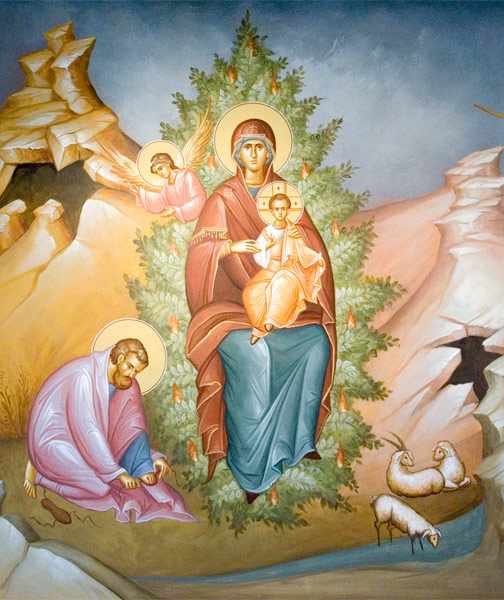
Today you will know the Lord is coming, and in the morning you will see His glory. ~Invitatory Antiphon for December 24. (Thanks to Karen for the picture.)

The Christmas Martyrology.
In the five thousand one hundred and ninety-ninth year of the creation of the world from the time when God in the beginning created the heavens and the earth;
the two thousand nine hundred and fifty-seventh year after the flood;

the two thousand and fifteenth year from the birth of Abraham;
the one thousand five hundred and tenth year from Moses and the going forth of the people of Israel from Egypt;
the one thousand and thirty-second year from David's being anointed king; in the sixty-fifth week according to the prophecy of Daniel;
in the one hundred and ninety-fourth Olympiad;
the seven hundred and fifty-second year from the foundation of the city of Rome;
the forty second year of the reign of Octavian Augustus;
the whole world being at peace,
in the sixth age of the world, Jesus Christ the eternal God and Son of the eternal Father, desiring to sanctify the world by his most merciful coming, being conceived by the Holy Spirit, and nine months having passed since his conception, was born in Bethlehem of Judea of the Virgin Mary, being made flesh.
Listen to the Christmas martyrology chanted by the Benedictines of Mary.

Tuesday, December 23, 2025

O Emmanuel

O Emmanuel, our King and Lawgiver, the Expectation and Savior of the nations! come and save us, O Lord our God!
Fr. Mark's commentary is here:
O Virgo Virginum

O Virgo Virginum, the last of the Great O Antiphons in the old English liturgy of Sarum , occurs on December 23rd. Its structure is quite different from all the other Great O Antiphons. The first part is a question addressed to the Virgin Mary; in the second part she replies with another question, and then, gives her answer.
O Virgin of virgins, how shall this be?
For neither before thee was any like thee, nor shall there be after.
Daughters of Jerusalem, why marvel ye at me?
That which ye behold is a divine mystery.

[...]
Like the six Great O Antiphons that preceded it, O Emmanuel is addressed to our Lord Jesus Christ. It seems to me that, with each succeeding day, the O of our invocation, and the Veni of our supplication has grown more confident, more intense and, in a sense, more urgent.

Afraid Never Again
Writing in 1964, Mother Marie des Douleurs Wrotnowska, the foundress of the Congregation of Benedictines of Jesus Crucified, offers us a somewhat anguished meditation on the Great Antiphon O Emmanuel. It appears to come out of an experience of weakness, fear, and uncertainty. Some would dismiss it as deeply pessimistic and too gloomy for Advent. I sense something else in it: the prayer of woman wrestling with her inner demons, as we all do, and confident nonetheless in the mystery of God-with-us. This is what she wrote:
Emmanuel. Could we have found a name more sweet? God-with-us. That is to say that nothing in our difficulties, our misunderstandings, our sorrows, even in our agony, will find us alone. We will always have Someone with us, Someone present in our very heart to give the strength and light necessary in those moments.
Also, at the same time, our Beloved is always before us. He is the All-Powerful and He wants that we should be saints, all of us. Therefore, we never again need to be afraid. We can be certain that, should it be called for, even heroism is within our reach because our Companion on the road, our daily Food, is always there. We know that He is in us and we know what He asks of us. We know to what degree of detachment and to what gift of self He calls us. We know to what point we must be found holy at the moment of our death.

 (Read more.)


 Now all is fulfilled....Ecce completa sunt omnia....(Lauds of December 23)

At the completion of the O Antiphons, we reflect on the acrostic ERO CRAS, which means "Tomorrow I shall come" or "Tomorrow I shall be."


Related Posts with Thumbnails