Showing posts with label Charles Coulombe. Show all posts

Tuesday, October 13, 2026

Novena to Blessed Karl of Austria


In honor of the holy Emperor's feast on October 21.
O Blessed Emperor Karl, you accepted the difficult tasks and burdensome challenges that God gave you during your life. In every thought, decision and action you trusted always in the Holy Trinity. We pray to you to intercede for us with the Lord our God to give us faith and courage, so that even in the most difficult situations of our earthly lives we may not lose heart, but continue faithfully in the footsteps of Christ. Ask for us the grace that our hearts may be moulded into the likeness of the Sacred Heart of Jesus. Help us to work with compassion and strength for the poor and needy, to fight with courage for peace in our homes and in the world, and in every situation to trustingly place our lives in the hands of God, until we reach Him, as you did, through Christ our Lord.
Amen.


On Blessed Karl's surprising connection to Fatima, HERE. From Archduke Ferdinand, HERE

Wednesday, September 30, 2026

The Politics of Michaelmas

Saint Michael in the Catholic Church - Wikipedia 

 From Charles Coulombe at One Peter Five:

There is a great deal of disinformation about to-day regarding angels in general and St. Michael in particular (whom the Jehovah’s Witnesses believe to be Jesus Christ before His Incarnation).  So before looking more closely into our topic, let us let Dom Guéranger guide us through this fascinating realm of Angelology, in his account of Michaelmas:

The glorious Archangel appears today at the head of the heavenly army: There was a great battle in heaven, Michael and his angels fought with the dragon, and the dragon fought and his angels. In the sixth century, the dedication of the churches of St. Michael on Monte Gargano and in the Roman Circus increased the celebrity of this day, which had however been long before consecrated by Rome to the memory of all the heavenly Virtues.

The east commemorates on the sixth of September an apparition of the victorious Prince at Chone (ancient Collossæ) in Phrygia; while the eighth of November is the solemnity of the angels, corresponding to our feast of today, and bearing the title: “Synaxis of Saint Michael prince of the heavenly host, and of the other spiritual Powers.” Although the term synaxis is usually applied only to religious assemblies here on earth, we are informed that in this instance it also signifies the gathering of the faithful angels at the cry of their chief, and their union eternally sealed by their victory.

Who, then, are these heavenly Powers, whose mysterious combat heads the first page of history? Their existence is attested by the traditions of all nations as well as by the authority of holy Scripture. If we consult the Church, she teaches us that in the beginning God created simultaneously two natures, the spiritual and the corporal, and afterwards man who is composed of both. The scale of nature descends by gradation from beings made to the likeness of God, to the very confines of nothingness; and by the same degrees the creature mounts upwards to his Creator. God is infinite being, infinite intelligence, infinite love. The creature is forever finite: but man, endowed with a reasoning intellect, and the angel, with an intuitive grasp of truth, are ever, by a continual process of purification, widening the bounds of their imperfect nature, in order to reach, by increase of light, the perfection of greater love.

(Read more.)


Thursday, July 2, 2026

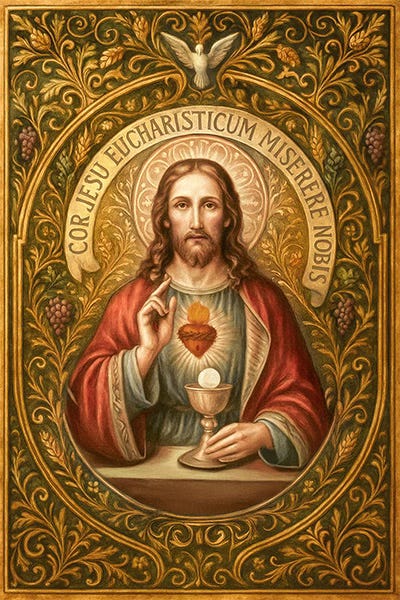
The Challenge of the Eucharistic Heart of Jesus

Corpus Christi and the Sacred Heart of Jesus - by Fr. AM 

 From 1P5:

Starting in the 12th century, there began what I like to call the Eucharistic Revolution. It began with Hildebert of Lavardin coining the word “Transubstantiation.” Then began the penning of stories about the Holy Grail; not very reliable as a source of history, they nevertheless incorporate stories of Eucharistic Miracles that would repeatedly occur in real life down to – especially in – our time. During the period they grew in popularity in the 13th century, Transubstantiation was defined as the best way to describe what happens at the Mass, and St. Juliana of Cornillon had her visions which led to the great feast of Corpus Christi. This turn led to the growth of Eucharistic processions, adoration, and much more. But in 1199, Christ appeared to St. Lutgarde of Saint-Trond. This is the first medieval apparition of the Sacred Heart passed down to us through Tradition.

At the same time, devotion grew to Our Lord’s Five Wounds, and their connection to the Eucharist was not unnoticed – after all, it was the same blood that came down daily upon each Altar, was reappearing in miracles (sometimes bleeding from hosts and at others from images of Our Lord), and relics of which were being brought back along a great many others from the Holy Land and Constantinople, thanks to the Crusades. Ss. Gertrude the Great and Mechtilde – both in the Abbey of Helfta, received visions of the Sacred Heart, and St. Bonaventure, and a great many other preached about this Heart and the Blood that flowed from it.

When the Protestant Revolt broke out, the Pilgrims of Grace in England marched against the King’s men under the banner of the Five Wounds. St. Ignatius of Loyola in his Anima Christi Prayer united all elements of devotion to Christ – and St. Peter Canisius spoke frequently of Christ’s Heart and Blood in defence of His Real Presence in the Eucharist; a theme taken up by many Catholic preachers fighting the new heresies. 

[...]

 When the French Revolution broke out in 1789, and drowned that word in fire and blood, the imprisoned Louis XVI privately consecrated the country to the Sacred Heart and vowed to do so publicly if restored to power. This did not happen, as we know. But from the Vendée to Spain to Tyrol, the Sacred Heart became the symbol of Catholic resistance to the revolution. Afterwards, it was a big part of the Catholic Restoration. (Read more.)

Related Posts with Thumbnails