Showing posts with label The Little Flower. Show all posts

Tuesday, February 17, 2026

Shrove Tuesday

Shrove Tuesday is the feast of the Holy Face of Jesus. Don Marco has an excellent meditations on this beautiful devotion. To quote:
Face and Person are synonymous, not only by reason of the Greek etymology, but even more because there is nothing more personal, nothing more precious, nothing dearer than the face of a loved one. The psalmist’s cry, “I long to see Thy Face” (Ps 26:8), is the cry of every lover to his beloved, the cry of child to parent, of parent to child, and of friend to friend. The most poignant moment in the rites of death and burial comes when the face of the deceased is covered for the last time. We cherish photographs of those we love, but what is a photograph without a face? The relationships that we call “heart to heart” never tire of the “face to face.”
The Holocaust that took place during the Second World War was, at the deepest level, an attempt to erase the dignity and uniqueness of each person, a sin against the Face of Christ, the Holy Face mirrored in millions of Jewish faces. Every sin against the dignity of the human person is a sin against the Face of Christ. Every act of violence, irreverence, or scorn directed against the human person is a sin against the Face of Christ. The abortion that prevents a child’s face from seeing another human face in the light of day is a sin against the Face of Christ. Torture and cruel ridicule are sins against the Face of Christ. The hard, stony gaze that looks at a person without seeing him is a sin against the Face of Christ. The eyes that judge, the look that condemns, is a sin against the Face of Christ. The refusal to see Christ in the faces of the sick, the stranger, and the immigrant is a sin against his Holy Face.
Reparation is the prayer that seeks to make whole what is fragmented by putting love where there is no love, by gazing with reverence upon what has been disdained, by allowing our eyes to rest on “One from whom men hide their faces” (Is 53:3). The extraordinary thing about the prayer of reparation is that it is healing not only for the one offended but for the offender as well. If by sin we offend the Face of Christ, by reparation to the Holy Face we are healed of our sins. “Thou has set our iniquities before thee,” says the psalmist, “our secret sins in the light of Thy Face” (Ps 89:8).

The prayer of reparation is most at home in the presence of the Most Blessed Sacrament. The light that shines from the Eucharistic Face of Christ heals us sinners, and heals those against whom we have sinned. The love we bring to the Eucharistic Face of Christ reaches every human face. The prayer of reparation is the veil of Veronica lifted to the face of Christ in His Passion; it is the hand that seeks to wipe away every disfiguring stain of filth, of blood, and of tears. (Read more.)
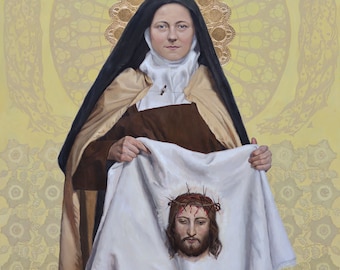
The image to the left is the representation of the imprint of Our Lord's face on the Veronica veil, as it is venerated in the Carmelite Order, and propagated by Sister Marie de Saint Pierre and Venerable Leo Dupont.
 

 Here is the prayer of Saint Thérèse of Lisieux to the Holy Face:
O Jesus, who in Thy bitter Passion didst become "the most abject of men, a man of sorrows," I venerate Thy Sacred Face whereon there once did shine the beauty and sweetness of the Godhead; but now it has become for me as if it were the face of a leper! Nevertheless, under those disfigured features, I recognize Thy infinite Love and I am consumed with the desire to love Thee and make Thee loved by all men. The tears which well up abundantly in Thy sacred eyes appear to me as so many precious pearls that I love to gather up, in order to purchase the souls of poor sinners by means of their infinite value. O Jesus, whose adorable Face ravishes my heart, I implore Thee to fix deep within me Thy divine image and to set me on fire with Thy Love, that I may be found worthy to come to the contemplation of Thy glorious Face in Heaven. Amen.
Another site with everything about the Holy Face devotion is HERE.And more HERE.

Here is a formula from the ancient Ambrosian liturgy, as quoted by Abbot Gueranger in The Liturgical Year for Shrove Tuesday:
Sweet is this present life, but it passes away; terrible, O Christ is thy judgment, and it endures forever. Let us, therefore, cease to love what is unstable, and fix our thought on what is eternal: saying: Christ, have mercy upon us!
Now the time has come to go into the desert, the desert of Lent.

Tuesday, January 13, 2026

We Have Seen the True Light

Baptism of Christ by Grigory Gaagarin
The Baptism of the Lord. From Vultus Christi:
Very few Catholics grasp the reality of their divine sonship by adoption. For too many, the great baptismal grace that is divine adoption remains something notional. something vague and, as it were, something obscure in the back of one’s mind. This is why, in every age, God raises up saints, and doctors, and mystics to call us back to what makes Christianity different from every other religion, philosophy, ethical system, and mystical meandering on the planet: divine sonship by adoption. We are, by grace, what Jesus is by nature. All the Fathers taught this. The Doctors scrutinised it and marveled at the divine condescension. Mother Mectilde seized upon this in the 17th century and wrote about it in her letters. Saint Thérèse, Blessed Abbot Marmion, Blessed Elisabeth of the Trinity, and the Venerable Itala Mela, all of these were raised up in modern times to say to souls: You are not mere seekers after wisdom, you are not slaves in submission to a remote divinity, you are not keepers of a moral order; you are sons in the Son. This is so stupendous a mystery that many put it aside and prefer to concentrate on things less unsettling.

We bring Thee offerings, O Lord, for the appearing of Thy new born Son, humbly beseeching Thee that, as He is the author of our gifts, so also He may mercifully receive them. (Secret of the Mass) (Read more.)
(Image source.)

Wednesday, December 31, 2025

Happy New Year!

As Saint Thérèse of the Child Jesus said, "As this year has gone, so our life will go, and soon we shall say 'it is gone.' Let us not waste our time; soon eternity will shine for us."

Friday, November 28, 2025

Saint Thérèse of the Child Jesus on Purgatory


 On June 9, 1895, at the Carmel of Lisieux, Saint Thérèse made the Act of Oblation to Merciful Love. In her autobiography she said: "I received the grace to understand, more than ever, how much Jesus desires to be loved." Instead of offering herself as victim to the justice of God, as did other religious, taking upon themselves the "punishment reserved for sinners," Saint Thérèse decided to offer herself as a victim to the Merciful Love of God. She asked to be consumed as a holocaust in the fire of the Sacred Heart, in order to console that Heart and save souls. "Fire transforms all things into itself, " the saint wrote in her Act of Oblation. "I know that the fire of love is more sanctifying than the fire of Purgatory."
 

 From Help the Holy Souls:

The common teaching within the Church is that Purgatory can hardly be avoided. While still only a novice, the saint commented about this with one of the sisters,  Sr. Maria Philomena, who believed in the near impossibility of going to heaven without passing through purgatory:

You do not have enough trust. You have too much fear before the good God. I can assure you that He is grieved over this. You should not fear Purgatory because of the suffering there, but should instead ask that you not deserve to go there in order to please God, Who so reluctantly imposes this punishment. As soon as you try to please Him in everything and have an unshakable trust He purifies you every moment in His love and He lets no sin remain. And then you can be sure that you will not have to go to Purgatory.5

She even said that we would offend God if we didn’t trust enough that we would get to heaven right after dying. When she found out that her novices talked occasionally that they would probably have to expect to be in Purgatory, she corrected them saying: “Oh! How you grieve me! You do a great injury to God in believing you’re going to Purgatory. When we love, we can’t go there.”6 Now, this is a new doctrine, but only for those who don’t know God, who are not childlike, who don’t trust. It is so correct to see things this way. It is true that God will judge us at one point, but He is always and first our Father Who… suffers when He has to punish His child and sees its suffering. The child should do His will just out of love, and not to avoid punishment. And this really means that God does not want Purgatory! He allows that His children suffer, but only as if He had to look away.7 (Read more.)


It has come to my attention from perusing Facebook that there is a great deal of confusion about purgatory, especially among Catholics. The EWTN website offers excellent catechesis. To quote St. John Paul II:

According to Old Testament religious law, what is destined for God must be perfect. As a result, physical integrity is also specifically required for the realities which come into contact with God at the sacrificial level such as, for example, sacrificial animals (cf. Lv 22: 22) or at the institutional level, as in the case of priests or ministers of worship (cf. Lv 21: 17-23). Total dedication to the God of the Covenant, along the lines of the great teachings found in Deuteronomy (cf. 6: 5), and which must correspond to this physical integrity, is required of individuals and society as a whole (cf. 1 Kgs 8: 61). It is a matter of loving God with all one's being, with purity of heart and the witness of deeds (cf. ibid., 10: 12f.)

The need for integrity obviously becomes necessary after death, for entering into perfect and complete communion with God. Those who do not possess this integrity must undergo purification. This is suggested by a text of St Paul. The Apostle speaks of the value of each person's work which will be revealed on the day of judgement and says:  "If the work which any man has built on the foundation [which is Christ] survives, he will receive a reward. If any man's work is burned up, he will suffer loss, though he himself will be saved, but only as through fire" (1 Cor 3: 14-15).

3. At times, to reach a state of perfect integrity a person's intercession or mediation is needed. For example, Moses obtains pardon for the people with a prayer in which he recalls the saving work done by God in the past, and prays for God's fidelity to the oath made to his ancestors (cf. Ex 32: 30, 11-13). The figure of the Servant of the Lord, outlined in the Book of Isaiah, is also portrayed by his role of intercession and expiation for many; at the end of his suffering he "will see the light" and "will justify many", bearing their iniquities (cf. Is 52: 13-53, 12, especially vv. 53: 11).

Psalm 51 can be considered, according to the perspective of the Old Testament, as a synthesis of the process of reintegration:  the sinner confesses and recognizes his guilt (v. 3), asking insistently to be purified or "cleansed" (vv. 2, 9, 10, 17) so as to proclaim the divine praise (v. 15).

Purgatory is not a place but a condition of existence

4. In the New Testament Christ is presented as the intercessor who assumes the functions of high priest on the day of expiation (cf. Heb 5: 7; 7: 25). But in him the priesthood is presented in a new and definitive form. He enters the heavenly shrine once and for all, to intercede with God on our behalf (cf. Heb 9: 23-26, especially, v. 24). He is both priest and "victim of expiation" for the sins of the whole world (cf. 1 Jn 2: 2).

Jesus, as the great intercessor who atones for us, will fully reveal himself at the end of our life when he will express himself with the offer of mercy, but also with the inevitable judgement for those who refuse the Father's love and forgiveness.

This offer of mercy does not exclude the duty to present ourselves to God, pure and whole, rich in that love which Paul calls a "[bond] of perfect harmony" (Col 3: 14).

5. In following the Gospel exhortation to be perfect like the heavenly Father (cf. Mt 5: 48) during our earthly life, we are called to grow in love, to be sound and flawless before God the Father "at the coming of our Lord Jesus with all his saints" (1 Thes 3: 12f.). Moreover, we are invited to "cleanse ourselves from every defilement of body and spirit" (2 Cor 7: 1; cf. 1 Jn 3: 3), because the encounter with God requires absolute purity.

Every trace of attachment to evil must be eliminated, every imperfection of the soul corrected. Purification must be complete, and indeed this is precisely what is meant by the Church's teaching on purgatory. The term does not indicate a place, but a condition of existence. Those who, after death, exist in a state of purification, are already in the love of Christ who removes from them the remnants of imperfection (cf. Ecumenical Council of Florence, Decretum pro Graecis:  DS 1304; Ecumenical Council of Trent, Decretum de iustificatione:  DS 1580; Decretum de purgatorio:  DS 1820).

It is necessary to explain that the state of purification is not a prolongation of the earthly condition, almost as if after death one were given another possibility to change one's destiny. The Church's teaching in this regard is unequivocal and was reaffirmed by the Second Vatican Council which teaches:  "Since we know neither the day nor the hour, we should follow the advice of the Lord and watch constantly so that, when the single course of our earthly life is completed (cf. Heb 9: 27), we may merit to enter with him into the marriage feast and be numbered among the blessed, and not, like the wicked and slothful servants, be ordered to depart into the eternal fire, into the outer darkness where "men will weep and gnash their teeth' (Mt 22: 13 and 25: 30)" (Lumen gentium, n. 48).

6. One last important aspect which the Church's tradition has always pointed out should be reproposed today:  the dimension of "communio". Those, in fact, who find themselves in the state of purification are united both with the blessed who already enjoy the fullness of eternal life, and with us on this earth on our way towards the Father's house (cf. CCC, n. 1032).

Just as in their earthly life believers are united in the one Mystical Body, so after death those who live in a state of purification experience the same ecclesial solidarity which works through prayer, prayers for suffrage and love for their other brothers and sisters in the faith. Purification is lived in the essential bond created between those who live in this world and those who enjoy eternal beatitude. (Read more.)


There can be children in purgatory, if they have committed any actual sins after reaching the age of reason and not expiated them on earth. From The New Theological Movement:
Is purgatory in the Bible?
While the word “purgatory” never appears in the Bible, the concept is present both implicitly and explicitly. Implicitly, the idea of praying for the dead – as when Job prays for his sons and daughters, or in Maccabees, or when St. Paul encourages the Corinthians to pray for the dead (cf. 1 Corinthians 15) – necessitates belief in purgatory. If the dead are in hell, our prayers could do no good; if they are in heaven, then they have no need of prayer. Therefore, there must be some third place (neither in heaven nor in hell) where the souls of the dead can benefit from our prayers.
The concept of purgatory is also explicitly presented in the Bible. Consider when Jesus says that the sin of blasphemy against the Holy Spirit cannot be forgiven in this life or in the next (cf. Matthew 12:31) – thus, it is clear that some sins can be forgiven in the next life (we mean the punishment of sin, not the guilt of sin). Likewise, St. Paul states that some who have died will be purified as by fire: If any man's work burn, he shall suffer loss; but he himself shall be saved, yet so as by fire. (1 Corinthians 3:15)
Must I believe in purgatory in order to be saved?
Yes, purgatory has been taught by the Catholic Church as de fide. To deny the existence of purgatory is to deny the authority of Christ Jesus who has revealed this doctrine to us through the Church. Hence, belief in purgatory is as necessary for salvation as the other truths of the Faith.
What is purgatory?
Purgatory is that purification which they must undergo who have died in God’s grace and friendship, but are still imperfect. Purgatory is “this final purification of the elect, which is entirely different from the punishment of the damned.” (CCC 1031) Purgatory is a great and most generous gift from the Lord.
How is purgatory different from hell?
Purgatory is essentially different from hell insofar as the souls there still possess grace. The souls in purgatory have faith, hope and love. Their punishment and suffering is of a purifying nature and prepares them for heaven. Moreover, purgatory is only a temporary purgation and all the souls in purgatory will eventually gain entrance to heaven.
Hell, on the other hand, is eternal. The sufferings of hell do not purify but only torture and punish. The souls in hell have no grace, neither have they any (true) faith, hope or love. The souls in hell will never attain to salvation.
How is purgatory different from heaven?
Purgatory is a sort of ante-chamber to heaven, a preparatory purgation for heaven. The souls in purgatory suffer intensely and are not yet perfectly happy. The souls in purgatory still have hope (rather than the fulfillment of hope in heaven), since they are not yet perfectly possessed by God. Likewise they still have faith, since they do not yet see God.
Do the souls in purgatory become holier?
Essentially, the souls in purgatory cannot grow in holiness. They cannot merit more grace or glory. Neither can they grow in charity. Rather, purgatory is a cleansing which purifies the holiness that they already possess.
Do the souls in purgatory want to get out?
This is a difficult question. On the one hand, they certainly desire heaven (this desire is cause of their chief pain, since they are not yet where they want to be). On the other hand, they would not want to move ahead without being purified. Hence, they love the sufferings insofar as they are purified by them. None are angry or upset about being in purgatory, but they do very much desire the assistance of our prayers so as to swiftly attain to the joy of heaven.
Are there any young children in purgatory?
No, there are most certainly no children who died before the age of reason in purgatory. Purgatory is a punishment for actual sin (either direct sins or sins of omission). Hence, since a child cannot sin until it has attained to the use of reason, it is not possible for any children to be in purgatory.
If the child has been baptized, it most certainly goes directly to heaven. If the child has not been baptized, it either goes to limbo (which is a state of perfect natural happiness, on the fringe of hell) or to heaven.
In any case, young children who die before gaining the use of reason are very happy, indeed they are perfectly happy. They are either supernaturally happy in heaven, or naturally happy in limbo – but they certainly do not suffer any subjective pains (as do the souls in hell and in purgatory).
Will purgatory go on forever?
No. Purgatory will be completed at the time of the final judgment. All the souls in purgatory at that time will be purified instantaneously and will be caught up with the saints in glory.
Is there really fire in purgatory?
Yes. There is real, physical fire in purgatory. This is the best and safest opinion which is nearly unanimous among the Latin theologians (especially the Fathers and Doctors), also it enjoys the favor of several prominent Eastern Doctors (including St. Basil the Great). Additionally, the mystics of the Church speak of physical fires.
It is in this sense only that purgatory can be called a “place”.
How can I help the souls in purgatory?
You can help the poor souls by praying for them, offering up works of mercy, gaining indulgences for them, mortifying yourself in their behalf, and completing other spiritual works for their sake. [Be sure that no prayer will go to waste; since, if the soul is not in purgatory (for one reason or another), Our Blessed Mother will certainly make good use of the graces for another]
Most especially, we consider the importance of praying for the holy souls when at Mass (especially during the Eucharistic prayer), and having Masses offered for the deceased.
Can the souls in purgatory help me?
This is a very complicated question. Generally we would say, no. The main point of purgatory is that the souls cannot help themselves or anyone else, but are in a passive state of purification. They are powerless, hence they rely greatly upon our prayers.
However, it is possible that God may (in exceptional circumstances) allow those in purgatory to pray for or assist in some manner those who are on earth and who implore their aid. Still, this does not seem to be the norm – however, there are most certainly cases in the lives of the saints (e.g. St. Pio) where this did occur. (Read more.)
Friday, November 14, 2025

All Carmelite Saints

"With zeal have I been zealous for the Lord God of Hosts." ~3 Kings 19:10

Today the Carmelite Order commemorates the members of our Order who have ascended the mountain of perfection to their heavenly home. They sought God alone, conversing with Him in the depths of their hearts. Our Lord once said to the Holy Mother St. Teresa: "I desire that you no longer hold conversation with men, but with angels," and in many ways those words can be applied to all who follow the Carmelite way. The habits of the interior life, of recollection and mortification, must be cultivated amid our daily duties in order to create an atmosphere conducive to contemplation. In the Rule of St. Albert, the medieval hermits were told: "In silence and hope shall your strength be." (Isaias 30:15) During the theophany on Mt. Horeb, Elias the prophet experienced the Lord God, not in the earthquake, or in the fire, but in a "whistling of gentle air." (3 Kings 19:12) It is in silence and solitude that generations of Carmelites have sought to live in imitation of Elias, "meditating day and night on the law of the Lord and watching in prayer." (Rule of St. Albert)

The primary example of the saints and blessed of the Order has been Our Lady, the Queen and Beauty of Carmel, both in her hidden life at Nazareth and in her anguish at the foot of the Cross. St. Teresa enjoined her nuns to meditate on the lives of Christ's Mother, and His saints. "We need to cultivate and think upon and seek the companionship of those who, though living on earth like ourselves, have accomplished such great deeds for God." (The Interior Castle, p.172)

Speaking particularly of the hermits of old, the Holy Mother exhorts her daughters in The Way of Perfection:
Let us remember our holy fathers of the past, those hermits whose lives we aim to imitate. What sufferings they endured! What solitude, cold, hunger, and what sun and heat, without anyone to complain to but God! Do you think that they were made of steel? Well, they were as delicate as we. (The Way of Perfection, p.81)

Tuesday, November 11, 2025

Martinmas


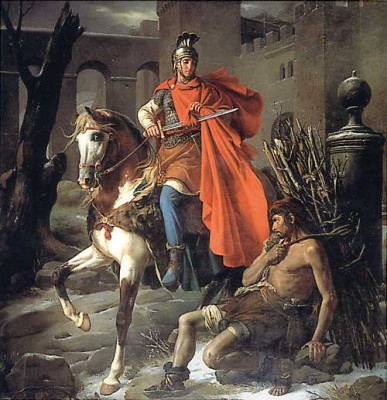
It is the feast of St. Martin of Tours, the great thaumaturgus who converted large parts of France. The cloak of St Martin was one of the most precious relics of France, borne before her armies, hence the word chape gave rise to our English words "chaplain" and "chapel." St. Martin spoke out against capital punishment for heretics. The shrine of St. Martin at Tours was one of the holiest of French pilgrimage sites; he is considered one of the patrons of the Holy Face devotion which also originated there. According to New Advent:
The Church of France has always considered Martin one of her greatest saints, and hagiographers have recorded a great number of miracles due to his intercession while he was living and after his death. His cult was very popular throughout the Middle Ages, a multitude of churches and chapels were dedicated to him, and a great number of places have been called by his name. His body, taken to Tours, was enclosed in a stone sarcophagus, above which his successors, St. Britius and St. Perpetuus, built first a simple chapel, and later a basilica (470). St. Euphronius, Bishop of Autun and a friend of St. Perpetuus, sent a sculptured tablet of marble to cover the tomb. A larger basilica was constructed in 1014 which was burned down in 1230 to be rebuilt soon on a still larger scale This sanctuary was the centre of great national pilgrimages until 1562, the fatal year when the Protestants sacked it from top to bottom, destroying the sepulchre and the relics of the great wonder-worker, the object of their hatred. The ill-fated collegiate church was restored by its canons, but a new and more terrible misfortune awaited it. The revolutionary hammer of 1793 was to subject it to a last devastation. It was entirely demolished with the exception of the two towers which are still standing and, so that its reconstruction might be impossible, the atheistic municipality caused two streets to be opened up on its site. In December, 1860, skilfully executed excavations located the site of St. Martin's tomb, of which some fragments were discovered. These precious remains are at present sheltered in a basilica built by Mgr Meignan, Archbishop of Tours which is unfortunately of very small dimensions and recalls only faintly the ancient and magnificent cloister of St. Martin. On 11 November each year the feast of St. Martin is solemnly celebrated in this church in the presence of a large number of the faithful of Tours and other cities and villages of the diocese.

Sunday, November 9, 2025

Novena Rose Prayer


My dear friends, please join me in making a novena to St.
Thérèse of the Child Jesus and the Holy Face for several personal intentions.
Novena Rose Prayer
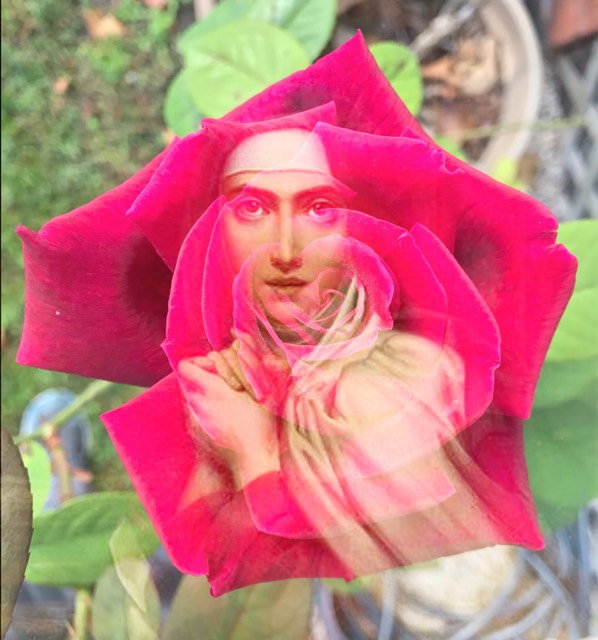
O Little Therese of the Child Jesus, please pick for me a rose from the heavenly gardens and send it to me as a message of love.
O Little Flower of Jesus, ask God today to grant the favors I now place with confidence in your hands...(mention petitions).
St. Therese, help me to always believe as you did, in God's great love for me, so that I might imitate your "Little Way" each day.  Amen.

(Say this prayer for nine days and St. Therese will send you a rose!)

Saturday, November 1, 2025

Solemnity of All Saints


On November 1 the Church commemorates the "cloud of witnesses" (Hebrews 12:1), both hidden and renowned, who have ascended the mountain of perfection to their heavenly home. As the nineteenth century French liturgist Dom Gueranger expressed it:
Blessed are they who are called to the marriage-supper of the Lamb! Blessed are we all, who have received in baptism the nuptial robe of holy charity, which entitles us to a seat at the heavenly banquet! Let us prepare ourselves for the unspeakable destiny reserved for us by love. To this end are directed all the labors of this life; toils, sufferings, struggles for God's sake, all adorn with priceless jewels the garment of grace, the clothing of the elect....Let us sing, then, with the psalmist: "I rejoiced at the things that were said to me: We shall go into the house of the Lord...." (Dom Gueranger's The Liturgical Year, Vol XV, p.58)
The Little Flower greatly relied upon the intercession of the saints. In her autobiography, St Thérèse wrote:
Remembering the prayer of Eliseus to his Father Elias when he dared to ask him for his double spirit, I presented myself before the angels and saints and I said to them: 'I am the smallest of creatures; I know my misery and feebleness, but I know also how much noble and generous hearts love to do good. I beg you then, O Blessed Inhabitants of Heaven, I beg you to adopt me as your child. To you alone will be the glory which you will make me merit, but deign to answer my prayer. It is bold, I know; however, I dare to ask you to obtain for me your twofold spirit.' (The Story of a Soul, pp.195-196)
Shortly before her death, St. Thérèse had a dream in which the Venerable Mother Anne of Jesus, one of the foundresses of the Carmelite reform in the sixteenth century, assured her that she would soon possess eternal beatitude. The saint of Lisieux was surprised because, as she penned:
I was, up until then, absolutely indifferent to Venerable Mother Anne of Jesus. I never invoked her in prayer and the thought of her never came to mind....And when I understood to what a degree she loved me, how indifferent I had been towards her, my heart was filled with love and gratitude, not only for the saint who visited me, but for all the blessed inhabitants of heaven. (The Story of a Soul, pp.191-192)
We will never know in this life how individual saints, perhaps ones we have never heard of, have interceded for us. Through prayer and the Eucharist, we can draw upon the merits of our brothers and sisters in Paradise. Such richness is ours in the Communion of Saints, for all belong to Christ.

(Published in the November-December 2008 issue of Canticle Magazine.)


Wednesday, October 1, 2025

St.Thérèse of the Child Jesus and the Holy Face


With zeal have I been zealous for the Lord God of hosts. (3 Kings 19:10)~Motto of the Carmelite Order
Today is the feast of Saint Thérèse of the Child Jesus and the Holy Face (1873-1897), whom Pope Pius XI hailed as being "the greatest saint of modern times." Her Little Way of love and self-surrender is vital to our modern materialistic age because she, like the sister of Lazarus, sought the "one thing necessary." (Luke 10:42) As she wrote to her sister Celine in 1889:
There is only one thing to do during the night, the one night of life which will come only once, and this is to love, to love Jesus with all the strength of our heart and to save souls for Him that He may be loved! (General Correspondence, Vol.I, ICS Publications, p.588)
In order to save souls, she was willing to embrace every suffering that came her way, from the petty annoyances of daily existence, to the physical and mental torments of the last months of her earthly life. In a letter to Celine, she exclaims:
Sanctity does not consist in saying beautiful things, it does not consist in thinking them, in feeling them!...It consists in suffering and suffering everything...A day will come when the shadows will disappear, and there will remain only joy, inebriation...Let us profit from our one moment of suffering...Let us see only each moment!...A moment is a treasure...one act of love will make us love Jesus better...it will bring us closer to Him during the whole of eternity...! (Ibid. pp 557-558)
Part of Saint Thérèse's secret of sanctity is that she kept the thought of eternity ever before her. "Just as this year passed, so also will our life pass, and soon we shall say: 'It is gone.' Let us not waste our time, soon eternity will shine for us." (Ibid, p.602)

Her profound realization of the shortness of life and her zeal for souls combined with a thirst for martyrdom. Through God's grace, she found the courage to face humiliations and disappointments that would have embittered lesser souls. Her father's mental deterioration and his committal to an asylum was a heavy trial for the teenage nun. Nevertheless, she wrote to Celine:
Let us die as martyrs! Unkown martyrdom, known to God alone, which the eye of the creature cannot discover, a martyrdom without honor, without triumph....That is love pushed to the point of heroism....Let us hurry to fashion our crown; let us stretch forth our hand to seize the palm. And if we love much, if we love Jesus with a passion, He will not be so cruel as to leave us for a long time on this earth of exile....Celine, during the short moments that remain to us, let us not lose our time...let us save souls! (Ibid, p.578)
During her fatal illness, Saint Thérèse reflected upon upon a glass of brightly covered but foul-tasting medicine, comparing it to her own life.
My life in the eyes of others must have seemed to be filled with the most pleasant colors....To them, I seemed to be drinking an exquisite draft, but in reality it was bitterness. I say bitterness and yet my life has not been bitter, for I have been able to find joy and sweetness in all that bitterness. (Father Jamart, The Complete Spiritual Doctrine of St. Therese , p.217)
Truly her love for Christ and souls was heroic. In her autobiography, St. Thérèse wrote: "When thinking of the torments which will be the lot of Christians at the time of the Anti-christ, I feel my heart leap with joy, and I would like these torments to be reserved for me." (The Story of a Soul, trans. by Father John Clarke, p. 193) Such zeal led her to offer herself as a victim to the Merciful Love of God in order to save souls, longing to spend her heaven "doing good upon earth." (Ibid, p.263)

God has honored the desires of His Little Flower. The efficacy of her intercession has been experienced in every part of the globe; her writings have been pondered by popes, saints, and scholars; she has drawn many souls to holiness by her prayer and example. Her Christ-like humility is the antidote for the intellectual pride of our time. Her zeal counteracts our sloth and dullness of mind, so suffocated are we by an excess of comforts and stimuli. She is a prophet of eternal beatitude; a guide to heaven for those on the brink of despair. She is Carmel's gift to modern man. How appropriately a Carmelite nun expressed it in one of the hymns for October 1:
Yet joy itself could not portray
The surge of her immense desire

Nor cloister walls have strength to stay

A love that swept the world like fire.

(Sister Miriam of the Holy Spirit, OCD)

Monday, September 22, 2025

Novena to the Little Flower

It begins today. Here are some lovely recommended prayers:
O Little Therese of the Child Jesus,
Please pick a rose for me
From the heavenly gardens
And send it to me
As a message of love.
O little flower of Jesus,
Ask God today to grant the favors
I now place with confidence
In your hands.
(Mention your specific requests)
St. Therese, help me to always believe, As you did, In God's great love for me, so that I might imitate your "Little Way" each day. Amen


O Glorious St. Therese, whom Almighty God has raised up to aid and inspire mankind, I implore your Miraculous Intercession. You are so powerful in obtaining every need of body and spirit from the Heart of God. Holy Mother Church proclaims you a 'Prodigy of Miracles... the Greatest Saint of Modern Times.' Now I fervently beseech you to answer my petition (mention here) and to carry out your promises of spending Heaven doing good on earth...of letting fall from Heaven a Shower of Roses. Little Flower, give me your childlike faith, to see the Face of God in the people and experiences of my life, and to love God with full confidence. St. Therese, my Carmelite Sister, I will fulfill your plea 'to be made known everywhere' and I will continue to lead others to Jesus through you. Amen

Wednesday, July 16, 2025

Our Lady's Scapular

In the last forty years many of the sacramentals of the Church, such as the scapular, have been either forgotten or misinterpreted. I have seen some very sophisticated Catholics on the internet mock the scapular as being superstitious. It requires a certain child-like piety to understand such things; an understanding of the history of the devotion does not hurt either. Here is an explanation of the origins of the scapular:
This monastic scapular, like the whole monastic habit and indeed the liturgical vestments of the priest, developed from the ordinary clothing of the laity. And, just as the stole is the special sign of the priestly dignity and power, the scapular is now the sign of the monk. In the West, in the case of St. Benedict, the scapular was at first nothing else than a working garment or apron such as was then worn by agricultural labourers. Thus, in the Rule of St. Benedict, it was expressly termed "scapulare propter opera" (c. xxv in P.L. LXXVI, 771). From this developed the special monastic garment, to which a hood could be fastened at the back. In fact, the original scapular of the Dominican Order was so made that it acted also as a covering for the head, and thus as a hood. The scapular of the West corresponded to the analabus of the East.
Since many of the religious orders had a version of the monastic scapular, lay people who were affiliated with those orders wished to a tangible sign of their dedication. In the beginning, tertiaries were permitted to don the habit of the order with which they were affiliated. Later, since a religious habit was not always conducive to the duties of secular life the small scapulars were worn instead, as the following relates:
Like the large scapulars the first and oldest small scapulars originated to a certain extent in the real monastic scapular. Pious lay persons of either sex attached themselves to the Servites for instance; many of those who were in a position to do so attached themselves to the third order with vows, but in the case of many others either this was impossible or the idea of doing so had as yet not occurred to them. In this manner developed, shortly after the foundation of the Servite Order, the Confraternity of the Servi B. Mariae Virginis. Similarly originated the Confraternity of Our Lady of Mount Carmel; that this existed in 1280 is proved by the still extant "Libro degli ordinamenti de la compagnia di Santa Maria del Carmine scritto nel 1280" (edited by Giulio Piccini at Bologna, 1867, in "Scelta di Curiosità letterarie"). The members of these confraternities were called the confratres and consores of the respective orders; they had special rules and participated in the spiritual goods of the order to which then belonged. It is probable also that many of those who could not be promoted to the third order or who were special benefactors of the first order received the habit of the order or a large scapular similar to that of the oblates, which they might wear when dying and in which they might be buried. It was only later and gradually that the idea developed of giving to everyone connected with the order the real scapular of the order in miniature as their badge to be always worn day and night over or under their ordinary clothing.
The scapulars, especially the brown scapular of the Carmelites, became so popular among the Christian people that even those who did belong to a religious order began to wear them. The brown scapular became the most highly indulgenced so that children were enrolled in the scapular confraternity around the time they made their first Holy Communion. Fr. Kieran Kavanaugh, OCD, discusses the facts surrounding the Carmelite scapular:
If we look for the earliest references to the scapular, we find them in the Carmelite constitutions of 1281 in which it was prescribed that all Carmelite friars should wear their tunics and scapulars to bed under penalty of a serious fault. It was also prescribed that the white mantle be made in such a way that the scapular would not be hidden. But the reason for these prescriptions was not a Marian one. At the time, the scapular was seen as signifying the "yoke of Christ." This yoke of Christ in turn pointed to obedience. And that explains the strictness of the legislation. Taking off the scapular was like taking off the yoke of Christ, or rebelling against authority. Only gradually did the scapular take on a Marian tone and grow until it reached such a point that it became identified with Carmelite piety toward Our Lady. In fact the feast of Our Lady of Mount Carmel began to be called the scapular feast. Devotion to Mary expressed by wearing the brown scapular seems to be resilient and resists the attempts made in various periods of history to diminish its value. The faithful keep coming back to it. From the official teaching of the Church, we can gather that the scapular of Carmel is one of the most highly recommended Marian devotions. This is true through the centuries, and into our own times with popes Paul VI and John Paul II.
Fr. Kieran goes on to explore how sacramental aspects of the brown scapular developed:
One of the early Carmelites in his enthusiasm went so far as to call the scapular a "sacrament." Actually the category into which the scapular fits is that of a sacramental. Sacramentals are sacred signs. The scapular is not a natural sign in the sense that smoke is the sign of fire. Smoke is intrinsically connected with fire. Where there's smoke there's fire, the saying goes.
The scapular is what is called a conventional sign. In the case of a conventional sign, the meaning is assigned to the object from outside. Thus a wedding ring is a sign or pledge of mutual love and enduring fidelity between two spouses. In this kind of sign, which is a conventional sign, there has to be an intervention from outside that establishes the connection between the object and what it represents. In the case of sacramentals, it is the Church that determines the connection.
Sacramentals also signify effects obtained through the intercession of the Church, especially spiritual graces. The sacramentals -- as holy pictures or icons, statues, medals, holy water, blessed palm and the scapular -- are means that dispose one to receive the chief effect of the sacraments themselves, and this is closer union with Jesus.
St. Teresa of Avila for example speaks in her life about holy water and the power she experienced that this sacramental has against the devil. She mentions as well how this power comes not through the object in itself but through the prayer through the prayer of the Church. Along with the sacraments, sacramentals sanctify almost every aspect of human life with divine grace. The passion, death, and resurrection of Christ is the source of the power of the sacramentals as it is of the sacraments themselves.
Such everyday things as water and words, oil and anointing, cloth and beeswax, paintings and songs are ingredients of the sacraments and sacramentals. The Son of God became the Son of Mary. What could be more down-to-earth, more human, indeed more unpretentious, plain, and simple? (Read more.)
 
Pope John Paul II, who was a Carmelite tertiary, wrote profoundly of the brown scapular in March 2001:
Over time this rich Marian heritage of Carmel has become, through the spread of the Holy Scapular devotion, a treasure for the whole Church. By its simplicity, its anthropological value and its relationship to Mary's role in regard to the Church and humanity, this devotion was so deeply and widely accepted by the People of God that it came to be expressed in the memorial of 16 July on the liturgical calendar of the universal Church....
The sign of the Scapular points to an effective synthesis of Marian spirituality, which nourishes the devotion of believers and makes them sensitive to the Virgin Mother's loving presence in their lives. The Scapular is essentially a "habit". Those who receive it are associated more or less closely with the Order of Carmel and dedicate themselves to the service of Our Lady for the good of the whole Church.... Those who wear the Scapular are thus brought into the land of Carmel, so that they may "eat its fruits and its good things" (cf. Jer 2: 7), and experience the loving and motherly presence of Mary in their daily commitment to be clothed in Jesus Christ and to manifest him in their life for the good of the Church and the whole of humanity....
Therefore two truths are evoked by the sign of the Scapular: on the one hand, the constant protection of the Blessed Virgin, not only on life's journey, but also at the moment of passing into the fullness of eternal glory; on the other, the awareness that devotion to her cannot be limited to prayers and tributes in her honour on certain occasions, but must become a "habit", that is, a permanent orientation of one's own Christian conduct, woven of prayer and interior life, through frequent reception of the sacraments and the concrete practice of the spiritual and corporal works of mercy. In this way the Scapular becomes a sign of the "covenant" and reciprocal communion between Mary and the faithful: indeed, it concretely translates the gift of his Mother, which Jesus gave on the Cross to John and, through him, to all of us, and the entrustment of the beloved Apostle and of us to her, who became our spiritual Mother.
...A splendid example of this Marian spirituality, which inwardly moulds individuals and conforms them to Christ, the firstborn of many brethren, is the witness to holiness and wisdom given by so many Carmelite saints, all of whom grew up in the shadow and under the protection of their Mother.
I too have worn the Scapular of Carmel over my heart for a long time!

Friday, June 27, 2025

Feast of the Sacred Heart of Jesus


"I have come to cast a fire on the earth: what will I, but that it be kindled?" (Luke 12:49)

During the first millennium of Christianity, many saints wrote with unction of the pierced side of Our Lord, from which flowed "blood and water" (John 19:34), symbolizing the sacraments of the Church. It was not until the later ages, "when the charity of many [had] grown cold" (Matthew 24:12), that Our Lord chose to reveal the hidden treasures of His Sacred Heart. The gnostic excesses of the Manicheans, the upheavals of the Protestant revolt, and the chilling exaggerations of Jansenism required as an antidote the gradual but compelling manifestations of the love and mercy of the Heart of God.

It was in the thirteenth century that mystic souls such as St. Bonaventure, St. Mechtilde, and St. Gertrude began to write explicitly about devotion to the Sacred Heart, focusing on the infinite love which pursues and surrounds us. St. Gertrude the Great relates that in one of her many visions St. John the Evangelist said to her:
To these latter times was reserved the grace of hearing the eloquent voice of the Heart of Jesus. At this voice the time-worn world will renew its youth, be roused from its lethargy, and again be inflamed with the warmth of Divine Love. ( Love, Peace and Joy by the Reverend André Prévot)
 Our Lord told St. Mechtilde:  
In this wound of love, so great that it embraces Heaven and earth, unite thy love to My Divine Love, that it may be perfect; and even as iron glowing with fire becomes, as it were, one with it, so let your love be transformed and absorbed into Mine. (Ibid.)
In the early 1600's, St John Eudes and St Francis de Sales, among others, promoted the cult of the Sacred Heart. However, it was the famous apparitions of Jesus Christ to St. Margaret Mary in the 1670's and 80's that led to the widespread, public homage of the Savior's heart. Our Lord revealed to St. Margaret Mary His desire for the establishment of a feast in honor of His Heart, to be held on the Friday after the Corpus Christi octave, as a day of reparation. He promised special graces to those who receive Holy Communion in a spirit of reparation and penitence on the First Friday of nine consecutive months.

Jesus further requested that France, the eldest daughter of the Church, be consecrated by her king to the Sacred Heart, in order to spare the kingdom from future cataclysmic events. For several reasons, the consecration was not performed until France was in the throes of a bloody and anti-Christian revolution. In 1791, the imprisoned King Louis XVI secretly made the consecration. However, it seems the formal, public consecration of France has never taken place.

In 1856, Pope Pius IX placed the feast of the Sacred Heart on the universal calendar. Meanwhile, the storm of modernism, communism, socialism, and secular humanism broke upon the Church and the world. Our Lord said to St. Margaret Mary in 1689: "It will take time, but I will reign despite Satan and his supporters." (The Sign of Her Heart by John Haffert)

While we prayerfully await the public acknowledgment of Christ the King by the nations, let us imitate the Carmelite saints in making Jesus the King of our hearts, immersing ourselves into the unfathomable mystery of His love. In the words of St. Thérèse of the Child Jesus: 
If I to see Thy glory would aspire
Then I must know Thy crucible of flame

Thy burning love, Heart of my God, I claim.

Then when my soul wings upward like a dove,

Called from the earth to heaven's home of light,

May it go forth in one pure act of love,
 
Plunge to Thy Heart in one unswerving flight.
(Carmelite Proper of the Liturgy of the Hours)

Monday, June 9, 2025

The Oblation of Saint Thérèse

On June 9, 1895, at the Carmel of Lisieux, Saint Thérèse made the Act of Oblation to Merciful Love. In her autobiography she said: "I received the grace to understand, more than ever, how much Jesus desires to be loved." Instead of offering herself as victim to the justice of God, as did other religious, taking upon themselves the "punishment reserved for sinners," Saint Thérèse decided to offer herself as a victim to the Merciful Love of God. She asked to be consumed as a holocaust in the fire of the Sacred Heart, in order to console that Heart and save souls. "Fire transforms all things into itself, " the saint wrote in her Act of Oblation. "I know that the fire of love is more sanctifying than the fire of Purgatory."
 
With her Act of Oblation, Saint Thérèse did not expect sufferings to go away. "I wish to suffer for Love's sake and for Love's sake even to rejoice...I will sing always, even if my roses must be gathered among thorns...." In a letter to her sister Celine, she explained: "The burden of our song is suffering. Jesus offers us a chalice of great bitterness. Let us not withdraw our lips from it, but suffer in peace. He who says peace does not say joy, or at least sensible joy....Do not think we can find love without suffering...."

Through her Oblation to Merciful Love, Saint Thérèse gained a deep insight into her Carmelite vocation. "I understand that love embraces all vocations, that it is all things, and that it reaches out through all ages, and to the uttermost limits of the earth, because it is eternal....In the heart of the Church my Mother, I will be love." She prayed that after her death she be allowed to "return to earth" to keep saving souls. She said: "I want to spend my heaven doing good upon earth."

"You will look down from Heaven, will you not?" asked her sister when Saint Thérèse was mortally ill. 

"No," replied the dying young woman. "I will come down." Another time she said: "After my death, I will let fall from Heaven a shower of roses." On September 30, 1897, in great mental and physical agony, the twenty-four year old nun, gasping for breath, proclaimed: "I do not regret having surrendered myself to Love." A few hours later, her last words were: "My God, I love You."

The miracles which followed her death took the Church and the world by storm.

(All quotations are from the book Soeur Thérèse of Lisieux, The Little Flower, 1912)

Saturday, May 17, 2025

The Little Way

Today is the centenary of the canonization of St. Thérèse of Lisieux. Pope Benedict XVI once spoke of the Little Way of the Little Flower and recommended reading The Story of a Soul.
  "Little Therese", the Pope continued, "never failed to help the most simple souls, the little ones, the poor and the suffering who prayed to her, but also illuminated all the Church with her profound spiritual doctrine, to the point that the Venerable John Paul II, in 1997, granted her the title of Doctor of the Church ... and described her as an 'expert in scientia amoris'. Therese expressed this science, in which all the truth of the faith is revealed in love, in her autobiography 'The Story of a Soul', published a year after her death".

  Therese was born in 1873 in Alencon, France. She was the youngest of the nine children of Louis and Zelie Martin, and was beatified in 2008. Her mother died when she was four years old, and Therese later suffered from a serious nervous disorder from which she recovered in 1886 thanks to what she later described as "the smile of the Virgin". In 1887 she made a pilgrimage to Rome with her father and sister, where she asked Leo XIII for permission to enter Carmel of Lisieux, at just fifteen years of age. Her wish was granted a year later; however, at the same time her father began to suffer from a serious mental illness, which led Therese to the contemplation of the Holy Face of Christ in his Passion. In 1890 she took her vows. 1896 marked the beginning of a period of great physical and spiritual suffering, which accompanied her until her death.

  In those moments, "she lived the faith at its most heroic, as the light in the shadows that invade the soul" the Pope said. In this context of suffering, living the greatest love in the littlest things of daily life, the Saint realised her vocation of becoming the love at the heart of the Church".(Read more.)
Related Posts with Thumbnails