Showing posts with label Divine Office. Show all posts

Wednesday, September 17, 2025

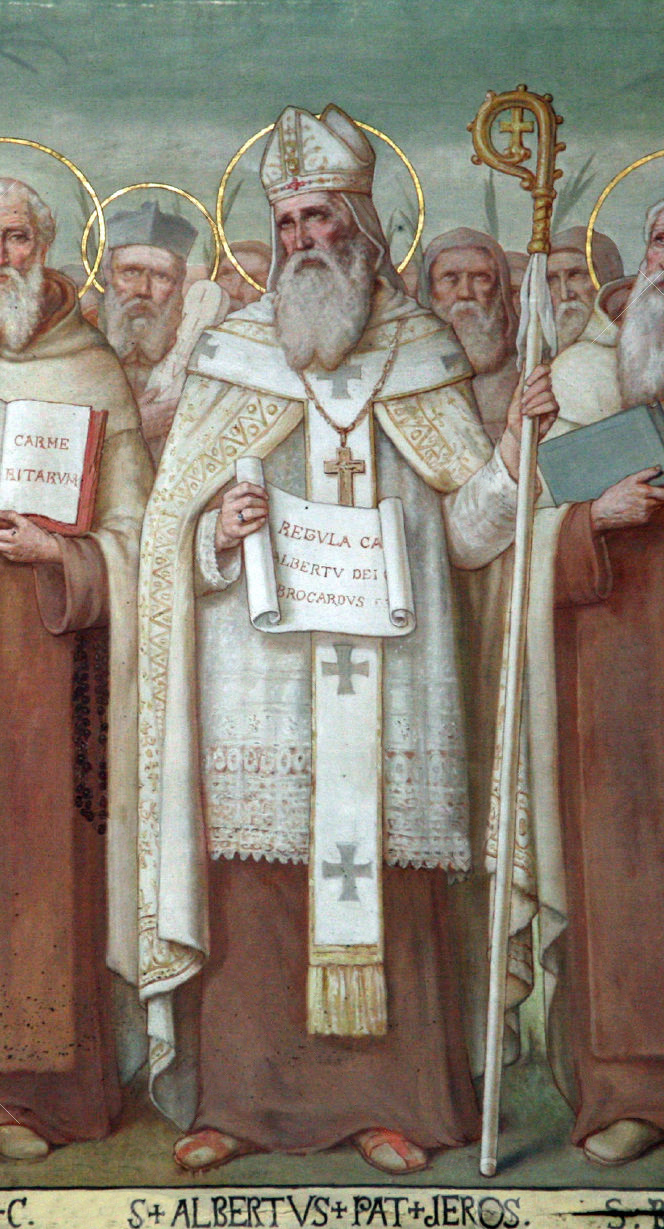
St. Albert of Jerusalem


Albert, by the grace of God, Patriarch of Jerusalem, to his beloved sons, Brocard and the other religious hermits who live under his obedience, near the fountain of Elias, on Mt. Carmel, health in the Lord, and the blessings of the Holy Spirit.
Thus opens the primitive Rule of St. Albert, one of the four great Rules of the Roman Church. Written for the early Carmelites, it is the shortest of all the Rules, because minimal attention is placed on material things and the affairs of the world. The heavenly strivings of the Hermit Brothers of Our Lady of Mt. Carmel are thereby emphasized. St Albert's exhortations on solitude, silence, poverty, obedience, fasting, and manual labor are all well-supported by his thorough knowledge of Sacred Scripture. Although the Rule was written for the hermits, its charism can be lived by any who seek to live a life of contemplation, even amid the cares of this world. The heart of the Rule is that the Carmelite should be "meditating day and night on the Law of the Lord, and watching in prayer." Is not our striving for interior recollection an attempt to mirror this precept?

St. Albert of Vercelli, an Italian by birth, was sent to Palestine by Pope Innocent III because his wisdom and diplomacy were needed in that turbulent region. As the Latin Patriarch, St. Albert gained the respect of the eastern Christians and even of the Moslems. As an Augustinian Canon of the Holy Cross, St. Albert knew the religious life first hand. Between 1206 and 1210 he composed the Rule for the Carmelite hermits. On September 14, 1214, the Feast of the Exaltation of the Holy Cross, St. Albert was stabbed to death by a disgruntled, immoral cleric whom he had deposed. St. Albert's feast on the Carmelite calendar is September 17.

Sunday, June 1, 2025

Sunday within the Octave of the Ascension

 From Dom Gueranger:

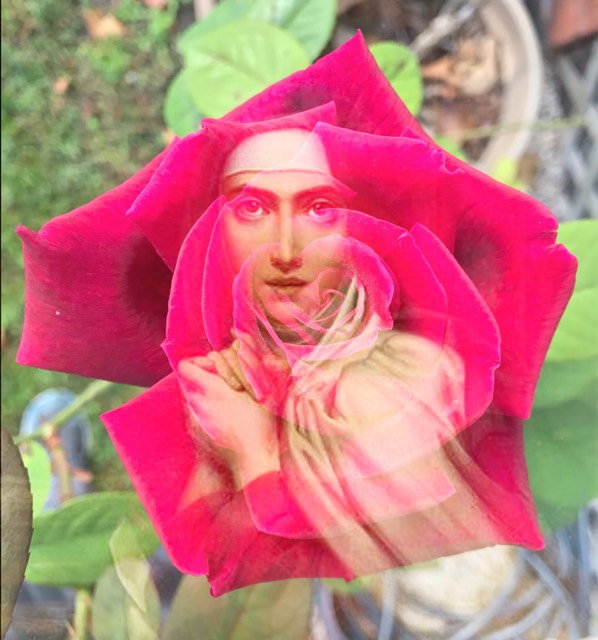
In the Middle Ages, the Sunday within the Octave of the Ascension, was called “The Sunday of Roses,” because it was the custom to strew the pavement of the Churches with roses, as an homage to Christ who ascended to heaven when earth was in the season of flowers. How well the Christians of those times appreciated the harmony that God has set between the world of grace and nature! The Feast of the Ascension, when considered in its chief characteristic, is one of gladness and jubilation, and Spring’s loveliest days are made for its celebration. Our forefathers had the spirit of the Church; they forgot, for a moment, the sadness of poor earth at losing her Emmanuel, and they remembered how he said to his Apostles: If ye loved me, ye would be glad, because I go to my Father! Let us do in like manner; let us offer to Jesus the Roses wherewith he has beautified our earth: their beauty and fragrance should make us think of him who made them, of Him who calls himself The Flower of the field and the Lily of the valleys. He loved to be called “Jesus of Nazareth;” for Nazareth means a Flower: and the symbol would tell us what a charm and sweetness there is in Him we serve and love as our God. (Read more.)

Saturday, September 7, 2024

The Perpetual Virginity of Mary

"The Magnificat" by Tissot

 Tomorrow is the feast of the Nativity of Mary. So much of what the Church teaches has been distorted in our times. The teaching on Our Lady's perpetual virginity is often misunderstood, as Fr. Mark* explained:

Even in the minds of many of the faithful, enfeebled by a forty year dearth of popular orthodox catechesis, a tragic confusion holds sway concerning the privileges of the Blessed Virgin Mary and, in particular, her virginity before, during, and after childbirth. There are many, alas, who, affected by various mutations of creeping Nestorianism and Arianism, have no grasp of what it means to call the Blessed Virgin Mary, Mother of God. Those who do not confess the privileges of the Blessed Virgin Mary, honoring them and celebrating them, fall inevitably into one or another of the classic Christological heresies.
Fr. Mark further discusses this beautiful and ancient teaching, as follows:
Ever since the Council of Ephesus in 431, icons of the Mother of God have been marked by three stars: one on her forehead, and one on each shoulder, The three stars signify her perpetual virginity: before, during, and after the birth of her Son....

Ancient liturgical texts reflect the language of the first great Christological councils of the Church. It was crucial, in the context of the prevailing heresies, to invoke Mary as Theotokos, Mother of God, or as Ever-Virgin. It was feared that by referring to Mary as a woman called simply by her ordinary name, something of the mystery of Christ, True God and True Man, might be obscured or compromised. The liturgy in both East and West reflects this ancient preference. While, in preaching and in works of devotion, we often hear the name of Mary without her theological titles, the liturgy calls her Sancta Dei Genetrix (Holy God-bearer) and Semper Virgo (Ever-Virgin).

The most ancient prayer to the Virgin Mother is the Sub tuum praesidium, found on an Egyptian papyrus from the 3rd century. It does not include the name “Mary,” but invokes her as Holy God-bearer (Sancta Dei Genetrix) and Virgin glorious and blessed, (Virgo gloriosa et benedicta).

The liturgy through the ages is consistent in confessing that God Himself is the author of Mary’s perpetual virginity. The same thought is carried over into the ancient rites for the Consecration of Virgins. Virginity, before being something offered to God, is a gift received from Him. It is a gift wholly ordered to union with Christ. Christ is the Spouse of Virgins; He is, at the same time, the blessed Fruit of a virginity received from God and offered back to Him. The liturgy does not separate virginity from motherhood. The virginity given by God is characterized not by sterility, but by an astonishing fecundity.

More on this de fide teaching in the Catechism of the Catholic Church:
The deepening of faith in the virginal motherhood led the Church to confess Mary's real and perpetual virginity even in the act of giving birth to the Son of God made man. In fact, Christ's birth "did not diminish his mother's virginal integrity but sanctified it." And so the liturgy of the Church celebrates Mary as Aeiparthenos, the "Ever-virgin."
Here are some beautiful quotes from Fathers of Church:
Believe in the Son of God, the Word before all the ages, who was...in these last days, for your sake, made son of Man, born of the Virgin Mary in an indescribable and stainless way, -for there is no stain where God is and whence salvation comes.... (St. Gregory of Nazianzen, Oration on Holy Baptism, 40:45; 381 AD)
According to the condition of the body (Jesus) was in the womb, He nursed at His mother's breast, He lay in the manger, but superior to that condition, the Virgin conceived and the Virgin bore, so that you might believe that He was God who restored nature, though He was man who, in accord with nature, was born of a human being. (St. Ambrose of Milan, Mystery of the Lord's Incarnation, 6:54; 382 AD)
Who is this gate (Ezekiel 44:1-4), if not Mary? Is it not closed because she is a virgin? Mary is the gate through which Christ entered this world, when He was brought forth in the virginal birth and the manner of His birth did not break the seals of virginity. (St. Ambrose of Milan, The Consecration of a Virgin and the Perpetual Virginity of Mary, 8:52; c. 391 AD)

(*Note: since this post was originally published fifteen years ago, Father Mark's blog is defunct but the quotes from him remain.)

"Birth of the Virgin Mary" by Giotto

The Annunciation by Tissot

Sunday, December 24, 2023

Alma Redemptoris Mater

The Alma Redemptoris Mater is sung after Night Prayer (Compline) throughout Advent until Candlemas on February 2nd.


Loving mother of the Redeemer, gate of heaven, star of the sea, assist your people who have fallen yet strive to rise again, To the wonderment of nature you bore your Creator, yet remained a virgin after as before, You who received Gabriel's joyful greeting, have pity on us poor sinners.


(Image: Virgin of Vladimir)

Monday, March 6, 2023

The Limits of Obedience


"Convent Thoughts" by Charles Allston Collins

 For better is one day in thy courts above thousands. I have chosen to be an abject in the house of my God, rather than to dwell in the tabernacles of sinners.~Psalm 83:11 (The Vulgate)
I saw this post making the rounds on Facebook, with much shock and dismay from the devout. It is by Mary T., a former postulant from a strict contemplative order of nuns. The post describes the true sufferings of a sincere and fervent young lady who really wanted to give her life to God as the Bride of Christ. She describes how she found the requirements of obedience onerous and almost unbearable; her health eventually declined. A reader asked me for my thoughts on the article, knowing that in the late 80's and early 90's I explored religious life in the Discalced Carmelite Order, which led me to three different monasteries over the course of five years. Mary immediately had my sympathy since for several years, as any of my family and close friends will attest, I wanted the same thing very much, to be a nun. I understand the total sacrifice, the burning of bridges and giving up everything in order to follow Jesus. I also understand the pain of having to leave a beloved way of life and return to the world that one thought was safely left behind. 

Let me say that it was an honor for me to be admitted for even five minutes to any of those Carmelite monasteries where I discerned a vocation; in each one what I learned about God, faith, prayer, the liturgy and my own human weakness. I had the example of holy women whom I would probably never have met anywhere else, who were filled with the joy of the Holy Spirit and with zeal for the Lord of Hosts. But a vocation is a call from God. If one does not have a vocation to a particular community or to a certain way of life, then all the good will in the cosmos cannot give it. And while a person may have a call to religious life, they might not have a call to a particular community. Or even to a certain order or congregation. It is a matter for a great deal of prayer, discernment and spiritual direction from a prudent advisor.

The first thing that occurred to me when reading Mary's account of her time in the monastery was how health issues made her life of holy obedience almost impossible. Someone with dire health issues should not be admitted to a strict penitential monastery. By "penitential" I mean corporal penances such as limited personal hygiene, and fasting. And other things, such as sleeping on boards. If the health issues arose during the time in the monastery, then most communities would have sent the postulant home right away, unless it was a passing illness. If  a nun has a passing but serious illness like the flu, shingles, COVID, etc then most monasteries have an infirmary where the sick are cared for and all austerities are suspended until the nun recovers. But long-term failing health is usually a sign that a postulant does not have a vocation to a particular community. Now there are some communities, like those of the Visitation Order, that accept aspirants with health problems; there are probably other congregations as well. There are plenty of convents that are not so strict, which are bearable for a sensitive candidate, a candidate who might find the lack of hygiene in a strict monastery to be too much. There are convents where you can shower every day and change your underclothes every day. There is no shame in wanting to be clean.

Which brings us to the subject of underclothes. Let me be frank. Remember when Star Wars director George Lucas told Carrie Fisher aka Princess Leia that there was no underwear in space? Well, some monasteries are like outer space. Underclothes do not exist, except a rough linen or wool tunic which you also sleep in and change once a week, twice a week if you are in a more "progressive" community. When I read Mary's complaint about not being able to change her underwear I thought: "Wow, they got to wear underwear." Neither do the super austere ones have deodorant. In the heat of summer, most places allow a daily bath or shower, but it has to be really hot outside. And no air conditioning, at all. In the winter, no socks, unless you go out to shovel snow. But then I was only in Discalced Carmelite monasteries. We wore sandals all year long. Other monasteries have shoes and socks. We had perpetual abstinence from meat as well. In spite of such renunciations of physical comforts, cloistered nuns are famously long-lived.

Now we come to the issues of holy obedience. I was twenty-five years old when I first entered Carmel and everyone who knew me thought of me as being quite ladylike. But I had to have thorough etiquette lessons in the novitiate, like Marie-Antoinette arriving at Versailles. In an ancient way of existence, following a venerable Rule and ceremonial, where much of the day is spent in silence, then deportment becoming to the consecrated life is important and saves a lot of misunderstandings in the long run. I had to learn the traditional sign language, to kiss the floor if I committed a fault, to beg pardon of the community at the chapter of faults. Now faults are different from sins. Sins are for the Sacrament of Reconciliation. Faults are mistakes you commit from human weakness and without intent, such as leaving the kitchen light on or forgetting to ring the bell for Compline.

As for obedience itself, in the monastery, under the three evangelical counsels of poverty, chastity and obedience, a person is never to obey a sinful command, just as in the secular world. No one has the right to command you to sin. If the legitimate command of a superior is more than the person's physical or emotional strength can bear, i.e., if it makes them soil their clothes, or fall into intense anger, etc. then they must make a representation to their superior. A representation is when you are bound to be honest with your superior. If a nun has a passing but debilitating illness such as shingles or measles or whatever, she is supposed to tell her superior. And the superior is supposed to see that the nun is properly cared for in the infirmary or hospitalized if necessary. Obedience is not supposed to be a crushing burden to the soul or body. If it is, the individual is in the wrong place.

This is not to say that obedience is meant to be easy. It is a sacrifice in faith of one's free will. It can be emotional martyrdom. The difficult part of obedience, from what I have experienced and from what nuns, priests and religious have shared with me, is not when you are asked to do something hard, like making dinner for the community. The difficult part of obedience is when you are told to do something you think is stupid or ridiculous or in bad taste. Like singing a song you dislike. And in the cloister the tiniest things can grate on the nerves. Perhaps you are asked to decorate the altar in a way that you personally think is tacky. You can ask: "Mother, may I tell you another idea for decorating the altar?" And the superior may ask you for your opinion. Or she might just say: "Sister, just do as I ask." And you have to do it, even though you are convinced that God would be better glorified by your artistic vision. But no, God is glorified by a meek and humble heart.

One issue that struck me about Mary's eloquent and heartrending article is that, although her words ring with sincerity and truth, we are still only hearing her side of the matter. It would be interesting to hear what the nuns have to say about the demands they made upon her and why. But nuns do not issue public statements about ex-postulants, as a rule, so we will never know their view. So we pray for Mary to be led by Our Lord to wherever her gifts will be appreciated and where she will blossom.

One more word about religious life in general and cloistered, contemplative life in particular. Holy obedience in religious life often demands sacrifices that in any other circumstances would be abusive. It is like being in marine boot camp, or the Navy Seals. It can be extremely tough; you can be corrected for faults you had no idea you had, and humiliated before the entire community. If a postulant cannot take it, there is absolutely no shame. They are just not meant to be in that particular community. All communities are different, even within the same order, and each order or congregation has very specific guidelines about obedience in their constitutions that have to be approved by Rome. There are levels of obedience in all vocations, such as in marriage or in parish life. But the obedience of religious life, especially when solemn vows are made, cannot be compared to what is asked of a layperson. I know that most laypeople, and even secular priests, reading Mary's account, have been shocked. But most of what she describes is typical of strict cloistered monasteries, from what I have read and from my personal experiences. What disturbs me are the health issues she experienced that appear to have been long-term and a source of continued suffering. I hope she has healed and I wish her every blessing and happiness.

People ask me all the time why I left the monastic life. I had to leave it due to continuous severe migraines. Also, the nuns at the Carmel where I spent most of my novitiate thought that I had gifts which I needed to use in the secular world. Although I heartily disagreed with them, they turned out to be right. Obedience can be a bitter chalice but for it we have the example of  Our Lord. "My Father, if it be possible, let this chalice pass from me. Nevertheless not as I will, but as thou wilt." (Matthew 26: 39)  
Thursday, November 10, 2022

Novena to St. Raphael Kalinowski

 St. Raphael of St. Joseph was a Polish Carmelite saint greatly venerated by St. John Paul. His feast is November 19. From Aleteia:
Born Joseph Kalinowski to a noble Polish family in 1835, the future saint lost his mother when he was just a baby, then his stepmother when he was 10. His father’s third wife became a great influence in his life, encouraging him spiritually as well as in his remarkable academic career. He graduated from the boarding school his father taught at, then headed to the improbably-named Hory Horki for university. Equally good, it seems, at a variety of sciences, he chose to study zoology, chemistry, agriculture, and apiculture (beekeeping).
But Kalinowski’s love of creation didn’t extend to a love of the Creator; gradually he drifted further and further from the faith of his youth. For him, knowledge and worldly success were enough. He had no particular need, he felt, of the things of God. Despite his aptitude, Kalinowski’s options were limited because of his ethnicity; Poles at the time were only permitted to pursue graduate studies if they were members of the Russian army. So Kalinowski enlisted in the Imperial Russian Army and began to study engineering. He spent some time as a math professor before beginning his work designing the railroad that would connect Kursk to Odessa.
It was during this time that the call of the Lord began to penetrate Kalinowski’s heart. As he worked on the railroad, he had many hours to spend in solitude. There, in the silence, God began to draw the young engineer back. He began to realize the need for an interior life, but still he remained far from the sacraments, seeing God more as an idea than as a lover.
Meanwhile Kalinowski was rising through the ranks, but his heart wasn’t with the Russian cause. He sympathized with the plight of his oppressed Polish brethren and when he was 27 he made the difficult decision to become a traitor—or, rather, a patriot.
After he defected to the Polish rebels during the 1863 January Uprising, Kalinowski’s brilliant mind was put to good use as minister of war. But while he had left behind the Russians, he still hadn’t left behind his sin. For 10 years, Kalinowski had been away from the sacraments; finally, his younger sister and his stepmother told him they would only get a particular gift for a friend of his if he would go to confession. Though not at all eager, Kalinowski went; in that moment, he experienced profound grace, mercy, and fullness of conversion. “After 10 years of apostasy,” he said, “I have returned to the bosom of the Church.” (Read more.)
More HERE.

Prayer in honor of Saint Raphael:
Lord God, You made Your Priest St. Raphael strong in adversity and filled Him with a great love in promoting Church unity. Through his prayers make us strong in faith and in love for one another, that we too may generously work together for the unity of all believers in Christ. We ask this through our Lord Jesus Christ, Your Son, Who lives and reigns with You and the Holy Spirit, one God, for ever and ever.

Sunday, November 8, 2020

Octave Day of All Saints


From Dom Gueranger at Sensus Fidelium:

How could we more appropriately conclude the teachings of this Octave, than by quoting the words used by the Church herself in today’s Liturgy? “Strangers as we are and pilgrims on the earth, let us fix our hearts and our thoughts on the day which will give to each of us a home, and restore us to Paradise. Who, that is on a voyage, would not hasten to return to his country! Who, that is on the way home, would not eagerly desire a favorable wind, that he might the sooner embrace his dear ones! Parents, brothers, children, friends in multitudes impatiently await us in our heavenly fatherland; blessed crowd! already secure of their own eternal happiness, they are solicitous about our salvation. What joy for them and for us, when at length we see them and they may embrace us!

“How great the delight of that heavenly kingdom: no more fear of death; but eternal and supreme happiness! Let all our earnest desires tend to this: that we may be united with the Saints, that together with them we pay possess Christ.”

These enthusiastic words, borrowed from St. Cyprian’s beautiful book “On Mortality,” are used by the Church in her second Nocturn; and in the third she also gives us the strong language of St. Augustine, consoling the faithful, who are obliged still to remain in exile, by reminding them of the great beatitude of this earth: the beatitude of those who are persecuted and cursed by the world. To suffer gladly for Christ, is the Christian’s glory, the invisible beauty which wins for his soul the good pleasure of God, and procures him a great reward in heaven.

He that hurteth, let him hurt still, says our Lord; and he that is filthy, let him be filthy still; and he that is just, let him be justified still; and he that is holy, let him be sanctified still. Behold I come quickly; and my reward is with me, to render to every man according to his works. I am Alpha and Omega, the first and the last, the beginning and the end. Patience, then, Christians! Patience, all who are now despised, for time is short; the fashion of this world passeth away! It is in the light of our Baptism that we must look upon those foolish men, who think themselves strong, because they are violent; who call themselves wise, because pleasure is their only law. When the Man-God, with the spirit of his mouth, shall take vengeance on Satan their leader, their lot will be the indignant sentence heard by the Prophet of Patmos: Without are dogs, murderers, every one that loveth and maketh a lie. Meanwhile the whole creation, which they made the unwilling slave of their corruption, will answer to their disgraceful fall by a triumphant song of deliverance. Itself will be transformed into new heavens and a new earth. It will partake of the glory of the children of God, delivered like itself, and will be worthy to contain the new Jerusalem, the holy city, where in our flesh we shall see God; and where, seated at the right hand of the Father in the Person of Jesus Christ, our glorified human nature will enjoy forever the honors of a bride. (Read more.)


Friday, June 21, 2019

The Mystic Number of Seven

From Vultus Christi:
The mystic number of seven signifies the fullness that overflows into eternity. The duties of our service, nostrae servitutis officia, are but a foretaste of heaven where our adoration and our praise will never cease. The vocation to perpetual adoration is a vocation to heaven on earth. Rightly did the Venerable Mother Caterina Lavizzari repeat, Gesù–Ostia è il nostro Paradiso in terra. This is the phrase that appears on the mementos printed after her death on Christmas day 1931.
Our obligation to the full Divine Office, by day and by night, though it be demanding of our time, of our best energies, and of our sustained attention, is the sweet duty of love. While all the community may not be present for every Hour of the Divine Office, when even a representative nucleus of the community assemble for the praise of God, they do so in communion of mind and heart with the absent brethren. The labours of the absent brethren, or their infirmity, or the duties that under obedience oblige them to be elsewhere, do not break the “charity that is the bond which makes us complete.” (Colossians 3:14). In the Epistle to the Colossians, the Apostles gives us the context of the Opus Dei. He says:
Put ye on therefore, as the elect of God, holy, and beloved, the bowels of mercy, benignity, humility, modesty, patience: bearing with one another, and forgiving one another, if any have a complaint against another: even as the Lord hath forgiven you, so do you also. But above all these things have charity, which is the bond of perfection: and let the peace of Christ rejoice in your hearts, wherein also you are called in one body: and be ye thankful. Let the word of Christ dwell in you abundantly, in all wisdom: teaching and admonishing one another in psalms, hymns, and spiritual canticles, singing in grace in your hearts to God. All whatsoever you do in word or in work, do all in the name of the Lord Jesus Christ, giving thanks to God and the Father by him. (Colossians 3:12–17)
(Read more.)
Related Posts with Thumbnails