


Saturday, May 31, 2025

The Visitation

For winter is now past, the rain is over and gone. The flowers have appeared in our land....Arise, my love, my beautiful one, and come....Show me thy face, let thy voice sound in my ears: for thy voice is sweet.... (Canticle of Canticles 2:11-12, 13-14)
 How appropriate that the month of May is crowned with the joyful feast of the Visitation. At the voice of Mary greeting her cousin Elizabeth, the infant St. John the Baptist received sanctifying grace and was cleansed of original sin. As St. Alphonsus Liquori wrote in The Glories of Mary those blessings were "the first graces which to our knowledge the Eternal Word granted on earth after His incarnation...thenceforward God made Mary the universal channel...through which all the other graces which which Our Lord is dispensed to us should pass." She whom the angel hailed as "full of grace" would be for all ages to come the "Mediatrix of Grace." "In me is all grace of the way and of the truth." (Ecclesiasticus 24:25)

We, too, are visited by Our Lady. Her prayers obtain for us many moments of actual grace. In the words of St. Francis de Sales in his Sermons on Our Lady: "Our Lady wants to visit us very often but we do not really want to receive her." Responding to grace means renunciation. To quote St. Francis de Sales again:
Transformation is the true mark of divine visitation. We would like to have revelations, but as a form of recreation...because they are sweet and pleasing. Now, God does not give them for that; always they must cost us something....We must then be firmly determined to suffer. And what? Dryness, aridity, disgust. It sometimes seems to us that we have been abandoned by God. You must endure all that if you wish to share in these visits, for to think we can be devout without suffering is a delusion. Where there is more difficulty, there is more virtue. (Sermons on Our Lady)
When the Israelites crossed the Red Sea, Miriam, the sister of Moses, led the women in song: "Let us sing to the Lord, for He is gloriously magnified." (Exodus 15:20-21) At the Visitation, Mary carries the Hidden God within her. She is the new Ark of the Covenant. As the Ark of the Lord led the ancient armies of Israel to victory, so the Blessed Mother goes before the pilgrim church to the Promised Land of Heaven. At evening prayer, the Church daily recites the Canticle of Mary: "My soul doth magnify the Lord." (Luke 1:46) Her song of praise has become our own, even in the land of exile.

Friday, May 30, 2025

Feast of St. Joan

"O how beautiful is the chaste generation with glory: for the memory thereof is immortal...." Wisdom 4:1
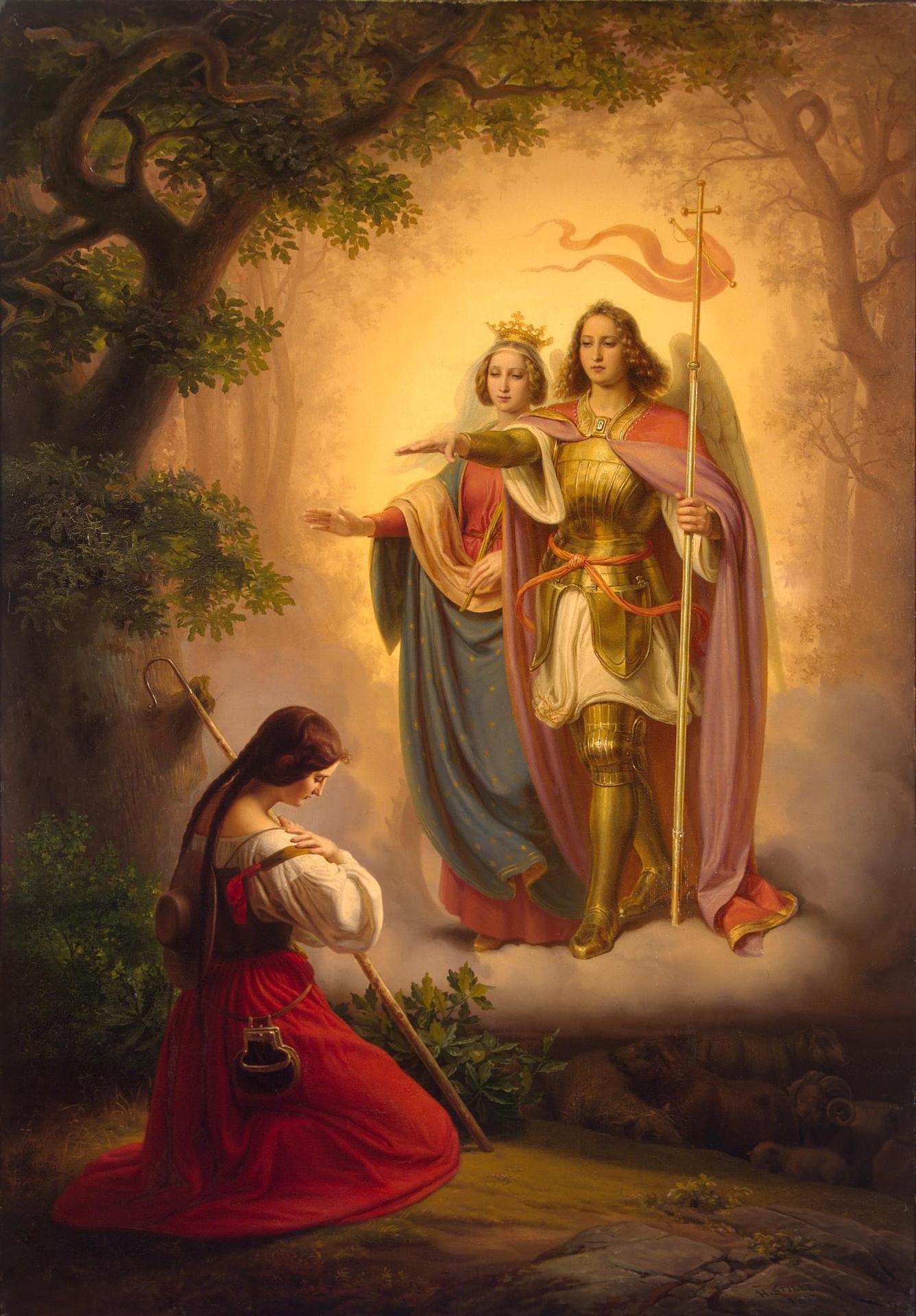
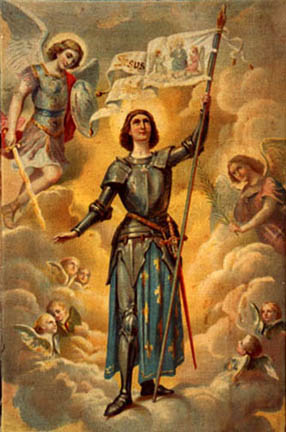
In 1431 May 30 fell upon a Wednesday, the Vigil of Corpus Christi. It was around noon when Jehanne Darc, or Jehanne la Pucelle, "the Maid," as she called herself, was led into the public square of Rouen by enemy soldiers to where the stake awaited her. Nineteen years old, her head shaven, surrounded by placards branding her a witch, idolatress, and abjured heretic, she invoked the Holy Names of Jesus and Mary, and St Michael the Archangel. She had been calumniated and condemned by those whose holy office it was to guide and protect her soul; she had been exposed to lewdness and impurity by those whose sacred duty it was to shelter her innocence and virginity. She was abandoned by the king whose crown her victories had won. She was in great interior darkness; the voices of her saints were silent.

Although she conversed with angels and saints, Joan the Maid was known to be practical and blunt. Very feminine, she missed her embroidery and her mother, yet she emerges on the pages of late medieval history like someone from the Acts of the Apostles. Surrounded by miracles, she was herself a Miracle; she led an army to victory at the age of 17, an illiterate peasant girl, who knew nothing of war or politics. She saved France as a nation, for it had all but ceased to exist when she came on the scene.

Such was her Faith that she confounded her judges, while exhausted, frightened and pushed to the breaking point of her mental and physical strength. Denied the Sacraments by her persecutors, she gazed upon the upheld crucifix, calling out, "Jesus! Jesus!" as the flames consumed her. When Joan's ashes were scattered in the river, her heart was found, untouched by the flames, and still bleeding.

"If I walk in the midst of the shadow of death, I shall fear no evil, for Thou art with me, O Lord Jesus." Communion Antiphon for the Feast of St Joan

St. Joan, pray for us!


Monday, May 26, 2025

St. Philip Neri


Today is the feast of the most cheerful of saints:
 On May 23, 1551, he was ordained. He carried on his mission mainly through the confessional. He started hearing confessions before dawn and continued for hours, while men of women of all ages and social rank flocked to him. In his later years, Philip became weak and suffered from many illnesses, each of which was cured through prayer.

On the feast of Corpus Christi, May 25, 1595, Philip was in a radiantly happy mood. All day he had heard confessions and met with visitors. About midnight, he had a severe hemorrhage and the other priests were called to his bedside. They prayed over him and then he raised his hand in Benediction to bless them one last time. As he raised his hand, he passed to his eternal reward. (Read more.)

Saturday, May 24, 2025

Our Lady, Help of Christians

The history of the feast.
This commemoration was introduced in the liturgical calendar by decree of Pope Pius VII on September 16, 1815, in thanksgiving for his happy return to Rome after a long and painful captivity in Savona and France due to Napoleon’s tyrannical power.

By order of Napoleon, Pius VII was arrested, 5 July, 1808, and detained a prisoner for three years at Savona, and then at Fontainebleau. In January, 1814, after the battle of Leipzig, he was brought back to Savona and set free, 17 March, on the eve of the feast of Our Lady of Mercy, the Patroness of Savona.
The journey to Rome was a veritable triumphal march. The pontiff, attributing the victory of the Church after so much agony and distress to the Blessed Virgin, visited many of her sanctuaries on the way and crowned her images (e.g. the “Madonna del Monte” at Cesena, “della Misericordia” at Treja, “della Colonne” and “della Tempestà” at Tolentino). The people crowded the streets to catch a glimpse of the venerable pontiff who had so bravely withstood the threats of Napoleon. He entered Rome, 24 May, 1814, and was enthusiastically welcomed.  (McCaffrey, “History of the Catholic Church in the Nineteenth Cent.”, 1909, I, 52).

The invocation “Help of the Christians” is very old, having been included in the Litany of Loreto by Pope Saint Pius V in 1571, as a token of gratitude to the Most Holy Virgin, by virtue of Christendom’s’ victory in the famous battle of Lepanto. (Read entire article.)

More HERE.

Thursday, May 22, 2025

Saint Rita: A Messy Life


An account of St. Rita's life is as follows:

High in the hills of the republic of Cascia, in a tiny Umbrian village called Roccaporena, Antonio and Amata Lotti were well-respected peacemakers. In 1381, they welcomed their only child, Margherita. In the local dialect, her name meant “pearl," but she was known simply as Rita. Baptized in the church of Saint Augustine in Cascia, Rita became acquainted with the local Augustinian nuns of Saint Mary Magdalene Monastery and was attracted to their way of life. But her parents arranged a marriage for her in order to provide safety and security, and so Rita obediently married Paolo Mancini with whom she had two sons.

 In the troubling political climate of the times, there was often open conflict between families. Paolo was the victim of one such conflict, and he was murdered when their sons were still young. The expectation of society at the time was that the boys should avenge the murder of their father to defend the family honor. Rita, however, influenced by the peacemaking example of her parents, pledged to forgive her husband’s killers. She faced a steep challenge, however, in convincing her sons to do the same. Tradition has it that she often pointed out to them the image of the crucified Christ and the fact that he forgave those who killed him. Within a year, however, both sons succumbed to a deadly illness leaving Rita not only a widow, but also childless. Following these tragedies, Rita placed her trust in God, accepting them and relying on her deep faith to find her way. After eighteen years of marriage, Rita felt called to a second but familiar vocation: to religious life in the Augustinian convent. (Read more.)


 This is one of the most beautiful pieces of writing I have ever read. To quote Fr. Mark:

Catholicism is a fleshy affair: it is the religion of thorns in the flesh and roses in the snow. It is the religion of little children making furtive neighborhood pilgrimages, weaving crowns of flowers for the Mother of God, and secretly lighting candles to the saints. It is the religion of men quietly telling their beads, interceding for their families. It is the religion of those who kneel in prayer at the tombs of the saints and shed tears over holy relics. Catholicism is the religion of little old ladies stopping in church laden with plastic shopping bags and burdened, even more, with concern for their children and their children’s children. It is the religion of the lonely, the confused, the broken, and the wounded who know that, in spite of everything, there is no shame in going to the Crucified Jesus, for He was “despised and rejected by men, a man of sorrows and acquainted with grief” (Is 53:3).
Catholicism is the religion of those tormented by gnawing hungers of the heart and thirsts of the spirit who, with faith and the fear of God, approach the inexhaustible Chalice of the Holy Mysteries for healing and relief. It is the untidy religion of those who trust that God and his saints can sort out whatever mess we have made of our lives and, in the end, by grace alone set all things aright. It all makes one supremely happy, and grateful, to be Catholic.
This was the religion of Saint Rita of Cascia, the wife of a husband who was murdered, the mother of two sons set on vengeance, a widow marked by emotional scars and lacerated by the cruel tongues of the pious. Finally, the doors of the cloister opened to admit her for the last stage of her life, one marked by sickness. Saint Rita’s life was messy.
Saint Rita lifted her eyes to meet the gaze of Christ and lived in His radiance; He blessed her with a thorn from His bloody crown and with a rose to console her in her final hour. By means of these very material signs, “the Counselor, the Spirit of Truth” (Jn 15:26) bore witness in Saint Rita’s life and in the Church to the abiding presence of the Crucified and Risen Lord.
Saint Rita, pray for us today, that we may not live in denial of the messiness of our lives but, rather, find comfort in the bosom of a Church warm with the intercession of the saints, a Church wide open to little children, a Church hospitable to failures and to fools, a Church who knows the value of the “little things” by which all of life can be suffused by paschal grace. (Read more.)

Wednesday, May 21, 2025

Novena to St. Joan of Arc


Here are some prayers in honor of Saint Joan, whose feast day is May 30.
SAINT JOAN OF ARC, GIVE ME STRENGTH!
In this, my time of need, I beg thee to come to my aid.
I humbly ask thee to help me bear my trials with honor,
As I remember you in your earthly agonies.
BLESSED JOAN, DUTY BOUND TO GOD, GIVE ME COURAGE!
You who left family and friends to enter into God’s service,
Devout and valiant to uphold righteousness to the end,
While being insulted and harmed by your enemies.
HOLY JOAN, DAUGHTER OF GOD, GIVE ME FORTITUDE!
Help me to prevail in life and death over evil,
While bearing my injuries with the dignity you showed
When wounded in the breast, head, thigh, and heel.
PIOUS JOAN, HELP ME TO BE FEARLESS!
Abandoned by the king you yourself had crowned,
Captured and sold to the highest bidder,
You put your trust in the King of Heaven to deliver you.
VENERABLE JOAN, HELP ME TO BE UNWAVERING IN MY FAITH!
Beaten, bruised, questioned and accused,
You were denied that which you loved most:
Communion, confession, mass and public prayer.
HEROIC JOAN, HELP ME TO UPHOLD JUSTICE!
Imprisoned, neglected, threatened and condemned,
Sentenced to die as a heretic the most cruel death,
To die by the fire and be raised up in heaven!
GLORIOUS VIRGIN, PLEASE INTERCEDE FOR ME.
Hear this petition and my heartfelt plea.
Pray for me in this, my time of need,
For I believe God will deny you nothing. Amen.
(Here mention you specific request.)


And this:

1) This is Joan, a most pious and simple maiden, who much feared the Lord, and of whom no one ever said an evil word.
2) The Lord raised her up, and behold the maiden was clad in the armor of God, so that she might withstand the snares of the enemy.
3) Her loins girt with verity and covered with the laurels of justice, she took up the shield and helmet of salvation.
4) And behold she raised her hand to the people and showed the nations the miracle of the Lord, so as to put the adversary to flight. Alleluia!
5) The angel guarded her; and when going and when stopping, and when returning, as well as in the midst of the fire, he never abandoned her. Alleluia!


And here is a litany:

Lord, have mercy on us!
Jesus Christ, have mercy on us!
Lord, have mercy on us!
Jesus Christ, hear us!
Jesus Christ, graciously hear us!
Our Heavenly Father, Who is God, have mercy on us!
Son, Savior of the world, Who is God, have mercy on us!
Holy Spirit, Who is God, have mercy on us!
Holy Trinity, Who is God, have mercy on us!
Holy Mary, virgin mother of God, pray for us.
Our Lady of the Assumption, principal patron of France, pray for us.
Saint Michael the Archangel, patron and special protector of France, pray for us.
Saint Catherine of Alexandria, virgin and martyr, pray for us.
Saint Margaret of Antioch, virgin and martyr, pray for us.
Saint Joan of Arc, chosen by God at Domremy, pray for us.
Saint Joan of Arc, informed [of her mission] by Saint Michael, the Archangel and his angels, pray for us.
Saint Joan of Arc, compliant to the call of God, pray for us.
Saint Joan of Arc, confidant [in] and submissive to her voices, pray for us.
Saint Joan of Arc, model of family life and labor, pray for us.
Saint Joan of Arc, faithfully devoted to Our Lady, pray for us.
Saint Joan of Arc, who delighted in the Holy Eucharist, pray for us.
Saint Joan of Arc, model of generosity in the service to God, pray for us.
Saint Joan of Arc, example of faithfulness to the Divine vocation, pray for us.
Saint Joan of Arc, model of union with God in action, pray for us.
Saint Joan of Arc, virgin and soldier, pray for us.
Saint Joan of Arc, model of courage and purity in the field [of battle], pray for us.
Saint Joan of Arc, compassionate towards all who suffer, pray for us.
Saint Joan of Arc, the pride of Orleans, pray for us.
Saint Joan of Arc, glory of Reims, pray for us.
Saint Joan of Arc, liberator of the Country, pray for us.
Saint Joan of Arc, abandoned and imprisoned at Compiegne, pray for us.
Saint Joan of Arc, pure and patient in your prison, pray for us.
Saint Joan of Arc, heroic and valiant before your judges, pray for us.
Saint Joan of Arc, alone with God at the hour of torment, pray for us.
Saint Joan of Arc, martyr of Rouen, pray for us.
Saint Joan of Arc and Saint Therese of Lisieux patronesses of France, pray for us.
All the Saints of France, intercede for us.
Lamb of God, Who take away the sins of the world, have mercy on us, Lord.
Lamb of God, Who take away the sins of the world, graciously hear us, Lord.
Lamb of God, Who take away the sins of the world, have mercy on us, Lord.
Saint Joan of Arc, pray for us, that we may become worthy of the promises of Our Savior Jesus Christ. 
Let us pray.
Oh God, Who has raised up in an admirable manner, the virgin of Domremy, Saint Joan of Arc, for the defense of the faith and [our] country. By her intercession, we ask You that the Church [may] triumph against the assaults of her enemies and rejoice in lasting peace; through Jesus Christ Our Lord. Amen.


Prayer to St. Joan of Arc for Faith

In the face of thine enemies, in the face of harassment, ridicule, and doubt, thou didst hold firm in thy faith. Even in thy abandonment, alone and without friends, thou didst hold firm in thy faith. Even as thou didst face thy own mortality, thou didst hold firm in thy faith. I pray that I may be as bold in my beliefs as thee, St. Joan. I ask that thou wilt ride alongside me in my own battles. Help me be mindful that what is worthwhile can be won by persistence in the Faith. Help me hold firm in the Faith. Help me to trust God to enable me to act well and wisely. Amen.

Saturday, May 17, 2025

The Little Way

Today is the centenary of the canonization of St. Thérèse of Lisieux. Pope Benedict XVI once spoke of the Little Way of the Little Flower and recommended reading The Story of a Soul.
  "Little Therese", the Pope continued, "never failed to help the most simple souls, the little ones, the poor and the suffering who prayed to her, but also illuminated all the Church with her profound spiritual doctrine, to the point that the Venerable John Paul II, in 1997, granted her the title of Doctor of the Church ... and described her as an 'expert in scientia amoris'. Therese expressed this science, in which all the truth of the faith is revealed in love, in her autobiography 'The Story of a Soul', published a year after her death".

  Therese was born in 1873 in Alencon, France. She was the youngest of the nine children of Louis and Zelie Martin, and was beatified in 2008. Her mother died when she was four years old, and Therese later suffered from a serious nervous disorder from which she recovered in 1886 thanks to what she later described as "the smile of the Virgin". In 1887 she made a pilgrimage to Rome with her father and sister, where she asked Leo XIII for permission to enter Carmel of Lisieux, at just fifteen years of age. Her wish was granted a year later; however, at the same time her father began to suffer from a serious mental illness, which led Therese to the contemplation of the Holy Face of Christ in his Passion. In 1890 she took her vows. 1896 marked the beginning of a period of great physical and spiritual suffering, which accompanied her until her death.

  In those moments, "she lived the faith at its most heroic, as the light in the shadows that invade the soul" the Pope said. In this context of suffering, living the greatest love in the littlest things of daily life, the Saint realised her vocation of becoming the love at the heart of the Church".(Read more.)

Sunday, May 11, 2025

The Good Shepherd


 From Vultus Christi:

The good Shepherd gives his life spontaneously for his own flock. Jesus already did it a first time  on the Cross—comments Saint Gregory in a homily—but He continues to give it to us every day in the Mysteries of the Sacred Altar. He gave His own life, immolating Himself then on the altar of the Cross; now He gives to us eternal life in the Sacrifice which commemorates His death.

The example of Christ summons whosoever acts in His stead in the Church to imitate Him by the daily sacrifice of commanding. Saint Benedict in fact calls it onus, that is, burden, service, and he desires that the goal of the prelate’s office should be the advantage of the flock, and not indeed the miserable prestige of the prelate: Sciatque sibi oportere prodesse magis quam praeesse. (Rule Ch. 64: ‘And let him know that he ought to be of profit more than to be at the head.’)

So that the sheep may not grow weary, the abbot must walk and run himself. So that the long journey towards the sheepfold may not tire the weakest, the abbot must carry them on his shoulders. So that they may finally recover their health, the abbot must wear out his own: Noverit se infirmarum curam suscepisse animarum, non super sanas tyrannidem. (Rule, Ch. 27: ‘Let him know that he has accepted the care of infirm souls, and not indeed the tyranny over the healthy.’) (Read more.)


Saturday, May 10, 2025

Madame Elisabeth's Prayer


Here is a prayer of Madame Elisabeth, the sister of Louis XVI, to the Sacred Heart of Jesus:
Adorable heart of Jesus, sanctuary of the love that led God to make himself man, to sacrifice his life for our salvation, and to make of his body the food of our souls: in gratitude for that infinite charity I give you my heart, and with it all that I possess in this world, all that I am, all that I shall do, all that I shall suffer. But, my God, may this heart, I implore you, be no longer unworthy of you; make it like unto yourself; surround it with your thorns and close its entrance to all ill-regulated affections; set there your cross, make it feel its worth, make it willing to love it. Kindle it with your divine flame. May it burn for your glory; may it be all yours, when you have done what you will with it. You are its consolation in its troubles, the remedy of its ills, its strength and refuge in temptation, its hope during life, its haven in death. I ask you, O heart so loving, the same favour for my companions. So be it.
O divine heart of Jesus! I love you, I adore you, I invoke you, with my companions, for all the days of my life, but especially for the hour of my death.
O vere adorator et unice amator Dei, miserere nobis. Amen.

Madame Elisabeth was guillotined on May 10, 1794 and her Cause for Beatification has been introduced. More HERE.

Monday, May 5, 2025

Saint Angelus


 Killed by the Cathars. From Catholicism: "Saint Angelus was born at Jerusalem and was the son of Jewish parents who had been converted to Christianity. He became a Carmelite priest and worked many miracles. He was martyred by heretics at Palermo in Sicily for defending the Catholic Faith."

From Wikipedia:

He was born in Jerusalem in 1185 to the Jewish parents Jesse and Maria.[1] His mother later converted to Roman Catholicism, and both he and his twin brother John were baptised when she converted. His parents died while he was in his childhood and the Patriarch Nicodemus oversaw their education until the twins turned eighteen. He and his brother John entered the Carmelites aged eighteen at the Saint Anne convent near the Golden Gate to commence their novitiate. The two could speak Greek as well as both Latin and Hebrew.[3][1]

In 1210, he was ordained to the priesthood in Jerusalem and he travelled in Palestine.[3] Miraculous cures were attributed to him around this time and his "acta" stated that he sought to avoid fame and withdrew to a hermitage in the desert (in imitation of Jesus Christ) when he was becoming popular for his miracles. He remained as a hermit on Mount Carmel when he was instructed in 1218[4] to leave for the Italian peninsula in order to preach against the patarini as well as the Albigensians and the Bulgars. He had likewise been instructed to go to Rome to obtain from Pope Honorius III confirmation of the new and definitive rule for the order (later granted in 1226).[3]

He set off on a Genoese ship on 1 April 1219 and stopped first in Messina before heading off to Civitavecchia before he ended up in Rome to meet with the pope. The friar preached in the Basilica of Saint John Lateran while in Rome where he met both Francis of Assisi and Dominic of Osma. It is said that he foretold that Francis would receive the stigmata while Francis foretold his premature death.[1] From there, he was a guest of the Basilians in Palermo where he was for over a month before preaching in Agrigento for over a month before settling in Licata. He had healed seven lepers and the ailing Archbishop of Palermo Bernardo de Castanea while in Palermo.[2] He settled on the Sicilian island though his fame as a wonderworker caused crowds to flock to him. He also had success in converting some Jews though most Jews in Palermo came to despise him for this since he himself was once Jewish.[2]

He wanted to convert a Cathar knight named Berenger (known also in sources as Berengarius).[2] Tradition states that Berenger was living in incest and that the friar convinced the knight's companion to leave Berenger. Berenger became enraged and had him attacked in front of the church of Santi Filippo e Giacomo in Licata on 1 May 1220, and was struck with Berenger's sword five times.[1] He died of his wounds within the week of 5 May and according to tradition asked for his assassin to be pardoned while urging the faithful not to avenge his death. He was buried at Santi Filippo e Giacomo. (Read more.)
My novel on the Cathars, HERE.

Sunday, May 4, 2025

Mystogia


Fr. Angelo
on the discipline of the secret.
Even so, we may regret, at least theoretically, the complete loss of the discipline of the secret, especially today when the introduction of the mundane and even the profane into the precincts of our sanctuaries have stripped the faithful of a sense of the sacred and mysterious.  The tragic consequence of this has been the systematic cultivation of irreverence.

But the discipline of the secret is built into the sacred mysteries we celebrate during Easter.  Our Lord celebrated the first Mass in the upper room into which he ensconced the apostles for the preservation of the mysteries of Holy Thursday.  Into that enclosed space they would return, as a huddled and fearful band, after the events of Good Friday, and into that enclosed and locked space Our Lord would reenter in order to reveal to them that which he did not reveal to all.  As St. Peter said of himself and his companions, the Lord manifested Himself not to all the people, but to witnesses preordained by God, even to us, who did eat and drink with him, after he arose again from the dead (Acts 10:41).

Our Lord also initially hid Himself from His inner circle, as He did to St. Mary Magdalen at the Holy Sepulcher, to the disciples on the road to Emmaus and to Peter and his companions at the Lake of Galilee.  Certainly this deprivation of their ability to recognize Him was symbolic of their own lack of faith and of the power of the Resurrection to break down that barrier against faith. They knew him in the breaking of bread (Lk 24:35).  But may we not also reflect that the revelation of what was hidden underscores the mysterious content of the faith and the mystical or dark way in which the activity of God touches our soul?

St. Bonaventure says that we must enter the tomb with Jesus—into another enclosed space—and there we must die and experience the suspension of our senses.  He is not necessarily referring to ecstasy, but what belongs more fundamentally to the mystical life, namely, a new way of thinking that is not dependent on what we see, but on what the Lord tells us.  Of course, first of all that means what the Church teaches, but it also must mean the manner in which we assimilate it through our own efforts to surrender in faith in the silence of prayer. (Read entire post.)
Related Posts with Thumbnails