Monday, June 30, 2025

Quo Vadis

Quo Vadis by the Polish author Henryk Sienkiewicz is a jewel of historical fiction. While the 1951 film is excellent, it is dated; the novel, however, transcends time. The heartrending and vivid portrait of Roman life in the days of Nero combines a romance with the acta sanctorum amid breathtaking historical accuracy. The feelings of the young tribune Marcus Vinicius for the Christian maiden Ligia Callina are transformed by sacrifice and suffering from mere lust into profound love and devotion. In the meantime the early Church prepares to face a grueling ordeal at the hands of Nero. The brutality and decadence of Imperial Rome stand in glaring contrast to the indefatigable new sect, guided and instructed by Peter and Paul. The Christians must deal not only with the violence of the pagans but with some of their own members who betray and deceive. Indeed, part of the impact of the novel is the way it conveys continuity of the past with the present. Followers of Christ must struggle with their own sins and weaknesses as much as with the outside world which seeks to destroy them. It was not easy then; it is not easy now.

Henryk Sienkiewicz (1846-1916) received the Nobel Prize for Quo Vadis. He was writing to encourage his Polish countrymen in their many difficulties, and combined superb story-telling with painstaking historical research. Although I prefer the book to the movie, I do not hesitate to recommend the latter. Among 1950's Biblical epics, Quo Vadis is outstanding. Peter Ustinov's performance as Nero is truly something worth watching; few actors could capture the same balance of comedy, pathos and unmitigated depravity. The sets are magnificent as well, and the flow of drama, quite piercing. It is a good way to glean both history and inspiration while being entertained.


Sunday, June 29, 2025

What Fairer Light?

For the last few days I have been thinking on and off of the Holy Apostles Peter and Paul, whose martyrdom is celebrated today in the universal church, and of how two men with such different personalities would come to share a similar fate. St. Peter was a robust and practical fisherman from a small town. St. Paul was more cosmopolitan, a scholar, a pharisee, and a Roman citizen. They were both killed in a public and grisly manner far, far from their homeland. One was crucified, the other was beheaded.

How easy it would have been to have retired to some safe corner somewhere where they would not have bothered anyone! To just give up preaching, and writing all those letters, and generally harassing the pagans and correcting lax Christians...surely they had already done and suffered enough! Didn't they have a right to live their own life, and find some peace and quiet? After all, they had given up all for God, and now they were old...why couldn't they obscurely die in bed?


Ask St Peter, as he was fleeing from Rome, where Nero was burning Christians at his garden parties, and suddenly he ran into Our Lord, Who was walking along the Appian Way in the opposite direction.

Quo vadis, Domine? "Where are you going, Lord?" asked St Peter.

"To Rome, to be crucified again," Jesus replied. And St. Peter knew what he had to do...he had to go back. He was arrested and crucified, upside down, at his own request, for he felt unworthy to die in the same manner as his Master. He was always deeply humbled by the memory of his past denial.

Here are some words from the ancient and beautiful hymn for this feast, "What fairer light?"

Rejoice, O Rome, this day; thy walls they once did sign
With princely blood, who now their glory share with thee.
What city's vesture glows with crimson deep as thine?
What beauty else has earth that may compare with thee?

Thursday, June 26, 2025

"I am Meek, and Humble of Heart"

From Vultus Christi:
The humility of the Heart of Jesus so impressed itself on Saint Peter that, years later, he enjoined the sheep of his flock to remain humble and trusting when visited by suffering:
Be you humbled under the mighty hand of God, that He may exalt you in the time of visitation casting all your care upon Him, for He hath care of you. (1 Peter 5:6–7)
The Epistle begins with the 6th verse of Chapter 5, but one who applies himself to his lectio divina will discover that it is the 5th verse of the same Chapter that casts light over all that follows:
In like manner, ye young men, be subject to the ancients. And do you all insinuate humility one to another, for God resisteth the proud, but to the humble he giveth grace. (1 Peter 5:5)
The quaint expression, “do you all insinuate humility one to another” may strike one as curious, given the modern slightly negative connotation of the verb “to insinuate”, but the word, understood according to its etymology is exactly right. Insinuate contains the two Latin words, in sinu, meaning in the bosom, in the breast, or in the heart. The man who insinuates humility takes it deeply into himself. Saint Peter would have the young men, whom he is addressing, hold humility in their hearts. What humility? The humility of Jesus, Peter’s Divine Master, who presents Himself to us as meek, and humble of heart. Every time one receives Holy Communion, it is an insinuation (a taking into the deepest part of oneself) of the humility of Jesus. The soul who abides silent and receptive before the Most Blessed Sacrament will, over time, experience an insinuation of the silence of the Host, of the humility of the Host, of the hiddenness of the Host. 

Wednesday, June 25, 2025

Consecration to the Sacred Heart

Fr. Mark discusses the importance of enthroning the Sacred Heart of Jesus as King of our families.
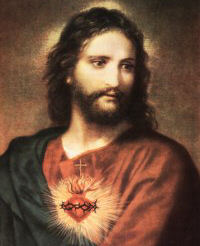
The value of images of the Sacred Heart derives from this: that the pierced Heart of Jesus sets before our eyes the whole mystery of the merciful love of God, softens our resistances to that love, and invites us to grown in confident surrender to it. One understands just why Our Lord said to Saint Margaret Mary: "I will bless those places wherein the image of My Sacred Heart shall be exposed and venerated."
Enthronement of the Sacred Heart
"Behold, I stand at the door and knock; if any one hears my voice and opens the door, I will come in to him and eat with him, and he with me" (Ap 3:20). The enthronement of an image of the Sacred Heart in one's home is a way of opening family life to the merciful love of Christ. Those who introduce an image of the Sacred Heart into their homes express their desire to say with the Apostle John, "So do we know and believe the love God has for us" (1 Jn 4:16). God who inspires that desire will also fulfill it.

Tuesday, June 24, 2025

Carmel and St. John the Baptist

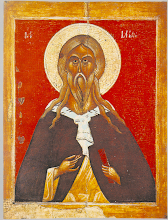
St. John the Baptist has long been a favored saint among Carmelites not only because of his kinship to Jesus and Mary, but because of his connection with the Prophet Elias as well. As one history of the Carmelite Order says:
The date of the foundation of the Order of Our Lady of Mount Carmel has been under discussion from the fourteenth century to the present day, the order claiming for its founders the prophets Elias and Eliseus, whereas modern historians, beginning with Baronius, deny its existence previous to the second half of the twelfth century. As early as the times of the Prophet Samuel there existed in the Holy Land a body of men called Sons of the Prophets, who in many respects resembled religious institutes of later times. They led a kind of community life, and, though not belonging to the Tribe of Levi, dedicated themselves to the service of God; above all they owed obedience to certain superiors, the most famous of whom were Elias and his successor Eliseus, both connected with Carmel, the former by his encounter with the prophets of Baal, the latter by prolonged residence on the holy mountain. With the downfall of the Kingdom of Israel the Sons of the Prophets disappear from history. In the third or fourth century of the Christian Era Carmel was a place of pilgrimage, as is proved by numerous Greek inscriptions on the walls of the School of the Prophets: "Remember Julianus, remember Germanicus", etc. Several of the Fathers, notably John Chrystostom, Basil, Gregory Nazianzen, and Jerome, represent Elias and Eliseus as the models of religious perfection and the patrons of hermits and monks. These undeniable facts have opened the way to certain conjectures. As St. John the Baptist spent nearly the whole of his life in the desert, where he gathered around him a number of disciples, and as Christ said he was endowed with the spirit and virtue of Elias, some authors think that he revived the institute of the Sons of the Prophets. (Read more.)

Monday, June 23, 2025

Midsummer's Eve

It is St. John's Eve. Tomorrow is the Feast of the Nativity of St. John the Baptist, born without the stain of original sin. It was a tradition in the days of Christendom to have a bonfire in honor of the saint who was a "burning and shining light." (John 5:35) In some places, they still do; my father always had a bonfire in honor of the Birthday of the Baptist. In the Middle Ages, there were St. John carols (carols were not just for Christmas), dancing, and everyone would burn rubbish and old bones as a sign of the end of the old covenant. Houses would be decorated with St. John's Wort, and young girls would sleep with wildflowers under their pillows in the hope that they would dream of their future spouse. Fish Eaters, which has the details about the festivity, also discusses how the Vespers hymn for St. John's Day is the origin for "Do, Re, Mi:"
Another interesting thing about the Feast of St. John: the Breviary's hymn for this day, Ut queant laxis -- the hymn sung or recited during the blessing of the bonfire -- is the source of our names of musical notes -- Do, Re, Mi, Fa, So, La, Ti, Do. The hymn, attributed to Paulus Diaconus (Paul the Deacon, ca. A.D. 720-799), was noted by a monk to rise one note in the diatonic C-Scale with each verse. The syllables sung at each rise in pitch give us the names of our notes (the "Ut" was later changed to "Do" for easier pronunciation):
Ut queant laxis
Re
sonare fibris
Mi
ra gestorum
Fa
muli tuorum,
So
lve polluti
La
bii reatum,
Sanc
Te Ioannes.

Saturday, June 21, 2025

The Joy of Charity

Charity flows abundantly from the Sacred Heart of Jesus. Here is what Father Lovasik says about charity in The Hidden Power of Kindness (Sophia Institute Press, 1999):
Joy is the reward of charity. This intimate joy of the soul is distinguished from all other joys by its purity. The joy that is the fruit of charity is abiding. All earthly happiness exhausts itself, except the happiness of a loving heart that knows how to share the joys and sorrows of others. The joy of charity is one of the few joys that support you at the hour of death.

Friday, June 20, 2025

Gaze Upon Christ

From Vultus Christi:
I have known souls whose concentration on sin is more intense than their concentration on the Face of Christ and on the merciful love of His Heart. These souls are never at peace. They are forever examining themselves, and searching for evidence of sin and imperfection where they should be searching for evidence of the grace of Christ and His readiness to raise up the fallen, heal the broken-hearted, and bind up their wounds.

It is more effective, and more fruitful, to love virtue than to live, at every moment, in the fear of vice. By this I do not mean that one should not fear vice and hate sin; I mean, rather, that to focus on such things is unhealthy for the soul and breeds a spirituality of pessimism and gloom. (Read more.)

Monday, June 16, 2025

Hidden in the Sacred Heart of Jesus

From Vultus Christi:
Devotion to the Sacred Heart, thus understood, is a manifestation in the Church of the Holy Spirit, "helping us in our weakness; for we do not know how to pray as we ought" (Rom 8:26).5 The Sacred Heart is, in the life of the Church, the organ by which "the Spirit intercedes for the saints according to the will of God" (Rom 8:27).
Cardinal Ratzinger wrote: "We see who Jesus is if we see him at prayer. The Christian confession of faith comes from participating in the prayer of Jesus, from being drawn into his prayer and being privileged to behold it; it interprets the experience of Jesus' prayer, and its interpretation of Jesus is correct because it springs from a sharing in what is most personal and intimate to him".6

This is the prayer of the Sacred Heart, the prayer that filled the days and nights of Jesus' earthly life, the prayer that suffused his sufferings and ascended from the Cross at the hour of his death, the prayer that with him descended into the depths of the earth, the prayer that continues uninterrupted in the glory of his risen and ascended life, the prayer that is ceaseless in the Sacrament of the Altar....

The prayer of the Heart of Christ at the hour of his sacrifice passes entirely into the heart of the Church, where it is prolonged and actualized "from the rising of the sun to its setting" (Mal 1:11) in the Liturgy of the Hours and in the mystery of the Eucharist.

Cardinal Ratzinger asks if, after the once-for-all Pasch of Jesus, anything more is needed. "After the tearing of the Temple curtain and the opening up of the heart of God in the pierced heart of the Crucified, do we still need sacred space, sacred time, mediating symbols? Yes, we do need them, precisely so that, through the 'image', through the sign, we learn to see the openness of heaven. We need them to give us the capacity to know the mystery of God in the pierced heart of the Crucified".14

It is through the liturgy, first and above all, that we pass over into the prayer of the Sacred Heart, the word to the Father forever inscribed in his pierced side.

Monday, June 9, 2025

The Oblation of Saint Thérèse

On June 9, 1895, at the Carmel of Lisieux, Saint Thérèse made the Act of Oblation to Merciful Love. In her autobiography she said: "I received the grace to understand, more than ever, how much Jesus desires to be loved." Instead of offering herself as victim to the justice of God, as did other religious, taking upon themselves the "punishment reserved for sinners," Saint Thérèse decided to offer herself as a victim to the Merciful Love of God. She asked to be consumed as a holocaust in the fire of the Sacred Heart, in order to console that Heart and save souls. "Fire transforms all things into itself, " the saint wrote in her Act of Oblation. "I know that the fire of love is more sanctifying than the fire of Purgatory."
 
With her Act of Oblation, Saint Thérèse did not expect sufferings to go away. "I wish to suffer for Love's sake and for Love's sake even to rejoice...I will sing always, even if my roses must be gathered among thorns...." In a letter to her sister Celine, she explained: "The burden of our song is suffering. Jesus offers us a chalice of great bitterness. Let us not withdraw our lips from it, but suffer in peace. He who says peace does not say joy, or at least sensible joy....Do not think we can find love without suffering...."

Through her Oblation to Merciful Love, Saint Thérèse gained a deep insight into her Carmelite vocation. "I understand that love embraces all vocations, that it is all things, and that it reaches out through all ages, and to the uttermost limits of the earth, because it is eternal....In the heart of the Church my Mother, I will be love." She prayed that after her death she be allowed to "return to earth" to keep saving souls. She said: "I want to spend my heaven doing good upon earth."

"You will look down from Heaven, will you not?" asked her sister when Saint Thérèse was mortally ill. 

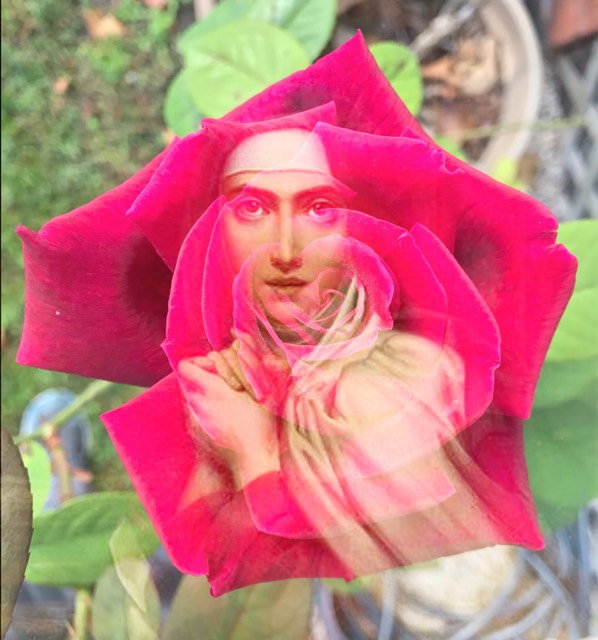
"No," replied the dying young woman. "I will come down." Another time she said: "After my death, I will let fall from Heaven a shower of roses." On September 30, 1897, in great mental and physical agony, the twenty-four year old nun, gasping for breath, proclaimed: "I do not regret having surrendered myself to Love." A few hours later, her last words were: "My God, I love You."

The miracles which followed her death took the Church and the world by storm.

(All quotations are from the book Soeur Thérèse of Lisieux, The Little Flower, 1912)

Saturday, June 7, 2025

Impossible Things

What to do when faced with the impossible. To quote Fr. Mark:
Every moment of crisis is an opportunity to confide our perplexities, worries, fears, and griefs to the maternal Heart of Mary. She is capable of listening to all with a benevolent silence. Her Immaculate Heart discerns what is best for each of us. And if we are silent enough, childlike enough, and even a little humble, she will counsel us and restore our troubled hearts to a peace that the world (and all its professional counselors) cannot give.

Blessed Anne of St. Bartholomew

Today is the feast of a Carmelite saint, Blessed Anne, the secretary and confidante of the Holy Mother St. Teresa of Avila. Here is her biography:
She entered in 1570 at the age of 21, taking the religious name Sr. Anne of St. Bartholomew and becoming the first discalced Carmelite lay sister. She made her profession on August 15th 1572 and was given the duty of infirmarian. In 1574 Anne went with St. Teresa to Valladolid and Medina del Campo. After that she became ill herself and was unable to travel for two years, but Teresa thought very highly of Anne and in 1577 she became her secretary and nurse. In the last five years of her life Teresa needed help with her large correspondence as she was often too tired or too ill to write herself, but she was able to dictate her letters. Anne had still not learnt to write, so Teresa gave her two lines of her own handwriting and told her to learn. In one afternoon Anne persevered and obeying Teresa’s directive she learned to write; this was cited as one of Teresa’s miracles in the process for her beatification, though it is true that, since Anne could read, she was already familiar with letters, which no doubt helped her learn to write. In the last years of Teresa’s life Anne wrote a great many letters for Teresa at her dictation. Teresa wanted Anne to receive the black veil and become a choir nun, but Anne begged to remain a lay sister, as she did not know how to read Latin which was required for the Divine Office and she said she would prefer to serve the community in practical ways than have the burden of administration. Teresa allowed her to remain a lay sister but predicted correctly that she would eventually become a choir nun. Anne visited many monasteries with Teresa and helped her with the foundations of Villanueva de la Jara, Palencia, Soria and Burgos. She was a dedicated nurse helping Teresa through her many health problems and attending to her lovingly in her last journeys. Teresa died in Anne’s arms at Alba de Tormes in 1582. (Read more.)

Wednesday, June 4, 2025

Novena to Saint Anthony of Padua

THE MIRACULOUS RESPONSORY OF ST. ANTHONY
By St. Bonaventure

1. If then you ask for miracles,
Death, error, all calamities,
The leprosy and demons fly,
And health succeeds infirmities.
Chorus:
The sea obeys, and fetters break,
And lifeless limbs thou dost restore,
Whilst treasures lost are found again,
When young and old thine aid implore.
2. All dangers vanish at thy prayer,
And direst need doth quickly flee;
Let those who know thy power proclaim,
Let Paduans say: "These are of thee."
Chorus:
The sea obeys, and fetters break,
And lifeless limbs thou dost restore,
Whilst treasures lost are found again,
When young and old thine aid implore.
3. To Father, Son, may glory be,
And Holy Spirit eternally.
Chorus:
The sea obeys, and fetters break,
And lifeless limbs thou dost restore,
Whilst treasures lost are found again,
When young and old thine aid implore.
Pray for us, St. Anthony,
That we may be made worthy of the promises of Christ.
Let us pray.
O God! May the votive commemoration of St. Anthony, Thy Confessor and Doctor, be a source of joy to Thy Church, that she may always be fortified with spiritual assistance and may deserve to possess eternal joy. Through Christ Our Lord. Amen.
Related Posts with Thumbnails