Showing posts with label Sacred Heart. Show all posts

Monday, October 5, 2026

The Debate Over St. Faustina

 From Christine Niles:

October 5th is the feast day of St. Faustina. Debate continues to swirl around her and the Divine Mercy devotion. In this episode (originally aired June 6, 2023), Christine Niles delves into St. Faustina's life and the controversies surrounding Divine Mercy to answer the question: Is Divine Mercy a fraud — or is it one of God's greatest gifts to the modern world? 

 Objection 1: St. Faustina's diary was placed on the Index of Forbidden Books. 

ANSWER: This was owing to errors in the Italian translation. Once an accurate translation was commissioned, any errors were eliminated and the ban was lifted in 1978. 

Objection 2: Divine Mercy preaches unconditional mercy without sacrifice. 

ANSWER: False. St. Faustina was given a terrifying vision of Hell, and confirmed that many souls who reject God and His mercy will end up there. She also practiced many penances and mortifications in reparation for sinners, understanding that suffering is the price of sin. 

Objection 3: How could Our Lord say to St. Faustina that He united Himself more intimately with her than with any other creature, when God clearly unites Himself more intimately with Our Lady? 

ANSWER: He clearly meant He united Himself with her more intimately than with any other mortal creature at that time living on earth — not for all time. 

 Objection 4: How could St. Faustina claim the Lord told her, “From today on, do not fear God’s judgment, for you will not be judged.” 

ANSWER: Any saint who dies in the state of perfection and goes directly to Heaven is exempt from judgment. Saint Faustina lived an extraordinarily holy life and is now a canonized saint; it would not be difficult to believe that God granted her the extraordinary grace not only of sainthood, but of knowing that she would escape judgment. (Read more and listen.)


Tuesday, September 15, 2026

Our Lady of Sorrows


"Holy Mother, pierce me through;
In my heart each wound renew
Of my Saviour, crucified."
~ Stabat Mater
How well do the words of the Stabat Mater reflect the words of Simeon to Our Lady: "Thy own soul a sword shall pierce." (Luke 2:35) According to many saints, the Blessed Virgin suffered throughout her life, knowing that her Son was to undergo a cruel death. Her sufferings reached their climax at the foot of the Cross. As St. Elizabeth of the Trinity wrote: "O Queen of Virgins, you are also the Queen of Martyrs; but it was written within your heart that the sword transpierced you, for with you everything took place within your soul."

Few are called to physical martyrdom, but all Christians are called to compassionate the Saviour at the foot of the Cross. Like the heart of Mary, the heart of the Holy Mother St. Teresa was also mystically pierced. We can apply to her, in a much lesser degree, of course, the Responsory from the Vespers of Our Lady of Sorrows: "Happy is she who without dying has won the martyr's crown." (Roman Breviary)

Sunday, September 6, 2026

Novena to Our Lady of Sorrows

My brothers and sisters in Christ, let us pray for all who suffer because of slavery and war. And please pray for my family.
V. O God, hasten to my aid.
R. O Lord, make haste to help me.
V. Glory be to the Father and to the Son and to the Holy Ghost.
R. As it was in the beginning, is now, and ever shall be, world without end. Amen.
1. I grieve for thee, O Mary most sorrowful, in the affliction of thy tender heart at the prophecy of the holy and aged Simeon. Dear Mother, by thy heart so afflicted, obtain for me the virtue of humility and the Gift of the holy Fear of God.
2. I grieve for thee, O Mary most sorrowful, in the anguish of thy most affectionate heart during the flight into Egypt and thy sojourn there. Dear Mother, by thy heart so full of anguish, obtain for me the virtue of generosity, especially toward the poor, and the Gift of Piety.
3. I grieve for thee, O Mary most sorrowful, in those anxieties which tried thy troubled heart at the loss of thy dear Jesus in the Temple. Dear Mother, by thy heart so full of anguish, obtain for me the virtue of chastity and the Gift of Knowledge.
4. I grieve for thee, O Mary most sorrowful, in the consternation of thy heart at meeting Jesus as He carried His Cross. Dear Mother, by thy heart so troubled, obtain for me the virtue of patience and the Gift of Fortitude.
5. I grieve for thee, O Mary most sorrowful, in the martyrdom which thy generous heart endured in standing near Jesus in His agony on the Cross. Dear Mother, by thy afflicted heart, obtain for me the virtue of temperance and the Gift of Counsel.
6. I grieve for thee, O Mary most sorrowful, in the wounding of thy compassionate heart, when the side of Jesus was pierced by a lance before His Body was removed from the Cross. Dear Mother, by thy heart thus transfixed, obtain for me the virtue of fraternal charity and the Gift of Understanding.
7. I grieve for thee, O Mary most sorrowful, for the pangs that wrenched thy most loving heart at the burial of Jesus. Dear Mother, by thy heart sunk in the bitterness of desolation, obtain for me the virtue of diligence and the Gift of Wisdom.
Let us pray.
Let intercession be made for us, we beseech Thee, O Lord Jesus Christ, now and at the hour of our death, by the throne of Thy mercy, by the Blessed Virgin Mary, Thy Mother, whose most holy soul was pierced by a sword of sorrow in the hour of Thy bitter Passion, through Thee, O Jesus Christ, Savior of the world, Who with the Father and the Holy Ghost lives and reigns world without end. Amen.

Wednesday, September 2, 2026

September Martyrs of the French Revolution


Let us not forget the September Martyrs, including the murder of Madame de Lamballe. 

 France was populated with Catholics prior to social and political upheavals in 1787. The agitations reached initial climax in 1789, thus, the expression Revolution of 1789 to denote the end of ancient regime in France. On October 10, 1789, the properties of the Catholic Church were seized by the National Constituent Assembly as assignats, or security for expropriated lands. On July 12, 1790, the Civil Constitution was approved, which subordinated the Catholic Church to the French government, which the pope and clergy detested. The archbishop of Arus, France, refused to uphold the Constitution and was imprisoned.

Rumors spread that “foreign and royalist armies would attack Paris,” supported by prisoners who would be freed. On the eve of August 9, 1792, “a Jacobin insurrection overthrew the leadership of Paris Commune, headed by Jerome de Villeneuve who proclaimed a new revolutionary commune, headed by transitional authorities.”

The royal family of King Louis XVI [was arrested] on August 10, 1792, and a “de facto revolutionary commune” took over the government. Since the religious were considered state employees, they were required to swear an oath of allegiance to the state. Priests who abide by the order became constitutional jurors, and those who refused were imprisoned, killed or deported. Monasteries were emptied and transformed into prisons. Religious orders were dissolved. The initial atrocities started when 24 priests, who were being transported for imprisonment in l’Abbaye in Paris, were attacked by an angry mob.

On September 2, 1792, the angry crowds went to the Carmelite church where priests and religious were imprisoned. All were mandated to take the mandatory oath of loyalty to the government. Refusal meant they were enemies of the state and were “hacked to death as they passed down the stairway.”

They called on Archbishop John du Lau to come out. He came out and said: “I am he whom you seek.” In a few minutes, they cracked his skull, stabbed him and trampled him to death. The bishop of Beauvais, who was wounded on the leg, called: “I do not refuse to die with the others, but I cannot walk. I beg you to have the kindness to carry me where you wish me to go.” Bishop François Joseph de la Rochefauld was killed with his brother, Pierre Louis de la Rochefauld, bishop of Saintes. (Nobility org.) Ambrose Chevreux, the last superior-general of the monastic congregation of Saint Maur, was also executed. (Read more.)

Tuesday, September 1, 2026

St. Theresa Margaret of the Sacred Heart of Jesus


One dawn at the Discalced Carmelite chapel in Florence, a lovely, fair-haired girl of seventeen, in white veil and bridal dress, walked slowly down the aisle, candle in her hand. Anna Maria Redi, the beloved eldest child of a noble Tuscan family, offered herself as spouse to the King of Heaven. In doing so, she exchanged wealth and comforts for poverty and humiliations. Joyfully, she gave up her silk dress for the rough brown habit of Our Lady, and undertook to serve Our Lady by adoring her Eucharistic Son.

Re-named "Theresa Margaret," she strove to console the Heart of Christ by performing many penances. One day at Vespers, the words Deus Caritas Est (God is love) sank deep into her soul. She realized that love (not hairshirts) was what counted most. "You know, my God," wrote St. Theresa Margaret, "that my one desire is to be a victim of your Sacred Heart, wholly consumed as a holocaust in the fire of your holy love...dispose of me according to your good pleasure...." she struggled to give up her own will, to be humble and obedient, even when it meant performing duties that were unpleasant, such as caring for a nun who had gone insane.

On March 7, 1770, at age 24, she died after 18 hours of agony due to a mysterious intestinal infection. The incorrupt body of St. Theresa Margaret lies in a glass coffin in the monastery chapel where she once entered as a bride.

Wednesday, August 26, 2026

The Pierced Heart

Today on the Carmelite calendar it is the feast of the Transverberation of the Heart of St. Teresa of Avila. Although the Holy Mother claimed the experience was purely mystical, it was found after her death that her heart had indeed been physically pierced. A priest once told me that such a phenomenon was a stigmata, although not the same stigmata that saints like St. Pio and St Francis of Assisi experienced. Those saints bore the five wounds of Christ; St Teresa bore a single wound in her heart. In this she resembled the Sorrowful Mother, trans-pierced at the foot of the Cross. St. Teresa, and those who wish to follow her in the Carmelite way, are to model the Blessed Virgin Mary, faithful in the greatest moment of darkness which was the crucifixion. It was also the moment of redemption, in which Mary became the Mother of the Church. Through our own sufferings and heartaches, we can participate in the redemption of the world.

Here is an excerpt of Richard Crashaw's "The Flaming Heart", about the transverberation of the heart of St. Teresa:
O heart, the equal poise of love’s both parts,
Big alike with wounds and darts,
Live in these conquering leaves; live all the same,
And walk through all tongues one triumphant flame;
Live here, great heart, and love and die and kill,
And bleed and wound, and yield and conquer still.
Let this immortal life, where’er it comes,
Walk in a crowd of loves and martyrdoms;
Let mystic deaths wait on ’t, and wise souls be
The love-slain witnesses of this life of thee.
O sweet incendiary! show here thy art,
Upon this carcass of a hard cold heart,
Let all thy scatter’d shafts of light, that play
Among the leaves of thy large books of day,
Combin’d against this breast, at once break in
And take away from me my self and sin;
This gracious robbery shall thy bounty be,
And my best fortunes such fair spoils of me.
O thou undaunted daughter of desires!
By all thy dow’r of lights and fires,
By all the eagle in thee, all the dove,
By all thy lives and deaths of love,
By thy large draughts of intellectual day,
And by thy thirsts of love more large than they,
By all thy brim-fill’d bowls of fierce desire,
By thy last morning’s draught of liquid fire,
By the full kingdom of that final kiss
That seiz’d thy parting soul and seal’d thee his,
By all the heav’ns thou hast in him,
Fair sister of the seraphim!
By all of him we have in thee,
Leave nothing of my self in me:
Let me so read thy life that I
Unto all life of mine may die.

Thursday, July 30, 2026

Port-Royal, Jansenism, and St. Thérèse: The Hidden Heresy That Still Haunts Catholicism

Port-Royal Abbey, Paris - Wikipedia
Madame de Montpeyroux, abbess of Port-Royal Abbey

 From Sensus Fidelium:

One of the greatest spiritual battles in Catholic history was not fought over the Trinity, the Eucharist, or even the papacy. It was fought over the character of God Himself.

Is God primarily a loving Father eager to save?

Or is He chiefly a stern Judge searching for reasons to condemn?

That question gave rise to one of the most influential, and spiritually devastating, movements in Church history: Jansenism.

Although officially condemned by multiple popes, its spirit survived for centuries. It shaped convents, seminaries, confessionals, and even family life. Its influence was so pervasive in France that St. Thérèse of Lisieux spent much of her short life offering what amounts to the Church’s greatest practical answer to it.

Ironically, the story begins not with obvious heretics, but with one of the most admired convents in Europe. (Read more.)

About the Little Flower — Little Flower Basilica
St. Thérèse of the Child Jesus


Wednesday, July 22, 2026

St. Mary Magdalen

In the materialistic society in which we must work out our salvation, we have forgotten, if we ever knew at all, what it is to truly fall in love with God. The woman of Magdala, the courtesan of the Roman resort, knew the unhappiness and degradation of being exploited and used. The love of the Son of God, restoring her human dignity with His words and glance, caused her to throw herself at His feet, even as she shattered the jar of alabaster. With the precious ointment she gave her entire self in a complete oblation.

...And the house was filled with the odor of the ointment.
(John 12:3) The fragrance of her repentant love continues to emanate throughout the entire Church, the house of God, especially in the person of the consecrated religious, and all those who kneel in awe before the Blessed Sacrament.


The ancient tradition of the church tells of how the Magdalen, after Our Lord's Ascension into Heaven, went to the South of France and lived in solitude and contemplation in a cave on a mountain. It is that region in which was born the culture of chivalry and courtly love, St. Mary Magdalen was named the patroness of lovers, not of unsanctified love but of chaste love, of the love that requires sacrifice, unselfishness and renunciation in which to thriv
e. She represents the spiritual love which enhances the beauty of the union of bride and groom, that union which foreshadows nothing less than the union of Christ with His Bride the Church in the Paradise of eternity.

In the Litany of the Saints, St. Mary
Magdalen's name appears before the list of all the virgins, so highly prized is her humility and repentance by the Church. May she pray for all woman and girls who are being exploited and for our society, enslaved by its worship of license, a license which is opposed to true freedom. May she pray for my ongoing conversion, and accept this small virtual votive light for all the intentions I offer her today.

Friday, July 17, 2026

Gertrud von le Fort and the Martyrs of Compiègne

I have long been an admirer of Gertrud von le Fort and her novel Song at the Scaffold, about the Blessed Martyrs of Compiègne. Baroness von le Fort's short but powerful depiction of the sixteen Carmelite nuns guillotined in 1795 during the Reign of Terror was the inspiration for the play by Bernanos and the opera by Poulenc, Dialogues des Carmelites. To Quell the Terror by William Bush is an excellent historical treatise on the martyrdom of the Carmelites. It is not widely known that Queen Marie-Antoinette provided a dowry for a poor, pious girl named Mademoiselle Lidoine, so that she could enter the Carmel of Compiègne. Mademoiselle Lidoine became the Mother Prioress of the heroic Martyrs of Compiègne, who like Marie-Antoinette, died on the guillotine during the French Revolution.

There is more HERE from The Inn At The End of the World.

 Here is the final scene from Poulenc's opera:

Thursday, July 2, 2026

The Challenge of the Eucharistic Heart of Jesus

Corpus Christi and the Sacred Heart of Jesus - by Fr. AM 

 From 1P5:

Starting in the 12th century, there began what I like to call the Eucharistic Revolution. It began with Hildebert of Lavardin coining the word “Transubstantiation.” Then began the penning of stories about the Holy Grail; not very reliable as a source of history, they nevertheless incorporate stories of Eucharistic Miracles that would repeatedly occur in real life down to – especially in – our time. During the period they grew in popularity in the 13th century, Transubstantiation was defined as the best way to describe what happens at the Mass, and St. Juliana of Cornillon had her visions which led to the great feast of Corpus Christi. This turn led to the growth of Eucharistic processions, adoration, and much more. But in 1199, Christ appeared to St. Lutgarde of Saint-Trond. This is the first medieval apparition of the Sacred Heart passed down to us through Tradition.

At the same time, devotion grew to Our Lord’s Five Wounds, and their connection to the Eucharist was not unnoticed – after all, it was the same blood that came down daily upon each Altar, was reappearing in miracles (sometimes bleeding from hosts and at others from images of Our Lord), and relics of which were being brought back along a great many others from the Holy Land and Constantinople, thanks to the Crusades. Ss. Gertrude the Great and Mechtilde – both in the Abbey of Helfta, received visions of the Sacred Heart, and St. Bonaventure, and a great many other preached about this Heart and the Blood that flowed from it.

When the Protestant Revolt broke out, the Pilgrims of Grace in England marched against the King’s men under the banner of the Five Wounds. St. Ignatius of Loyola in his Anima Christi Prayer united all elements of devotion to Christ – and St. Peter Canisius spoke frequently of Christ’s Heart and Blood in defence of His Real Presence in the Eucharist; a theme taken up by many Catholic preachers fighting the new heresies. 

[...]

 When the French Revolution broke out in 1789, and drowned that word in fire and blood, the imprisoned Louis XVI privately consecrated the country to the Sacred Heart and vowed to do so publicly if restored to power. This did not happen, as we know. But from the Vendée to Spain to Tyrol, the Sacred Heart became the symbol of Catholic resistance to the revolution. Afterwards, it was a big part of the Catholic Restoration. (Read more.)


Friday, June 26, 2026

Sacred Fire: Practicing Devotion to the Heart of Jesus

Sacred Fire by Philip Michael Bulman is a gem of a book about the development of the devotion to the Sacred Heart of Jesus among the Catholic faithful. From the words of Jesus Himself and the piercing of his Heart to the mystic writings of St. Gertrude and St. Margaret Mary, to the Carmelite saints and ending with St. Faustina and the Divine Mercy revelations, the author shows how the Sacred Heart devotion is firmly rooted in Scripture and Tradition. Not only has the devotion long been a part of the piety of the faithful but in times of crisis the symbol of the Heart of Our Savior has emerged with special power. The back of the book has many prayers, litanies and other devotions. Sacred Fire is a book for every Catholic household.

Thursday, June 25, 2026

Consecration to the Sacred Heart

Fr. Mark discusses the importance of enthroning the Sacred Heart of Jesus as King of our families.
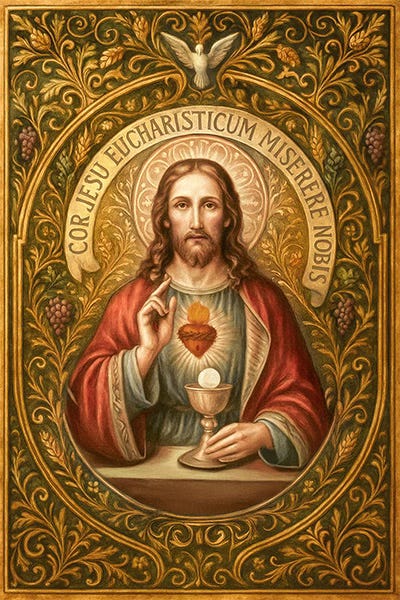
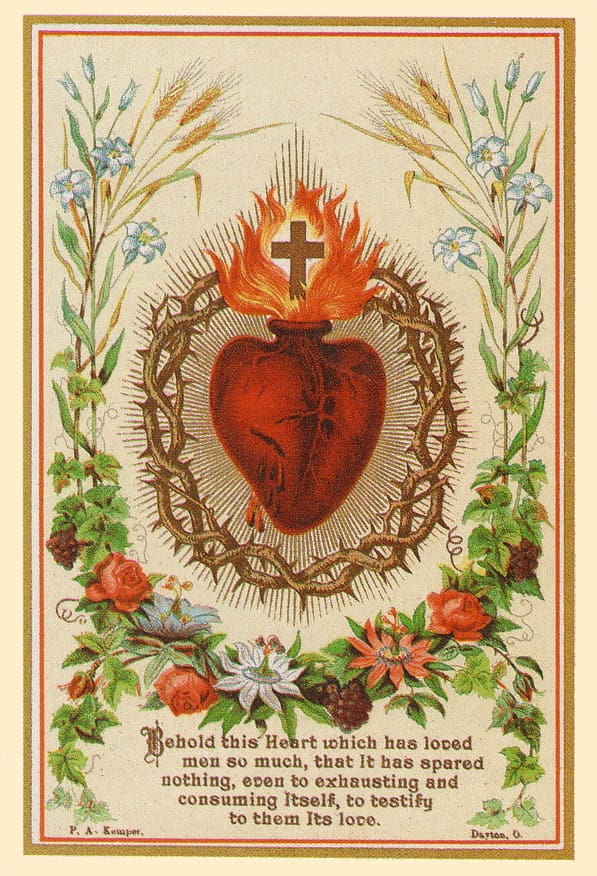
The value of images of the Sacred Heart derives from this: that the pierced Heart of Jesus sets before our eyes the whole mystery of the merciful love of God, softens our resistances to that love, and invites us to grown in confident surrender to it. One understands just why Our Lord said to Saint Margaret Mary: "I will bless those places wherein the image of My Sacred Heart shall be exposed and venerated."
Enthronement of the Sacred Heart
"Behold, I stand at the door and knock; if any one hears my voice and opens the door, I will come in to him and eat with him, and he with me" (Ap 3:20). The enthronement of an image of the Sacred Heart in one's home is a way of opening family life to the merciful love of Christ. Those who introduce an image of the Sacred Heart into their homes express their desire to say with the Apostle John, "So do we know and believe the love God has for us" (1 Jn 4:16). God who inspires that desire will also fulfill it.

Sunday, June 21, 2026

The Joy of Charity

Charity flows abundantly from the Sacred Heart of Jesus. Here is what Father Lovasik says about charity in The Hidden Power of Kindness (Sophia Institute Press, 1999):
Joy is the reward of charity. This intimate joy of the soul is distinguished from all other joys by its purity. The joy that is the fruit of charity is abiding. All earthly happiness exhausts itself, except the happiness of a loving heart that knows how to share the joys and sorrows of others. The joy of charity is one of the few joys that support you at the hour of death.

Saturday, June 20, 2026

Avoiding the Spirit of Criticism

It is with the moral infirmities we may see in one another- our defects of character or temperament, our faults, our failings- that I think we should try to be watchful to exercise charity in thought, word, and deed.

It is so easy and so natural to criticize; yet we cannot do so even interiorly without detriment to our soul. Such thoughts consented to, certainly retard our progress in the perfection of charity, if they do not offend God. And surely the aim of a Carmelite should be higher than to merely keep from offending God. Were we careful to live always that deep interior life that is our obligation as well as our privilege, we would realize that everyone has a right to the most delicate charity from us, and that it is a duty for each to have it for all. Let us try to bring a practical charity into our least relations with one another, never permitting the smallest criticism and always putting a charitable interpretation on the actions of others.

Let us cultivate the habit of thinking kindly of everyone and regarding as a temptation any impulse that would lead us ever to dwell upon the actions of others unless duty demands it of us, and as a greater temptation any impulse to correct them or mention them to another.

If we are watchful over our thoughts in relation to charity, our words will more easily take on a kindly tone. When our work brings us in contact with others, let us always show them the spirit of humility, respect, and deference that charity calls for, whether the persons we work with are older or younger, or in a higher or lower position that we are.

It is with this same delicate charity we should speak of one another if persons happen to to be the subject of our conversation either private or general, and this is only possible when our own spirit is being guided by the Holy Spirit Whose light would cause us to see our neighbor 'in the Sacred [Heart] of the Savior,' as St. Francis de Sales says. To be faithful to this charity means the practice of much self-denial. It will be to give place to that Spirit Who is all charity, Whose fruits are peace, joy and holiness.

~Fragrance from Alabaster
by Mother Aloysius of the Blessed Sacrament, OCD

Friday, June 19, 2026

Sacred Heart Badge


"We rose hastily," says Madame Royale . . . "My poor brother was asleep; they pulled him roughly from his bed to search it . . . They took from my mother the address of a shop, from my Aunt Élisabeth a stick of sealing-wax, and from me a Sacred Heart of Jesus and a Prayer for France."
That Sacred Heart of Jesus and that Prayer for France were closer bound together than would seem at first; and perhaps she needed all her faith in the one to be able at that moment to pray for the other.
~from The Duchesse d'Angoulême by C-A Sainte-Beuve

Accompanying devotion to the Sacred Heart of Jesus are the little badges which over the years have had great significance on many levels. Here is a brief history:
Our Lord revealed to St. Margaret Mary Alacoque "His wish for her to order a picture of the image of that Sacred Heart for people specifically to venerate and have in their homes and also small pictures to carry with them." She wrote this to her Superior, Mother Saumaise, on March 2, 1686. Thus was born the devotion of wearing the little Badges.
St. Margaret Mary Alacoque always kept a badge with her and inspired her novices to do the same. She made many badges and often said this practice was very pleasing to the Sacred Heart. In the beginning, only nuns of the Visitation were allowed to wear the Badge. It was later spread by Venerable Ana Magdalena Rémuzat, a religious of the Visitation who died in the odor of sanctity (1696-1730). Our Lord told this nun that a serious epidemic would afflict the French city of Marseilles in 1720, and that its inhabitants would receive a marvelous help through this devotion to His Sacred Heart. Mother Rémuzat, helped by her sister in the convent, made thousands to Sacred Heart Badges and distributed them throughout the city where the plague was rampant.
Soon afterward, the epidemic stopped as if by a miracle. Many Badge wearers were not infected and even people who got sick experienced extraordinary help through the Badge. Analogous events happened elsewhere. From then on, use of the badge spread to other cities and countries.
The news of the graces obtained through the Badges reached the Court. Maria Lesczynska, wife of King Louis XV became devoted to the Badge. In 1748 she received several Badges from Pope Benedict XIV as a wedding gift. Among the various presents sent by the Pontiff were "many Badges of the Sacred Heart made of red taffeta and embroidered in gold," the records say.
Special emblem of counter-revolutionaries
The unfortunate French Revolution erupted in France in 1789, a worse punishment than any plague, causing tragic consequences for the whole world. True Catholics found protection in the Most Sacred Heart of Jesus during that period. Many priests, nobles, and commoners who resisted the bloody anti-Catholic revolution wore the Badge. Even ladies of the Court, like the Princess of Lamballe, wore the Badge embroidered with precious materials over fabric. The simple fact of wearing it became a distinctive sign of those who opposed the French Revolution.
Among the belongings of Queen Marie Antoinette, guillotined out of revolutionary hatred, was found a drawing of the Sacred Heart, with the wound, the cross, and crown of thorns, and the inscription: "Sacred Heart of Jesus, have mercy on us!"
In 1793, when the peasants of the Vendée revolted against the anti-Christian character of the French Revolution, they wore the Sacred Heart Badge into battle, with cries of "Rembarre!" The gallant revolt was viciously put down by the Revolutionary government; in the name of liberty, many men, women and children were tortured and massacred. To don the emblem of the Sacred Heart was to be an enemy of the new world order.

Wednesday, June 17, 2026

Vow of Louis XVI to the Sacred Heart


There is a great deal of misunderstanding on the internet concerning the Consecration of France to the Sacred Heart by Louis XVI. It is not true that the king made the Vow/Consecration in the Temple prison while awaiting execution. He made it while still living at the Tuileries palace. In the spring of 1791, after signing the Civil Constitution of the Clergy a few months earlier, King Louis XVI fell ill at the Tuileries, where the royal family were living under house arrest. His illness was undoubtedly the result of the stress of the upheavals which he had tried to prevent, as well as the fact that his conscience was troubling him about signing the Catholic Church in France over to the revolutionary government, severing the ties with Rome. Louis had signed it under duress but deeply regretted his decision immediately.

According to biographer Bernard Fay, Louis made the Vow under the guidance of his non-juring confessor, a Eudist priest Fr. Hebert. In the 1600's a Visitation nun, Saint Margaret Mary, had claimed that Jesus had requested that the King of France consecrate France to His Sacred Heart. The consecration had never been performed. So, with the help of Fr. Hebert, Louis drafted the following Vow, which he sealed in the walls of his apartments.

The Vow was not found until the palace had been partially burned by the Commune and was being torn down in 1871. It was discovered still sealed in the wall of the king's room. Louis was a locksmith and was fascinated with construction, so building a hiding place for his papers would not have been beyond him. He was known for his penchant for secrecy and his hiding of private papers from prying eyes. The fact that the Vow was not discovered until the 1870's demolishes the claim of some that it was merely a product of pious forgery during the 1814-1830 Restoration. The methodical legality of the document is typical of Louis XVI, who as an amateur cartographer was characterized by his precision and attention to detail. The translation is a bit rough because it is mine, with some help from Google.

Dedication of France to the Sacred Heart of Jesus by King Louis XVI

You see, ô my God! all the wounds which tear my heart, and depth of the abyss into which I have fallen. Evils without number surround me on all sides. My personal misfortunes and those of my family, which are dreadful, overwhelm my heart, as well as those which cover the face of the kingdom. The cries of all the unfortunate ones, the moaning of oppressed religion resounds in my ears, and an interior voice still informs me that perhaps Your justice reproaches me with all these calamities, because, in the days of my power, I did not repress the license of the people and the irreligion, which are the principal sources; because I served the weapons of heresy which triumphed, by supporting it by laws which doubled its forces and gave it the audacity to dare all.

I will not have temerity, ô my God! to justify to myself before You; but You know that my heart was always subject to faith and morals; my faults are the fruit of my weakness and seem worthy of Your great mercy. You forgave King David, who caused your enemies to blaspheme You and King Manassès, who had involved his people in the idolatry. Disarmed by their penitence, you restored them one and the other on the throne of Juda; you made them reign with peace and glory. Would You be inexorable today towards a son of Saint Louis, who takes these penitent kings for models, and which, with their example, wishes to repair his faults and to become a King according to Your Heart?

O Jesus-Christ! divine Redeemer of all our iniquities, it is in Your Adorable Heart that I want to deposit the overflowing of my afflicted heart. I call upon the help of the tender Heart of Mary, my majestic protector and my mother, and the assistance of Saint Louis, my most famous patron and of my ancestor. O adorable Heart, by the so pure hands of my powerful intercessors, receive with kindness the wishes that confidence inspires in me and that I offer to You like the humble expression of my feelings. If, by an effect of the infinite kindness of God, I recover my freedom, my crown and my royal power, I promise solemnly:

1. To revoke as soon as possible all the laws which will be indicated to me, either by the Pope, or by a Council, or by the four Bishops chosen among most enlightened and most virtuous of my kingdom, with the purity and the integrity of the faith, the discipline and the spiritual jurisdiction of Holy Catholic, Apostolic Church, Roman, and in particular to revoke the Civil Constitution of the Clergy.

2. To take, in a one year interval, in union with the Pope and the Bishops of my kingdom, all measurements necessary to establish, according to the canonical forms, a solemn festival in honor of the Sacred Heart of Jesus, which will be celebrated in perpetuity in all France, on the first Friday after the octave of the Blessed Sacrament, and always followed by a general procession, in repair of the insults and profanations made in the time of the disorders, by the schismatics, the heretics and the bad Christians.


3. To go myself in person, within three months from the day of my delivery, to the church of Notre-Dame of Paris, or in any other principal church of the place where I will be, and to pronounce, one day of Sunday or festival, at the foot of the high altar, after the offertory of the Mass, and between the hands of the celebrant, a solemn act of dedication of my person, my family and my kingdom to the Sacred Heart of Jesus, promising to give to all my subjects, the example of the worship and the devotion which are due to this adorable Heart.


4. To set up and to decorate at my own expense, in the church which I will choose for it, within one year from the day of my delivery, an altar which will be dedicated to the Sacred Heart of Jesus, and which will be used as an eternal monument of my recognition and my confidence without end in the infinite merits and in the inexhaustible treasures of grace which are contained in this Crowned Heart.


5. Finally, to renew every year, in the place where I will be, on the Feast of the Sacred Heart, the act of dedication expressed in the third article, and to attend the general procession which will follow the Mass of this day. Today I pronounce only in secrecy this promise, but I would sign it my blood if it were needed; and the most beautiful day of my life will be that where I will be able to aloud publish it in the temple. O Adorable Heart of my Savior! Let my right hand be forgotten and let me curse myself, if I forget Your blessings and my promises, if I cease to love You, finding my confidence in You and all of my consolation. Amen.

Here is the original French:


Consécration de la France au sacré-Coeur de Jésus


Vous voyez, ô mon Dieu ! toutes les plaies qui déchirent mon coeur, et la profondeur de l'abîme dans lequel je suis tombé. Des maux sans nombre m'environnent de toutes parts. A mes malheurs personnels et à ceux de ma famille, qui sont affreux, se joignent pour accabler mon âme, ceux qui couvrent la face du royaume. Les cris de tous les infortunés, les gémissements de la religion opprimée retentissent à mes oreilles, et une voix intérieure m'avertit encore que peut-être votre justice me reproche toutes ces calamités, parce que, dans les jours de ma puissance, je n'ai pas réprimé la licence du peuple et l'irréligion, qui en sont les principales sources ; parce que j'ai fourni moi-même des armes à l'hérésie qui triomphe, en la favorisant par des lois qui ont doublé ses forces et lui ont donné l'audace de tout oser.

Je n'aurai pas la témérité, ô mon Dieu ! de me justifier devant vous ; mais vous savez que mon coeur a toujours été soumis à la foi et aux règles des moeurs ; mes fautes sont le fruit de ma faiblesse et semblent dignes de votre grande miséricorde. Vous avez pardonné au roi David, qui avait été cause que vos ennemis avaient blasphémé contre vous ; au roi Manassès, qui avait entraîné son peuple dans l'idolâtrie. Désarmé par leur pénitence, vous les avez rétabli l'un et l'autre sur le trône de Juda ; vous les avez fait régner avec paix et gloire. Seriez-vous inexorable aujourd'hui pour un fils de saint Louis, qui prend ces rois pénitents pour modèles, et qui, à leur exemple, désire réparer ses fautes et devenir un Roi selon votre coeur ?
O Jésus-Christ ! divin Rédempteur de toutes nos iniquités, c'est dans votre Coeur adorable que je veux déposer les effusions de mon âme affligée. J'appelle à mon secours le tendre Coeur de Marie, mon auguste protectrice et ma mère, et l'assistance de saint Louis, mon patron et le plus illustre de mes aïeux.
Ouvrez-vous, Coeur adorable, et par les mains si pures de mes puissants intercesseurs, recevez avec bonté les voeux satisfactoires que la confiance m'inspire et que je vous offre comme l'expression naïve de mes sentiments.
Si, par un effet de la bonté infinie de Dieu, je recouvre ma liberté, ma couronne et ma puissance royale, je promets solennellement :
1_ De révoquer le plus tôt possible toutes les lois qui me seront indiquées, soit par le Pape, soit par un Concile, soit par quatre Evêques choisis parmi les plus éclairés et les plus vertueux de mon royaume, comme contraires à la pureté et à l'intégrité de la foi, à la discipline et à la juridiction spirituelle de la sainte Eglise catholique, apostolique, romaine, et notamment la Constitution civile du clergé ;
2_De prendre, dans l'intervalle d'une année, tant auprès du Pape qu'auprès des Evêques de mon royaume, toutes les mesures nécessaires pour établir, suivant les formes canoniques, une fête solennelle en l'honneur du Sacré-Coeur de Jésus, laquelle sera célébrée à perpétuité dans toute la France, le premier vendredi après l'octave du Saint-Sacrement, et toujours suivie d'une procession générale, en réparation des outrages et des profanations commises dans le temps des troubles, par les schismatiques, les hérétiques et les mauvais chrétiens.
3_D'aller moi-même en personne, sous trois mois, à compter du jour de ma délivrance, dans l'église Notre-Dame de Paris, ou dans toute autre église principale du lieu où je me trouverai, et de prononcer, un jour de dimanche ou de fête, au pied du maître-autel, après l'offertoire de la messe, et entre les mains du célébrant, un acte solennel de consécration de ma personne, de ma famille et de mon royaume au Sacré-Coeur de Jésus, avec promesse de donner à tous mes sujets, l'exemple du culte et de la dévotion qui sont dus à ce Coeur adorable.
4_D'ériger et de décorer à mes frais, dans l'église que je choisirai pour cela, dans le cours d'une année à compter du jour de ma délivrance, une chapelle ou un autel qui sera dédié au Sacré-Coeur de Jésus, et qui servira de monument éternel de ma reconnaissance et de ma confiance sans bornes dans les mérites infinis et dans les trésors inépuisables de grâce qui sont renfermés dans ce Coeur Sacré.
5_Enfin de renouveler tous les ans, au lieu où je me trouverai, le jour qu'on célébrera la fête du Sacré-Coeur, l'acte de consécration exprimé dans l'article troisième, et d'assister à la procession générale qui suivra la messe de ce jour.
Je ne puis aujourd'hui prononcer qu'en secret cet engagement, mais je le signerais de mon sang s'il le fallait ; et le plus beau jour de ma vie sera celui où je pourrai le publier à haute voix dans le temple.
O Coeur adorable de mon Sauveur ! Que j'oublie ma main droite et que je m'oublie moi-même, si jamais j'oublie vos bienfaits et mes promesses, si je cesse de vous aimer et de mettre en vous ma confiance et toute ma consolation. Ainsi soit-il.
Tuesday, June 16, 2026

Confidence and Abandonment

...Abandonment is, I may dare to say, the principle virtue of souls devoted to the Sacred Heart....By abandonment He offers them a means by which they are enabled to participate in His almighty power. He opens to them them the treasures of His Heart, which undertakes to supply for all the shortcomings of souls abandoned to Him, and to perfect all their works. He makes them docile instruments, who place no obstacles to the action of God, and faithfully give Him the glory in all....Confidence by itself can easily obtain all things.

~ Love, Peace and Joy by the Reverend André Prévot

Monday, June 15, 2026

Of Fatima, the King of France, and the Consecrations

Let us revisit a post by Fr. Richard Heilman on Roman Catholic Man:
On Sunday May 13th, 1917, the children were pasturing their flock as usual at the Cova da Iria, which was about a mile from their homes. They were playing when suddenly a bright shaft of light pierced the air. The lady spoke to them and said: “Fear not! I will not harm you.” “Where are you from?” the children asked. “I am from heaven” the beautiful lady replied, gently raising her hand towards the distant horizon. “What do you want of me?”, Lucia asked. ” I came to ask you to come here for six consecutive months, on the thirteenth day, at this same hour. I will tell you later who I am and what I want.”

It was Mary’s final appearance, on Oct. 13, 1917 (exactly 33 years, to the day, after Pope Leo XIII’s vision), that became the most famous. An estimated 70,000 people were in attendance at the site, anticipating the Virgin’s final visit and with many fully expecting that she would work a great miracle. As everyone gazed upward, and saw that a silvery disc had emerged from behind clouds, they experienced what is known [as] a ‘sun miracle.’ Not everyone reported the same thing; some present claimed they saw the sun dance around the heavens; others said the sun zoomed toward Earth in a zigzag motion that caused them to fear that it might collide with our planet (or, more likely, burn it up). Some people reported seeing brilliant colors spin out of the sun in a psychedelic, pinwheel pattern. The whole event took about 10 minutes.

With these apparitions at Fatima, God asked for the Consecration of Russia to the Immaculate Heart of Mary by the Pope in union with all of the bishops of the world. Our Lady of Fatima said that if the Consecration of Russia was done, Russia would be converted and there would be peace. However, if the Pope and the bishops did not obey the request, Our Lady said that Russia would spread her errors throughout the world, causing wars and persecutions of the Church and of Holy Father, the martyrdom of the good and the annihilation of nations. I find it interesting that Our Lady appeared in Fatima with these warnings exactly 100 years before the 500th anniversary of the Protestant revolt (1517-2017).

[...]

At Rianjo, Spain in August 1931, Our Lord communicated to Sister Lucy His dissatisfaction with the Pope’s and the Catholic bishops’ failure to obey His command to consecrate Russia. He said:
Make it known to My ministers, given that they follow the example of the King of France in delaying the execution of My requests, they will follow him into misfortune. It is never too late to have recourse to Jesus and Mary.
In another text Lucy wrote that Our Lord complained to her:
They did not wish to heed My request! Like the King of France they will repent of it, and they will do it, but it will be late. Russia will have already spread its errors in the world, provoking wars and persecutions against the Church. The Holy Father will have much to suffer.
 The reference by Jesus to the King of France’’s disobedience and punishment is as follows:
On June 17, 1689 the Sacred Heart of Jesus manifested to Saint Margaret Mary Alacoque His command to the King of France that the King was to consecrate France to the Sacred Heart. For 100 years to the day the Kings of France delayed, and did not obey. So on June 17, 1789 the King of France was stripped of his legislative authority by the upstart Third Estate, and four years later the soldiers of the French Revolution executed the King of France as if he were a criminal. In 1793 France sent its King, Louis XVI, to the guillotine. He and his predecessors had failed to obey Our Lord’s request that France be consecrated to the Sacred Heart of Jesus, and thus misfortune had befallen both the King and his country. (Read more.)
Now it must be noted that Louis XVI, with the consent and guidance of his confessor, the Eudist priest Fr. Hebert, made a Vow to the Sacred Heart in the spring of 1791 when he and his family were under house arrest at the Tuileries Palace in Paris. To quote from the Vow:
O Jesus-Christ! divine Redeemer of all our iniquities, it is in Your Adorable Heart that I want to deposit the overflowing of my afflicted heart. I call upon the help of the tender Heart of Mary, my majestic protector and my mother, and the assistance of Saint Louis, my most famous patron and of my ancestor. O adorable Heart, by the so pure hands of my powerful intercessors, receive with kindness the wishes that confidence inspires in me and that I offer to You like the humble expression of my feelings. If, by an effect of the infinite kindness of God, I recover my freedom, my crown and my royal power, I promise solemnly:
1. To revoke as soon as possible all the laws which will be indicated to me, either by the Pope, or by a Council, or by the four Bishops chosen among most enlightened and most virtuous of my kingdom, with the purity and the integrity of the faith, the discipline and the spiritual jurisdiction of Holy Catholic, Apostolic Church, Roman, and in particular to revoke the Civil Constitution of the Clergy. (Read more.)
The King was killed before he could fulfill his Vow. There are more details in my biography of Louis's wife, Marie-Antoinette.

Meanwhile, Cardinal Burke has called for Russia to be consecrated in the manner requested by Our Lady of Fatima:
“It is evident that the consecration (of Russia) was not carried out in the manner requested by Our Lady,” said Vatican Cardinal Raymond Burke in his keynote address marking the highlight and conclusion of the Fatima Centennial Summit held over the weekend.

“I do not doubt for a moment the intention of Pope St. John Paul II to carry out the consecration on March 25, 1984,” said Cardinal Burke. He noted that Sister Lucia stated that “Our Lady had accepted it.”

He continued nonetheless, “Recognizing the necessity of a total conversion from atheistic materialism and communism to Christ, the call of Our Lady of Fatima to consecrate Russia to Her Immaculate Heart in accord with Her explicit instruction remains urgent.”

The former head of the Vatican’s highest court reissued his call, first made at the Rome Life Forum in May, for the faithful to pray and work for the consecration of Russia according to Our Lady’s specific instruction. He quoted the end of the famous secret to the children where Our Lady Herself predicted: “In the end, my Immaculate Heart will triumph. The Holy Father will consecrate Russia to me, and she shall be converted, and a period of peace will be granted to the world.” With some 700 attendees, the conference was the largest Fatima centennial celebration in North America. To a standing ovation both before and after he spoke, Cardinal Burke delved deeply into the message of Our Lady of Fatima, her predictions and the consequences of failing to heed her warnings to the world. The Cardinal drew a direct line from the famous Third Secret of Fatima’s dire predictions for the massacre of priests, religious and the death of the Pope to the current crisis in the Church.

“The teaching of the Faith in its integrity and with courage is the heart of the office of the Church’s pastors: the Roman Pontiff, the Bishops in communion with the See of Peter, and their principal co-workers, the priests,” he said. “For that reason, the Third Secret is directed, with particular force, to those who exercise the pastoral office in the Church. Their failure to teach the faith, in fidelity to the Church’s constant teaching and practice, whether through a superficial, confused or even worldly approach, and their silence endangers mortally, in the deepest spiritual sense, the very souls for whom they have been consecrated to care spiritually.”

Cardinal Burke, who has suffered publicly for his defense of the faith, urged the faithful, “Let us not fail to embrace whatever suffering comes from our faithful witness to Him Who is the true Treasure of our hearts.”

“Let us not give way to discouragement but rather remember that the Immaculate Heart of the Blessed Virgin Mary assumed into glory, never ceases to beat with love for us, the children Her Divine Son gave to Her as He was dying on the cross,” he said. (Read more.)


And the Consecration has been made, HERE and HERE.

Saturday, June 13, 2026

The Immaculate Heart of Mary


"My heart and my flesh have rejoiced in the living God." (Psalm 83:4)

Devotion to the Immaculate Heart of Mary has grown along side of the devotion to the Sacred Heart, for the heart of the Mother can never be separated from that of her Son. According to the visionary St. Bridget of Sweden (14th century), Our Lady said: "As Adam and Eve sold the world for one apple, so my son and I redeemed the world, as it were, with one Heart." (Sign of Her Heart by John Haffert)

St. John Eudes, who in the 17th century promoted devotion to the Two Hearts, reported to have heard Our Lord saying: "I have given you this admirable heart of My dearest Mother which is but one with Mine, to be truly your heart also, in order that the children may have but one heart with their Mother...." (Ibid.)

The Belgian mystic Berthe Petit (1870-1943) experienced several revelations concerning the "Sorrowful and Immaculate Heart of Mary." She recorded Jesus as saying:
This devotion to the Sorrowful and Immaculate Heart of My Mother will restore faith and hope to broken hearts and to ruined families...it will sweeten sorrow. It will be a new strength for My Church, bringing souls not only to confidence in My Heart, but also to abandonment to the Sorrowful Heart of my Mother. (Prayers and Heavenly Promises by Joan Carroll Cruz)
The 1917 apparitions of Our Lady in Fatima, Portugal led to Pope Pius XII instituting the feast of the Immaculate Heart of Mary. Originally kept on August 22, the memorial of the Immaculate Heart is presently kept on the day after the Solemnity of the Sacred Heart.

The mystery of the Immaculate Heart is the mystery of the Mercy of God; the mercy He showed to Mary by preserving her from all stain of original sin; the mercy He bestows on us through the prayers of the Mother of Mercy, the Mediatrix of all Graces, on our behalf. It is a mystery of compassion, for Mary's heart was pierced with sorrow at the foot of the cross. The brown scapular of Carmel is a sign of one's personal consecration to Our Lady, as well as of the compassionate intercession we hope to receive from her at the hour of death.

Sr. Lucy of Fatima said: "Our Lady wants all to wear the scapular." (Haffert) The scapular is an exterior sign of interior abandonment to the Heart of Mary. The Carmelite Venerable Michael of St. Augustine wrote:
We can live in Mary if we strive, in all our deeds and omissions, in our penances and trials and afflictions, to preserve and promote within ourselves a filial, tender inclination of soul towards Mary....Our love will then flow, as it were, from God to Mary and from Mary back to God. (Life with Mary by Ven. Michael of St. Augustine)

Friday, June 12, 2026

Feast of the Sacred Heart of Jesus


"I have come to cast a fire on the earth: what will I, but that it be kindled?" (Luke 12:49)

During the first millennium of Christianity, many saints wrote with unction of the pierced side of Our Lord, from which flowed "blood and water" (John 19:34), symbolizing the sacraments of the Church. It was not until the later ages, "when the charity of many [had] grown cold" (Matthew 24:12), that Our Lord chose to reveal the hidden treasures of His Sacred Heart. The gnostic excesses of the Manicheans, the upheavals of the Protestant revolt, and the chilling exaggerations of Jansenism required as an antidote the gradual but compelling manifestations of the love and mercy of the Heart of God.

It was in the thirteenth century that mystic souls such as St. Bonaventure, St. Mechtilde, and St. Gertrude began to write explicitly about devotion to the Sacred Heart, focusing on the infinite love which pursues and surrounds us. St. Gertrude the Great relates that in one of her many visions St. John the Evangelist said to her:
To these latter times was reserved the grace of hearing the eloquent voice of the Heart of Jesus. At this voice the time-worn world will renew its youth, be roused from its lethargy, and again be inflamed with the warmth of Divine Love. ( Love, Peace and Joy by the Reverend André Prévot)
 Our Lord told St. Mechtilde:  
In this wound of love, so great that it embraces Heaven and earth, unite thy love to My Divine Love, that it may be perfect; and even as iron glowing with fire becomes, as it were, one with it, so let your love be transformed and absorbed into Mine. (Ibid.)
In the early 1600's, St John Eudes and St Francis de Sales, among others, promoted the cult of the Sacred Heart. However, it was the famous apparitions of Jesus Christ to St. Margaret Mary in the 1670's and 80's that led to the widespread, public homage of the Savior's heart. Our Lord revealed to St. Margaret Mary His desire for the establishment of a feast in honor of His Heart, to be held on the Friday after the Corpus Christi octave, as a day of reparation. He promised special graces to those who receive Holy Communion in a spirit of reparation and penitence on the First Friday of nine consecutive months.

Jesus further requested that France, the eldest daughter of the Church, be consecrated by her king to the Sacred Heart, in order to spare the kingdom from future cataclysmic events. For several reasons, the consecration was not performed until France was in the throes of a bloody and anti-Christian revolution. In 1791, the imprisoned King Louis XVI secretly made the consecration. However, it seems the formal, public consecration of France has never taken place.

In 1856, Pope Pius IX placed the feast of the Sacred Heart on the universal calendar. Meanwhile, the storm of modernism, communism, socialism, and secular humanism broke upon the Church and the world. Our Lord said to St. Margaret Mary in 1689: "It will take time, but I will reign despite Satan and his supporters." (The Sign of Her Heart by John Haffert)

While we prayerfully await the public acknowledgment of Christ the King by the nations, let us imitate the Carmelite saints in making Jesus the King of our hearts, immersing ourselves into the unfathomable mystery of His love. In the words of St. Thérèse of the Child Jesus: 
If I to see Thy glory would aspire
Then I must know Thy crucible of flame

Thy burning love, Heart of my God, I claim.

Then when my soul wings upward like a dove,

Called from the earth to heaven's home of light,

May it go forth in one pure act of love,
 
Plunge to Thy Heart in one unswerving flight.
(Carmelite Proper of the Liturgy of the Hours)
Related Posts with Thumbnails