Wednesday, April 16, 2025

Wednesday of Holy Week

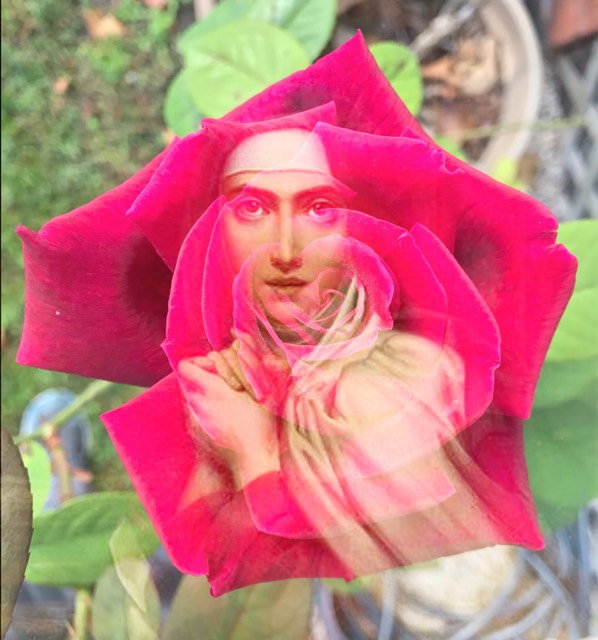
Madonna of the Precious Blood
From Vultus Christi:
We confess the self-emptying obedience of Christ, obedience even to the death of the cross, calling him LORD. We summon the entire cosmos — things in heaven, on earth, and under the earth — to adoration of his Name! Already, we lift our eyes to the see the glory of the risen and ascended Christ. The very melody of the introit scales an entire octave to soar into the heights, obliging us to “seek the things that are above” (Col 3:1). Dame Aemiliana speaks of “the irresistible, shining tone of triumph with which today’s Mass straightaway puts the approaching shadows of evening to flight.” Like Saint Stephen at the hour of his death, we see Christ in the glory of God the Father. “Behold, I see the heavens opened, and the Son of Man standing on the right hand of God” (Acts 7:56). The Crucified is our Kyrios, the triumphant king, raised up into the glory of the Father.
[...]

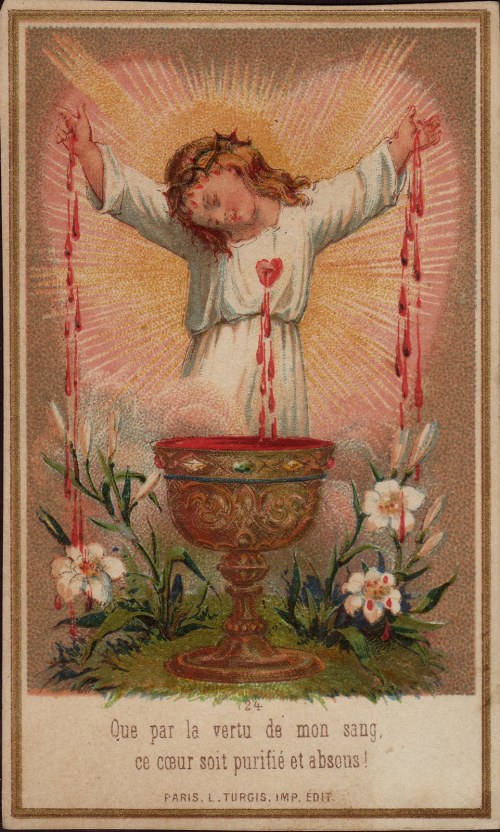
The Communion Antiphon begins today with a mysterious word, a word of the suffering Christ, given to sustain us. Potum meum cum fletu temperebam. “I mingled my drink with weeping” (Ps 101:10). The chalice is given Christ by the Father. “Father, if thou art willing, remove this cup from me; nevertheless not my will, but thine, be done” (Lk 22:42). The chalice of Christ’s sufferings is made full when he adds to it his own tears, the tears of a Man, the tears of God. This is the chalice offered us in the Eucharist: a communion with the suffering Christ, a communion in his blood and in his tears. He mingled his drink with weeping to make our drink sweet. He was lifted up and thrown down (cf. Ps 101:10) that we who are thrown down might, by grace, be lifted up. He became withered like the grass (cf. Ps 101:11) that the garden of the kingdom might be planted and flourish and grow beautiful among us. (Read more.)
And they shall say to him: What are these wounds in the midst of thy hands? And he shall say: With these I was wounded in the house of them that loved me. (Zacharias 13:6)
  

Tuesday, April 15, 2025

Tuesday of Holy Week


From Dom Gueranger:

On the road from Bethania to Jerusalem, the Disciples are surprised at seeing the fig-tree, which their Divine Master had yesterday cursed, now dead. Addressing himself to Jesus, Peter says: Rabbi, behold, the fig-tree, which thou didst curse, is withered away. In order to teach us that the whole of material nature is subservient to the spiritual element, when this last is united to God by faith—Jesus replies: Have the faith of God. Amen I say to you, that whosoever shall say to this mountain: Be thou removed and cast into the sea! and shall not stagger in his heart, but believe, that whatsoever he saith shall be done, it shall be done unto him.

Having entered the City, Jesus directs his steps towards the Temple. No sooner has he entered, than the Chief Priests, the Scribes, and the Ancients of the people accost him with these words: By what authority dost thou these things? and who has given thee this authority, that thou shouldst do these things? We shall find our Lord’s answer given in the Gospel. Our object is to mention the leading events of the last days of our Redeemer on earth; the holy Volume will supply the details.

As on the two preceding days, Jesus leaves the City towards evening: he passes over Mount Olivet, and returns to Bethania, where he finds his Blessed Mother and his devoted friends.

In today’s Mass, the Church reads the history of the Passion according to St.Mark, who wrote his Gospel the next after St. Matthew: hence it is that the second place is assigned to him. His account of the Passion is shorter than St. Matthew’s, of which it would often seem to be a summary; and yet certain details are peculiar to this Evangelist, and prove him to have been an eyewitness. Our readers are aware that St. Mark was the disciple of St. Peter, and that his Gospel was written under the very eye of the Prince of the Apostles. (Read more.)

Monday, April 7, 2025

A Time of Increased Spiritual Warfare

It is a time of increased spiritual warfare. It is Passiontide, which always sees an increase of spiritual warfare. I am reminded of my Irish ancestors who were forced to go without the regular life of the church for 300 years when their religion was outlawed. They lost all their civil rights for being Catholic. But they persevered.

Lately, I have been recalling the prophecy of the "Three Days Darkness," a time when the forces of hell will be unleashed and the faithful are bidden to stay in their homes with plenty of sacramentals and unceasing prayer. Here is Emmett O'Regan's article from 2013 in Unveiling the Apocalypse:
It thus appears that the prophecies of the Three Days of Darkness refer to the long night-time of the Great Apostasy, which must take place before the dawn of the Second Pentecost. And there can be little doubt that we are currently enduring a spiritual dark age, with millions of baptised Catholics deliberately forsaking their faith, in order to engage in the current hedonistic excesses that are being sponsored by the consumer-driven mass media.

Three days of darkness before a time of enlightenment is a recurring theme in the Bible, which all directly points to the three days of Christ's Passion, Death and Resurrection. Starting with the Agony in the Garden, Jesus had to endure terrible suffering before His death on the Cross on Good Friday. On Holy Saturday, He even descended into Sheol itself in order to free the captives that were imprisoned there (1Pet 3:19-20; 4:6). But with His glorious Resurrection on the third day, he gave us the light of eternal life.   

We all know that Jonah being in the belly of a great fish for three days and three nights (Jon 1:17) prefigured the Resurrection of Christ. But we can find some other biblical references to three days of darkness. The Book of Acts tells us that Saul was without sight for three days before starting his new life in Christ (Acts 9:9). The Apocalypse tells us that the Two Witnesses lie dead on the streets of Jerusalem for three and a half days before they are restored to life:

For three and a half days some from the peoples and tribes and languages and nations will gaze at their dead bodies and refuse to let them be placed in a tomb, and those who dwell on the earth will rejoice over them and make merry and exchange presents, because these two prophets had been a torment to those who dwell on the earth. But after the three and a half days a breath of life from God entered them, and they stood up on their feet, and great fear fell on those who saw them.
(Rev 11:9-11)

And to borrow from the "Finding in the Temple" analogy once again, it is interesting to note that the boy Jesus was found in the Temple after three days:

Now his parents went to Jerusalem every year at the Feast of the Passover. And when he was twelve years old, they went up according to custom. And when the feast was ended, as they were returning, the boy Jesus stayed behind in Jerusalem. His parents did not know it, but supposing him to be in the group they went a day's journey, but then they began to search for him among their relatives and acquaintances, and when they did not find him, they returned to Jerusalem, searching for him. After three days they found him in the temple, sitting among the teachers, listening to them and asking them questions. And all who heard him were amazed at his understanding and his answers.
(Luke 2:41-47)

The recurring theme of "three days" in Scripture therefore almost universally focuses on a new and glorious dawn after a time of great spiritual darkness. Much like the "Dark Night of the Soul" experienced by St. John of the Cross and various other mystics, it seems that in order to attain spiritual perfection, we must endure a long night of darkness before seeing the light of union with the Creator.  As St. Paul states above in 2Cor 3:4-6, the light of of the knowledge of the glory of God will eventually shine out of the darkness, just as the light of Creation was brought forth through the Eternal Logos after the Spirit moved on the face of the deep:

In the beginning, God created the heavens and the earth. The earth was without form and void, and darkness was over the face of the deep. And the Spirit of God was hovering over the face of the waters. And God said, “Let there be light,” and there was light. And God saw that the light was good. And God separated the light from the darkness.
(Gen 1:1-4)

Just as the Holy Family were forced to flee into Egypt to escape King Herod's slaughter of the innocents, the Book of Revelation tells us that the Woman Adorned with the Sun (who also represents the Church) would have to flee into the wilderness for "a time, times and half a time" to evade the pursuit of the Dragon:

And when the dragon saw that he had been thrown down to the earth, he pursued the woman who had given birth to the male child. But the woman was given the two wings of the great eagle so that she might fly from the serpent into the wilderness, to the place where she is to be nourished for a time, and times, and half a time.
(Rev 12:13-14)

The above passage is also partially based on the wilderness wanderings of the Israelites led by Moses, who spent forty years in the desert before they could enter the Promised Land. Because of their apostasy in fashioning the Golden Calf, it was only after a period of trial, testing, and purification, that the Israelites would be allowed to enter the Holy Land. And the Holy Family were only able to return to Nazareth in Galilee after their own dark period of wandering in the wilderness, upon the death of King Herod.

But there will be no gloom for her who was in anguish. In the former time he brought into contempt the land of Zebulun and the land of Naphtali, but in the latter time he has made glorious the way of the sea, the land beyond the Jordan, Galilee of the nations.
The people who walked in darkness
have seen a great light;

those who dwelt in a land of deep darkness,
on them has light shone.
(Isa 9:1-2)

We are told that the Woman was able to escape from the river sent forth from the Dragon, because not only did the earth open its mouth to swallow the flood, but she was given the two wings of the great eagle. These two "wings" represent the Two Witnesses, who are the two healing wings of the sun of righteousness rising at the new dawn, described in the Book of Malachi:

But for you who fear my name, the sun of righteousness shall rise with healing in its wings. You shall go out leaping like calves from the stall. And you shall tread down the wicked, for they will be ashes under the soles of your feet, on the day when I act, says the LORD of hosts. 

 “Remember the law of my servant Moses, the statutes and rules that I commanded him at Horeb for all Israel. “Behold, I will send you Elijah the prophet before the great and awesome day of the LORD comes. And he will turn the hearts of fathers to their children and the hearts of children to their fathers, lest I come and strike the land with a decree of utter destruction.”
(Malachi 4:2-6)

As well as being the two olive trees that stand before the Lord of all the earth in Rev 4:11 and Zech 4:11-14, the Two Witnesses are also represented by the two trees of life in Rev 22 - whose leaves are for "the healing of the nations". In the Heavenly Jerusalem, the Tree of Life is divided into two (one of which replaces the Tree of Knowledge of Good and Evil spoiled by the Serpent), and it now stands as two trees on each side of the river of life, which flows forth from the throne of God and the Lamb:

Then the angel showed me the river of the water of life, bright as crystal, flowing from the throne of God and of the Lamb through the middle of the street of the city; also, on either side of the river, the tree of life with its twelve kinds of fruit, yielding its fruit each month. The leaves of the tree were for the healing of the nations.
(Rev 22:1-2)

A precursor to the Church as the Bark of St. Peter can also be found in Noah's Ark, which withstood the flood lasting forty days and nights. Seeking to find out if the waters had receded, Noah sent forth a dove, which came back with an olive leaf in its mouth:

And the dove came back to him in the evening, and behold, in her mouth was a freshly plucked olive leaf. So Noah knew that the waters had subsided from the earth.
(Gen 8:11)

And as Dr. Taylor Marshall points out
here, Christ's own "Dark Night of the Soul" took place amongst the olive trees of Gethsemane, during the Agony in the Garden.

As well as being intimately connected to the introduction of the new "slaughter of the innocents" that is abortion, the apparitions of Our Lady at Zeitoun between 1968-1971 also appear to have symbolised that the Church was about to endure its very own "flight into Egypt", at the beginning of the Great Apostasy. And it is noteworthy that the Arabic name zeitoun means "olives" - so this can be literally translated as "Our Lady of the Olives". There is no doubt that the wholesale collapse of Mass attendance began during this very time period (see
here for example). This is almost certainly related to not only the impact of the sexual revolution of the 1960's, but also to the growth of the influence of television - which allowed Christian families to be constantly bombarded with Masonic-inspired secular values. Being immersed in this culture, which is directly transmitted into our living spaces, has gradually chipped away at the Christian faith. Could this be related to Bl. Anna Maria Taigi's prophecy concerning the Three Days of Darkness, that the "air shall be infected by demons who will appear under all sorts of hideous forms"?

It seems almost certain that the prophecies of the Three Days of Darkness are chiefly concerned with a new dawn after a long, dark night of the soul for Christian culture. The superlative form in Hebrew is emphasised by a threefold repetition. So there being "three days" of darkness communicates the fact that we would have to endure the very darkest night before the dawn of the New Springtime. (Read more.)


Monday, March 24, 2025

Mary, the Earthly Paradise

From Rorate Caeli:
Mary alone found grace before God without the help of any other creature. All those who have since found grace before God have found it only through her. She was full of grace when she was greeted by the Archangel Gabriel and was filled with grace to overflowing by the Holy Spirit when he so mysteriously overshadowed her. From day to day, from moment to moment, she increased so much this twofold plenitude that she attained an immense and inconceivable degree of grace. So much so, that the Almighty made her the sole custodian of his treasures and the sole dispenser of his graces. She can now ennoble, exalt and enrich all she chooses. She can lead them along the narrow path to heaven and guide them through the narrow gate to life. She can give a royal throne, sceptre and crown to whom she wishes. Jesus is always and everywhere the fruit and Son of Mary and Mary is everywhere the genuine tree that bears that Fruit of life, the true Mother who bears that Son. ~ Saint Louis de Montfort (Read entire article.)

Saturday, March 15, 2025

Purim and Lent


 From The Missive:

Another Jewish feast, Purim, commemorates the saving of the Jewish exiles in the Persian Empire through the intercession of Queen Esther.  It is recorded in the Book of Esther that the Persian King, Assuerus, dismissed his queen because she offended him in front of the dignitaries of the Empire.  A quest was then made to find the most beautiful woman in the kingdom to be the new queen, and Esther, a Jewess, was chosen.  When later her adopted father and uncle Mardochai learned of a plot by Aman, a court official, to have all the Jews in the kingdom killed by command of the king, Mardochai asked Esther to approach and intercede with the king for their people.  This was not without danger, however, as the law stated that any who appeared before the king unsummoned would be immediately killed if the king did not signal clemency with his scepter.  After praying, Esther entered the presence of the king.  The king granted her mercy and said to her that “this law,” concerning entering the king’s presence, “this law is not made for thee, but for all others” (15:13).  Then, through the intercession of Esther, the Jews of the kingdom were saved, and their enemies defeated.

This Feast of Purim is yearly celebrated in February or March.  On this feast, the entire Book of Esther is read in the synagogues.2  The only time, in the Roman tradition, when a reading is taken from the Book of Esther during the Temporal Cycle is on the Wednesday after the Second Sunday of Lent, which occurs yearly around the same time as Purim.  This year, the Wednesday after the Second Sunday of Lent falls on March 8th, Purim on March 6th-7th.  In this way, the Roman Liturgy preserves, incorporates, and elevates, as it were, the celebration of Purim.

The Station, the Roman church where the Pope would celebrate Mass on a given day, chosen for the Mass of the Wednesday after the Second Sunday of Lent, is the church of St. Cecilia in Trastevere.  This is worth noting because the “oldest synagogue,” in Rome is “situated in the Trastevere quarter, near the present Church of St. Cecilia.”3  Indeed, “until the first century C.E. the Jewish settlement in Rome occupied the Trastevere section of the city.”4  So the Roman Christians, then, would have had their Liturgical observation of Purim, as it were, near the oldest synagogue in Rome in the area of the city historically associated with the Jews of the diaspora, Jews living outside of the Holy Land.  It should be remembered that the events recounted in the Book of Esther took place outside of the Holy Land also. (Read more.)
Thursday, March 6, 2025

On Penances for Lent


The best penance of all, I was once told, is to accept without complaining the mortifications, trials, and vicissitudes of daily life. The penances which God Himself sends us are the ones best designed to benefit our souls. I remember in the past being upset that my health or my schedule did not permit me to do all the penances I wanted to do for Lent. I failed to see that the penances had already been provided. I do not mean to imply that it is not of value to make other sacrifices for Lent. I think when people are young (and even when they are old) giving up dessert or alcohol, etc. help to discipline the soul and the body. For me, the challenges are mostly interior. We should always try to give up bad habits, negative thought patterns, and activities that are becoming addictive. It is good to examine oneself for inordinate attachments that are taking over the thought patterns, especially those of anger, lust, or resentment. It is always valuable to try to make extra prayers or sacrifices, as the duties of our state in life permit, for special intentions and the needs of the world. And making a good confession is important, too.

Monday, March 3, 2025

St. Katherine Drexel

St. Katherine founded the Sisters of the Blessed Sacrament to educate African-American and Native-American children. Today is her feast. To quote:

Katharine Drexel was born in Philadelphia on November 26, 1858, the second child of Hannah and Francis Anthony Drexel. Hannah died five weeks after her baby’s birth. For two years Katharine and her sister, Elizabeth, were cared for by their aunt and uncle, Ellen and Anthony Drexel. When Francis married Emma Bouvier in 1860 he brought his two daughters home. A third daughter, Louise, was born in 1863. The children grew up in a loving family atmosphere permeated by deep faith.

The girls were educated at home by tutors. They had the added advantage of touring parts of the United States and Europe with their parents. By word and example Emma and Francis taught their daughters that wealth was meant to be shared with those in need. Three afternoons a week Emma opened the doors of their home to serve the needs of the poor. When the girls were old enough, they assisted their mother.

When Francis purchased a summer home in Torresdale, Pa., Katharine and Elizabeth taught Sunday school classes for the children of employees and neighbors. The local pastor, Rev. James O’Connor (who later became bishop of Omaha), became a family friend and Katharine’s spiritual director. (Read more.)


Related Posts with Thumbnails