Thursday, August 28, 2025

St. Augustine on Envy


Fr. Mark quotes St. Augustine on envy, the diabolical sin, saying:
Envy is one of the seven capital sins. It is a root sin that produces a number of poisonous offshoots. What is envy? It is sadness at the sight of another’s goods, opportunities, talents, or advantages. Envy itself may lurk below the surface but it comes out in sarcasm, in bitter comments, in nasty criticisms....Saint Augustine saw envy as the diabolical sin. “From envy,” he says, “are born hatred, detraction, calumny, joy caused by the misfortune of a neighbour, and displeasure caused by prosperity.” How does one if one is harbouring envy in one’s heart? If when another person is praised or acknowledged you feel a twinge of displeasure, it is rooted in envy. If when another person is given opportunities for personal growth, education, or travel, you feel resentment, it is rooted in envy. If when another person shows the ability to do something well, you can resist the temptation to snipe and criticize, it is rooted in envy. Envy is an insidious sin. In community life it can be deadly, especially when it goes unconfessed and when there is no repentance for it.
One wonders how many good works have been hampered by other Christians who were envious, who would not lend a hand, or put obstacles in the way.

Wednesday, August 27, 2025

St. Monica

It is a feast for those of us who have been praying for decades for the conversion of certain people. As St. Monica found, prayers that are accompanied by tears are never in vain. From Fr. Mark:
"And when He came night to the gate of the city, behold a dead man was carried out, the only son of his mother; and she was a widow: and a great multitude of the city was with her” (Lk 7:12). In the dead man the Church sees an image of Augustine before his conversion. In the widowed mother the Church sees an image of the holy mother Monica. In the crowd of mourners, the Church sees an image of those who experience sin and desire to be delivered from it: “those who dwell in darkness and in the shadow of death” (Benedictus). Saint Luke depicts a striking scene: two crowds, arriving from opposite directions, meet. One is the community of death. The other is the community of life: an image of the Church.

“And when the Lord saw her, being moved with mercy towards her, he said to her, ‘Weep not'” (Lk 7:13). Our Lord looked upon Saint Monica just as he looked upon the mother of the man being carried out for burial. Tears were the language of Saint Monica’s prayer. Saint Augustine himself says: “Thou didst listen to her, O Lord, and Thou didst not despise those tears of hers which moistened the earth wherever she prayed” (Benedictus Antiphon). (Read more.)


More HERE.

Thursday, August 14, 2025

The Mind of the Immaculate

From Fr. Angelo:
The Immaculate is a living ideal, a pattern of life to be replicated by our external comportment, and more importantly, by our interior lives. She lives enthroned, not merely in paradise, but in the hearts and minds of those who truly love Her. In this way She is alive and active in and through us, influencing directly the choices we make as a Mother who loves and nurtures us. This we must remember every time we think of Her. Here we will find true enlightenment and our feet will be led into the way of peace (Luke 1:79) to “the summits of our desired holiness,” to peaceful rest and blissful union with the Father, Son and Holy Spirit. But to achieve this our thought of Her must be prayerful and profound. This is only made possible by humble meditation and prayer.

Thinking about the Immaculate

St. Maximilian Kolbe was a man who during his whole life meditated and contemplated in this fashion. He was consumed by a truth in which he believed with all his mind and heart. Often he spoke of his love and zeal for the Mother of God in terms of a “fixed ideal,” and for love of Her he wished to live, work, suffer, be consumed and die.

Now, St. Maximilian was not an idealist, not a man chasing after a dream. Nor was his ideal some abstract principle formulated by philosophers, rather it was a person, the knowledge of whom had been handed on to him through infallible divine revelation. This person, the Church taught him, is the Immaculate Mother of God, given to us as our Mother by Her divine Son. Throughout the Christian era the Church had spoken about Her in the most solemn fashion, indicating the central and unique role She plays in salvation history, and defining precisely the nature of Her dignity and role in the lives of men. For this reason St. Maximilian came to fully appreciate the holiness of this Woman without stain, and the love of the Mother of God who became also our Mother.

For good reason, then, Saint Maximilian links together a disciplined reading or study habit with a filial prayer relationship with Mary. Perfectly harmonized spiritual reading or study and a prayerful dependence on grace constitute the kind of meditation, leading to contemplation that fuels progress in the interior life. This is not merely a philosophical approach to life, which deals with everything in terms of some abstract ideal, nor is it simply a convenient or consoling spiritual experience of a transcendent person. Rather, it is a deep relationship with God who reveals and saves, and who is the only theoretical and practical basis for resolving the demands of life in this world.

Truth and Life

In the person of St. Maximilian, truth and life are perfectly harmonized. A man of great apostolic works and a hero of charity, St. Maximilian is hailed by our production-preoccupied culture as a practical man. Publisher, journalist, founder, reformer, missionary, scientific and organizational genius: he was a man ahead of his times. However, his indomitable energy, productivity and his concern for his fellow man are senseless if not for his life-long contemplation of the truth. In particular, one question preoccupied his thoughts from his youth to the death cell: Who are you, O Immaculate? In his blurring activity St. Maximilian was not a fanatic, nor a superman. He was a poor banished child of Eve, like the rest of us, who had been transformed by his ideal, because this ideal was true, and because this truth was the Woman conceived without sin, who became the Mother of God and the Mediatrix of All Grace. (Read more.)

Saturday, August 9, 2025

St. Teresa Benedicta (Edith Stein)

On October 11, 1998, Pope John Paul II canonized St. Teresa Benedicta of the Cross, a Discalced Carmelite nun known in the world as Dr. Edith Stein. Edith Stein was born to a German Jewish family on October 12, 1891, the Day of Atonement on the Hebrew calendar. She grew up to become a brilliant philosopher and university professor, as well as a feminist. Her purely secular lifestyle eventually brought her to a state of melancholy. She began to search for a deeper meaning of life.

One evening, while at the home of some Catholic friends, Edith read the Life of St. Teresa of Avila, and when she finished it she said: "This is truth." Edith was baptized in 1922, and for the next decade was a dedicated teacher in Catholic schools, as well as a lecturer on women's issues. The confusion of today concerning the role of women in the home, in the Church, and in public life was also rampant in the Europe of the 1920's and 30's. Dr. Stein gave a series of lectures on such topics as "Ethos of Women's Professions" and "Vocations of Man and Woman," in which she discussed the controversy in the light of Sacred Scripture and Tradition.

At a convention of Catholic Academics in 1930, Dr. Stein said:
Many of the best women are almost overwhelmed by the double burden of family duties and professional life-- or often simply of gainful employment. Always on the go, they are harassed, nervous, and irritable. Where are they to get the needed inner peace and cheerfulness in order to offer stability, support, and guidance to others?...To have divine love as its inner form, a woman's life must be a Eucharistic life. Only in daily confidential relationship with the Lord in the tabernacle can one forget self, become free of all one's wishes and pretensions, and have a heart open to all the needs of others. ( The Collected works of Edith Stein, Vol 2, ICS Publications, 1987)
Edith presented the Blessed Virgin Mary as being the role model for all women.
Whether she is a mother in the home, or occupies a place in the limelight of public life, or lives behind quiet cloister walls, she must be the handmaid of the Lord everywhere. So had the Mother of God been in all the circumstances of her life....Were each woman an image of the Mother of God, a Spouse of Christ, an apostle of the Divine Heart, then would each fulfill her feminine vocation no matter what conditions she lived in and what worldly activity absorbed her life. (Collected Works, Vol 2)

At the age of forty-two, Edith Stein entered the Carmel of Cologne, where she made her first profession on Easter Sunday, 1935 and her final vows in April of 1938. Due to the Nazi persecution of the Jews in Germany, Sr. Teresa Benedicta of the Cross, as she was known in the cloister, was transferred to the Dutch Carmel of Echt on December 31, 1938. On Passion Sunday, 1939, she asked her superior for permission to "offer herself to the Sacred Heart of Jesus as a sacrifice of atonement for the peace of the world" and the conversion of the Jewish people. (J. Fabrerues, "The Science of the Cross," Carmelite Digest, 1994)

Soon afterwards, Holland ceased to be a refuge; it was invaded by the Germans. In July of 1942, the Dutch bishops protested the Nazi mistreatment and deportation of the Jews. The Nazis retaliated. On August 2, all Catholics of Jewish descent were arrested, including Sr. Teresa Benedicta and her sister Rosa Stein. Beaten and half-starved, the sisters were deported first to Westerbork prison prison camp in Northern Holland. Sr. Teresa was able to send a message to her superior that she was still wearing her Carmelite habit, and planned to keep wearing it as long as she could. (Fabrerues)

At the camp, St. Teresa Benedicta comforted and cared for frightened mothers and their little children. Before her arrival in Auschwitz on August 9, 1942, she managed to smuggle one last message to her mother prioress: "I am content now. One can only learn the Scientia Crucis if one truly suffers under the weight of the Cross. I was entirely convinced of this from the very first and I have said with all my heart: Hail, Cross, our only hope." (Fabrerues)

After disappearing into the hell of the death camp, it is assumed that the brave Carmelites were gassed almost immediately, but the exact date and hour of the death of St. Teresa Benedicta has never been known for certain. She was beatified as a martyr of the Catholic faith on May 1, 1987 by Pope John Paul II.


 Here is an extract from St. Teresa Benedicta's writings on prayer in Before the Face of God:

“Through him, with him, and in him in the unity of the Holy Spirit, all honor and glory is yours, Almighty Father, for ever and ever.” With these solemn words, the priest ends the Eucharistic prayer at the center of which is the mysterious event of the consecration. These words at the same time encapsulate the prayer of the church: honor and glory to the triune God through, with, and in Christ.
Although the words are directed to the Father, all glorification of the Father is at the same time glorification of the Son and of the Holy Spirit. Indeed, the prayer extols the majesty that the Father imparts to the Son and that both impart to the Holy Spirit from eternity to eternity. All praise of God is through, with, and in Christ. Through him, because only through Christ does humanity have access to the Father and because his existence as God-man and his work of salvation are the fullest glorification of the Father; with him, because all authentic prayer is the fruit of union with Christ and at the same time buttresses this union, and because in honoring the Son one honors the Father and vice versa; in him, because the praying church is Christ himself, with every individual praying member as a part of his Mystical Body, and because the Father is in the Son and the Son the reflection of the Father, who makes his majesty visible. The dual meanings of through, with, and in clearly express the God-man’s mediation. The prayer of the church is the prayer of the ever-living Christ. Its prototype is Christ’s prayer during his human life.
Friday, August 8, 2025

St. Dominic: A Bright Light in the Church


 From The National Catholic Register:

Recognizing his gifts, in 1203, the bishop of Osma invited Dominic to accompany him on a journey to negotiate a marriage between a French prince and a Spanish princess. Although the meeting never transpired due to the unexpected death of the princess, the journey provided both men with their first exposure to a dangerous new movement ravaging the Church. 

The heresy, known as Catharism, had taken root in the region of southern France and was destroying the souls of Catholics. The sect’s clerical leaders had devised a doctrine of two Gods — one good, the other evil — and declared that all matter was evil, including the body of Jesus Christ “made flesh.” Those unwilling to follow the extreme dictates of fasting, lifelong virginity and marital abstinence were required to deny the Roman faith and the sacraments of baptism, confession, Eucharist and marriage. As Father Jarrett summarized the toxic ideal, “The only real act of goodness was getting rid of life.”

To restore God’s life within souls, “in the strength of the Spirit,” one by one, Dominic began to win lapsed Catholics back to the faith by engaging them in private and public debates. At the same time, he felt a call to establish a new apostolic order dedicated to preaching God’s word, but hesitated, realizing the monumental challenge. Even the Cistercians, he knew, had tried but failed to break up through the well-organized stronghold of the Catharists.

In need of encouragement, on the evening of the feast of St. Mary Magdalen in 1206, while sitting on a hillside above Prouille, France, and gazing out over the valley, he turned to Mary in prayer and asked for a mark of her guidance. Then, as he continued to watch, her luminous response emerged from above. Father Jarrett described the event in his book: “Out of the heavens descended a globe of flame, with a trail of glory following, coming down over the forlorn church of Prouille.” As if a confirmation of the visions seen by others in his infancy, Dominic realized he had seen the full import. Strengthened, he moved forward and established the first community of the Order of Preachers in Prouille and received the blessing of Pope Honorius III in 1216. The Dominicans are now credited with extinguishing the heresy of Catharism.

For me, the Dominican victory inspires hope. Hope as we daily battle against the culture of death and the forces of moral relativism and hope in the Light of Christ that “shines on in the darkness and the darkness has not overcome it” (John 1:5). From now on, as I look upon St. Dominic’s star, I will remember his heroic example and pray, asking his intercession: Good servant of the Word, please help me to bear my torch and to radiate the charity of Christ as you did. (Read more.)


From Dominicana:

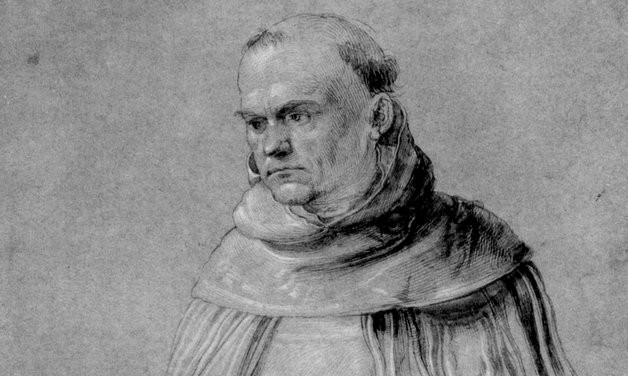
For non-Catholics, Francis is the easiest saint to understand and love, while Dominic is the most difficult, once remarked Chesterton. If the abundance of Francis-emblazoned garden decorations and the world’s new-found devotion to Pope Francis—whose namesake is the beggar friar of Assisi—are a reliable indication, the statement is undoubtedly true. The endearing vagabond stigmatist of Alverna, known for his love of creation and his sympathy for the poor, easily captures the hearts of multitudes, Catholics and non-Catholics alike. In contrast, many written or artistic depictions portray Dominic as the black-and-white clad, crusade-preaching, stern-faced Spaniard of the un-holy Inquisition.  Even today it seems this unfortunate caricature of Dominic abides, as many find Saint Dominic difficult to love and to others he is completely unknown.

Perhaps some would feel drawn to Saint Dominic if his great sympathy for the poor was spoken of more frequently.  As the records of his canonization recall, when he was a student of theology, he sold his books to feed the poor of Palencia.  But the great saint lived this solidarity with the poor his entire life, even dying in the bed of another friar—since he had no cell of his own.  To witness to the authenticity of his preaching, Dominic crossed the countryside walking barefoot (in great contrast to the official papal preachers of his day, travelling as they did in luxurious caravans).  A further glimpse of his absolute dedication to poverty is offered by contemporaries of Saint Dominic who attest they only ever saw him wearing the same one habit, covered in patches.

Could it not also be hard to admire Saint Dominic because of the hidden nature of his life of prayer and study?  With a reputation for sincerity and dedication to his work of learning, the young saint was known to spend many long nights poring over his books.  Later in life these sleepless vigils became nights given over to the work of prayer for the conversion of souls.  The fruits of these kinds of efforts, though, are all-so-often veiled from our prying eyes.

Maybe affection for Dominic is foreign to some hearts because of how little is said of the intensity of his labors.  Saint Dominic’s idea to found the Order was original and highly innovative.  To establish the unprecedented group, the Order of Preachers, required him to be a master of efficiency and organization. Consider the fact that Dominic only worked for five years after papal approval of the Order before his death and in that time managed to bequeath to it a lasting legacy of governance, traditions, and ideals.  Accordingly, these earliest days of the Order leave behind a vivid image of the extraordinary abilities and intuition of its founder.

Is it not also possible that some struggle to be devoted to Saint Dominic because they find the idea of the work of “preaching” aloof or disconnected?  We have said Dominic was a man of study, a true intellectual, but Saint Dominic himself ordered these efforts towards his preaching.  He was a man of learning so that he could reach people with the truth, not be distanced from them! We have only to think of the night Dominic, the preacher of grace, spent speaking until dawn with an innkeeper to convert him in order to see the saint’s acquired knowledge at work, a powerful tool put to use for the salvation of souls. (Read more.)

 Read my novel on the Cathars.

Related Posts with Thumbnails