

Tuesday, January 14, 2020

Why Mass is Cheapened by Socializing

The house of God should be a place of prayer, as Jesus said. When people are chatting then those who seek to pray cannot. In the presence of Our Lord there should be silence and awe, for we participate in a profound mystery. From Life Site:
The liturgy of the Church has for its primary aim to honor and glorify God, and in so doing, to sanctify our souls, leading us to an ever deeper intimacy with Jesus Christ. In accomplishing these aims, the liturgy furthers the brotherhood of man: it enables fellowship to exist, for there is common brotherhood only in the common adoration of the Father through His Son. The problem with the notion of “fraternity” is not that it is completely false, but that it has been sundered from the only context in which it makes any sense, the only source from which it can actually come.
Sometimes people of “liberal” or “progressive” persuasions accuse traditionally-minded Catholics of so overemphasizing the transcendent and divine aspects of worship that we neglect the immanent and human aspects—that God gave liturgy to us for our benefit (“the sabbath was made for man, not man for the sabbath”), and that it is a communal activity that expresses and builds up our social bond with one another.
Now, there is no question that liturgy is a public and communal action, and that it redounds to our benefit; God is already absolutely perfect and unchangeably good in every way and cannot be improved by anything we do for Him. It is good and fitting for us to pray to God as a people and to be conscious of our neighbors as fellow citizens of the household of God. (All the same, the public character of the liturgy consists not in any number of people being present, but because of the action of Christ the High Priest as Head of His Mystical Body that extends through time and space; this is why even a “private Mass” offered by a priest alone is still a public and corporate act.) This being said, we must make sure that our grasp of the meaning of community is sufficiently in tune with the real nature of the Church.

First and foremost, when we worship we are in the presence of God and of His angels and saints. Reverence, solemnity, and majesty belong to worship precisely because it is no mere human gathering, but a momentary opening up of our world to the life and grace of the heavenly Jerusalem. We are joined to all the saved who have worshiped in the past, with all who worship in the present (whether next to us in the pew or anywhere else in the world), and, in a way hidden in God’s foreknowledge and predilection, with all who will worship for ages to come. It is not just “our” worship, the action of this particular local community; it always has a cosmic, universal, transtemporal dimension to it. (Read more.)

 From Virgo Potens:
The central act of Catholic worship is what we’re doing right now. The Mass. Now you know that I'm like a broken record, I don't come up with a lot of original stuff so I’m constantly droning on and on about how the Mass isn't about you, it’s about God. You've heard that from me a million times. What the Mass is, is the self sacrifice of Jesus to His father on Calvary re-presented in ritual form. That ritual form is the perfect act of the virtue of religion, whereby we pay to God the worship that is His due and it is perfect because it is God Himself in the person of the Son, who pays worship to the Father. 
That is why whenever we come to Mass, even if we don't receive Communion, our participation in it is still the perfect act of worship. It is the most pleasing thing we can ever offer to God, because we are offering Him His very own Son. Jesus died on the cross and that sacrifice of propitiation was completed, which is why the priest who stands in the person of Christ at the altar receives the entire contents of the host and the chalice to symbolize the consummation and completion of the sacrifice. You know even if there were a million people at Mass, the priest has to consume the sacrifice, the victim even if not one other person receives. If I drop dead after the consecration, eventually get around to calling the funeral home, but before then another priest has to come in to complete the sacrifice. In that sacrifice the symbolism of its completion is by the consuming of the elements by the priest.
There is a priest who celebrates the Latin Mass somewhere else in the diocese and I won’t say who he is but he got the flu and he was sicker than a dog and he was like, “I have to say Mass. I can’t do this.” So right after the consecration he literally just faints because he was so sick and so of course everyone was all kind of flustered because Father is laying on the ground in front of the altar and he’s grabbing on to the altar saying, “I have to finish the sacrifice! I have to finish it.” So he was like fighting people off of him so that he could finish the Mass and then go home and go to bed for several weeks.  (Read more.)

Friday, January 10, 2020

The Shrine of the Magi

From The Reliquarian:
The relics of the three kings remained in Milan until the twelfth century when the city of Milan rebelled against the Holy Roman Emperor, Frederick I, also known as Frederick Barbarossa. In need of assistance against the Milanese, the emperor appealed to Rainald von Dassel, Archbishop of Cologne, who recaptured Milan and delivered the city to the emperor. In gratitude, and “at the Archbishop’s great entreaty,” the emperor transferred the relics to the Archbishop in 1164. The Archbishop, “with great solemnity and in procession,” carried the bodies of the three kings from Milan to Cologne, where they were placed in the church of Saint Peter. “And all the people of the country roundabout, with all the reverence they might, received these relics, and there in the city of Cologne they are kept and beholden of all manner of nations unto this day.” The Historia concludes, “Thus endeth the legend of these three blessed kings—Melchior, Balthazar, and Jasper.”14 (Read more.)

Wednesday, January 1, 2020

Honoring the Mother of God

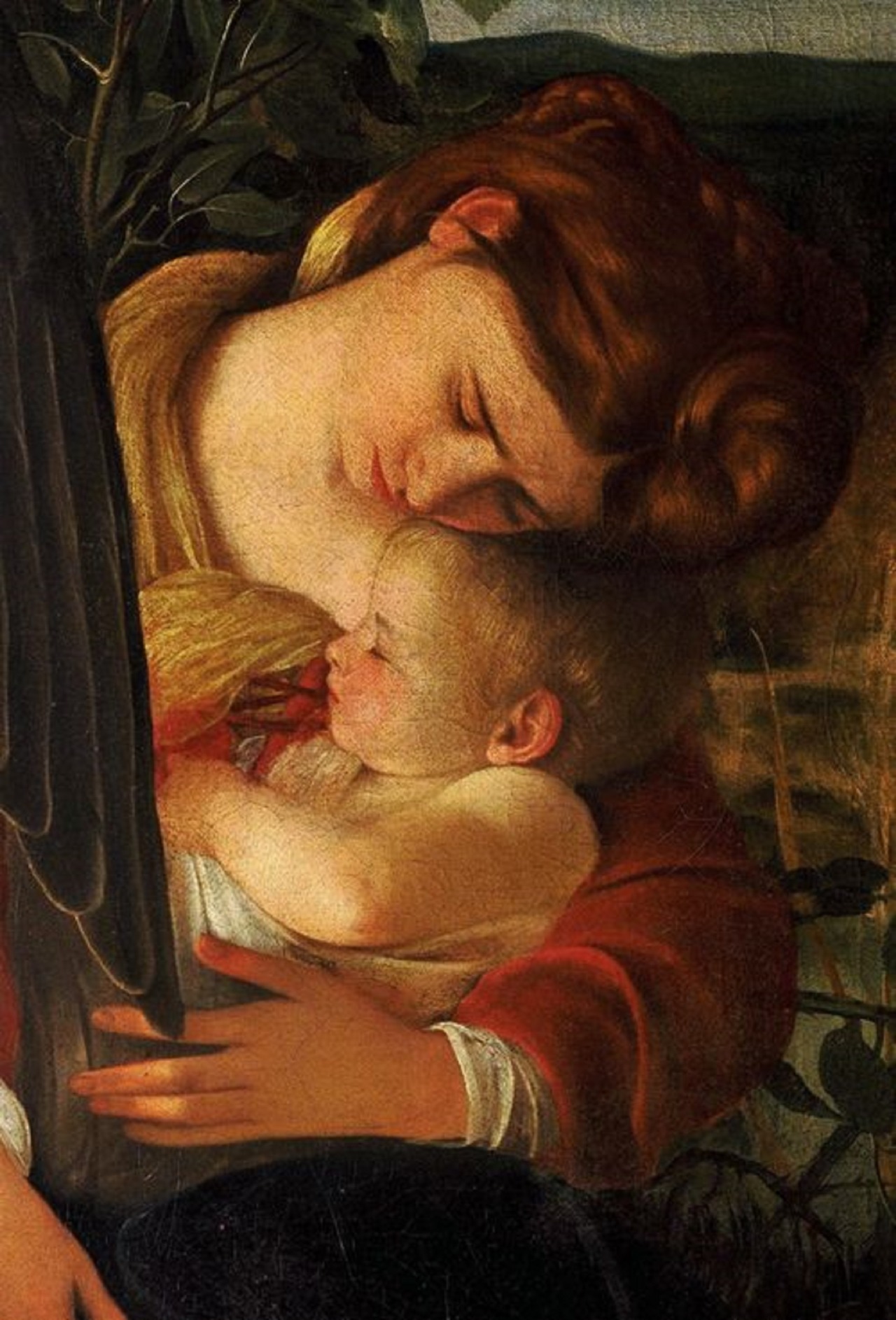
Caravaggio (1571-1610) - Rest on the Flight into Egypt (Detail)
Here is a meditation on Our Lady by a Catholic writer who wishes to be known as Mi Amigo.
All Christians, Protestants and Catholics, as the Christian family seems to be divided, or defined, these days, have one thing in common: all believe in the divinity of Jesus Christ. In the matter of honoring his mother, Mary, with devotion and imitation, however, the commonality dissolves. Why?

All believe that In the beginning was the Word, that the Word is God, that woman and man are creatures made in the image and likeness of the Word, and that the Word incarnated on earth as a man in the fullness of God, as Jesus, born of a virgin known as Mary, to save us by the forgiveness of sins.
Mothers, imagine your child is the incarnation of the Word. An angel appears to you, and tells you that you are favored by God, for He sees that you are full of grace, so that He will overshadow you by His Spirit and bless you with His Presence so that you will bear....wait....Himself?….yes, Him.
Mothers, imagine that your child is born, and you are visited by kings, wise men, who bow down to your child and present Him with gifts representing royalty, prophecy and priesthood.

Mothers, imagine that your child is presented to the High Priest in the temple, and he looks you directly in the eyes with love and compassion, with thankfulness that you have blessed him with the opportunity to hold your child in his arms, and he tells you that your child will be a stumbling block to your nation, even while a Savior of the world, and that you, yourself, will be pierced in the soul.

Mothers, who are you? Who is Mary? You are the bearers, teachers, protectors, nurturers of the bodies of humanity bearing His breath of life, of us bearing his image and likeness, and we are eternally grateful in love to you for you. Mary was also the bearer, the teacher, the protector, the nurturer of a child: He who made you and us, your children, He from whom, in whom, and through whom we were made and now exist, and have the promise of eternal life.

Mothers, your children listen to you, follow you, and obey you (at least ideally, or for the most part hopefully!). Jesus did the same in respect of his mother. How much more proper was it that Mary listened to, followed, chased after even, and obeyed her Lord? Mother, here is your son, and son, here is your mother.

Mothers, imagine knowing, not only because the angel of God told you before your child was born, but because you saw with your own eyes, and touched with your own hands and soul, every day of your child's life, from infancy to young adulthood, the blind given sight, the lame walking, the feeding of thousands with only a few loaves, the dead brought back to life, the condemned forgiven....imagine knowing that your child, yes the child to which you gave birth, is God come to save us.

Mothers, imagine witnessing, before your own eyes, your child condemned by false witness, He who was Truth, whipped, bruised and battered, and then nailed to a cross, hanging in front of you on the trunk of a tree, praying for his persecutors, thirsting, fulfilling His purpose.

Mothers, can you imagine that this child is yours?

Why? Again, I ask, why? It seems to me that only the one of us who stands in Mary’s shoes has any standing to respond with any considerable answer. Anybody? Why?

As brothers and sisters, at least, certainly, we can recognize Mary our common mother, because, if for no other reason, Jesus is our brother.

We honor Mary with singular devotion because no ark has ever borne the Covenant like she did.

Monday, December 30, 2019

The Passion of the Infant Christ

I love Caryll Houselander's book, The Passion of the Infant Christ. From Fr. Mark:
Houselander understood that nothing of the paschal mystery of Christ is locked in an irretrievable past. The liturgy is the passion of the Infant Christ made present to us and for us, here and now, in all its fullness. Are you in Egypt, “groaning under bondage” (Ex 2:23), learning to pray in suffering? Are you wandering in a desert waste, tortured by hunger and thirst, a prey to temptations and terrors of the night? Have you crossed over into that good and broad land where milk and honey flow? Through the Holy Sacrifice of the Mass the Infant Christ is with you, his prayer in yours, and yours in his: a prayer that says “Yes” to the wood of the cradle, to the wood of the Cross, and to everything that lies in between.

Caryll Houselander, a woman of our own times, a woman “acquainted with grief” (Is 53:3) can, I think, help us understand something of the mystery of the Innocent Christ, something of the mystery of suffering innocence in each of us. “The Divine Infancy in us,” she wrote, “is the logical answer to the peculiar sufferings of our age and the only solution to its problems. If the Infant Christ is fostered in us, no life is trivial. No life is impotent before suffering, no suffering is too trifling to heal the world, too little to redeem, to be the point at which the world’s healing begins.” (Read more.)

Sunday, December 29, 2019

Duties of Christian Parents

Happy Feast of the Holy Family! This is worth pondering. We must fear God not man. From Esther:
1. To give their children the necessary food, clothing and shelter. This obligation rests on both parents, whether living together or separated. They must also keep their children from all danger to life and protect them from possible death.
2. To give them good example. Parents give good example by observing strictly all of their religious duties. For example: Regularly attending Mass, not eating meat on days of abstinence, carefully avoiding indecent speech, lying, cursing, criticism of others, immodesty and drunkenness.
-- Parents should remember that children are great imitators, and they should be very careful of everything they do and say in the presence of their children.

3. To provide a truly Catholic home for them. A Catholic home is one in which God and Religion are of the greatest importance.
-- In the home there should be crucifixes, pictures of Jesus, the Blessed Virgin Mary and the Saints. Indecent pictures and calendars, lewd and sensational magazines, books, comic books, TV shows and videos [http://olrl.org/misc/educ_TV.shtml] have no place in the Christian home. There should be good books, Catholic newspapers, and Catholic magazines.

4. To have them baptized as soon as possible after birth. It is a serious sin to delay the Baptism of infants, and if there is any danger to the life of the newly born baby, the priest should be called immediately.
-- In danger of death, and if no priest is available, Baptism can and should be given by anyone. The one baptizing must have the intention of doing what the Church does in Baptism. The procedure is: Pour water over the head of the child, saying at the same time: "I baptize thee in the name of the Father and of the Son and of the Holy Ghost."

5. To see that they go to Confession, receive Holy Communion and receive Confirmation. The children should be taught to go to Confession and Holy Communion regularly and frequently - every week, if possible, especially during vacation time.

6. To teach them to pray. Daily prayers should be said together by the whole family.
-- As the saying goes, "The family that prays together stays together." The daily family Rosary will go a very long way toward ensuring that the children grow up to be good Catholics.

7. To see that they go to Mass every Sunday and on the six Holy Days. Parents should not keep children home from Mass except for very serious reasons.

8. To see that on Ash Wednesday and the Fridays of Lent they abstain from meat altogether and that on the other Fridays of the year they refrain from meat or perform a comparable penance.
--See Lesson 43, especially Question 11 - http://www.olrl.org/Lessons/

9. To send them to a Catholic school. This includes high school and college, as well as grammar school. Parents are forbidden by Church Law to send their children to any other kind of school. [*See below for more on this subject]
-- In very many cases today, the only truly Catholic school available is home schooling. Experience has shown that Catholic home schooling produces excellent results both spiritually and academically and that it brings great blessings to the family.

10. To insist that they marry in the Catholic Church. A Catholic cannot marry except in the presence of a Catholic priest and two witnesses.
--When a son or daughter begins to think seriously of marrying, the parents should have him (or her) see the priest and receive the necessary instructions on marriage. They should encourage courting only Catholics, or at least with non-Catholics who are willing to take a full course of instructions in the Catholic Religion. Parents commit a mortal sin by forcing or unduly persuading any of their children to marry.

11. To give them the Christian attitude on marriage and having children. Parents should avoid complaining about the hardships of married life or joking about the sacred duties of marriage.
--The birth of another child should be a joyful occasion for the whole family so that the other children will consider having children as the greatest blessing of married life.

12. To prepare them for marriage. The children should be taught the serious duties and responsibilities of marriage, both by word and example.
--They should also be taught the practical side of making a home, such as cleaning, cooking, sewing, repairing, caring for children, being on time, and being neat and orderly.

13. To teach them the facts on sex. This information should be given carefully and with great emphasis on the beauty and sacredness of sex.
--Answers to questions about the facts of life should be correct, but always suited to the age and mental development of the child. Parents should encourage the confidence of their children so that the children will come to them for information.

14. To protect them from sin, particularly sins of impurity. In addition to protecting their children from bad companions, etc., parents have a grave obligation to do whatever is necessary to protect their children from classroom "Sex Education" either in public or Catholic schools.
--Formal "Sex Education" is always grossly immodest and a temptation to sin, even aside from the un-Catholic and un-Christian "slant" with which it is usually delivered.

15. To correct their sins and faults. It is a serious sin to neglect this duty.

16. To teach them the virtues of honesty, obedience, truthfulness, purity, and modesty in dress. These lessons must be given early and repeated continually.

17. To teach them respect for the rights and property of others. Many parents sin seriously by bad example in this matter.

18. To teach them respect for all lawful authority. Children should be taught early to respect all lawful authority, especially the authority of the Church, the State and the School.

19. To give them wholesome recreation and keep them from evil companions. The Christian home should be the center of the child's social life, a place where he feels free to bring his companions.
-- Parents should be extremely careful about allowing their children to attend motion pictures; they should also examine their comic books and govern their use of the radio and television, as well as other electronic media. Children receive many un-Christian ideas on life, marriage, crime, drinking, body piercing, etc. from these sources of entertainment. [One can imagine what Fr. Cogan would say of modern radio, motion pictures and television.]

20. To encourage a child's desire to be a priest, a brother or sister. Having a priest, brother or sister in the family is one of the greatest blessings that God can give a mother and father. Instead of turning a child away from such a desire, parents should encourage the child.

Saturday, December 28, 2019

Our Lady of Zeitoun and the Slaughter of the Innocents

From Unveiling the Apocalypse:
Marian apparitions often occur before periods of great upheaval. Perhaps most famously, Our Lady appeared at Fatima just before the rise of communist Russia - with the Miracle of the Sun on the 13th October 1917 directly coinciding with the October Revolution which saw the Bolsheviks rise to power within a month. The other Church approved apparition at Beauraing and Banneux, in Belgium during the years 1932 and 1933 respectively appeared just before the rise to power of Hitler, who was made chancellor of Germany on 30th January 1933 - the same month when the first apparitions at Banneux occurred on the 15th. The apparitions at Kibeho, Rwanda, between 1981-1989 prophesied the Rwandian genocide, which was to claim the lives of an estimated 800,000 people in 1994, including one of the visionaries - Marie Claire. While the significance of the apparitions at Zeitoun are thought by some to be related to the Six Day War of 1967, it is much more likely to concern the legalisation of abortion, given the above background context. The fact that the Six Day War took place before these apparitions would also indicate that the Zeitoun apparitions were not related to this event, since all the other apparitions appeared before the events occurred. Our Lady first began to appear at Zeitoun on 2nd April 1968, and the UK Abortion Act was brought into effect just weeks later on 27th April.

Now that the apparitions of Our Lady of Light are in the process of making the return journey, we are left to reflect upon Matthew's quote of Hosea 11:1: "Out of Egypt I called my Son". During the season of Advent, the Church looks not only to the first coming of Christ, but it also focuses on His Second Coming. The birth-pangs of the Woman adorned with the Sun indicates that the Second Advent is near. Could these apparitions, which appear to be the ultimate fulfillment of the prophecy of the Woman adorned with the Sun, signal that God is calling his Son out of Egypt to return to His earthly homeland? (Read more.)

Wednesday, December 18, 2019

Expectation of the Blessed Virgin Mary

The Office and Mass of the Expectation of the Blessed Virgin Mary are today, more than ever before, worthy of celebration and meditation, given that the perpetual virginity of the Mother of God is roundly mocked by many. Even in the minds of many of the faithful, enfeebled by a forty year dearth of orthodox catechesis, a tragic confusion holds sway concerning the privileges of the Blessed Virgin Mary and, in particular, her virginity before, during, and after childbirth. There are many, alas, who, affected by various mutations of creeping Nestorianism and Arianism, have no grasp of what it means to call the Blessed Virgin Mary, Mother of God. Those who do not confess the privileges of the Blessed Virgin Mary, honouring them and celebrating them, fall inevitably into one or another of the classic Christological heresies. All of this makes me want to open my Processionale Monasticum to page 146 and sing, Gaude Maria, Virgo, cunctas haereses sola interemisti:

Rejoice, O Mary,
by whose mighty hand the Church hath victory
over her foes [every heresy] achieved,
since thou to Gabriel’s word of quickening power
in lowliness hast listened, and believed
— thou, still a virgin, in thy blessed womb
hast God Incarnate of thy flesh conceived,
and still, in heaven, of that virginity remainest
after childbirth unbereaved.
V. Blessed art thou that hast believed,
for there is a performance of those things
which were told thee from the Lord.
(Read more.)
Related Posts with Thumbnails