Saturday, July 18, 2009

On the Priesthood

A consecrated soul cannot be unconsecrated.
"Priests have a power not their own, and priests who abandon the priesthood carry with them a volatile power they cannot shed. A consecrated soul cannot be unconsecrated but only desecrated by pride and the guilt of pride. And when a desecrated priest ceases to offer worthy sacrifice, he may start to require sacrifice...

...saints need priests to help them be saints, especially priests willing to be saints. There cannot be a Church without priests. Sometimes priests themselves underestimate that. (...) [St Jean-Marie] Vianney preached to his uncertain flock, "When you see a priest, you should say: 'There is the one who has made me a child of God... one who has cleansed me from my sins, who gives nourishment to my soul.'"


-- The Curé D'Ars Today: St John Vianney by Fr George William Rutler

Thursday, July 9, 2009

Pope Benedict on the Precious Blood

Some beautiful words from Our Holy Father.

Wednesday, July 8, 2009

Motu Proprio

Ecclesiae Untitatem.
The goal of guarding the UNITY OF THE CHURCH, with the solicitousness of offering to all the aid for responding in an opportune manner to this vocation and divine grace, belongs in a particular way to the Successor of the Apostle Peter, who is the perpetual and visible principle and foundation of the unity both of Bishops and of the faithful1. The supreme and fundamental priority of the Church, in every age, of leading men towards an encounter with God must be favored through the effort of promoting the common witness of faith of all Christians.

Tuesday, July 7, 2009

The New Encyclical

Caritas in Veritate. There is no love without truth. Our Holy Father says:
Love — caritas — is an extraordinary force which leads people to opt for courageous and generous engagement in the field of justice and peace. It is a force that has its origin in God, Eternal Love and Absolute Truth. Each person finds his good by adherence to God's plan for him, in order to realize it fully: in this plan, he finds his truth, and through adherence to this truth he becomes free (cf. Jn 8:22). To defend the truth, to articulate it with humility and conviction, and to bear witness to it in life are therefore exacting and indispensable forms of charity. Charity, in fact, “rejoices in the truth” (1 Cor 13:6).

Monday, July 6, 2009

On Patience

A meditation from the Introduction to the Devout Life by St Francis de Sales.
Do not limit your patience to this or that kind of trial, but extend it universally to whatever God may send, or allow to befall you. Some people will only bear patiently with trials which carry their own salve of dignity,—such as being wounded in battle, becoming a prisoner of war, being ill-used for the sake of their religion, being impoverished by some strife out of which they came triumphant. Now these persons do not love tribulation, but only the honour which attends it. A really patient servant of God is as ready to bear inglorious troubles as those which are honorable. A brave man can easily bear with contempt, slander and false accusation from an evil world; but to bear such injustice at the hands of good men, of friends and relations, is a great test of patience.

Friday, July 3, 2009

Mother Elias, Part 2

Mother Elias had long feared that the dangers to the nuns would force the Carmelite community at Aguascalientes to flee the country. In her monastery there was a young nun of singular beauty whom, it was rumored, the local revolutionaries were planning on kidnapping. At night Mother would hide the young sisters in chests and cupboards and would herself keep vigil until dawn, guarding the door of the enclosure. She knew she had to get them all to safety, somehow. The hair of the nuns was shaved or cut very short so Mother Elias had made wigs from the novices' hair. In 1914, disguised in wigs, bonnets, and secular clothes over their wool habits, Mother Elias and the younger sisters escaped to Cuba, enduring many perils en route.

After establishing the young nuns safely in Cuba, Mother Elias returned to Mexico to rescue the older nuns of her community who were in danger of starvation and imprisonment. Traveling with a young novice, she was apprehended by the authorities and placed under arrest. The two nuns stood for stood for three days and three nights in a prison cell with twelve inches of water on the floor. In desperation, Mother Elias prayed to the Little Flower, promising to establish a Carmel in her honor if she were delivered from prison.

After a brief interrogation, in which Mother refused to divulge the hiding place of her other nuns, she and her young companion were marched before a firing squad. Shots rang out; the nuns were left lying motionless on the ground. Some hours later, Mother Elias regained consciousness and found that there were no wounds on her body. Both women were unhurt and a mysterious stranger showed them how to slip away from the prison unseen.

After many more narrow escapes, Mother Elias made it to the rest of her community. They managed to flee to Cuba, and then to New Orleans. In 1915, they were invited to Grand Rapids, Michigan, where Mother Elias founded the Carmel of Our Lady of Guadalupe, a community still thriving in Ada-Parnell, Michigan. In 1919, Mother Elias fulfilled her promise to Saint Therese by establishing the Carmel of the Little Flower in Buffalo, New York. In 1923, she founded the Carmel of Saint Teresa in Schenectady, New York, now removed to Rochester, New York.

Eventually, Mother Elias returned to the Grand Rapids Carmel and died there on February 28, 1943, leaving behind her a heritage of heroic determination to please God in all things. Many stories of prodigies surrounding Mother are told in the monasteries which she founded, even to this day. She had great devotion to the Infant Jesus, and a beautiful, life-like statue which is now at the Ada-Parnell monastery. Once, during her travels through Mexico, trying to avoid arrest, Mother was on a train, dressed as a housewife. She had the statue of Baby Jesus in her arms wrapped in a blanket, like a real baby. There were revolutionary soldiers on the train. One of them, vigilant for escaping religious, noticed Mother Elias and her little bundle. "That baby is being awfully quiet," he said, and started over towards Mother. At that moment, the statue of the Infant came to life, and began to wail like a living child. The soldiers left Mother alone.
(See The Dove With The Scarlet Collar by Mother Teresa of Jesus, OCD and Dr. Jose L. Morales)
Thursday, July 2, 2009

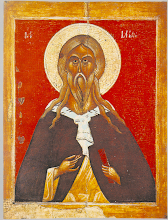
Mother Mary Elias of the Blessed Sacrament, OCD (1879-1943)

Little known among Catholics in America today are the sufferings of our Mexican brethren at the hands of the Communist, anti-clerical forces of the revolutionary government, amid a series of persecutions which were focused particularly on religious orders. Many communities of consecrated life in the United States owe their existence to Mexican priests and nuns who fled here in the first three decades of the twentieth century.

One of the most fascinating and enigmatic of the refugee-foundresses is the Discalced Carmelite prioress, Mother Mary Elias of the Blessed Sacrament. Of Napoleon's line, Elena Maria Thierry was born on August 15, 1879 to a devout family of European extraction. The second to the youngest of twenty children, she received a thorough education, including operatic training, gifted as she was with a beautiful singing voice.

Called by God to the religious life, she first sought to enter a teaching order. On September 30, 1897, when traveling on a train to the convent, she suddenly found herself face to face with a young Carmelite nun. The nun looked at her knowingly and said, "You will remain there a short time. Then you will come to my order." The mysterious nun vanished.

Elena Maria was dismissed from the teaching order after a few years and sought to enter the Mexico City Carmel. On the walls of the Carmel hung a picture of the same nun Elena Maria had seen on the train. She was told it was the Little Flower who was already world famous because of her autobiography and the prodigies which had been worked through her intercession. The day Elena Maria had seen her on the train was the exact day Sister Therese of the Child Jesus had died far away in France.

Around 1904, Elena Maria Thierry entered the Carmel of Mexico City and was given the name of "Mary Elias of the Blessed Sacrament." Due to her fervor, charity and leadership abilities, she was transferred to the Carmel of Queretaro. Queretaro Carmel had been closed for many years because of the persecution and needed nuns like Mother Elias to help rebuild it. In 1910, the persecution broke out again. In 1913, Mother Elias, who by that time had been elected prioress, decided to move the community to the town of Aguascalientes where she thought they would be safer. However, there were few safe places for Mexican religious. The soldiers of the Revolution often broke into convents and kidnapped the young sisters. In 1914, Mother Elias decided she had better get all of her younger nuns out of Mexico.
(To be continued....)
Related Posts with Thumbnails