Sunday, March 2, 2014

Pray for Ukraine!

From Abbey-Roads:
Russia may act in a surprise way, when you least expect it… [God's] justice will begin in Venezuela.The Bridge to Heaven: Interviews with Maria Esperanza of Betania
I've not been a follower of the Servant of God, Maria Esperanza, but the recent developments in the Ukraine and Crimea seem to be cause for concern.  Venezuela is having its problems as well.  Hence her prophecy comes to mind as I watch the news and read about the latest developments in Russia. 
More on Maria Esperanza, HERE.

Here is an article about Our Lady and Ukraine.

More on Putin and Ukraine, HERE and HERE.


Saturday, March 1, 2014

The Church is a Hospital

Often, being a Catholic means leaving your comfort zone in order to be healed. First, you must acknowledge your wounds. It can be very inconvenient at times. It is not a "feel good" religion although there are moments of peace and joy. But it is worth it in the end. From Aleteia:
The reason is that it’s not that kind of inn. It’s a place where the weary can rest, for sure, but it’s a place for the afflicted. It answers our deepest needs, not our momentary whims.  That is the role of the Church in the world, and the role of each member of the Church. We must care for the afflicted, those in deep need of body and soul. And so very often we may chafe when our true needs are addressed. It always hurts when the wound is touched, even when it is for healing.

On Thursday, the Holy See issued a press release about its participation in the world Expo in Milan in 2015. The theme of the Expo is Feeding the Planet - Energy for Life. The theme of the Holy See’s pavilion will be Not by Bread Alone. While the Expo’s website speaks about Italy’s fame for food and “living well,” the Church reminds us that we are not in fact living well. Creature comforts alone cannot remedy the ills of fallen creatures.

The Good Samaritan did not bring the unfortunate man a Happy Meal and an iTunes gift card. There are so many who need the bodily basics: clean water, shelter, sufficient food. And there are many more who need the spiritual essentials: truth from sound teaching, counsel, comfort, prayer. (Read more.)

Friday, February 28, 2014

Pope-bashing

Here is an article from ChurchMilitantTV on why they will not engage in pope-bashing. To quote:
While we greatly admire and are the beneficiaries of the work of those on whose shoulders we stand in the work to help restore the Catholic Church to its authentic glory, we can neither support nor encourage their ongoing, unnecessary and harmful attacks on the Church and the Holy Father....

Faithful Catholics need help in persevering through their anxieties and doubts, not continual reinforcement and encouragement of those troubling states. Less faithful Catholics form their judgments of "traditional Catholics" through the lens of perceived dissatisfaction and unhappiness with the Church and the Holy Father. Those who relentlessly criticize the Church, Her leaders, and especially the Holy Father, do immense harm to the Church Herself and discourage both potential converts and those struggling to stay faithful through the crisis that is all around us. The sad reputation of "traditional Catholics" as angry dissidents from virtually everything in the Church today is as well deserved as the reputations of those rightly described as modernists.

A line must be drawn when it comes to criticism of the Holy Father, even when he says or does things that would invite appropriate criticism when said or done by those of lower ecclesiastical rank. Errant priests and bishops can be replaced. The Pope cannot. It may make us cringe at times but it always was and always will be true that ubi Petrus, ibi ecclesia. There have been extraordinarily awful Popes in the past but, for all that, the Church not only survived but thrived. The Popes immediately before, during and after the Protestant Revolt showed little recognition or understanding of the catastrophe unfolding before them (not unlike the post-conciliar Popes of our own time) yet, from such unpromising soil emerged an astonishing number of great Saints, and the Council of Trent.

Australian Mary MacKillop became St. Mary of the Cross [LINK] in circumstances astonishingly similar to what we now perceive happening with the Franciscan Friars of the Immaculate (FFI). She founded a religious order, was replaced as Mother Superior by her local bishop, served for many years under her replacement before being restored as Mother Superior, was unjustly excommunicated by her bishop, and the order that she founded is, today, a complete mess. But she became a Saint through all that. She showed respect for her local bishop who truly didn't deserve it, even finding excuses for his behavior. During the time she was excommunicated, she didn't seek to start an alternative order to preserve the integrity of what she had started. She was obedient, humble, trusted God, and she became a Saint. (Read more.)

Thursday, February 27, 2014

Mother Mectilde and Friends

Here are more beautiful passages about the holy Benedictine Abbess Mother Mectilde de Bar from Fr. Mark:
Abbot Louys’ friendship with Catherine–Mectilde de Bar would have been akin to other more famous spiritual friendships of the 17th century: that of Vincent de Paul and Louise de Marillac, of Francis de Sales and of Jeanne–Françoise de Chantal, of Jean–Jacques Olier and Catherine de Langeac.

Mother Mectilde’s circle of male friends included besides Jean de Bernières and several other notable laymen, Benedictine monks of the Congregation of Saint–Maur, Premonstratensians, Cistercians, Cordeliers (Franciscan Friars), Tiercelin Penitents (Franciscans of the Third Order Regular), Carmelite Fathers, Capuchins, Lazarists, and Sulpicians. Mectilde de Bar was not narrow–minded. (Let us not rashly assume that the conspicuous absence of Jesuits means anything in particular!)

Mectilde de Bar was no shrinking violet when it came to engaging with the men of her day. She maintained her dignity, her exquisite sense of decorum and, at the same time, was not afraid of confronting her own humanity and the humanity of others on the terrain — or should I say battlefield? — of real life. Far from being a pious dreamer lost to this world and time, Mother Mectilde was, like Saint Teresa of Avila, a contemplative fully engaged in the messiness of life. Rarely, if ever, did things go as she hoped they would. Mectilde de Bar persevered in her Benedictine and Eucharistic vocation, quietly trusting God in the midst of war, famine, poverty, sickness, pillage, harassment from a rejected suitor, insecure housing, constant travel, vexing lawsuits, calumny, an attempted house invasion by the agents of a fake princess, and insidious detractions. God sent Abbot Épiphane Louys into her life to support her, defend her interests, and deepen her attraction to a fully Eucharistic life of adoration and reparation.

Born in 1614, the same year as Catherine–Mectilde de Bar, Épiphane (born Nicolas) Louys, was also, like her, a native of the Lorraine. Their peregrinations through a war–torn France led them both, at about the same time, to Paris. Early in 1664, Abbot Louys called on Mother Mectilde to give her news of her community in the Lorraine. A few months later, he appears as the protagonist in the drama surrounding the foundation of a monastery of perpetual adoration in Toul; the city’s notables are all opposed to it. Abbot Louys winning arguments prevail. He installs in the new monastery an image of Our Lady of Benoistevaux, a sanctuary in the care of the Premonstratensians. On 8 December 1664, Abbot Épiphane himself exposes the Blessed Sacrament in the monastery of Toul, thereby inaugurating the new observance. (Read more.)

Monday, December 30, 2013

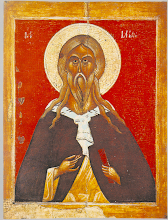
Our Lady of Zeitoun and the Flight into Egypt

Unveiling the Apocalypse offers an intriguing interpretation of Scripture and approved apparitions of modern times. To quote:
Despite being officially recognised as authentic by the local Cardinal Patriarch, the fact that Our Lady chose to appear over Coptic churches in Egypt, rather than Catholic churches elsewhere in the world has baffled some commentators, and can perhaps explain the lack of adequate devotion to these apparitions amongst Catholics.  It seems that many have failed to recognise the true significance of these apparitions lies above all in their timing and location. The Virgin Mary chose to appear over Coptic churches for two very simple reasons - firstly because she is re-tracing the steps of the Holy Family's flight into Egypt (and the vast majority of churches in Egypt are Coptic, especially those in locations associated with the sojourn of the Holy Family), and secondly, that despite not being in full communion with Rome, they show that Our Lady has deep love and respect for the Coptic Church, which like the rest of Oriental Orthodoxy, as well as the Eastern Orthodox Church, offers a great devotion to her.
 
While some have recognised that Our Lady is in some way re-enacting the journey of the Holy Family during their flight into Egypt, none (to my knowledge) have went on to ponder the primary reason for their escape into the Egyptian wilderness and attempt to re-apply the same conditions to a modern context; or compare them with the account of Woman adorned with the Sun given in Rev 12 - which is basically the story of the nativity seen through an apocalyptic lens. 
 
The main and indeed only reason that the Holy Family fled into Egypt, was to escape from King Herod, who in an attempt to quash any potential Messianic usurpers to his throne, had ordered the massacre of any infants in the vicinity of Bethlehem under two years of age:
Now when they had departed, behold, an angel of the Lord appeared to Joseph in a dream and said, “Rise, take the child and his mother, and flee to Egypt, and remain there until I tell you, for Herod is about to search for the child, to destroy him.” And he rose and took the child and his mother by night and departed to Egypt and remained there until the death of Herod. This was to fulfill what the Lord had spoken by the prophet, “Out of Egypt I called my son.”

Then Herod, when he saw that he had been tricked by the wise men, became furious, and he sent and killed all the male children in Bethlehem and in all that region who were two years old or under, according to the time that he had ascertained from the wise men. Then was fulfilled what was spoken by the prophet Jeremiah:

“A voice was heard in Ramah, weeping and loud lamentation, Rachel weeping for her children;
she refused to be comforted, because they are no more.”

But when Herod died, behold, an angel of the Lord appeared in a dream to Joseph in Egypt, saying, “Rise, take the child and his mother and go to the land of Israel, for those who sought the child's life are dead.” And he rose and took the child and his mother and went to the land of Israel. (Matt 2:13-21)
 (Read more.)

Sunday, December 29, 2013

The Example of St. Joseph

In the words of Our Holy Father Pope Francis:
The Gospel does not explain his thoughts, but it tells us the basics: he seeks to do God's will and is ready to make a radical renunciation. Instead of defending himself and asserting his rights, Joseph chooses a solution that represents, for him, a great sacrifice. And the Gospel tells us that Joseph, 'being a righteous man and unwilling to disgrace her, decided to divorce her secretly'. This short sentence encapsulates a real inner drama, if we consider Joseph's love for Mary. But, as in the case of Abraham, the Lord intervenes: 'Joseph, son of David', he said, 'don't be afraid to take Mary as your wife, because what has been conceived in her is from the Holy Spirit'. (Read more.)

Monday, December 9, 2013

The Solemnity of the Immaculate Conception

Meditations from Fr. Mark. To quote:
In the end, for those who allow themselves to be illumined by the grace of the sacred liturgy today, there is a return to the song of the beginning. “Rejoicing, I will rejoice in the Lord, and my soul shall be joyful in my God. He has clothed me with the garment of salvation, and with the robe of justice he has wrapped me about, as a bride adorned with her jewels” (Is 61:10). This is the song not only of the beginning of today’s Mass; it is the song of Mary’s beginning in her mother’s womb. It is the song of every new beginning in grace. It is the song of every man and woman once paralyzed by fear, but now set free to stand unafraid in the sight of the Father. It is the song of every heart darkened and stained by sin, but now made bright and clean by grace. It is the song of every life wounded by sin, but healed by the Sun of Justice who, even now, will rise glorious above the altar “with healing in his wings” (Mal 4:2). The last word and the first belong to joy. (Read more.)
Related Posts with Thumbnails