






 Posts
Posts


My way is one of gentleness, of mercy, and of compassion. I offer My Cross to souls, but I never impose it, and when a soul begins to say “Yes” to the sweet and terrible exigencies of My love, I fit My Cross to her shoulders and, then, help her to carry it step by step, increasing its weight only as that soul grows in love and in the fortitude that comes from the Holy Spirit.
Conversions that are sudden and excessive are not My habitual way of leading souls in the way of holiness. I prefer to see souls advance by little steps along a way of spiritual childhood, trusting in Me to bring them to Calvary and to the fullness of joy in My presence and in the presence of My Father.
This way is no less demanding than the high road along which, by reasons known to Me alone, I lead certain other souls. The little way, marked by little steps, is, nonetheless, the way I prefer, because it perfects souls quickly in the image of My own littleness, My poverty, and My abandonment to the Father’s will. (Read more.)
Saturday, August 27, 2016
A Little Way
From Vultus Christi:


Saturday, May 28, 2016
Gabrielle de Bossis

Gabrielle Bossis (1874-1950) was a Catholic Mystic and layperson who lived in France in the 20th century. Born in Nantes, France in 1874, she was the youngest child of a family of four children. As a child in a well to do family, she was taught and raised in proper social graces and etiquette, and she grew up to be a graceful, happy and high spirited young woman, but as from her childhood she possessed a strong yearning for God and the things of the Spirit. She obtained a Degree in Nursing, and enjoyed the fine arts of that time, including sculpting, painting, illuminating and music. Later in life she discovered that she had another talent- that of writing moral plays and also acting. From that point on until two years before her death she traveled extensively in France and abroad, producing her own plays and acting in the principal role. Those who still remember her remark about her infectious laughter and her unfailing charm.
On very rare occasions in her early life, Gabrielle had been surprised by a Mysterious Voice, which she heard and felt with awe, and sometimes anxious questionings, which she perceived to be the Voice of Christ. It was only at the age of 62, however, that this touching dialogue with the "Inner Voice" began in earnest, continuing (at least in her notes) until two weeks before her death on June 9, 1950.
The journal that she kept of her dialogue with the Inner Voice has been published in numerous languages under the title "He and I" (see note above) and has become a source of deep inspiration and edification for those who read it. Below are a few excerpts from this extraordinary dialogue between "the Inner Voice" and Gabrielle. (Read more.)
Thursday, March 17, 2016
Lough Derg and Croagh Patrick
 Local tradition, as well as substantiated historical evidence and artifacts, prove that Saint Patrick did pray in seclusion on the island of Lough Derg, performing penances for his new flock of wayward Irish converts. It is called "Saint Patrick's Purgatory" because of the cave that was supposed to lead to the nether world. People are still able to make pilgrimages at this holy site, going barefoot and fasting on tea and toast, while sleeping in bee-hive cells, just like the old monks. It would be an interesting place for a retreat.
 We often forget what St. Patrick endured to bring the faith to Ireland. The Irish had such a reputation for fierceness and piracy so that most missionaries were afraid to go there. Saint Patrick had suffered as a slave in Ireland (he would make a great patron of the enslaved) after being kidnapped from his home. That he would have the courage to return to the place of his degradation is amazingly heroic in itself. Once in Ireland as a missionary, Saint Patrick had many ordeals. The druids hated him and tried to kill him at least once; he was often hunted like an animal. In order to recollect himself and gain strength and grace for his apostolic endeavors, he would retreat to a mountain called "Croagh Patrick."
According to New Advent:
A mountain looking out on the Atlantic ocean from the southern shore of Clew Bay, in the County Mayo, and called "the Sinai of Ireland." In pagan times it was known as Cruachan Aigli. It rises in a perfect cone to a height of 2510 feet. The account given below is taken from sources that post-date the saint's death by three hundred years. There are, however, good reasons to believe that the traditions they embody are genuine, St. Patrick was careworn and fatigued when he came to this remote part of the country. He longed to retire for a while to refresh his soul in solitude, and for that purpose on the Saturday before Ash Wednesday in the year 441, he betook himself to the mountain top. Here he spent the days of Lent, chastising his body with fasts, pouring out his heart to God, and entreating Him with prolonged importunity and with tears that the Faith may not fail in the land of Erin. The "Book of Armagh" mentions that God summoned all the saints of Erin, past, present and future, to appear before their father in the Faith to comfort him with a vision of the teeming harvest his labours would produce, and to join him in blessing their kinsmen and their country.It is good to know that even the great saints had times when they had to fight discouragement. They rejuvenated themselves by being alone with God. Croagh Patrick is still a place of pilgrimage.
Tuesday, December 8, 2015
The Jubilee of Mercy
 |
| "The Immaculate Conception" by Bartolomeo Altomonte |
This liturgical feast day recalls God’s action from the very beginning of the history of mankind. After the sin of Adam and Eve, God did not wish to leave humanity alone in the throes of evil. And so he turned his gaze to Mary, holy and immaculate in love (cf. Eph 1:4), choosing her to be the Mother of man’s Redeemer. When faced with the gravity of sin, God responds with the fullness of mercy. Mercy will always be greater than any sin, and no one can place limits on the love of God who is ever ready to forgive. I will have the joy of opening the Holy Door on the Solemnity of the Immaculate Conception. On that day, the Holy Door will become a Door of Mercy through which anyone who enters will experience the love of God who consoles, pardons, and instills hope.
On the following Sunday, the Third Sunday of Advent, the Holy Door of the Cathedral of Rome – that is, the Basilica of Saint John Lateran – will be opened. In the following weeks, the Holy Doors of the other Papal Basilicas will be opened. On the same Sunday, I will announce that in every local church, at the cathedral – the mother church of the faithful in any particular area – or, alternatively, at the co-cathedral or another church of special significance, a Door of Mercy will be opened for the duration of the Holy Year. At the discretion of the local ordinary, a similar door may be opened at any shrine frequented by large groups of pilgrims, since visits to these holy sites are so often grace-filled moments, as people discover a path to conversion. Every Particular Church, therefore, will be directly involved in living out this Holy Year as an extraordinary moment of grace and spiritual renewal. Thus the Jubilee will be celebrated both in Rome and in the Particular Churches as a visible sign of the Church’s universal communion. (Read more.)Here is a Litany of Trust in the Mercy of Christ from Vultus Christi:
Let Thy mercy, O Lord, be upon us,
as we have placed our trust in Thee.
For myself, a poor sinner,
I trust in Thy mercy.
For all whom I have offended,
I trust in Thy mercy.
For all who have offended me,
I trust in Thy mercy.
For all whom Thou hast brought into my life,
I trust in Thy mercy.
For all whom Thou hast entrusted to my prayer,
I trust in Thy mercy.
For all Thy priests,
I trust in Thy mercy.
For my family
I trust in Thy mercy.
For the sick,
I trust in Thy mercy.
For the dying,
I trust in Thy mercy.
For prisoners,
I trust in Thy mercy.
For those who are farthest from Thee,
I trust in Thy mercy.
For those who persecute Thee in the members of Thy Mystical Body,
I trust in Thy mercy.
For those who kill Thee in the unborn,
I trust in Thy mercy.
For those who perpetrate violence,
I trust in Thy mercy.
For those who harbour resentment in their hearts,
I trust in Thy mercy.
For those enslaved to money, pleasure, and power,
I trust in Thy mercy.
For those who treat with irreverence, mockery, and scorn
the adorable Mysteries of Thy Body and Blood,
I trust in Thy mercy.
For those who blaspheme Thy Most Holy Name,
I trust in Thy mercy.
For those who dishonour Sunday, the Day of Thy Resurrection,
I trust in Thy mercy.
For those who revile Thy Bride, the Church,
I trust in Thy mercy.
For those who have fallen away from the Holy Catholic Faith,
I trust in Thy mercy.
For those who are consumed by hatred,
I trust in Thy mercy.
For those who will face death in despair,
I trust in Thy mercy.
For those who remain impenitent in their last hour,
I trust in Thy mercy.
For those who have taken their own lives,
I trust in Thy mercy.
For all the Holy Souls in Purgatory,
I trust in Thy mercy.
For those who will die this day,
I trust in Thy mercy.
For those who no longer believe in mercy,
I trust in Thy mercy.
For those who refuse to show mercy,
I trust in Thy mercy.
For all poor sinners,
I trust in Thy mercy.
Let Thy mercy, O Lord, be upon us,
as we have placed our trust in Thee.
Saturday, November 14, 2015
Litany for France

O God the Father of mercies: — Have mercy upon us.
✢ O God the Son, who wept over Lazarus: — Have mercy upon us.
✢ O God the Holy Ghost, the Comforter: — Have mercy upon us. ✢ Holy Mary, assumed into heaven: — Have mercy upon us.
✢ Mother of Christ, Lady of Sorrows: — Have mercy upon us.
✢ Mary, our Advocate in this vale of tears: — Have mercy upon us.
✢ Saint Michael, heavenly defender of Christians: — Have mercy upon us.
✢ Saint Denis, faithful martyr of the Lamb: — Have mercy upon us.
✢ Saint Martin, merciful Confessor of Christ: — Have mercy upon us.
✢ Saint Genevieve, protector of Paris: — Have mercy upon us.
✢ Saint Remigius, Enlightener of the Franks: — Have mercy upon us.
✢ Saint Francis, Apostle to the Muslims: — Have mercy upon us.
✢ Saint Louis, champion of justice: — Have mercy upon us.
✢ Saint Joan, valiant in battle: — Have mercy upon us.
✢ Saint Vincent de Paul, captive of the Turks: — Have mercy upon us.
✢ Saint Therese, little martyr of love: — Have mercy upon us.
✢ Blessed Charles, brother of Christ and of all men: — Have mercy on us.
✢ All ye Saints of France: — Have mercy upon us.
✢ All ye holy Martyrs and Confessors: — Have mercy upon us.
✢ All ye Saints of God, men and women: — Have mercy upon us.
✢ O Lord, be merciful: — Spare us, O Lord.
✢ From all evil, — Spare us, O Lord.
✢ From all sin, — Spare us, O Lord.
✢ From thy wrath, — Spare us, O Lord.
✢ From a sudden and unprovided death, — Spare us, O Lord.
✢ From anger, hatred, and all ill-will, — Spare us, O Lord.
✢ From plague, famine, and war, — Spare us, O Lord.
✢ From everlasting death, — Spare us, O Lord.
✢ O Lamb of God, that takest away the sins of the world, grant them rest.
✢ O Lamb of God, that takest away the sins of the world, grant them rest.
✢ O Lamb of God, that takest away the sins of the world, grant them rest eternal.
V. Give peace in our time, O Lord.
R. For it is thou, Lord, only, that makest us dwell in safety.
Let us pray.
Do well, O Lord, unto those that are good and true of heart; grant the rule of thy salvation, watch over thy people’s safety with constant care, and restrain with thy right hand the rage of the enemy. Through Jesus Christ, thy Son our Lord: Who livest and reignest with thee, in the unity of the Holy Ghost, ever one God, world without end. Amen.
✢ Most Sacred Heart of Jesus: — Have mercy upon us, and upon France.
✢ Most Sacred Heart of Jesus: — Have mercy upon us, and upon France.
✢ Most Sacred Heart of Jesus: — Have mercy upon us, and upon France.
Dom Benedict wrote this litany upon hearing of the terrorist attacks in Paris on Friday, 13 November 2015.
Tuesday, October 27, 2015
Blessed Francisco Marto
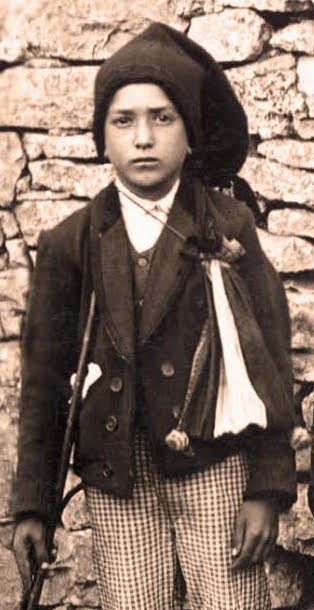
The words of the Angel of Fatima, “Console your God”, engraved themselves in young Francisco’s heart. They became the compelling inspiration of his short life of eleven years (1908–1919). Francisco wanted, more than anything else, to be the Consoler of the Hidden Jesus. He did this by praying rosary after rosary, and by spending hours close to the tabernacle of the parish church.
Readers familiar with the story of Fatima will recall that on 13 May 1917, after hearing the Lady say, “I come from heaven”, Lucia asked if she and her little companions would go to heaven. The Lady replied that both Lucia and Jacinta would go to heaven , but that Francisco would need to say many rosaries first.
This enigmatic utterance concerning Francisco has, over the years, given rise to a certain amount of speculation as to its meaning. Various interpretations have been ascribed to it, but I found none of them satisfying. Some commentators even suggested that Francisco was somehow held back in his spiritual development and, therefore, needed more prayer than his sister Jacinta and his cousin Lucia. (Read more.)
Sunday, October 25, 2015
Praying the Rosary
From Fr. Mark:
In a not so distant past, when the Rosary was prayed aloud, the individual leading the prayers would, invariably, do so while kneeling at a prie–dieu facing the image of the Blessed Virgin Mary. All were united in turning to the representation of Our Lady’s presence. The shift from the prie–dieu to the ambo, and the change in direction, has brought about and continues to foster an altogether unsettling development in the public recitation of the Rosary, analogous to what happens when the Holy Sacrifice of the Mass is celebrated at a forward–facing altar. Inevitably, the Rosary takes on a didactic character, in contrast to the contemplative, supplicatory, and doxological movement that has always been its very soul.
During my pilgrimage I could not help but notice the inflation of a verbose didactic approach to the Rosary. Each decade of the Rosary became an opportunity for someone to hold forth about something. These were not mere meditations on the mysteries but, rather, moralising and exhortatory fervorini stitched together with all the fashionable pastoral buzz words. My sense was that people would have preferred to get on with their prayers, and found all this holding forth wearisome. (Read more.)
Subscribe to:
Posts (Atom)