Saturday, June 13, 2020

Into the Silence of Mary and of the Host

From Vultus Christi:
The silence of Mary leads one into the silence of the Host. Of this silence of the Host I have spoke to you before. Friends and lovers speak one to the other to express what they hold in their hearts; once these things have been expressed, it is enough for them to remain united one to the other in the silence that is the more perfect expression of their love. So many souls are afraid of the silence into which Our Lord would lead them if only they would let Him. Fear is what causes souls to hide behind a barrage of words and concepts. Our Lord’s desire is to unite us directly to Himself by means of faith, hope, and especially, of love. The theological virtues do not require words. Words, in fact, can impede the pure expression of the theological virtues in a prayer that seeks to rise above them. (Read more.)

Monday, June 1, 2020

Days of Fire and Light

Fr. Mark has a fascinating post about how the suppression of the Octave of Pentecost in 1969 made Pope Paul VI weep. I love the octaves of the great solemnities. Certain feasts are too wonderful to be confined to one day. It takes an octave to absorb the joy and mystery which even in a lifetime we can never fully comprehend. To quote:
 The story goes that on the Monday after Pentecost in 1970 His Holiness Pope Paul VI rose early and went to his chapel for Holy Mass. Instead of the red vestments he expected, green ones were laid out for him. He asked the Master of Ceremonies, “What on earth are these for? This is the Octave of Pentecost! Where are the red vestments?” “Your Holiness,” replied the Master of Ceremonies, “this is now The Time Throughout the Year. It is green, now. The Octave of Pentecost is abolished.” “Green? That cannot be,” said the Pope, “Who did that?” “Your Holiness, you did.” And Paul VI wept.
Paul VI did not weep alone. Many wept with him. It was reported that Catherine de Hueck Doherty of Madonna House was inconsolable. Faithful the world over were speechless at the brutal removal of one of the Church Year’s most cherished moments. In some countries the hierarchy were frightfully embarrassed: the civil calendar had retained the Monday and Tuesday after Pentecost as holidays, while the Church had erased them from hers. Little by little, the voices of those seeking the restoration of the Pentecost came to be heard in high places. (Read entire post.)

Saturday, May 16, 2020

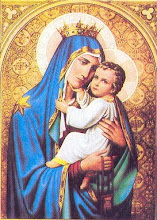
St. Simon Stock (1165-1265)


The son of a noble family, St. Simon Stock was born in England in 1165. At the age of twelve, he became a hermit in one of the vast forests for which England was then famous. He lived in the hollow trunk of an ancient tree, whence he derived the surname "Stock." Herbs, roots, berries, and an occasional crust of bread were his sustenance. He would leave his woodland retreat to visit different shrines of Our Lady, which in those days could be found throughout the kingdom. His devotion to Mary was so great that he would carve her holy name on the trees of the forest.

The Mother of God often appeared to St. Simon. During one apparition, she told him that the holy hermits of Mount Carmel, her special sons, would come to England and he was to join their order. Years passed by, and as prophesied, the "Brothers of Our Lady" came to Aylesford in Kent. They accepted St. Simon into their ranks. After his ordination, he made a pilgrimage to the Holy Land where he stayed with the hermits on Mount Carmel in silence and contemplation like Elias of old. He returned to Europe to help establish the Order in the West. In 1245, the first General Chapter of the Carmelite Order in the West was held at Aylesford. St. Simon was elected Father General of the Order.

It was a formidable task. Because of the rise of Islam in Palestine, it was of vital importance that the Order become firmly established in Europe. This meant advocating a "mixed life" of prayer and active ministry, similar to the Franciscans, rather than a purely eremetical, contemplative life. St. Simon sent the young hermits to the universities to receive the training necessary to be preachers. His decision was strongly criticized by some of the hermits who thought their charism was being destroyed. Many prelates were trying to have the Carmelites completely suppressed. The very existence of the Order was threatened.

St. Simon composed a prayer to Our Lady which begins: "Flower of Carmel, blossoming vine, splendor of Heaven, Mother Divine, none like to thee." He begged Our Lady to grant his order a privilegium or pledge of protection in exchange for total loyalty and service, such as a king or queen would grant a knight or a vassal in feudal society. On the night of July 15-16, 1251, the Queen of Heaven appeared to St. Simon, the Infant Jesus on her arm, surrounded by a multitude of angels. She gave him a large brown scapular. A scapular was a monastic apron worn by monks during their manual labor to protect their habits. Our Lady said: "Receive, my beloved son, this habit of thy Order: this shall be to thee and to all Carmelites a privilege, that whosoever dies clothed in this scapular shall never suffer eternal fire." What had been an apron now became a symbol of consecration to the Virgin Mary, a sign of her constant protection.

From that night on, the fortunes of the Carmelite Order improved. They received the protection of the Pope. The brown scapular became the main part of their habit, while small scapulars were distributed among the faithful. The brown scapular has become one of the most highly indulgenced sacramentals of the Church. In the fourteenth century, after a vision of Our Lady, Pope John XXII published the"Sabbatine Bull," promising delivery from purgatory on the Saturday following one's death to all who worthily wear the brown scapular, fulfilling the prescribed conditions.
Saturday, May 2, 2020

Novena to the Servant of God Élisabeth of France

The Servant of God Madame Élisabeth de France, sister of Louis XVI

Here is a novena in honor of the martyred princess of France, lasting from May 2 until May 10. From Hozana (translated from the French by Tea at Trianon):
Born on May 3, 1764, sister of Louis XVI, unmarried, after a life of prayer and service to the poor, she chose to stay with her family despite the danger and experienced imprisonment and death on the scaffold on May 10, 1794. On February 10, 1790, she dedicated France to the Sacred Heart and the Immaculate Heart of Mary, while asking for the protection of poor children. In these particularly difficult times, let us entrust to her our particular intentions, the single people whom we know and who seek to give meaning to their lives and, of course, our country. (Read more.)
Prayer the Beatification of Élisabeth of France
God our Father In your great mercy You called Élisabeth of France to the offering of her life for her family at the heart of the tumult of the Revolution. Driven by an unwavering faith in eternal life she supported her companions in their ordeals and brought hope to those who were going to die with her. Unmarried, she helped the poor and the sick, supported by fervent prayer. By her intercession grant us, according to Your will, the graces that we implore. In Your great kindness, make the Church recognize soon in her an authentic witness to the Gospel, a model of celibacy, diligent in prayer and attentive to the most fragile. We ask You through Jesus Christ our Lord. Amen.
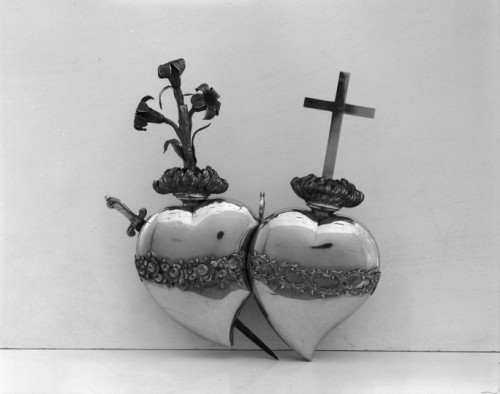
Above are votive offerings of the Immaculate Heart of Mary and the Sacred Heart of Jesus from Chartres Cathedral. The Immaculate Heart is pierced with the sword of sorrow, wreathed with flowers and crowned with lilies, symbols of Mary's love and purity. The Heart of Mary is offered on behalf of the Louis XVI and the Royal Family. The Sacred Heart, wreathed in the crown of thorns and crowned with the flame of love and the cross, represent the Passion of Christ and His love for the world. The Sacred Heart is offered on behalf of the Church in France. The votives were left at Chartres Cathedral in 1790 by members of the household of Madame Élisabeth of France,  at her bidding.

More on the life of the Servant of God, HERE.

Friday, May 1, 2020

The Popes and the Rosary

From Vatican News:
Promoted by the Dominicans in the 15th century, the Rosary took the form of a meditation on the life of Christ, while the Our Father and the Hail Marys were recited. In the 16th century, the Dominican theologian, Antonio Ghislieri, who became Pope St Pius V, structured the Rosary around 15 mysteries. On 7 October 1571, he instituted the feast of Our Lady of the Rosary. 
John Paul II in 2002 completed the Rosary with five new mysteries: The Luminous Mysteries were added to the Joyful, Sorrowful and Glorious mysteries. 
Between 1571 and 2002, the Popes never ceased to encourage the recitation of the Rosary. In September 1893, in the Encyclical Laetitiae sanctae, Leo XIII stated that he was “convinced that the Rosary, if devoutly used, is bound to benefit not only the individual but society at large”, whose evils he denounced at the dawn of the second Industrial Revolution, which was deepening the imbalance between the social classes. (Read more.)

Tuesday, April 28, 2020

The Czech Republic Remembers the Martyrs of Communism

From FSSPX:
Almost two years had passed since the “Prague coup” of February 25, 1948, which saw the Communist Party seize power in Czechoslovakia. While the whole country fell into the hands of Joseph Stalin’s agents, another Joseph, a Catholic priest, celebrated Mass on December 11, 1949 in his church in Cihost, a village located 100 kilometers southeast of Prague.

During Fr. Joseph Toufar’s sermon, the 20 or so faithful present saw the crucifix on the main altar move several times. The priest, who was not aware of this unusual event high above the pulpit, was informed of it by the parishioners at the end of the Mass. He recommended that they remain silent. Despite everything, the news spread and reached the ears of the sinister Statni Bezpecnost (StB), the political police charged with carrying out the base works of the Communist party.

For the StB, it could only be a false miracle, fabricated by the priest in order to encourage the gullible to oppose the regime in place. Fr. Toufar was imprisoned at the end of January 1950. He was tortured many times and died of his wounds on February 25, 1950. (Read more.

Wednesday, April 15, 2020

Imploring the Intercession of St. Michael


From Church Militant:
Saint Michael is believed to have made multiple appearances in the mountain town beginning in late A.D. 400, when a bishop, hesitant at first about who he was seeing, acquiecsed to the veracity of his visons after fasting and prayer. The cave-church was built following St. Michael's request and is believed to be the only building of worship in the Catholic Church consecrated by the archangel, earning its title of Celestial Basilica. Saint Michael makes his presence felt in another powerful way in Gargano: the Sanctuary of Monte Sant'Angelo rests in the middle of a mysterious ley line that links seven sacred sites — all connected to the archangel — from Ireland to Israel. The line cuts a perfectly straight swath for over 2,000 km across the heart of Europe. According to tradition, "The Sword of Saint Michael" represents the blow with which St. Michael sends the devil to Hell.   
The seven holy sites, each with stories of St. Michael to tell, include 
  • Skellig Michael in Ireland, where the archangel appeared to St. Patrick, helping him drive the evil creatures in the 400s
  • Saint Michael's Mount in England, where he appeared to a group of fishermen in A.D. 495
  • Mont Saint Michel in France, where he appeared to St. Aubert urging him to build a church in the rock in the 700s
  • Sacra di San Michele near Turin, Italy, where St. Michael appeared to San Lorenzo Maiorano in the 5th and 6th centuries
  • Sanctuary of Monte Sant'Angelo, Gargano, Italy, where St. Michael appeared and interceded multiple times 
  • Panormitis Monastery in Symi, Greece, which houses one of the largest statues of St. Michael in the world
  • Stella Maris Monastery on Mount Carmel in Israel, where, according to folk legend, St. Michael gave Elijah the thunder he wrested from Satan
Archbishop Viganò's call to bishops and priests worldwide "to fight the common enemy of the whole human race" also represents a return to St. Michael many faithful had forgotten and is now being resurrected. "Since the early days of the Church, the archangel has been venerated as the defender of God's rights, helping Christians to be steadfast in their fidelity to God in times of trial," Abp. Viganò said. 
During the troubled times of the Wuhan virus — when the "common enemy" seems to have won many battles — the faithful are turning to St. Michael for protection, as they prepare for the victory of Easter and ponder these words from the Apocalypse: "And there was a great battle in heaven: Michael and his angels fought with the dragon, and the dragon fought, and his angels. And they prevailed not ... ." (12:7–8).(Read more.)
Related Posts with Thumbnails