Only a very foolish person would change or “modernize” the words of Saint Robert Southwell, whose lengthy hymn is a brilliant treatise on Transubstantiation. We must remember that the Anglicans were vehemently opposed to Catholic doctrines, especially the invocation of the Blessed Virgin Mary and (in particular) the doctrine of Transubstantiation. After the time of King Henry VIII—in both England and its American Colonies—religious oaths were required to hold a rank in the military or government. (Read more.)
Saturday, March 5, 2022
His Words Matter
Friday, February 25, 2022
Fatima Novena for the Consecration of Russia to the Immaculate Heart of Mary
NOTE: St. John Paul's consecration of the world to the Immaculate Heart of Mary no doubt led to the fall of the Iron Curtain. Sr. Lucia said as much. Nevertheless, it is still the hope of many that some day a Sovereign Pontiff will make the Fatima Consecration of Russia to the Immaculate Heart specifically as requested by Our Lady.
Can Anyone Choose Hell?
From Regis Martin at Crisis:
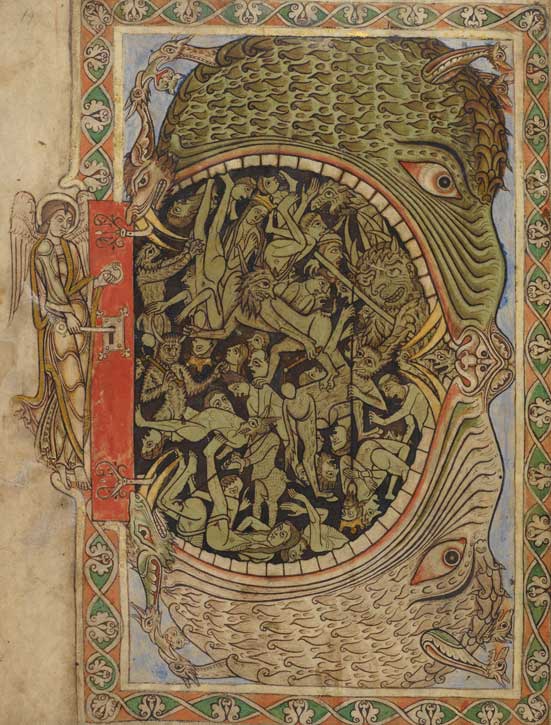
It is, of course, very bad indeed. Exceedingly, even hellishly bad, as it leaves one perpetually forlorn. Sartre, in other words, was dead wrong: Hell is not other people, as depicted in No Exit. Hell is being alone, absolutely and forever. It is, as the holy monk Fr. Zossima reveals in Dostoevsky’s The Brothers Karamazov, “the suffering of being unable to love.” Not to love the other, whether it be God or one’s neighbor, to anchor all one’s eros upon oneself, this is the philosophy on which Hell depends. And God, taking us finally at our word, will not stop us.
“Hell is what the judging God condemned and cast out of his creation,” writes Hans Urs von Balthasar. “It is filled with all that is irreconcilable with God, from which he turns away for all eternity. It is filled with the reality of all the world’s godlessness, with the sum of the world’s sin; therefore, with precisely all of that from which the Crucified has freed the world.” (Read more.)
Sunday, January 30, 2022
The Seven Sundays of St. Joseph
Whatever the origins may be, a devotion was developed where the seven sorrows and seven joys of Joseph became the focus of meditation on the seven Sundays preceding his feast on March 19. The first Sunday of these meditations is typically either the last Sunday of January or the first Sunday of February.
Below are the following joys and sorrows of St. Joseph, along with their respective passages in scripture. One approach to these Sundays is to read each passage and consider how Joseph would have felt in the situation. This is a form of lectio divina or “divine reading,” where you are able to put yourself into the scene and see Joseph’s expressions during each episode.
When praying the Seven Sundays devotion, it is customary to pray for a specific intention, asking St. Joseph’s powerful intercession for your needs.
1st Sunday
Sorrow (Matthew 1:19) The Doubt of St. Joseph
Joy (Matthew 1:20) The Message of the Angel
2nd Sunday
Sorrow (Luke 2:7) The Poverty of Jesus’ Birth
Joy (Luke 2:10-11) The Birth of the Savior
3rd Sunday
Sorrow (Luke 2:21) The Circumcision
Joy (Matthew 1:25) The Holy Name of Jesus
4th Sunday
Sorrow (Luke 2:34) The Prophecy of Simeon
Joy (Luke 2:38) The Effects of the Redemption
5th Sunday
Sorrow (Matthew 2:14) The Flight into Egypt
Joy (Isaiah 19:1) The Overthrow of the Idols of Egypt
6th Sunday
Sorrow (Matthew 2:22) The Return from Egypt
Joy (Luke 2:39) Life with Jesus and Mary at Nazareth
7th Sunday
Sorrow (Luke 2:45) The Loss of the Child Jesus
Joy (Luke 2:46) The Finding of the Child Jesus in the Temple
(Read more.)
More meditations, HERE.
Saturday, December 25, 2021
The Joy of Wonder
For me that mystery is expressed in the line about the Church being filled with wonder at the nearness of her God. Wonder is not fashionable. It has no street cred. It is the reverse of ‘cool’, yet wonder is one of the most generous and joyful of emotions. We are surprised with wonder at the unexpected or even the familiar seen or heard as for the first time. It is not dependent on our circumstances. I remember once being moved almost to tears by the luminous beauty of a raindrop slowly coursing down a window-pane. At the time, I was busy with many things, distracted and irritable, but my attention was suddenly held and a rainy day transformed by that glimpse of loveliness. Christmas Day is a little like that. At one level, it is a day like any other; at another, it is a day out of time, a day that allows us a glimpse of eternity and of God himself.
Today we are invited to wonder at the miracle of God made man, the mighty Word reduced to a baby’s wail. This we can celebrate no matter where we are or the circumstances in which we find ourselves. Too much family or too little, feasting or forced to fast, our God is near to us. All glory, honour and praise be to Him for ever and ever! (Read more.)
Sunday, December 19, 2021
Faith, Reason and the Virgin Birth
In the Catholic view of things, faith and reason are mutually compatible, although through faith we are able to know things that we could not know by reason alone. Hence, faith is both reasonable and transcends reason, just as grace builds on nature but also transcends it. Reason shows us that what God has revealed is compatible with nature. In other words, God is not arbitrary. The natural law written in our hearts is confirmed by supernatural revelation not contradicted by it....
Among Catholics there is much confusion as to the precise meaning of the Virgin Birth. It is not to be confused with the Virginal Conception of Our Lord. The Church, from the earliest times, has articulated the Perpetual Virginity of Our Lady as pertaining to three distinct moments: before the birth of Jesus (ante partum), during the birth of Jesus (in partu), and after birth of Jesus (post partum). Virtually every time the magisterium has spoken on the subject, this threefold distinction is made. This teaching is derived from the early fathers of the Church, who maintained, defended and made the teaching a universally held truth of the Catholic Church.
The Virginity of Our Lady “before the birth of Jesus” (ante partum) refers to the Virginal Conception, namely, that Jesus was conceived in the womb of Mary by the power of the Holy Spirit, and not by the seed of man. That is fairly clear. It is also clear that the Virginity of Our Lady “after the birth of Jesus” (post partum) refers to the fact that Our Lady never had sexual relations, even after the birth of Jesus, a fact that many Protestants deny. For many Catholics, unfortunately, these two points say everything that is to be said about the Virginity of Our Lady and such Catholics proceed to explain away the Virginity of Our Lady “during the birth of Jesus” (in partu). They say that the Virginity of Our Lady in partu, just refers to her “spiritual virginity,” an idea that is contrary to magisterial clarifications. Or, they say, that the “Virgin Birth” is a misnomer for “Virginal Conception.”
But the middle moment of Our Lady’s Perpetual Virginity is real and its reality is the only viable reason why the Church would continue to insist on a threefold distinction as opposed to a twofold one. In fact, unless the Virginity of Our Lady in partu means exactly what the Fathers of the Church said it means, namely, miraculous birth, then it means nothing at all and as a statement of faith is completely superfluous and meaningless.
Theologians can speculate all they want on what does or does not belong to the essential matter of the Church’s definition of the Perpetual Virginity, but the only reason anyone would doubt that the birth of Jesus is any less miraculous than the conception is a lack of faith. People will cite this or that theologian, whose convoluted explanation of the Virgin Birth allows for a natural birth, including pain and afterbirth, but they cannot cite any ancient authorities or magisterial affirmations. They do not want to believe the full truth of the Virgin Birth because it is hard to believe—and because it is not convenient doctrine for Apologetics. (Read entire post.)
Wednesday, December 15, 2021
The Spanish Privilege
From The Liturgical Arts Journal:
Blue vestments are frequently a topic of very great interest -- so much so, one wonders why the Church doesn't simply permit this colour since it pretty clearly seems to be a development that is not only well situated with the precedent of custom but also the manifest desire of the lay faithful; but I digress. If you want a general guideline for 'decoding' blue vestments it is this: not all blue vestments are in fact blue (liturgically speaking); blue was sometimes meant to function liturgically as purple or even occasionally black. (For example, purple sometimes has strong blue undertones and when you look at it, you can see how it could be interpreted as either colour. Likewise, some blues are so dark, navy blue for example, it could easily function as black. To extend this further, some blues have green tones in them and could even be intended to function as liturgical green.) A good general starting point is this: the lighter the colour of blue -- and thus the less arguably able to function as purple or black -- the more likely it was specifically blue, or Marian, in its liturgical intent. The permission that was given for blue does in fact specify the shade of blue known as cerulean. (Read more.)