Saturday, December 25, 2021

The Joy of Wonder

From iBenedictines:
For me that mystery is expressed in the line about the Church being filled with wonder at the nearness of her God. Wonder is not fashionable. It has no street cred. It is the reverse of ‘cool’, yet wonder is one of the most generous and joyful of emotions. We are surprised with wonder at the unexpected or even the familiar seen or heard as for the first time. It is not dependent on our circumstances. I remember once being moved almost to tears by the luminous beauty of a raindrop slowly coursing down a window-pane. At the time, I was busy with many things, distracted and irritable, but my attention was suddenly held and a rainy day transformed by that glimpse of loveliness. Christmas Day is a little like that. At one level, it is a day like any other; at another, it is a day out of time, a day that allows us a glimpse of eternity and of God himself. 
Today we are invited to wonder at the miracle of God made man, the mighty Word reduced to a baby’s wail. This we can celebrate no matter where we are or the circumstances in which we find ourselves. Too much family or too little, feasting or forced to fast, our God is near to us. All glory, honour and praise be to Him for ever and ever! (Read more.)

Sunday, December 19, 2021

Faith, Reason and the Virgin Birth

It is the ancient and constant teaching of the Church that Our Lady gave birth without loss of her virginity. In the words of Father Angelo:
In the Catholic view of things, faith and reason are mutually compatible, although through faith we are able to know things that we could not know by reason alone.  Hence, faith is both reasonable and transcends reason, just as grace builds on nature but also transcends it.  Reason shows us that what God has revealed is compatible with nature.  In other words, God is not arbitrary.  The natural law written in our hearts is confirmed by supernatural revelation not contradicted by it....

Among Catholics there is much confusion as to the precise meaning of the Virgin Birth.  It is not to be confused with the Virginal Conception of Our Lord.   The Church, from the earliest times, has articulated the Perpetual Virginity of Our Lady as pertaining to three distinct moments:  before the birth of Jesus (ante partum), during the birth of Jesus (in partu), and after birth of Jesus (post partum).  Virtually every time the magisterium has spoken on the subject, this threefold distinction is made.  This teaching is derived from the early fathers of the Church, who maintained, defended and made the teaching a universally held truth of the Catholic Church.

The Virginity of Our Lady “before the birth of Jesus” (ante partum) refers to the Virginal Conception, namely, that Jesus was conceived in the womb of Mary by the power of the Holy Spirit, and not by the seed of man.  That is fairly clear.  It is also clear that the Virginity of Our Lady “after the birth of Jesus” (post partum) refers to the fact that Our Lady never had sexual relations, even after the birth of Jesus, a fact that many Protestants deny.  For many Catholics, unfortunately, these two points say everything that is to be said about the Virginity of Our Lady and such Catholics proceed to explain away the Virginity of Our Lady “during the birth of Jesus” (in partu).  They say that the Virginity of Our Lady in partu, just refers to her “spiritual virginity,” an idea that is contrary to magisterial clarifications.  Or, they say, that the “Virgin Birth” is a misnomer for “Virginal Conception.”

But the middle moment of Our Lady’s Perpetual Virginity is real and its reality is the only viable reason why the Church would continue to insist on a threefold distinction as opposed to a twofold one.  In fact, unless the Virginity of Our Lady in partu means exactly what the Fathers of the Church said it means, namely, miraculous birth, then it means nothing at all and as a statement of faith is completely superfluous and meaningless.

Theologians can speculate all they want on what does or does not belong to the essential matter of the Church’s definition of the Perpetual Virginity, but the only reason anyone would doubt that the birth of Jesus is any less miraculous than the conception is a lack of faith.  People will cite this or that theologian, whose convoluted explanation of the Virgin Birth allows for a natural birth, including pain and afterbirth, but they cannot cite any ancient authorities or magisterial affirmations.  They do not want to believe the full truth of the Virgin Birth because it is hard to believe—and because it is not convenient doctrine for Apologetics. (Read entire post.)

Wednesday, December 15, 2021

The Spanish Privilege


From The Liturgical Arts Journal:

Blue vestments are frequently a topic of very great interest -- so much so, one wonders why the Church doesn't simply permit this colour since it pretty clearly seems to be a development that is not only well situated with the precedent of custom but also the manifest desire of the lay faithful; but I digress. If you want a general guideline for 'decoding' blue vestments it is this: not all blue vestments are in fact blue (liturgically speaking); blue was sometimes meant to function liturgically as purple or even occasionally black. (For example, purple sometimes has strong blue undertones and when you look at it, you can see how it could be interpreted as either colour. Likewise, some blues are so dark, navy blue for example, it could easily function as black. To extend this further, some blues have green tones in them and could even be intended to function as liturgical green.) A good general starting point is this: the lighter the colour of blue -- and thus the less arguably able to function as purple or black -- the more likely it was specifically blue, or Marian, in its liturgical intent. The permission that was given for blue does in fact specify the shade of blue known as cerulean. (Read more.)

Thursday, November 18, 2021

Guide to Confession


For Catholics Striving for Holiness:

When our Lord speaks about the Apostles being clean, now, just before the institution of the Blessed Eucharist, he is referring to the need for the soul to be free from sin if it is to receive this Sacrament. St Paul repeats this teaching when he says:

“Whoever eats the bread or drinks the cup of the Lord in an unworthy manner will be guilty of profaning the body and blood of the Lord” (1 Cor 11:27).

On the basis of these teachings of Jesus and the Apostles, the Church lays down that anyone who is conscious of having committed a grave sin, or who has any positive doubt on that score, must go to Confession before receiving Holy Communion.
If one has not gone to confession first,  one must  NOT receive Holy Communion if HE OR SHE IS GUILTY of having committed  the following  MORTAL sins, KNOWING that they are GRAVE and in spite of that, FREELY CHOSE to do it:

1. Having MISSED a SUNDAY or HOLY DAY MASS WITHOUT a valid reason (i. e., out of laziness, giving priority to sports, shopping, parties etc.) (Read more.)


Sunday, November 14, 2021

The Word of the Lord Remains Forever!

From Monsignor Charles Pope:

Yes, we know very well that the Day of Judgment is coming. Too easily, though, we dream on and do not follow the prescribed priority. Wealth, fame, and glory are all uncertain and  passing, but death, judgment, Heaven, and Hell are certain and remain forever. We too easy fiddle on with things that are uncertain and passing while neglecting what is certain and eternal. Ridiculous!

It would be foolish to book passage on a sinking ship. Similarly, it is imprudent to make this world and its demands our fundamental priority. It is wise to set our sights on, and lay hold of, the Kingdom that lasts forever. It is sad that so many spend people their time “rearranging the deck chairs on the Titanic” of this world. What are our priorities? Frankly, most of our priorities are not things that matter to God. Even if we attain the passing things for which we strive, they will all ultimately slip through our fingers. We obsess over passing things like our physical health while neglecting enduring things like our spiritual health. We should care for our bodies, but even more should we care for our souls. If we would expend as much effort looking for a time and place to pray as we do searching for a restaurant for dinner, we would be spiritual heavyweights rather than physically overweight.

In today’s Gospel the Lord stands before the Temple: an impressive building, a symbol of power and of worldly glories. Impressed by it though the Apostles are, the Lord is not impressed with passing things. He counsels us to get our priorities straight and to focus on things that last: His Word, which never passes away, and our ultimate destiny, where we will spend eternity. (Read more.)
Saturday, October 16, 2021

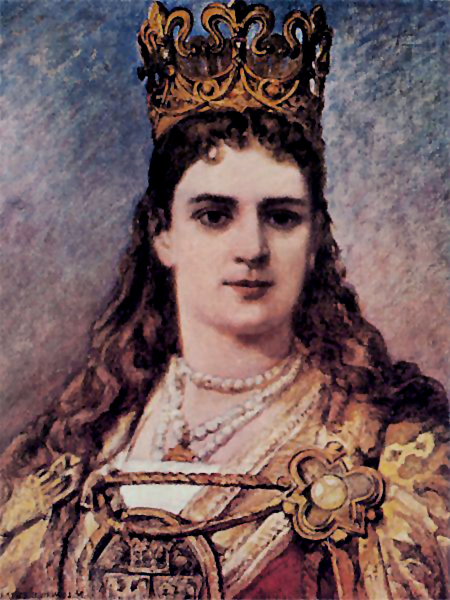
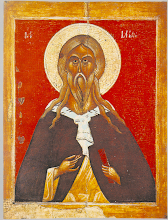
St. Hedwig

So young a queen.
Born, 1371. Died, 17 July 1399 during child birth. Hedwig was the youngest daughter of King Louis I of Hungary. Because she was great-niece to King Casimir III of Poland, she became Queen of Poland in 1382 upon her father‘s death. She was engaged to William, Duke of Austria, whom she loved, but broke off the relationship in order to marry Jagiello, non-Christian Prince of Lithuania, for political reasons.

In 1384, upon the death of Louis I of Hungary and Poland, the Polish nobles, having crowned his daughter Hedwig, decided that as the new queen was but fifteen years old, she must be provided with a consort capable of protecting her dominions. Their choice fell upon Jagiello, or Jagello, the Prince of Lithuania, whose hostility to the Teutonic Order made him their natural ally. (Read entire post.)

Thursday, September 23, 2021

Cumbre Vieja and Sr. Lucia's 1944 Tuy Apparition

 From Unveiling the Apocalypse:

A lot of people have been contacting me recently, to ask my thoughts on the recent eruption of Cumbre Vieja in the Canary Islands, on 19th Sept, 2021 - the feast of Our Lady of La Salette. Some are worried that this could potentially result in the cataclysm that Sr. Lucia seen in a vision, during an apparition of Our Lady in 1944. It was during this apparition that the Blessed Virgin instructed Sr. Lucia to write down the contents of the Third Secret of Fatima. During a recent podcast with Fr. Richard Heilman and Doug Barry, I tried to explain how I'm not expecting the catastrophe seen in Sr. Lucia's 1944 apparition anytime soon, because of the significance of the katēchon of 2Thes 2:6-7 - the "restraining force" which holds back the appearance of the Antichrist. See around the 41 minute at this link: The Katechon and the Binding of Satan .

In my book Unveiling the Apocalypse: The Final Passover of the Church, I argue that Sr. Lucia's vision of the angel touching the earth with a flaming lance is connected with the eschatological earthquake described in Rev 16:

The seventh angel poured out his bowl into the air, and out of the temple came a loud voice from the throne, saying, “It is done!” Then there came flashes of lightning, rumblings, peals of thunder and a severe earthquake. No earthquake like it has ever occurred since mankind has been on earth, so tremendous was the quake. The great city split into three parts, and the cities of the nations collapsed. God remembered Babylon the Great and gave her the cup filled with the wine of the fury of his wrath. (Rev 16:17-19)
I felt my spirit flooded by a light-filled mystery which is God and in Him I saw and heard: the point of the flame-like lance which detaches, touches the axis of the earth and it [the earth] shakes: mountains, cities, towns and villages with their inhabitants are buried. The sea, rivers and clouds leave their bounds, they overflow, flood and drag with them into a whirlpool, houses and people in a number unable to be counted; it is the purification of the world from the sin it is immersed in. Hatred, ambition, cause destructive wars 
(Sr. Lucia, Tuy, 1944. See Sr. Lucia's official biography by the Carmelites of Coimbra - A Pathway Under the Gaze of Mary)
The event seen by Sr. Lucia in her 1944 Tuy apparition is specifically connected with the fall of "Babylon", which is symbolized by an angel throwing a millstone into the sea in Rev 18:21:
Then a mighty angel picked up a boulder the size of a large millstone and threw it into the sea, and said: "With such violence the great city of Babylon will be thrown down, never to be found again."
This scriptural passage is in turn associated with the "great mountain, burning with fire" which St. John seen being thrown into the sea in Rev 8:8. In my book, I attempt to demonstrate that this burning mountain is closely associated with the seven burning mountains described in the Book of Enoch, which are identified with the Canary Islands. (See the blog post The Seven Burning Mountains of Enoch and the Canary Islands for further details).

As I state in the above podcast, I don't think that the events described in Sr. Lucia's 1944 vision will happen anytime soon, since they are concerned with the very end time itself. In the Book of Revelation, the fall of "Babylon" is directly connected with the rise to power of the Antichrist, who ascends to world dominance as a result of the power vacuum created by the downfall of the world's leading superpower. (Read more.)


More HERE.

Related Posts with Thumbnails