

Thursday, January 9, 2025

Novena to Our Lady of Hope

Let us pray for our country. From Return to Order:
I am the mother of fair love, and of fear, and of knowledge, and of holy hope.
In me is all grace of the way and of the truth; in me is all hope of life and of virtue. Come to me all that desire me and be filled with my fruits. (Ecclesiasticus 24:24-26).
O Blessed Virgin Mary, Mother of Grace, Hope of the world
Hear us, your children, who cry to you!
Let Us Pray
O God, Who by the marvelous protection of the Blessed Virgin Mary has strengthened us firmly in hope, grant we beseech You, that by persevering in prayer at her admonition, we may obtain the favors we devoutly implore. Through Christ Our Lord. Amen. 
Prayer to Our Lady of Hope 
O Mary, my Mother, I kneel before you with heavy heart. The burden of my sins oppresses me. The knowledge of my weakness discourages me. I am beset by fears and temptations of every sort. Yet I am so attached to the things of this world that instead of longing for Heaven I am filled with dread at the thought of death. O Mother of Mercy, have pity on me in my distress. You are all-powerful with your Divine Son. He can refuse no request of your Immaculate Heart. Show yourself a true Mother to me by being my advocate before His throne. 
O Refuge of Sinners and Hope of the Hopeless, to whom shall I turn if not you? Obtain for me, then, O Mother of Hope, the grace of true sorrow for my sins, the gift of perfect resignation to God’s Holy Will, and the courage to take up my cross and follow Jesus. Beg of His Sacred Heart the special favor that I ask in this novena. (Make your request.) But above all I pray, O dearest Mother, that through your most powerful intercession my heart may be filled with Holy Hope, so that in life’s darkest hour I may never fail to trust in God my Savior, but by walking in the way of His commandments I may merit to be united with Him, and with you in the eternal joys of Heaven. Amen.
Mary, our Hope, have pity on us.
Hope of the Hopeless, pray for us.
Say three (3) Hail Marys

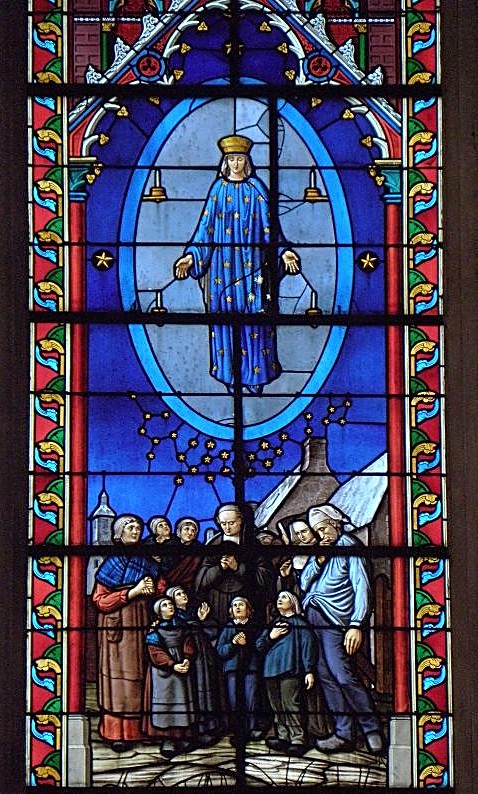
Read about Our Lady of Hope of Pontmain, HERE.

Saturday, January 4, 2025

St. Elizabeth Ann Seton and the Mountain of Grace

One winter I made a retreat about ten miles from the tomb of Saint Elizabeth Ann Seton, the first American-born citizen to be canonized. Today is her feast-day. She was a beautiful, cultured, educated lady who suffered the loss of husband, two children, and social standing. Shunned by most of her family after she converted to Catholicism, Saint Elizabeth started a community of teaching nuns in what was called Saint Joseph's valley at the foot of Saint Mary's mountain near Emmitsburg, Maryland. I often went to Emmitsburg during my childhood and young adulthood, visiting the Grotto of Our Lady of Lourdes.

The grotto is a popular pilgrimage site and has a miraculous spring. My mother once injured her foot after she dropped a motor bike on it. We took her to the grotto. After bathing her foot in the icy water the pain disappeared, even as she was walking back to the car. There are many other healings that have happened there, both physical and spiritual. The daily Mass is in the glass chapel on the side of the mountain. Through the tall trees can be seen the blue expanse of Frederick County, "fair as the garden of the Lord," as the poet Whittier said. (Well, at least it used to be; now it is a bit congested.)

At the grotto is the rock where Mother Seton would come every Sunday and teach the children, those of the neighborhood and her own, the catechism, explaining the truths of the faith with clarity and love. Mother and her nuns would walk up from the valley, rain or shine, to spend Sunday on the mountain. It was in the first decades of the nineteenth century, before the Lourdes apparitions in France, but the grotto was seen as a venerable and holy place by Mother and the French priests who assisted her. Walking there in the twenty-first century one is still overwhelmed by the sense of being on holy ground.

Sunday, December 8, 2024

Fr. Peter and the Immaculate

I was blessed as a young Carmelite to be taught by  the late Fr. Peter Damian Fehlner. Here is a magnificent conference by Fr. Angelo about Fr. Peter's Marian writings. To quote:
At the Symposium titled "Sursum Actio" at Notre Dame Univ. from Jun 8-9, 2015, in honor of the life work of Fr. Peter Damian Fehlner, F.I., Fr. Angelo Geiger, FI, from the Pontifical University of St. Thomas, gives the thirteenth conference which he titles, "In the Counsels of the Immaculate: Fr. Peter Damian Fehlner’s Contribution to the Renewal of Franciscan Immaculatism". He points out how much Fr. Peter has contributed to renewing the great Marian tradition of the Franciscan Conventuals and how this is the way they will regroup and fulfill their mission of renewing the Church. Fr. Peter did this primarily by bringing to light the great patrimony of St. Maximilian Kolbe in promoting total consecration to Mary in the Church as a way of bringing to fruition the declaration of the Immaculate Conception as a dogma in 1854. (Read more.)

Saturday, November 30, 2024

O Bona Crux

On this day, Andrew the poor fisherman from Galilee, patron saint of Scotland, of Greece, and of Russia, passed into eternal glory after many ordeals. Here is an excerpt from the old Martyrology for November 30, Feast of St Andrew the Apostle, as quoted in Dom Gueranger's The Liturgical Year, Vol XV :
Andrew, having been brought to the place of execution, seeing the cross at some distance, began to cry out: O good cross, made beautiful by the body of my Lord! so long desired, so anxiously loved, so unceasingly sought after, and now at last ready for my soul to enjoy! take me from amidst men, and restore me to my Master; that by thee He may receive me, Who by thee redeemed me. He was therefore fastened to the cross, on which he hung alive two days, preaching without cessation the faith of Christ....

Thursday, November 28, 2024

The Pilgrims

The image “http://www.printsoldandrare.com/thanksgiving/001thnk.jpg” cannot be displayed, because it contains errors.

Laudem Gloriae discusses the origins of our American Thanksgiving. To quote:

Queen Elizabeth had little patience for the Catholics, but even less for the Calvinists, who complained the Church of England remained too papist. In their desire to complete the Reformation and purify religion of popish trumperies, the Puritans broke from the Anglican Church, rejected the Book of Common Prayer, and preferred the anti-royalist Geneva Bible to the King James version. They instituted an independent congregationalist ideal that upheld the notion of the common priesthood of all believers, and thus granted an equal say among congregants in the election of the minister (some claim the roots of American democracy lie here). All of this naturally brought down upon them the wrath of the Crown. A number of Puritans sought refuge in Holland, where they lived in religious freedom for a dozen years, after which they chose to emigrate to America. After meeting another group of Puritans in Southampton, all boarded the Mayflower on September 16, 1620. Sixty-five days later, they sighted Cape Cod. The first Thanksgiving celebration (which lasted three days) took place in 1621 with about ninety Native Americans, and wasn't celebrated again until some years later, when in 1863 Abraham Lincoln declared it a national holiday. (Read more.)


More HERE.
The persistence of American Thanksgiving customs is impressive. While cranberry sauce and pumpkin pie may not have been on the menu at Plymouth in 1621, when venison and an unspecified "fowle"; graced the communal table, Americans have celebrated their unique holiday for giving thanks to God in ways that are highly recognizable from generation to generation, from century to century.

Saturday, November 23, 2024

Blessed Miguel Pro

From Blessed Miguel Pro Catholic Academy:

 Blessed Fr. Miguel Pro was a Jesuit priest who was executed by a firing squad in Mexico for exercising his priestly ministry during the persecution of the Catholic Church in Mexico during the presidency of Elias Plutarco Calles.

Fr. Pro was born into a mining family in Guadalupe, Zacatecas on January 13, 1891. He was the third of eleven children, four of whom had died as infants or young children. Two of his sisters joined a convent. He was known for his great charity and for being a playful and prayerful man. He was known for the long periods he spent in the chapel. He was known for his great joy and love, even as he suffered from years of stomach illness that resulted in having to have multiple stomach surgeries.

Pro studied in Mexico until 1914 when a massive wave of governmental anti-Catholicism forced the novitiate to dissolve and the Jesuits to flee to Los Gatos, California, in the United States. He then went to study in Granada, Spain (1915–19), and from 1919 to 1922 taught in Nicaragua. Sadly, in Mexico, beginning in 1917, anti-Catholic laws were passed that did not allow priests to minister publicly, or even to wear clothing that identified them as priests in public. People had to be ministered to in their homes and in an underground manner. During this time the League for the Defense of Religious Liberty began to fight back against the oppression. They came to be known as the cristeros or Soldiers of Christ.

Fr. Pro took on many disguises in order to minister secretly to the persecuted Church and avoid being captured by the federales for carrying out ministry illegally. He was known to dress as a ‘dandy’ on the streets of Mexico City. He even disguised himself as a mechanic in order to give a conference to a group of cab and bus drivers.

Fr. Pro was also known for his great works of charity. The poverty level in Mexico at the time was so extreme that Fr. Pro, in addition to carrying out his spiritual duties, had an active ministry providing the poor with food, clothing, and shelter.

A  failed attempt to assassinate Álvaro Obregón in November 1927, provided the state with a pretext for arresting Pro, this time with his brothers Humberto and Roberto. A young engineer who confessed his part in the assassination testified that the Pro brothers were not involved. However, President Calles gave orders to have Pro and his brother Humberto executed for the assassination attempt.

On November 23, 1927, as Fr. Pro walked from his cell to the courtyard and the firing squad, he blessed the soldiers, knelt, and briefly prayed quietly. Declining a blindfold, he faced his executioners with a crucifix in one hand and a rosary in the other and held his arms out in imitation of the crucified Christ and shouted out,

“May God have mercy on you! May God bless you! Lord, Thou knowest that I am innocent! With all my heart I forgive my enemies!”

Before the firing squad was ordered to shoot, Pro raised his arms in imitation of Christ and shouted,

“Viva Cristo Rey!” – “Long live Christ the King!”. (Read more.)


Sunday, November 17, 2024

The Last Judgment

From A Pilgrim's Journey:

We live in the “last days,” and those last days began with the birth, death and resurrection of our Lord Jesus Christ. At the time of His ascension into heaven, the promise was given to the apostles that “this Jesus, whom you have seen taken from your sight, will return in the same way as you have seen Him go.” The second coming of Christ is a doctrine of our faith.

Our Lord Jesus Christ said, “In those days, after that great tribulation, the sun will be darkened, and the moon will not give its light, and the stars will be falling from heaven, and the powers in heaven will be shaken. And then they will see the Son of man coming in clouds with great power and glory. And then he will send out the angels, and gather his elect from the four winds, from the ends of the earth to the ends of heaven...” And so when considering the second coming of our Lord Jesus Christ, there are four main features which call for our attention:

First, He will come in truth and with an unmistakable reality. Christ tells us, “They will see the Son of Man coming...” In other words, there won’t be any doubt about who He is. Up until the moment of His return, deception is possible. There were many false prophets in the Old Testament; we’re warned about false Christs in the New Testament. In fact, people were so accustomed to false Messiahs and false prophets, that even on the day of the Resurrection, two of the disciples said sadly on the way to Emmaus, “But we had hoped that he was the one to redeem Israel...” thinking that Jesus was just one more in a long line of men who gave false hope. The rising up of false leaders giving false hopes is part of the common history of mankind. Certainly, we can understand that for those who don’t believe that Christ has come, they might be prepared to accept a self-styled Christ with the right credentials; but for those who believe that Christ has already come, it’s harder to understand how they could be fooled; however, Jesus warned of this very possibility, when He said, “For false Christs and false prophets will arise and show great signs and wonders, so as to lead astray, if possible, even the elect.” These false prophets will work on the fears and prejudices and doubts of the faithful, and there will be any number of movements and false apparitions and empty promises to fool even those who belong to Christ. We’ve seen these things come and go, even in our own lifetime, with people chasing after some charismatic speaker, or some supposed apparition, even some smooth-talking world leader. But at His true second coming, Christ will stand before the whole world, unmistakable as the one and only Saviour and Lord.

Secondly, Christ will be manifested universally. He tells us that He will be seen “from the far ends of the earth to the far ends of the heavens.” That’s what will happen. But for now, it is our responsibility to carry the message of Christ throughout the world. Dark corners need the Light of Christ so that we can help bring about the day when “the earth shall be full of the knowledge of the Lord.” But the coming of Christ, when it happens for the second time, will not be so gradual, and it won’t depend upon our efforts. Rather, it will be like the flash of lighting which races across the dark sky. Lightning seems to follow no law. It penetrates everywhere with a frightening beauty, and there’s a split-second silence before the roar of the thunder is heard. Here’s a way to distinguish false Christs from true: the whole world will, all at once, know that He has come, just as the bolt of lightning illumines the whole sky.

Thirdly, Christ will come with “great power and glory.” This will be manifested first in the changes that will come over the material heavens. The sun will be darkened, the moon will no longer shine with the sun’s reflected light; the stars will appear to fall from heaven, and the powers of heaven will shake, in preparation for their demise. And then, there will be the appearance of the Son of man. What will be His sign? Perhaps a fiery Cross, remembering the sign of our salvation; or maybe a new sign, corresponding to the new heavens and the new earth. We don’t know. But there will be some signal so that everyone will know of this glory which will surround Christ in His second coming. We can scarcely imagine such a thing, and we cannot really put it into words before it happens. (Read more.)


Related Posts with Thumbnails