Tuesday, August 18, 2026

St. Helena the Empress


My patron saint. She discovered the True Cross. Father Mark Kirby said:
Saint Helena was not merely collecting relics for posterity. Her discovery of the True Cross saved the Orthodox Catholic faith from being submerged in a sea of speculative philosophies that denied the true Flesh and Blood of Christ. Saint Helena’s discovery points to the God who became man and suffered death on a real cross in a particular place at a precise moment in history. Mary Magdalene, the Apostle to the Apostles was the herald of Christ’s resurrection; Saint Helena became the herald of the mystery of the Cross. (Read more.)


Sunday, August 16, 2026

The Splendor of Heaven


From Art for the Liturgical Year:

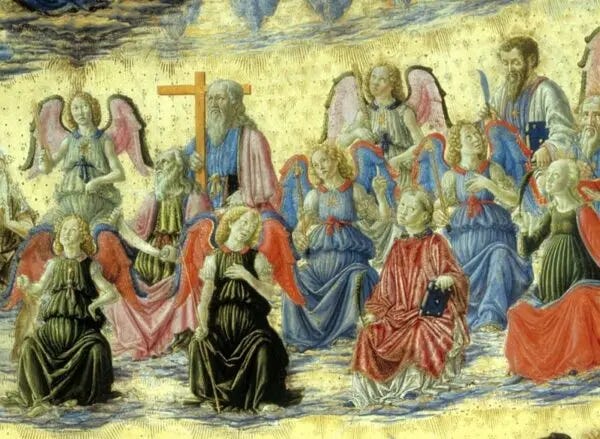
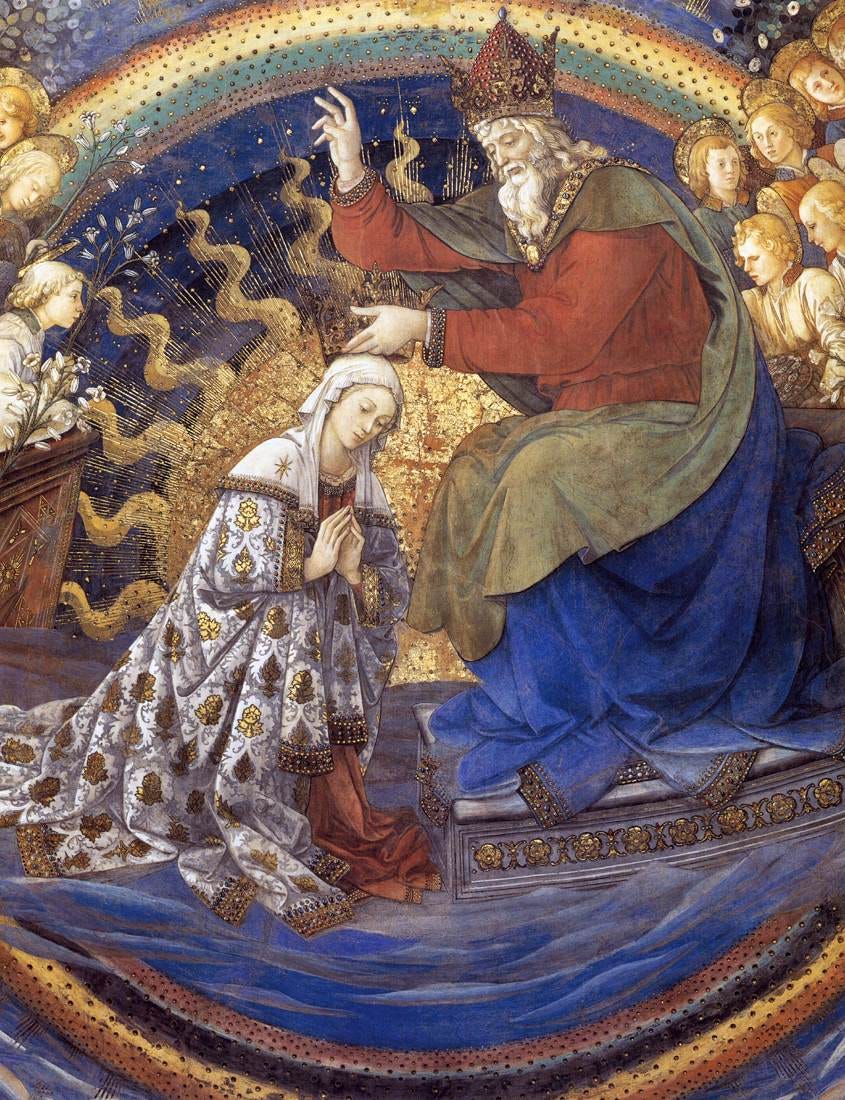
The radiance of the gilded dome of heaven draws attention upward to where Christ welcomes his mother, body and soul, into the splendor of Heaven, where she shares the glory of her Son’s resurrection.4

Four concentric circles of light surround the figure of Christ while golden bands of light holding the nine tiers of angels compose the dome of heaven. Saints mingle with the angels and include such recognizable figures of Adam and Eve, David, Saint Jerome, Bartholomew, Saint Lawrence, Saint Augustine.

A quote from the eleventh-century bishop and martyr Saint Gerard, included in the Golden Legend, describes the jubilant scene:

The heavens welcomed the Blessed Virgin joyfully: Angels rejoicing, Archangels jubilating, Virtues honouring, Thrones exalting, Dominions psalming, Principalities harmonizing, Powers playing their lyres, Cherubim and Seraphim hymning and leading her to the supernal tribunal of the divine majesty.

The harmonious arrangement of bodies and colors in Botticini’s painting echoes the harmony of the heavenly hierarchy of angels described by Saint Gerard; The orderliness of the painting inspires confidence in the unity of God’s plan for all things. (Read more.)


 From The Sacred Images Project:

Throughout the Christian world, east and west, August 15th1 is the day we remember the death or “falling asleep” of the Blessed Virgin Mary. In the west it’s called the Feast of the Assumption and commemorates the moment she was assumed, or taken up, body and soul into heaven at the end of her earthly life. This event, which underscores Mary’s purity and her role as the Mother of God - the Theotokos in Greek - has always been a central doctrine in Christianity but was formally defined as dogma by Pope Pius XII in 1950.

Despite the lateness of the dogmatic definition, the commemoration of the Virgin’s holy death is of the most extreme antiquity. In the second century, the account of the bodily ascent of the Most Holy Virgin Mary to Heaven is found in a document attributed to Meliton, Bishop of Sardis. In the fourth century, Saint Epiphanius of Cyprus refers to the tradition about the “falling asleep” (Dormition) of the Mother of God. In the fifth century, Saint Juvenal, Patriarch of Jerusalem, told the holy Byzantine Empress Pulcheria: “Although there is no account of the circumstances of Her death in Holy Scripture, we know about them from the most ancient and credible Tradition.” (Read more.)

Saturday, August 15, 2026

The Assumption and Gender

The Church Life Journal:

It is important to realize that this dogma was not invented in the 1950’s. As Pope Pius XII’s encyclical points out, this tradition is found in the ancient liturgical books of both East and West. It is also attested to by St. Sergius I, Pope in the late 7th century, who even prescribed a litany to be prayed on the feast. But this feast−although solidly grounded in the tradition−is also more than that. It reveals the wisdom of God and the importance of masculinity and femininity in the plan of creation. Every celebration of the Church does not just celebrate a random act of God, but a thoroughly intentional act, an action that means something. All of God’s actions in history reveal something about his design, and about us, his creatures. The Assumption reveals something to us about the central role played by relationality in creation.

God’s plan of assuming the Mother of God into heaven becomes intelligible when we reflect on Jesus Christ as the New Adam, and the Blessed Virgin Mary as the New Eve. St. Paul wrote, “For since death came through man, the resurrection of the dead came also through man” (1 Cor 15.21). This is true, but death did not come exclusively from Adam’s decision, but involved the cooperation of Eve, and indirectly came through her; both are responsible, of course, even as each played a different part.

Likewise, the resurrection of the dead came through Jesus Christ, but not directly, rather it was by way of Mary’s cooperation in God’s plan to become the Mother of God that led to the resurrection. God wanted the free cooperation of a woman, whom he preordained to be his Mother, to give him his human body and human personality in order to redeem the world. He did not force himself on the world, but ever so subtly entered into our history through the “yes” of one woman.

What this reveals is that humanity is essentially male and female, creation is essentially marital.  What it means to be human cannot adequately be expressed without both sexes, and just as at the beginning God’s relationship with our first parents was a relationship between him and a couple (both a male and a female) so now God redeems the world through the relationship between one man and one woman (not a married couple, but nevertheless one man and one woman working together). Christ saves as male only in union with a female, and what Adam and Eve were supposed to do together (but failed together), now Jesus and his Mother redeem together.

To clarify: Christ, the God-Man redeems us by his blood. It is his sacrifice that merits our salvation. He is the one mediator between God and man, but his human nature (his human body, soul, heart, and mind) came through Mary and were even dependent upon Mary. God chose to depend upon a woman to provide the body (the matter, the nature) through which he would redeem the world. It is good to remember that Jesus Christ not only is a reflection of the Eternal Father through the fact that he is the Son of God, but also reflects the image of his Mother as the son of Mary. He would have looked like his mother, the only one from whom he was born since he had no earthly father.

Mary is that important. The Son of God chose to be biologically, genetically, related to her. If the marital covenant is at the center of reality, then we are restored to being in the image of God through a male and a female in their union. Mary is the one with Jesus who fashions this new covenant between God and man.

This is a clear indication that gender is significant and not arbitrary in God’s design. Just as we use words to express things, so God uses things (things that he creates with an intention) to express a deeper meaning: things mean something for God, just like our words mean something for us. Audible words are not the only things that communicate meaning. Being a woman means something significant and reveals something about God, just as being a man does. Discovering what they mean can only be understood in relation, not in isolation.

You cannot understand masculinity isolated from femininity, and you cannot understand femininity isolated from masculinity. (Read more.)


A Mystery Bigger Than Ourselves

In meditating upon the mystery of the Assumption we remember that nothing is impossible with God.
Gaudeamus!...Let us all rejoice in the Lord, celebrating a festival in honour of the Blessed Virgin Mary, at whose Assumption the angels rejoice and all together praise the Son of God. This is no mere earthly joy; it is the joy of heaven spilling over, cascading down through the choirs of angels until, having reached us here below, it again takes flight heavenward, leaving us surprised by joy.

The joy of today's festival descends from heaven and returns to heaven. It leaves us caught up in a mystery bigger than ourselves, obliges us to set our sights "on the things that are above, where Christ is, seated at the right hand of God" (Col 3:1). It is as if the Virgin Mother herself, borrowing the words of the Apostle, speaks to us out of that glory in which she is "hidden with Christ in God" (Col 3:3), and says, "Set your minds on things that are above, not on things that are on earth" (Col 3:2). The Assumption of the Mother of God is a jubilant "Sursum corda!"(Read entire article.)

The Assumption of Mary

And a great sign appeared in heaven: A woman clothed with the sun, and the moon under her feet, and on her head a crown of twelve stars....(Apocalypse 12:1)
On November 1, 1950, Pope Pius XII in the bull Munificentissimus Deus defined the dogma of the Assumption of the Blessed Virgin Mary. The teaching that the Immaculate Mother of God was taken body and soul into heaven at the close of her earthly existence has been the constant belief of the universal Church, as ancient liturgical manuscripts bear witness. "Everything tends to indicate that the privilege of the Assumption was explicitly revealed to the Apostles...and that it was transmitted subsequently by the oral tradition of the Liturgy," wrote Fr. Reginald Garrigou-Lagrange in The Mother of the Saviour and Interior Life.

It was not until the middle of the twentieth century, a century so traumatized by genocide, mass murders, world wars, the breakdown of modesty, morality, and family life; the spread of false ideologies such as communism, socialism, and feminism, which promise to liberate but in reality only enslave and destroy, that the pope was moved to declare the dogma. "The political, social, and religious atmosphere in the middle of the twentieth century influenced greatly the decision of the Pope" so that "mindful of the human misery caused by war, of the ever present threat of materialism and the decline of moral life, and of the internal problems that disturbed the Church, [he] turned to Mary, confident of her intercession." Pope Pius XII "believed...that calling attention to the bodily Assumption of Mary would remind all men and women that the human body is sacred, that the whole person is holy and destined to live forever." (Fr. Kilian Healy, O.Carm. The Assumption of Mary)

For those who struggle to offer to God hearts free from all stain of actual sin, who strive to experience even in this life the joys of union with God through contemplation, the mystery of the Assumption is one which characterizes a way of life. According to Fr. Gabriel of St. Mary Magdalen, O.C.D. in his classic work Divine Intimacy:
Mary's Assumption shows us the route we must follow in our spiritual ascent: detachment from earth, flight towards God and union with God....It is not enough to purify our heart from sin and attachment to creatures, we must at the same time to direct it towards God, tending toward Him with all our strength...Mary's Assumption thus confirms in us this great and beautiful truth: we are created for and called to union with God. Mary herself stretches out her maternal hand to guide us to the attainment of this high ideal.
On our journey to Heaven, we confidently grasp the hand of our merciful Mother, the Mediatrix of all Grace. As St. Thérèse of the Child Jesus wrote a few months before her death: "It is true that no human life is exempt from faults; only the Immaculate Virgin presents herself pure before the Divine Majesty. Since she loves us and knows our weakness, what have we to fear?" (Letters of St. Therese of Lisieux, Vol II, trans. by Fr John Clarke, O.C.D.) How fitting that the acclamation from the Book of Judith is so often applied to Our Lady: "Thou art the glory of Jerusalem, thou art the joy of Israel, thou art the honor of our people." (Judith 15:10)

Friday, August 14, 2026

Prayer, Mortification and Fraternal Charity

On the feast of the Franciscan martyr St. Maximilian Mary Kolbe it is a privilege to read one of his homilies translated from Polish by Fr. Angelo. I once had the privilege of meeting the Catholic Polish officer Franciszek Gajowniczek for whom St. Maximilian gave up his life. Mr. Gajowniczek told us that before the saint was led away he turned and gave him a beautiful smile. In the words of the heroic priest-martyr:
Prayer, above all prayer, is the effective weapon to use in the fight for the liberty and happiness of souls. Why?

Because only supernatural means lead to a supernatural end. Heaven—if one may say—is the divinization of the soul, a supernatural reality in the full sense of the term. Consequently, it cannot be attained by merely natural power. It is also indispensable to have a supernatural means, that is, divine grace. And this is obtained by humble and confident prayer. Grace, and only grace, which enlightens the intellect and strengthens the will, is the cause of conversion or the liberation of the soul from the bonds of evil.

But a prayer lifted up to God through the hands of the Immaculate cannot remain without effect, as it is said in the invocation of St. Bernard: "Remember, O most gracious Virgin Mary, that never was it known that anyone who fled to thy protection was ever abandoned by You." So before all else there must be humble, confident and unfailing prayer. (Read more.)
More HERE about the saint of Auschwitz. And HERE.

Mariology in the Franciscan Order

From The Marian Room:
The Franciscan Mariologist, Fr. Peter Damian Fehlner, was not only an expert on the writings and teachings of St. Francis and St. Bonaventure, but those of St. Maximilian Kolbe, as well; thus he was proficient in tracing the golden thread of “Mary’s presence and continuing influence” at the outset of the Franciscan order to the present day, as seen in the following:
In the early 1980s….Fr. Peter Damian undertook a study of the writings of the newly canonized Conventual Franciscan martyr of Auschwitz, Saint Maximilian Kolbe. The impact of this Kolbean study proved incalculable. For Fr. Peter Damian, St. Maximilian’s writings demonstrated the “golden thread” of Mary’s coherent presence and continuing influence in the Franciscan tradition. St. Maximilian asserted that in the earliest days of the Order’s foundation, in the intentions of St. Francis of Assisi himself, God was putting Mary Immaculate to work. Fr. Peter Damian grasped with a new clarity the coherent, consistent, unbroken line of Marian ideal inherent in the Franciscan tradition, beginning with Francis and continuing through Bonaventure, Scotus, the Franciscan School, all the way through Kolbe. The key to this new synthesis of insight for Fr. Peter Damian was the Divine Will and Plan that Mary qua Immaculate – and thereby “spouse” of the Holy Spirit and thereby “Virgin made Church” – would be God’s chosen instrument for gathering the Friars and their flock to implement God’s Plan for the Kingdom, building a Divine civilization of lovesource
St. Francis, and the long line of his spiritual descendants, loved, and do love, the Virgin Mary, who is the “Virgin made Church.” Fr. Fehlner writes:
According to both Thomas of Celano and St. Bonaventure (11), St. Francis could not exalt Mary in praise or serve her too much, because it was she who brought our Lord and Savior into our midst and made possible for us direct access to Him. De Maria numquam satis (12). St. Francis is clearly a Marian maximalist, a position clearly bearing on his way of thinking about Mary. If we understand who Mary is, what she has done and continues to do, then we can never exalt her too much, because we cannot come close to matching, let alone exceeding, what the Blessed Trinity has done for her. Of course St. Bonaventure warns against attempting to maximize our Marian prayer and doctrine with stupidities which in fact do not exalt but demean the Virgin Mother of God. But the more we grasp of the mystery objectively, e.g., the Immaculate Conception, the greater must be our praise, devotion and service objectively. For St. Francis, just as the absolute primacy of Christ appears after the triumph of the Cross as Christ’s Kingship over all creation, so the mystery of the Spouse of the Holy Spirit or Immaculate Conception appears as the Queenship of Mary gloriously crowned as Mistress of heaven and earth. In the practical order this constitutes the doctrinal foundation for her universal mediation of grace in the Church and among the Angels, the indispensable basis for realizing the purpose of the Franciscan Order, the rebuilding of the Church: to be without stain or spot, viz., immaculate (13).
These themes converge on the sacrifice of Calvary, hence the importance of perfect conformity to the Crucified through the maternal mediation of Mary in order to accomplish the glorification of the Church. This consists precisely in the completion of the Body of Christ, formed by Mary, so that in and through Christ the Father sees in us what he sees in his Only-begotten Son. This entails on the part of Mary a dual relation: one to Christ as His Mother and so on Calvary Mother of the Church (Virgo Ecclesia facta) and to the Holy Spirit as his instrument in realizing the Incarnation and animating the Church as Body of Christ. Once we see this, we see why Mary is first born daughter of the Father, and how St. Francis’ Marian thought rests profoundly on Trinitarian insights, which underlie the Franciscan thesis on the absolute predestination of Christ and Mary. This Marianized Christology (in St. Maximilian M. Kolbe) will ultimately yield a key to a pneumatology-ecclesiology in the mystery of Mary’s person as Virgin Mother: in relation to the Holy Spirit and in relation to the Church as Virgin-Mother of the faithful (14).
Careful examination of the St. Francis’ Salute to the Virgin (15), whence comes the title Virgo Ecclesia facta, and whose composition is to be related not only to the Portiuncula, St. Mary of the Angels, effectively celebrating Mary’s Assumption and mediation of all graces in the Church, but also to Francis’ conversion experience under the tutelage of the Immaculate Co-redemptrix, particularly reveals how it stresses the joint centrality of the divine Maternity and Incarnation. Thus it reveals how thoroughly the Marian thought of St. Francis was permeated precisely by those three notes stressed by Paul VI in Marialis cultus: the Trinitarian, Christological-pneumatological, and ecclesial (16).
Similarly, the antiphon for the Office of the Passion (17), whence comes the title Sponsa Spiritus Sancti, or Immaculate Conception, whose composition was profoundly linked to the Poverello’s (St. Francis, added by SCF) conversation with the Crucified in San Damiano, the moment when Francis was stigmatized interiorly, reveals the same. This time, however, it does so in relation to the consummation of Christ’s mission on the Cross. The mystery of what is today called the coredemption, based on the “Franciscan thesis,” stands at the very center of this Office and unique antiphon. The identification and labeling of this mystery will be a contribution of the Franciscan Mariological school.
Two doctrinal themes, anchored in the conversion experience of the Poverello (again, St. Francis, added by SCF) in the Church of San Damiano as well demonstrated by Fr. Schneider (18): themes to become central to the Franciscan Mariological School, emerge from this unlimited devotion to Mary as Mother of God: a sense of her unique mediation, first as an active co-cause of the Incarnation and then as spiritual Mother of the Church and its members; and then, as a consequence, a sense of her person as one capable of being the Mother of God and our Mother. For she is Spouse of the Holy Spirit and the Virgin made Church, who is able to bring into this world the Son of God and Savior by the operation of the Holy Spirit, and by the operation of the same Spirit make of the Church virginal Mother of Christ in the minds and hearts of the faithful. Thus, in chapter 10 of his Regula bullata, St. Francis insists that all the friars are obliged to have in themselves “the Spirit of the Lord and his holy operation,” no where so fully realized as in the Mother of God and our Mother.
This sense of Marian mediation of all grace will be a prominent feature of the Christology and Mariology of St. Bonaventure. This sense of her person in St. Francis will later emerge in Duns Scotus’ formulation of the theology of the Immaculate Conception, metaphysical ground of Mary’s universal mediation, as the Incarnation is the ground of Christ’s.
We are not dealing here with two partial aspects of a single mediation, but with a single mediation entire in Christ, but with a Marian mode, for the same reason the mission of the Son involves the mission of the Spirit and divine Maternity. Or mediation in the supernatural order entails a divine and maternal aspect, prefigured in the formation of man as male and female (Gen 2: 18-25) (19): in Bonaventure a dual dimension to a single mediation consummated on Calvary, but ultimately grounded in the dual complementary missions of Word and Spirit (20); and in Scotus founded respectively in the Incarnation and Immaculate Conception. This noted, it is easy to see how the profound insight of St. Maximilian ascribing the same name to the Spirit and Mary (21) is a kind of synthesis of these two great Marian Doctors.
In the Franciscan school, and first of all in St. Francis himself, Christ and Mary are involved, apart from any consideration of sin, in a work of mediation for the rest of the elect. Although from the gnoseological point of view of our theology here and now, demonstration of the Immaculate Conception rests on the prior recognition of our redemption as perfect, ontologically a parte rei the perfection of that redemption derives in fact from the mediation of Christ and Mary: real, even had Adam not sinned (22).
Evidently, the Marian thought of St. Francis, like his profound theology in general, fountainhead of the famed Franciscan school of theology and philosophy (and some would add science), when described in terms of the three possible modes of “our theology” in a time of pilgrimage (23) , is contemplative. For St. Bonaventure, without this form of theology, it would be impossible to perfect or develop the other two, viz., symbolic and academic (or proper). On the other hand without a sound symbolic and academic presentation it would be impossible for the vast majority to grasp the mind of St. Francis and similar saints on the mysteries of faith. source
That quote was a bit long, but I think it is instructive as it details how St. Francis viewed Our Lady, the Immaculate Conception, the Virgin made Church, and how the golden thread of her presence and influence are weaved within (and the thread remains unbroken!) the very foundations of the Franciscan Order. (Read more.)

Tuesday, August 11, 2026

Saint Clare, Virgin

 From EWTN:

The Lady Clare, "shining in name, more shining in life," was born in the town of Assisi about the year 1193. Her mother was to become Blessed Ortolana di Fiumi. Her father is said to have been Favorino Scifi, Count of Sasso-Rosso, though whether he came of that noble branch of the Scifi family is not certain. Concerning Clare's childhood we have no reliable information. She was eighteen years old when St. Francis, preaching the Lenten sermons at the church of St. George in Assisi, influenced her to change the whole course of her life. It is likely that a marriage not to her liking had been proposed; at any rate, she went secretly to see Friar Francis and asked him to help her to live "after the manner of the Holy Gospel." Talking with him strengthened her desire to leave all worldly things behind and live for Christ. On Palm Sunday of that year, 1212, she came to the cathedral of Assisi for the blessing of palms, but when the others went up to the altar-rails to receive their branch of green, a sudden shyness kept Clare back. The bishop saw it and came down from the altar and gave her a branch.

The following evening she slipped away from her home and hurried through the woods to the chapel of the Portiuncula, where Francis was then living with his small community. He and his brethren had been at prayers before the altar and met her at the door with lighted tapers in their hands. Before the Blessed Virgin's altar Clare laid off her fine cloak, Francis sheared her hair, and gave her his own penitential habit, a tunic of coarse cloth tied with a cord. Then, since as yet he had no nunnery, he took her at once for safety to the Benedictine convent of St. Paul, where she was affectionately welcomed.

When it was known at home what Clare had done, relatives and friends came to rescue her. She resisted valiantly when they tried to drag her away, clinging to the convent altar so firmly as to pull the cloths half off. Baring her shorn head, she declared that Christ had called her to His service, she would have no other spouse, and the more they continued their persecutions the more steadfast she would become. Francis had her removed to the nunnery of Sant' Angelo di Panzo, where her sister Agnes, a child of fourteen, joined her. This meant more difficulty for them both, but Agnes' constancy too was victorious, and in spite of her youth Francis gave her the habit. Later he placed them in a small and humble house, adjacent to his beloved church of St. Damian, on the outskirts of Assisi, and in 1215, when Clare was about twenty-two, he appointed her superior and gave her his rule to live by. She was soon joined by her mother and several other women, to the number of sixteen. They had all felt the strong appeal of poverty and sackcloth, and without regret gave up their titles and estates to become Clare's humble disciples. Within a few years similar convents were founded in the Italian cities of Perugia, Padua, Rome, Venice, Mantua, Bologna, Milan, Siena, and Pisa, and also in various parts of France and Germany. Agnes, daughter of the King of Bohemia, established a nunnery of this order in Prague, and took the habit herself.

The "Poor Clares," as they came to be known, practiced austerities which until then were unusual among women. They went barefoot, slept on the ground, observed a perpetual abstinence from meat, and spoke only when obliged to do so by necessity or charity. Clare herself considered this silence desirable as a means of avoiding the innumerable sins of the tongue, and for keeping the mind steadily fixed on God. Not content with the fasts and other mortifications required by the rule, she wore next her skin a rough shirt of hair, fasted on vigils and every day in Lent on bread and water, and on some days ate nothing. Francis or the bishop of Assisi sometimes had to command her to lie on a mattress and to take a little nourishment every day.

Discretion, came with years, and much later Clare wrote this sound advice to Agnes of Bohemia: "Since our bodies are not of brass and our strength is not the strength of stone, but instead we are weak and subject to corporal infirmities, I implore you vehemently in the Lord to refrain from the exceeding rigor of abstinence which I know you practice, so that living and hoping in the Lord you may offer Him a reasonable service and a sacrifice seasoned with the salt of prudence."

Francis, as we know, had forbidden his order ever to possess revenues or lands or other property, even when held in common. The brothers were to subsist on daily contributions from the people about them. Clare also followed this way of life. When she left home she had given what she had to the poor, retaining nothing for her own needs or those of the convent. Pope Gregory IX proposed to mitigate the requirement of absolute poverty and offered to settle a yearly income on the Poor Ladies of St. Damien. Clare, eloquent in her determination never to break her vows to Christ and Francis, got permission to continue as they had begun. "I need," she said, "to be absolved from my sins, but I do not wish to be absolved from my obligation to follow Jesus Christ." In 1228, therefore, two years after Francis' death, the Pope granted the Assisi sisterhood a Privilegium paupertatis, or Privilege of Poverty, that they might not be constrained by anyone to accept possessions. "He who feeds the birds of the air and gives raiment and nourishment to the lilies of the field will not leave you in want of clothing or of food until He come Himself to minister to you for eternity." The convents in Perugia and Florence asked for and received this privilege; other convents thought it more prudent to moderate their poverty. Thus began the two observances which have ever since been perpetuated among the Poor Clares, as they later came to be called. The houses of the mitigated rule are called Urbanist, from the concession granted them in 1263 by Pope Urban IV. But as early as 1247 Pope Innocent IV had published a revised form of the rule, providing for the holding of community property. Clare, the very embodiment of the spirit and tradition of Francis, drew up another rule stating that the sisters should possess no property, whether as individuals or as a community. Two days before she died this was approved by Pope Innocent for the convent of St. Damian.

Clare governed the convent continuously from the day when Francis appointed her abbess until her death, a period of nearly forty years. Yet it was her desire always to be beneath all the rest, serving at table, tending the sick, washing and kissing the feet of the lay sisters when they returned footsore from begging. Her modesty and humility were such that after caring for the sick and praying for them, she often had other sisters give them further care, that their recovery might not be imputed to any prayers or merits of hers. Clare's hands were forever willing to do whatever there was of woman's work that could help Francis and his friars. "Dispose of me as you please," she would say. "I am yours, since I have given my will to God. It is no longer my own." She would be the first to rise, ring the bell in the choir, and light the candles; she would come away from prayer with radiant face.

The power and efficacy of her prayers are illustrated by a story told by Thomas of Celano, a contemporary. In 1244, Emperor Frederick II, then at war with the Pope, was ravaging the valley of Spoleto, which was part of the patrimony of the Holy See. He employed many Saracens in his army, and a troop of these infidels came in a body to plunder Assisi. St. Damien's church, standing outside the city walls, was one of the first objectives. While the marauders were scaling the convent walls, Clare, ill as she was, had herself carried out to the gate and there the Sacrament was set up in sight of the enemy. Prostrating herself before it, she prayed aloud: "Does it please Thee, O God, to deliver into the hands of these beasts the defenseless children whom I have nourished with Thy love? I beseech Thee, good Lord, protect these whom now I am not able to protect." Whereupon she heard a voice like the voice of a little child saying, "I will have them always in My care." She prayed again, for the city, and again the voice came, reassuring her. She then turned to the trembling nuns and said, "Have no fear, little daughters; trust in Jesus." At this, a sudden terror seized their assailants and they fled in haste. Shortly afterward one of Frederick's generals laid siege to Assisi itself for many days. Clare told her nuns that they, who had received their bodily necessities from the city, now owed it all the assistance in their power. She bade them cover their heads with ashes and beseech Christ as suppliants for its deliverance. For a whole day and night they prayed with all their might- and with many tears, and then "God in his mercy so made issue with temptation that the besiegers melted away and their proud leader with them, for all he had sworn an oath to take the city." (Read more.)

Monday, August 10, 2026

Saint Lawrence, Deacon and Martyr

Blessed feast of Saint Lawrence, Deacon and Martyr. He is one of the most widely venerated martyrs of the early church of Rome. : r/Catholicism 

St. Lawrence was also a powerful exorcist. From My Catholic Life:

The Church’s liturgy, like all public rituals whether sacred or secular, is inherently conservative. Its form is not easily altered. Its content shapes, more than is shaped by, the Church and the wider culture. The liturgy moves through time like a great river moves through the land. It plows its own path, carving the terrain, gradually and incontrovertibly forming a new landscape. One generation is too few to notice, but a few generations pass and, suddenly, a river separates two families, a valley turns into a lake, a dam submerges a city, water destroys what once had been, and the world is different. Feast days and solemnities, most notably Christmas and Easter, shape entire cultures too: their calendars, music, food, festivals, dress, dance, language, art, architecture, and on and on. There is almost nothing that the liturgy and its calendar do not touch. Liturgy creates worlds.

Besides being culture creators, liturgical Feast Days also preserve the past for the present and the future. A Feast Day freezes time and preserves the memory of the world’s oldest mind—that of the Catholic Church. The Church does not suffer from Alzheimer’s disease. She is rejuvenated with every baptism and so is perpetually young, impervious to the dementia typical of great age. Today’s saint, the Deacon Lawrence, is celebrated with a Feast on the Church’s calendar, not just a memorial or an optional memorial. This liturgical fact is revelatory and beautiful. He was martyred so long, long ago. He is not Christ, Mary, or a pope. Yet he has a Feast Day! What is the past telling us by this? What is the Church’s perennial calendar communicating to the faithful by this interesting fact?

This Feast draws open the curtains on the events of August 258 as if they were as fresh as buns right out of the oven. Look and see the cast of characters. Emperor Valerian is to the side, sitting on his marble throne. An official reads the Emperor’s decree aloud: “All bishops, priests, and deacons are to be summarily executed.” Pope Sixtus II is roughly taken away by Valerian’s soldiers during Mass in the candle light of a catacomb on August 6. Six of Rome’s seven deacons are killed with Sixtus. In accord with the Church’s theology, they were closer to their bishop than to any priest, so they die with him. The Church has been almost decapitated. There is only one deacon left. The hunt is on for Lawrence, the ranking head of the Church. He is found. He is martyred. It is August 10. The curtain closes.

In a tradition already ancient by the third century, Rome had seven deacons to minister to the material needs of the impoverished, widows, and orphans of Rome. Lawrence excelled at this task, which he operated out of a house-church in central Rome. When the popular and well-loved Lawrence died, he was venerated with a fervor unlike almost any other early martyr. His cult spread like the fire that tradition says roasted him alive. Devotion to him spread as far north as Scandinavia, England, and Germany. Traditions large and small abounded. (Read more.)

Saturday, August 8, 2026

St. Dominic and the Triumph of Grace

The St Dominic Guide to Defending your Faith — Catholic Voices
From Vultus Christi:
If Saint Dominic preached the rosary and prayed it, it was because he knew it to be a prayer capable of winning every grace. The rosary is a prayer of repetition. It is a prayer of confidence. It helps one to persevere in supplication, bead by bead, and decade by decade. Our Lord finds the rosary irresistible because His own Mother “subsidizes” it. She stands behind it. The rosary is the voice of the poor, the needy, the downtrodden, and the weak. Persevere in praying the rosary and one day you will hear Our Lord say to you what He said to the woman of the Gospel: “Great is thy faith! Be it done for thee as thou wilt” (Mt 15:28). Saint Dominic shows us that, with the rosary in hand, we will experience the triumph of grace. (Read more.)


  From The National Catholic Register:

Recognizing his gifts, in 1203, the bishop of Osma invited Dominic to accompany him on a journey to negotiate a marriage between a French prince and a Spanish princess. Although the meeting never transpired due to the unexpected death of the princess, the journey provided both men with their first exposure to a dangerous new movement ravaging the Church. 

The heresy, known as Catharism, had taken root in the region of southern France and was destroying the souls of Catholics. The sect’s clerical leaders had devised a doctrine of two Gods — one good, the other evil — and declared that all matter was evil, including the body of Jesus Christ “made flesh.” Those unwilling to follow the extreme dictates of fasting, lifelong virginity and marital abstinence were required to deny the Roman faith and the sacraments of baptism, confession, Eucharist and marriage. As Father Jarrett summarized the toxic ideal, “The only real act of goodness was getting rid of life.”

To restore God’s life within souls, “in the strength of the Spirit,” one by one, Dominic began to win lapsed Catholics back to the faith by engaging them in private and public debates. At the same time, he felt a call to establish a new apostolic order dedicated to preaching God’s word, but hesitated, realizing the monumental challenge. Even the Cistercians, he knew, had tried but failed to break up through the well-organized stronghold of the Catharists.

In need of encouragement, on the evening of the feast of St. Mary Magdalen in 1206, while sitting on a hillside above Prouille, France, and gazing out over the valley, he turned to Mary in prayer and asked for a mark of her guidance. Then, as he continued to watch, her luminous response emerged from above. Father Jarrett described the event in his book: “Out of the heavens descended a globe of flame, with a trail of glory following, coming down over the forlorn church of Prouille.” As if a confirmation of the visions seen by others in his infancy, Dominic realized he had seen the full import. Strengthened, he moved forward and established the first community of the Order of Preachers in Prouille and received the blessing of Pope Honorius III in 1216. The Dominicans are now credited with extinguishing the heresy of Catharism.

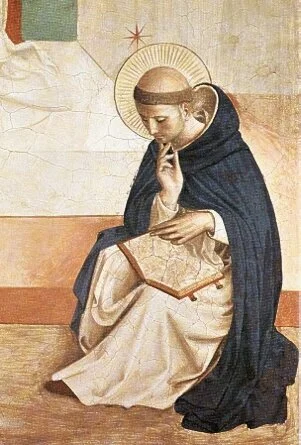
For me, the Dominican victory inspires hope. Hope as we daily battle against the culture of death and the forces of moral relativism and hope in the Light of Christ that “shines on in the darkness and the darkness has not overcome it” (John 1:5). From now on, as I look upon St. Dominic’s star, I will remember his heroic example and pray, asking his intercession: Good servant of the Word, please help me to bear my torch and to radiate the charity of Christ as you did. (Read more.)


From Dominicana:

For non-Catholics, Francis is the easiest saint to understand and love, while Dominic is the most difficult, once remarked Chesterton. If the abundance of Francis-emblazoned garden decorations and the world’s new-found devotion to Pope Francis—whose namesake is the beggar friar of Assisi—are a reliable indication, the statement is undoubtedly true. The endearing vagabond stigmatist of Alverna, known for his love of creation and his sympathy for the poor, easily captures the hearts of multitudes, Catholics and non-Catholics alike. In contrast, many written or artistic depictions portray Dominic as the black-and-white clad, crusade-preaching, stern-faced Spaniard of the un-holy Inquisition.  Even today it seems this unfortunate caricature of Dominic abides, as many find Saint Dominic difficult to love and to others he is completely unknown.

Perhaps some would feel drawn to Saint Dominic if his great sympathy for the poor was spoken of more frequently.  As the records of his canonization recall, when he was a student of theology, he sold his books to feed the poor of Palencia.  But the great saint lived this solidarity with the poor his entire life, even dying in the bed of another friar—since he had no cell of his own.  To witness to the authenticity of his preaching, Dominic crossed the countryside walking barefoot (in great contrast to the official papal preachers of his day, travelling as they did in luxurious caravans).  A further glimpse of his absolute dedication to poverty is offered by contemporaries of Saint Dominic who attest they only ever saw him wearing the same one habit, covered in patches.

Could it not also be hard to admire Saint Dominic because of the hidden nature of his life of prayer and study?  With a reputation for sincerity and dedication to his work of learning, the young saint was known to spend many long nights poring over his books.  Later in life these sleepless vigils became nights given over to the work of prayer for the conversion of souls.  The fruits of these kinds of efforts, though, are all-so-often veiled from our prying eyes.

Maybe affection for Dominic is foreign to some hearts because of how little is said of the intensity of his labors.  Saint Dominic’s idea to found the Order was original and highly innovative.  To establish the unprecedented group, the Order of Preachers, required him to be a master of efficiency and organization. Consider the fact that Dominic only worked for five years after papal approval of the Order before his death and in that time managed to bequeath to it a lasting legacy of governance, traditions, and ideals.  Accordingly, these earliest days of the Order leave behind a vivid image of the extraordinary abilities and intuition of its founder.

Is it not also possible that some struggle to be devoted to Saint Dominic because they find the idea of the work of “preaching” aloof or disconnected?  We have said Dominic was a man of study, a true intellectual, but Saint Dominic himself ordered these efforts towards his preaching.  He was a man of learning so that he could reach people with the truth, not be distanced from them! We have only to think of the night Dominic, the preacher of grace, spent speaking until dawn with an innkeeper to convert him in order to see the saint’s acquired knowledge at work, a powerful tool put to use for the salvation of souls. (Read more.)

 Read my novel on the Cathars.


Friday, August 7, 2026

St. Albert of Trapani


Also known as St. Albert of Sicily. Today in the Carmelite Order water is blessed known as "St Albert's Water." Sr. Mary, the late departed extern sister at the Carmel of Loretto, PA., kept a generous supply of jars filled with St Albert's water in the pantry near the Turn. Sometimes the water would be there for so long that the jars began to look like small aquariums of interesting life forms. But people would take them home anyway, because of the connection to the Carmelite priest who was a man of prayer and a worker of miracles. And the miracles never cease....

Thursday, August 6, 2026

Assumption Novena

I am praying my novena for some private intentions as well as for my country and for President Donald Trump. Those who hate Trump, I pray for you, too. And those who hate Trump should especially pray for him, since Our Lord bids us to pray for our enemies.

Mary, Queen Assumed into Heaven, I rejoice that after years of heroic martyrdom on earth, you have at last been taken to the throne prepared for you in heaven by the Holy Trinity.
Lift my heart with you in the glory of your Assumption above the dreadful touch of sin and impurity. Teach me how small earth becomes when viewed from heaven. Make me realize that death is the triumphant gate through which I shall pass to your Son, and that someday my body shall rejoin my soul in the unending bliss of heaven.
From this earth, over which I tread as a pilgrim, I look to you for help. I ask for this favor: (Mention your request).
When my hour of death has come, lead me safely to the presence of Jesus to enjoy the vision of my God for all eternity together with you.

For those who like to pray Scripture as part of a novena, here are some favorite passages:
And the temple of God was opened in heaven: and the ark of his testament was seen in his temple, and there were lightnings, and voices, and an earthquake, and great hail. And a great sign appeared in heaven: A woman clothed with the sun, and the moon under her feet, and on her head a crown of twelve stars....(Apocalypse 11:19-12:1)
  But as the same Lord liveth, his angel hath been my keeper both going hence, and abiding there, and returning from thence hither: and the Lord hath not suffered me his handmaid to be defiled, but hath brought me back to you without pollution of sin, rejoicing for his victory, for my escape, and for your deliverance. Give all of you glory to him, because he is good, because his mercy endureth for ever. And they all adored the Lord, and said to her: The Lord hath blessed thee by his power, because by thee he hath brought our enemies to nought....Blessed art thou, O daughter, by the Lord the most high God, above all women upon the earth. Blessed be the Lord who made heaven and earth, who hath directed thee to the cutting off the head of the prince of our enemies. Because he hath so magnified thy name this day, that thy praise shall not depart out of the mouth of men who shall be mindful of the power of the Lord for ever, for that thou hast not spared thy life, by reason of the distress and tribulation of thy people, but hast prevented our ruin in the presence of our God....Blessed art thou by thy God in every tabernacle of Jacob, for in every nation which shall hear thy name, the God of Israel shall be magnified on occasion of thee....And when she was come out to him, they all blessed her with one voice, saying: Thou art the glory of Jerusalem, thou art the joy of Israel, thou art the honour of our people....(Judith 13:20-2, 23-25, 31,15:10 )

The Transfiguration

Let us run with confidence and joy to enter into the cloud like Moses and Elijah, or like James and John. Let us be caught up like Peter to behold the divine vision and to be transfigured by that glorious transfiguration. Let us retire from the world, stand aloof from the earth, rise above the body, detach ourselves from creatures and turn to the Creator, to whom Peter in ecstasy exclaimed: Lord, it is good for us to be here.
~Anastasius of Sinai, from The Liturgy of the Hours according to The Roman Rite, 1975

Wednesday, August 5, 2026

Our Lady of the Snow

The legend, the feast and the basilica.
The most important church in the city of Rome dedicated to Our Lady is the Basilica of Saint Mary Major, erected around the year 352, during the reign of Pope Liberius. (352-366)  According to legend, a member of an aristocratic family, John and his wife were childless and prayed that the Blessed Mother might designate an heir to bequeath their wealth.  They were favored with a dream in which Our Lady appeared to them on the night of August 4-5. She requested that they build a church in her honor on the Esquiline hill and the sign to accompany this dream is that the exact location would be marked out in snow.

During that hot summer evening, a miraculous snowfall traced the form of the basilica on the hill.  Our Lady also appeared to Pope Liberius in a dream that same night so that he too could arrive at the location to see the miraculous snowfall.  Many people gathered to see the unusual event of snow glistening in the August sun.  Upon awakening, John and his wife rushed to the site and Pope Liberius arrived in solemn procession.

Realizing that the snow marked the exact location of the church, the people staked off the area before the snow melted.  The basilica was completed within two years and consecrated by Pope Liberius; that is why it is sometimes referred to as the Basilica Liberiana, after the Pope who consecrated it.
When the Council of Ephesus defined Mary as Theotokos, the God-bearer, in 431 A.D., Pope Sixtus III (432-440) rebuilt and embellished the basilica.  From the seventh century onward, it was referred to as St. Mary the Great or Major.  The Basilica has also been called Our Lady of the Snows in commemoration of the miraculous snowfall.  The imposing facade was built by Pope Eugene III (1145-1153).

Among its great treasures is a painting of the Madonna and Child known as the Salus Populi Romani, the Protectress of the People of Rome, which is attributed to St. Luke.  This image had been brought back from the Holy Land by St. Helena, the mother of the Emperor Constantine, who also located the true cross and other relics of the Passion in Jerusalem.  The venerable picture hung in the private chapel of Pope Liberius, and he ordered that it be brought to the Basilica for public veneration by the faithful.

Throughout the centuries, there has been a special devotion to this famous picture of Our Lady.  During the pontificate of Pope St. Gregory the Great (590-604) a plague attacked the people of Rome and the Pope carried the image in procession to pray to their Protectress for an end to the plague.  In 1837, Pope Gregory XVI (1830-1846) also carried the image in procession throughout Rome to ask Our Lady for an end to an epidemic of cholera.  When it soon ended, the Pontiff solemnly placed crowns of gold and gems on the heads of Mary and the child Jesus on the miraculous image. 


Today is the anniversary of my grandmother's death. Please pray for the repose of her soul.

Tuesday, August 4, 2026

St. John Vianney

He is the patron saint of parish priests. I will never forget our brief visit to Ars in September 1999, when my husband and I decided to rent a car in Toulouse and drive up the east side of France to Paris. We motored along winding and precipitous roads through the mountains of Auvergne to Le Puy-en-Velay, the site of the shrine of Our Lady of France, popular in the Middle Ages. I could not imagine the rigors of reaching the shrine via horse or mule when it was difficult enough to reach it by car.

The next morning we drove up to Lyon and then made our way on the back roads to Ars. It was noon; most of the pilgrims were at dinner so we had the church pretty much to ourselves. They were repairing the roof but other than that it was a stunningly beautiful church. I wandered around, lighting candles for those with grave needs. I turned a corner and almost jumped, because there he was-- the Curé d'Ars in his glass coffin, incorrupt, looking as if he were asleep. It was like being at a wake rather than visiting the tomb of someone long dead. His expression was so peaceful and serene, communicating both the shortness of life and the joy of final victory. Even in death, the holy Curé preaches to us.

Sunday, August 2, 2026

Our Lady of the Angels

Today we mystically kneel at the Portiuncula, to gain the triple indulgence of Rome, Compostela, and Jerusalem. To quote:
According to a legend, the existence of which can be traced back with certainty only to 1645, the little chapel of Portiuncula was erected under Pope Liberius (352-66) by hermits from the Valley of Josaphat, who had brought thither relics from the grave of the Blessed Virgin. The same legend relates that the chapel passed into the possession of St. Benedict in 516. It was known as Our Lady of the Valley of Josaphat or of the Angels — the latter title referring, according to some, to Our Lady's ascent into heaven accompanied by angels (Assumption B.M.V.); a better founded opinion attributes the name to the singing of angels which had been frequently heard there. However this may be, here or in this neighbourhood was the cradle of the Franciscan Order, and on his death-bed St. Francis recommended the chapel to the faithful protection and care of his brethren. Concerning the form and plan of the first monastery built near the chapel we have no information, nor is the exact form of the loggia or platforms built round the chapel itself, or of the choir for the brothers built behind it, known. Shortly after 1290, the chapel, which measured only about twenty-two feet by thirteen and a half, became entirely inadequate to accommodate the throngs of pilgrims. The altar piece, an Annunciation, was painted by the priest, Hilarius of Viterbo, in 1393. The monastery was at most the residence, only for a short time, of the ministers-general of the order after St. Francis. In 1415 it first became associated with the Regular Observance, in the care of which it remains to the present day. The buildings, which had been gradually added to, around the shrine were taken down by order of Pius V (1566-72), except the cell in which St. Francis had died, and were replaced by a large basilica in contemporary style. (Read more.)


 Marian devotion according to the Franciscan tradition. From The Marian Room:

The Franciscan Mariologist, Fr. Peter Damian Fehlner, was not only an expert on the writings and teachings of St. Francis and St. Bonaventure, but those of St. Maximilian Kolbe, as well; thus he was proficient in tracing the golden thread of “Mary’s presence and continuing influence” at the outset of the Franciscan order to the present day, as seen in the following:
In the early 1980s….Fr. Peter Damian undertook a study of the writings of the newly canonized Conventual Franciscan martyr of Auschwitz, Saint Maximilian Kolbe. The impact of this Kolbean study proved incalculable. For Fr. Peter Damian, St. Maximilian’s writings demonstrated the “golden thread” of Mary’s coherent presence and continuing influence in the Franciscan tradition. St. Maximilian asserted that in the earliest days of the Order’s foundation, in the intentions of St. Francis of Assisi himself, God was putting Mary Immaculate to work. Fr. Peter Damian grasped with a new clarity the coherent, consistent, unbroken line of Marian ideal inherent in the Franciscan tradition, beginning with Francis and continuing through Bonaventure, Scotus, the Franciscan School, all the way through Kolbe. The key to this new synthesis of insight for Fr. Peter Damian was the Divine Will and Plan that Mary qua Immaculate – and thereby “spouse” of the Holy Spirit and thereby “Virgin made Church” – would be God’s chosen instrument for gathering the Friars and their flock to implement God’s Plan for the Kingdom, building a Divine civilization of love
St. Francis, and the long line of his spiritual descendants, loved, and do love, the Virgin Mary, who is the “Virgin made Church.” Fr. Fehlner writes:
According to both Thomas of Celano and St. Bonaventure (11), St. Francis could not exalt Mary in praise or serve her too much, because it was she who brought our Lord and Savior into our midst and made possible for us direct access to Him. De Maria numquam satis (12). St. Francis is clearly a Marian maximalist, a position clearly bearing on his way of thinking about Mary. If we understand who Mary is, what she has done and continues to do, then we can never exalt her too much, because we cannot come close to matching, let alone exceeding, what the Blessed Trinity has done for her. Of course St. Bonaventure warns against attempting to maximize our Marian prayer and doctrine with stupidities which in fact do not exalt but demean the Virgin Mother of God. But the more we grasp of the mystery objectively, e.g., the Immaculate Conception, the greater must be our praise, devotion and service objectively. For St. Francis, just as the absolute primacy of Christ appears after the triumph of the Cross as Christ’s Kingship over all creation, so the mystery of the Spouse of the Holy Spirit or Immaculate Conception appears as the Queenship of Mary gloriously crowned as Mistress of heaven and earth. In the practical order this constitutes the doctrinal foundation for her universal mediation of grace in the Church and among the Angels, the indispensable basis for realizing the purpose of the Franciscan Order, the rebuilding of the Church: to be without stain or spot, viz., immaculate (13).
These themes converge on the sacrifice of Calvary, hence the importance of perfect conformity to the Crucified through the maternal mediation of Mary in order to accomplish the glorification of the Church. This consists precisely in the completion of the Body of Christ, formed by Mary, so that in and through Christ the Father sees in us what he sees in his Only-begotten Son. This entails on the part of Mary a dual relation: one to Christ as His Mother and so on Calvary Mother of the Church (Virgo Ecclesia facta) and to the Holy Spirit as his instrument in realizing the Incarnation and animating the Church as Body of Christ. Once we see this, we see why Mary is first born daughter of the Father, and how St. Francis’ Marian thought rests profoundly on Trinitarian insights, which underlie the Franciscan thesis on the absolute predestination of Christ and Mary. This Marianized Christology (in St. Maximilian M. Kolbe) will ultimately yield a key to a pneumatology-ecclesiology in the mystery of Mary’s person as Virgin Mother: in relation to the Holy Spirit and in relation to the Church as Virgin-Mother of the faithful (14).
Careful examination of the St. Francis’ Salute to the Virgin (15), whence comes the title Virgo Ecclesia facta, and whose composition is to be related not only to the Portiuncula, St. Mary of the Angels, effectively celebrating Mary’s Assumption and mediation of all graces in the Church, but also to Francis’ conversion experience under the tutelage of the Immaculate Co-redemptrix, particularly reveals how it stresses the joint centrality of the divine Maternity and Incarnation. Thus it reveals how thoroughly the Marian thought of St. Francis was permeated precisely by those three notes stressed by Paul VI in Marialis cultus: the Trinitarian, Christological-pneumatological, and ecclesial (16).
Similarly, the antiphon for the Office of the Passion (17), whence comes the title Sponsa Spiritus Sancti, or Immaculate Conception, whose composition was profoundly linked to the Poverello’s (St. Francis, added by SCF) conversation with the Crucified in San Damiano, the moment when Francis was stigmatized interiorly, reveals the same. This time, however, it does so in relation to the consummation of Christ’s mission on the Cross. The mystery of what is today called the coredemption, based on the “Franciscan thesis,” stands at the very center of this Office and unique antiphon. The identification and labeling of this mystery will be a contribution of the Franciscan Mariological school.
Two doctrinal themes, anchored in the conversion experience of the Poverello (again, St. Francis, added by SCF) in the Church of San Damiano as well demonstrated by Fr. Schneider (18): themes to become central to the Franciscan Mariological School, emerge from this unlimited devotion to Mary as Mother of God: a sense of her unique mediation, first as an active co-cause of the Incarnation and then as spiritual Mother of the Church and its members; and then, as a consequence, a sense of her person as one capable of being the Mother of God and our Mother. For she is Spouse of the Holy Spirit and the Virgin made Church, who is able to bring into this world the Son of God and Savior by the operation of the Holy Spirit, and by the operation of the same Spirit make of the Church virginal Mother of Christ in the minds and hearts of the faithful. Thus, in chapter 10 of his Regula bullata, St. Francis insists that all the friars are obliged to have in themselves “the Spirit of the Lord and his holy operation,” no where so fully realized as in the Mother of God and our Mother.
This sense of Marian mediation of all grace will be a prominent feature of the Christology and Mariology of St. Bonaventure. This sense of her person in St. Francis will later emerge in Duns Scotus’ formulation of the theology of the Immaculate Conception, metaphysical ground of Mary’s universal mediation, as the Incarnation is the ground of Christ’s.
We are not dealing here with two partial aspects of a single mediation, but with a single mediation entire in Christ, but with a Marian mode, for the same reason the mission of the Son involves the mission of the Spirit and divine Maternity. Or mediation in the supernatural order entails a divine and maternal aspect, prefigured in the formation of man as male and female (Gen 2: 18-25) (19): in Bonaventure a dual dimension to a single mediation consummated on Calvary, but ultimately grounded in the dual complementary missions of Word and Spirit (20); and in Scotus founded respectively in the Incarnation and Immaculate Conception. This noted, it is easy to see how the profound insight of St. Maximilian ascribing the same name to the Spirit and Mary (21) is a kind of synthesis of these two great Marian Doctors.
In the Franciscan school, and first of all in St. Francis himself, Christ and Mary are involved, apart from any consideration of sin, in a work of mediation for the rest of the elect. Although from the gnoseological point of view of our theology here and now, demonstration of the Immaculate Conception rests on the prior recognition of our redemption as perfect, ontologically a parte rei the perfection of that redemption derives in fact from the mediation of Christ and Mary: real, even had Adam not sinned (22).
Evidently, the Marian thought of St. Francis, like his profound theology in general, fountainhead of the famed Franciscan school of theology and philosophy (and some would add science), when described in terms of the three possible modes of “our theology” in a time of pilgrimage (23) , is contemplative. For St. Bonaventure, without this form of theology, it would be impossible to perfect or develop the other two, viz., symbolic and academic (or proper). On the other hand without a sound symbolic and academic presentation it would be impossible for the vast majority to grasp the mind of St. Francis and similar saints on the mysteries of faith. 
That quote was a bit long, but I think it is instructive as it details how St. Francis viewed Our Lady, the Immaculate Conception, the Virgin made Church, and how the golden thread of her presence and influence are weaved within (and the thread remains unbroken!) the very foundations of the Franciscan Order. (Read more.)

Saturday, August 1, 2026

St. Alphonsus Liguori


Today is his feast. Here is an excerpt from his book The Glories of Mary:
And here we say, that although Mary, now in heaven, can no longer command her Son, nevertheless her prayers are always the prayers of a Mother, and consequently most powerful to obtain whatever she asks. "Mary," says Saint Bonaventure, "has this great privilege, that with her Son she above all the Saints is most powerful to obtain whatever she wills." And why? Precisely for the reason on which we have already touched, and which we shall later on again examine at greater length, because they are the prayers of a mother. And therefore, says Saint Peter Damian, the Blessed Virgin can do whatever she pleases both in heaven and on earth. She is able to raise even those who are in despair to confidence; and he addresses her in these words: "All power is given to thee in heaven and on earth, and nothing is impossible to thee, who canst raise those who are in despair to the hope of salvation."
And then he adds that "when the Mother goes to seek a favor for us from Jesus Christ" (whom the Saint calls the golden altar of mercy, at which sinners obtain pardon), "her Son esteems her prayers so greatly, and is so desirous to satisfy her, that when she prays, it seems as if she rather commanded than prayed, and was rather a queen than a handmaid. Jesus is pleased thus to honor His beloved Mother, who honored Him so much during her life, by immediately granting all that she asks or desires. This is beautifully confirmed by Saint Germanus, who addressing our Blessed Lady says: "Thou art the Mother of God, and all powerful to save sinners, and with God thou needest no other recommendation; for thou art the Mother of true life." — From Glories of Mary, Chapter VI


Friday, July 31, 2026

St. Ignatius Loyola


 From Jesuits in Ireland:
The Society of Jesus was founded in 1540 by St. Ignatius Loyola and since then has grown from the original seven to 24, 400 members today who work out of 1,825 houses in 112 countries. In the intervening 455 years many Jesuits became renowned for their sanctity (41 Saints and 285 Blesseds), for their scholarship in every conceivable field, for their explorations and discoveries, but especially for their schools. The Society is governed by General Congregations, the supreme legislative authority which meets occasionally. The present Superior General is Father Arturo Sosa. Ignatius Loyola was a Spanish Basque soldier who underwent an extraordinary conversion while recuperating from a leg broken by a cannon ball in battle (see picture). He wrote down his experiences which he called his Spiritual Exercises and later he founded the Society of Jesus with the approval of Pope Paul III in 1540.

From the very beginning, the Society served the Church with outstanding men: Doctors of the Church in Europe as well as missionaries in Asia, India, Africa and the Americas. Men like Robert Bellarmine and Peter Canisius spearheaded the Counter Reformation in Europe, courageous men like Edmund Campion assisted the Catholics in England suffering under the terrible Elizabethan persecutions and missionaries like deNobili Claver, González, deBrito, Brebeuf, and Kino brought the Gospel to the ends of the earth. No other order has more martyrs for the Faith.

Ignatius Loyola had gathered around him an energetic band of well-educated men who desired nothing more than to help others find God in their lives. It was Ignatius’ original plan that they be roving missionaries such as Francis Xavier, who would preach and administer the sacraments wherever there was the hope of accomplishing the greater good. It soon became clear to Ignatius that colleges offered the greatest possible service to the church, by moral and religious instruction, by making devotional life accessible to the young and by teaching the Gospel message of service to others. From the very beginning these Jesuit schools became such an influential part of Catholic reform that this novel Jesuit enterprise was later called “a rebirth of the infant church”. The genius and innovation Ignatius brought to education came from his Spiritual Exercises whose object is to free a person from predispositions and biases, thus enabling free choices leading to happy, fulfilled lives.

Jesuits were always deeply involved in scholarship, in science and in exploration. By 1750, 30 of the world’s 130 astronomical observatories were run by Jesuit astronomers and 35 lunar craters have been named to honor Jesuit scientists. The so-called “Gregorian” Calendar was the work of the Jesuit Christopher Clavius, the “most influential teacher of the Renaissance”. Another Jesuit, Ferdinand Verbiest, determined the elusive Russo-Chinese border and until recent times no foreign name was as well known in China as the Jesuit Matteo Ricci, “Li-ma-teu”, whose story is told by Jonathan Spence in his 1984 best seller. China has recently erected a monument to the Jesuit scientists of the 17th century – in spite of the fact that since 1948 120 Jesuits languished in Chinese prisons. By the way, no other religious order has spent as many man-years in jail as the Jesuit order. (Read more.)

Thursday, July 30, 2026

Port-Royal, Jansenism, and St. Thérèse: The Hidden Heresy That Still Haunts Catholicism

Port-Royal Abbey, Paris - Wikipedia
Madame de Montpeyroux, abbess of Port-Royal Abbey

 From Sensus Fidelium:

One of the greatest spiritual battles in Catholic history was not fought over the Trinity, the Eucharist, or even the papacy. It was fought over the character of God Himself.

Is God primarily a loving Father eager to save?

Or is He chiefly a stern Judge searching for reasons to condemn?

That question gave rise to one of the most influential, and spiritually devastating, movements in Church history: Jansenism.

Although officially condemned by multiple popes, its spirit survived for centuries. It shaped convents, seminaries, confessionals, and even family life. Its influence was so pervasive in France that St. Thérèse of Lisieux spent much of her short life offering what amounts to the Church’s greatest practical answer to it.

Ironically, the story begins not with obvious heretics, but with one of the most admired convents in Europe. (Read more.)

About the Little Flower — Little Flower Basilica
St. Thérèse of the Child Jesus


Wednesday, July 29, 2026

St. Martha's Day


St. Martha of Bethany. It is ironic to me that she who tamed a dragon would also be the patroness of housewives. To quote from Aleteia:

Once there, Martha was immediately sought after for her association with Jesus. According to tradition, she performed many miraculous feats, including the slaying of a dragon along the Rhone river. The Golden Legenprovides all the details.

At that time, in the forest along the Rhone between Aries and Avignon, there was a dragon that was half animal and half fish, larger than an ox, longer than a horse, with teeth as sharp as horns and a pair of bucklers on either side of his body. This beast lurked in the river, killing all those who tried to sail by and sinking their vessels … The people asked Martha for help, and she went after the dragon. She found him in the forest in the act of devouring a man, sprinkled him with blessed water, and had a cross held up in front of him. The brute was subdued at once and stood still like a sheep while Martha tied him up with her girdle, and the people killed him then and there with stones and lances.

(Read entire article)

Related Posts with Thumbnails