Friday, September 10, 2010

He Came Down from Heaven

A consolation. In the words of the late Alice Thomas Ellis:
Once when I was afraid of death, not of my own but that of the people I loved, I would go and sit in the presence of the Blessed Sacrament in the quiet of a church, redolent of incense, ancient ritual, and prayer. A church was a place where you could meet death on neutral ground, a no-man's land between now and eternity, where matters fell into perspective and terror became irrelevant because you knew it to be transitory.
There was a silent peace with a hidden promise of unimaginable joy to which all the objects of devotion attested: the altar, the statues, the crucifix, all the appurtenances of faith belonged to no one and to everyone. Still and worthy of trust, they were there yesterday and now and would be there tomorrow. Inanimate yet living testimony to a vital certainty. It is rare now to find such a church. Stripped and barren, while the people themselves are encouraged to buy more and more to support the market economy and cram their houses with trivia, the churches are denuded in the name of progress.

It is impossible to understand without laying bare the motives of those who wrought such destruction. The result is terrible in the terms of disillusion and loss, and those who say they wished only to affirm life and community have robbed us of consolation, giving death a greater power than is his due. The here and now is what concerns us they say, forgetting that life is short and but a preparation.

The new and re-ordered churches are symbolic only of a denied but underlying despair, a loss of faith to the sad conviction that death is the end. The noisy ceremonies that now fill these churches, the guitars, the clapping, swaying, and showy raptures are a mere extension of the drug culture, a whistling in the wind, a neurotic insistence that happiness is attainable immediately and does not need to be waited for or earned. The notion that suffering can bring forth good, that deprivation can nourish the soul is unacceptable. Suggest that the saints lived their lives in the promise and not the fulfillment of joy and you will not be heard. The Protestant cult of the "born again" with its ecstatic overtones has laid hold of a Church that still claims to lay all store on baptism. We are at the mercy of doctrinal error, often imposed from above, with little recourse to authority which is often too pusillanimous to argue with the trend. The wolves are in the fold.

Now that the churches are no longer peaceful but full of people determined to convey to you their loving care, their innate virtuousness, with handshakes and smiles, the bereft are best off in solitude, listening for the still, small voice. The country graveyard is perhaps now the place nearest to God on earth, for that too is neutral ground where death has had his way, is satisfied and thus of no more significance and no threat.
Freedom lies in looking on the face of death and knowing that there is no true battle here, that he does not need to be fought and defeated, for he is only God's instrument and God lives.

Thursday, September 9, 2010

Mary the Throne of Grace

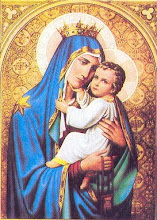
Two statues of Mary.

Tuesday, September 7, 2010

On Exorcism

Fr. Angelo discusses the ultimate spiritual warfare.
Spiritual warfare is, then, first of all, a matter of the heart, that is, it is a matter of remaining morally free of demonic contamination.  Such contamination we call sin.  Exorcists will tell us that the primary way to guard against extraordinary demonic influence is to resist the ordinary one that takes the form of temptation.  For this the “armor of God,” consists in the faith, prayer and the sacraments.  More often than not, if we are living a faith-filled, sacramental life we will be protected from evil.

Monday, September 6, 2010

Blessed Mother Teresa's Secret

The spiritual life that forged her soul.
Mother Teresa’s understanding of the thirst of God was entirely simple, yet deep, powerful and engaging. She learned that God not only accepts us with all our misery, but that he longs for us, “thirsts” for us, with all the intensity of his divine heart, no matter who we are or what we have done.

But how can God “thirst” for us if there is no lack in God? While thirst can imply lack, it also has another sense. In Mother Teresa’s lexicon, thirst signifies deep, intense desire. Rather than indicating lack, the symbol of divine thirst points to the mystery of God’s freely chosen longing for man. Simply put, though nothing in God needs us, everything in God wants us -- deeply and intensely, as he shows throughout Scripture.
Mother Teresa’s insights reveal something important, even essential, in the depths of God’s being. Mother Teresa insists that the thirst of Christ reveals something not only about Jesus, but about God himself. Jesus’ thirsts points us toward a great mystery in the very bosom of the Godhead -- what Mother Teresa describes as “the depths of God's infinite longing to love and be loved.” As ardent a statement as this is, her insights are confirmed by no less a source than the Fathers of the Church. The great St. Augustine would write that “God thirsts to be thirsted for by man” (see Appendix Three for a collection of patristic quotes on the divine thirst). In our own day, Benedict XVI would affirm that “the thirst of Christ is a gateway into the mystery of God.”

The mystery of God’s thirst for us was the one great light Mother Teresa held high in the night, hers and ours. This was the banner she raised for the poor and suffering of Calcutta and beyond. It was as witness to this message that Jesus commissioned her, soon after the experience of the train, to “Be My light;” and this she would energetically do, in season and out of season. She would spend her whole life proclaiming the light of divine love, even when her words fell silent, her hands spoke more eloquently still.

Saturday, September 4, 2010

Month of Our Lady of Sorrows

September is dedicated to the Sorrowful Mother.

Friday, September 3, 2010

The Hour of Crisis

It can be a renovation for the soul.
Thus, it seems that only through suffering can our lives be real. We want to lock up our hearts away from the crisis of suffering. We want to protect them from being broken. But then, in their security, they will become unbreakable. They will become hard hearts. Only through the suffering of letting go of our will to control can we experience anything as a reality on its own right—outside of ourselves. Only by opening ourselves in vulnerability can our suffering turn into the joy and wonderment of true communion with others and with what is real. Therefore, love itself is essentially a crisis because it is the intrusion (for better and for worse) into our lives of another. But unless the soul consents to suffering, it can never experience the renovation necessary for the experience of love and real life.

Wednesday, September 1, 2010

Part III: Piety the Just Gift

A continuation of the discussion of the sometimes despised and often forgotten gift of piety.

Piety the Just Gift
by Mary Lanser
St. Thomas Aquinas, among others, teaches that the gift of piety perfects the virtue of justice. This synergistic relationship between piety and justice comes down to us through the ages from both classical ethics and Christian morality, although the interaction is distinctly different in each system respectively.

Socrates, in his dialogue with Euthyphro, turns his entire argument on the virtue of piety in itself. The discussion of piety in itself, as opposed to pious things, finally helps us to realize that there is indeed a middle ground between relativistic justice, and justice as a rigid universal moral virtue with respect to one's duty to the gods and family and state. [Plato] There is a natural balance in a good life that is pleasing to the gods and that keeps man, his family and his community from tearing apart from the stresses of polarized extremes.

So we can say that justice as an acquired or natural virtue often concerns keeping the passions in check so that we do not allow baser instincts to blind us to what is right and what is true in any situation requiring that we choose or discriminate among various thoughts, words or deeds. In this way piety, as a known duty to ones gods, family and country, encourages or promotes just words and deeds.

St. Peter of Damaskos cites St. Dionysios the Areopagite, in The Divine Names as saying that God is praised through justice. [The Divine Names VIII, 7, P.G.iii, 893D] And St. Peter says that this is indeed true because “...justice is sometimes called discrimination: it establishes the just mean in every undertaking, so that there will be no falling short...or excess.” [Philokalia, Vol. 3, p.258] In this understanding of justice, it also appears that balance is a desirous outcome for the two virtues of piety and justice.

However we must remember that Plato's gods warred among themselves, and visited evil upon mankind, and unjustly abused mankind, as often as they bestowed goodness. In Plato's world the gods were the source of both good and evil. In the world of classical Greek and Rome, a balanced life hopes to mark out a path between most unforgiving extremes of good and evil, justice and injustice, piety and impiety.

However, for St. Dionysios, as it is for all Christians, God is the source of all goodness. God is never seen as the source of evil at all, in any form or fashion. Balance is not at all the desired outcome of leading a virtuous life in Christian terms. The desired outcome for a Christian life quite simply put is the beatific vision. So that all that we do and all that we are must be directed toward that end, by faith, in the hope that we may be granted the grace of union with the divine and the beatific vision.

In The Divine Names, St. Dionysios said:
Again the title Righteousness is given to God because he assigns what is appropriate to all things; He distributes their due proportion, beauty, rank, arrangement, their proper and fitting place and order according to a most just and righteous determination. He is the cause of their individual activity. It is the righteousness of God which orders everything...it gives the appropriate and deserved qualities to everything and that it preserves the nature of each being in its due order and power. [The Divine Names, VIII, 7]
Rather than seeking a life in balance, the Christian seeks to discover the right order in Creation, by the power of the Holy Spirit, through the guidance of Scripture and life in the Body of Christ, the Church. It is the Holy Spirit and the gifts of the Holy Spirit in our lives that makes it possible for us to be able to discern rightly, to comprehend revealed truth, and to live lives of self-discipline and self-control. It is in this way that the fathers and the tradition of the Church can teach that “piety perfects justice.” Without the divine grace to obtain perfect justice or what is also called infused justice, then we would never be able to even begin to see Creation as God see is. We would never begin to be able to have a creatures share in the divine life.

"God has sent the Spirit of his Son into our hearts, crying, 'Abba! Father!'" (Gal 4:6). "All who are led by the Spirit are children of God... It is that very Spirit bearing witness to our spirit that we are children of God" (Rm 8:14, 16). The words of the Apostle Paul remind us that the fundamental gift of the Spirit is sanctifying grace (gratia gratum faciens), with which we receive the theological virtues—faith, hope and charity—and all the infused virtues (virtutes infusae), which enable us to act under the influence of the Holy Spirit. Unlike the charisms, which are bestowed for the service of others, these gifts are offered to all, because they are intended to lead the person to sanctity and perfection. [JPII, "Letter to Priests, For Holy Thursday" 1998]

Piety does not merely influence or prompt justice or set a balanced path between two extremes. Piety perfects justice in that it divinely empowers us to discern what God intends as the right order of all Creation. The ability to turn our will to the rightly ordered divine will is the hoped for result of the perfection of justice. It is the purpose of the divine gift of piety or reverence that we have the necessary spiritual tools that will enable us to know the mind of God, for as we read in the book of the Prophet Isaiah 5:20 "Woe to those who call evil good, who put darkness for light and light for darkness, who put bitter for sweet and sweet for bitter."

To quote from Luke 18 (Douay-Rheims 1899 American Edition):
2...There was a judge in a certain city, who feared not God, nor regarded man. 3 And there was a certain widow in that city, and she came to him, saying: Avenge me of my adversary. 4 And he would not for a long time. But afterwards he said within himself: Although I fear not God, nor regard man,5 Yet because this widow is troublesome to me, I will avenge her, lest continually coming she weary me. 6 And the Lord said: Hear what the unjust judge saith. 7 And will not God revenge his elect who cry to him day and night: and will he have patience in their regard? 8 I say to you, that he will quickly revenge them. But yet the Son of man, when he cometh, shall he find, think you, faith on earth?
It is by the power of the Holy Spirit that it is possible for any of us at all to have faith. God, the Just Judge, has given us all that we need to attain the ultimate end of every soul in everlasting life, a share in the divine life in the presence of the beatific vision. Such a sublime justice!! Glory to God for all things!
Related Posts with Thumbnails