Friday, March 11, 2011

Catholic England

Fr. Angelo visits some holy places.
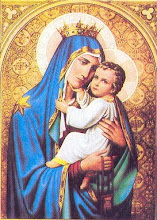
The next day, Claudio drove us to the Carmelite Monastery in Aylesford where St. Simon Stock was given the Brown Scapular. Aylesford is perhaps the oldest Carmelite foundation in Europe, the greater part of the current monastery was built after 1949, when the property was purchased back by the Carmelite Order, after having been lost to the Reformation in 1538.

Monday, March 7, 2011

Going Up To Jerusalem

Many times, the extremists tried to kill me and imprison me, I have been threatened, persecuted and my family has been terrorized. The extremists, a few years ago, even asked my parents, my mother and my father, to dissuade me from continuing my mission to help Christians and those in need, otherwise I would be lost. But my father always encouraged me. I say that, as long as I live, until my last breath, I will continue to serve Jesus and this poor, suffering, mankind, Christians, the needy, and the poor.
 More HERE. (Via Fr. Blake) 

And HERE.

Saturday, March 5, 2011

Shrovetide: A Meditation from the Pope

Shrovetide, as the week immediately before Lent was called, was once a season of making certain one was "shriven" by going to confession in preparation for the discipline and spiritual warfare of Lent. It was also a season for making reparation for the excesses of Carnival, which included the Forty Hours devotion. Here is an excerpt from Our Holy Father's new book, which looks at the mystery of the betrayal of Jesus at the Last Supper:
Jesus' agony, his struggle against death, continues until the end of the world, as Blaise Pascal said on the basis of similar considerations (cf. PenseÅLes VII, 553). We could also put it the other way around: at this hour, Jesus took upon himself the betrayal of all ages, the pain caused by betrayal in every era, and he endured the anguish of history to the bitter end.

John does not offer any psychological interpretation of Judas' conduct. The only clue he gives is a hint that Judas had helped himself to the contents of the disciples' money box, of which he had charge (12:6). In the context of chapter 13, the evangelist merely says laconically: "Then after the morsel, Satan entered into him" (13:27).

For John, what happened to Judas is beyond psychological explanation. He has come under the dominion of another. Anyone who breaks off friendship with Jesus, casting off his "easy yoke", does not attain liberty, does not become free, but succumbs to other powers. To put it
another way, he betrays this friendship because he is in the grip of another power to which he has opened himself.

True, the light shed by Jesus into Judas' soul was not completely extinguished. He does take a step toward conversion: "I have sinned", he says to those who commissioned him. He tries to save Jesus, and he gives the money back (Mt 27:3–5). Everything pure and great that he had received from Jesus remained inscribed on his soul—he could not forget it.

His second tragedy—after the betrayal—is that he can no longer believe in forgiveness. His remorse turns into despair. Now he sees only himself and his darkness; he no longer sees the light of Jesus, which can illumine and overcome the darkness. He shows us the wrong type of
remorse: the type that is unable to hope, that sees only its own darkness, the type that is destructive and in no way authentic. Genuine remorse is marked by the certainty of hope born of faith in the superior power of the light that was made flesh in Jesus.

John concludes the passage about Judas with these dramatic words: "After receiving the morsel, he immediately went out; and it was night" (13:30). Judas goes out—in a deeper sense. He goes into the night; he moves out of light into darkness: the "power of darkness" has taken hold of him (cf. Jn 3:19; Lk 22:53).
Friday, March 4, 2011

The Charismatic Gifts

It has been my experience over the years that many people upon entering Carmel expect at some point to partake of the charismatic gifts as did Our Holy Mother St. Teresa and Our Holy Father St. John of the Cross. Although St. Teresa and St. John experienced such phenomena, they warned against seeking out extraordinary experiences and maintained that holiness is not necessarily found in such manifestations but in prayer and good works; in living the virtues of faith, hope and charity. Fr. Gabriel of St. Mary Magdalen, O.C.D. distills the teachings of both saints in regard to the charismatic gifts in his spiritual classic Divine Intimacy, as follows:
The Apostle [St. Paul in I Cor. 12:2-11] mentions charismatic gifts, that is, those special graces, such as the gift of tongues, of knowledge, of miracles, bestowed by the Holy Spirit with great generosity upon the primitive Church. Although they are very precious gifts, they are inferior to sanctifying grace and charity, which alone give supernatural life to the soul. Whereas charismatic gifts may or may not accompany sanctifying grace, they neither increase nor decrease its intensity thereby. St. Thomas notes that while grace and charity sanctify the soul and unite it to God, these miraculous gifts, in the contrary, are ordered for the good of another and can subsist in one who is not in the state of grace....The smallest degree of [grace and charity] is worth more than all the extraordinary gifts which, although they can dispose souls to good, can neither infuse nor increase divine life in us. ~Divine Intimacy, pp.777-778

Wednesday, March 2, 2011

Great Master of Spirituality and Peace

Our Holy Father spoke today of St. Francis de Sales.
Born in 1567 to a noble family in the Duchy of Savoy, while still very young Francis, "reflecting on the ideas of St. Augustine and St. Thomas Aquinas, underwent a profound crisis which led him to question himself about his own eternal salvation and about the destiny God had in store for him, experiencing the principle theological questions of his time as an authentic spiritual drama". The saint "found peace in the radical and liberating truth of God's love: loving Him without asking anything in return and trusting in divine love; this would be the secret of his life".

  Francis de Sales, the Holy Father explained, was ordained a priest in 1593 and consecrated as bishop of Geneva in 1602, "in a period in which the city was a stronghold of Calvinism. ... He was an apostle, preacher, writer, man of action and of prayer; committed to realising the ideals of the Council of Trent, and involved in controversies and dialogue with Protestants. Yet, over and above the necessary theological debate, he also experienced the effectiveness of personal relations and of charity".

  With St. Jane Frances de Chantal he founded the Order of the Visitation, characterised "by a complete consecration to God lived in simplicity and humility". St. Francis of Sales died in 1622.

  In his book "An Introduction to the Devout Life", the saint "made a call which may have appeared revolutionary at that time: the invitation to belong completely to God while being fully present in the world. ... Thus arose that appeal to the laity, that concern for the consecration of temporal things and for the sanctification of daily life upon which Vatican Council II and the spirituality of our time have laid such emphasis".

  Referring then to the saint's fundamental work, his "Treatise on the Love of God", the Pope highlighted how "in a period of intense mysticism" it "was an authentic 'summa' and at the same time a fascinating literary work. ... Following the model of Holy Scripture, St. Francis of Sales speaks of the union between God and man, creating a whole series of images of interpersonal relationships. His God is Father and Lord, Bridegroom and Friend".

  The treatise contains "a profound meditation on human will and a description of how it flows, passes and dies, in order to live in complete abandonment, not only to the will of God, but to what pleases Him, ... to His pleasure. At the apex of the union with God, beyond the rapture of contemplative ecstasy, lies that well of concrete charity which is attentive to all the needs of others".

  Benedict XVI concluded his catechesis by noting that "in a time such as our own, which seeks freedom, ... we must not lose sight of the relevance of this great master of spirituality and peace who gave his disciples the 'spirit of freedom', true freedom, at the summit of which is a fascinating and comprehensive lesson about the truth of love. St. Francis of Sales is an exemplary witness of Christian humanism. With his familiar style, with his parables which sometimes contain a touch of poetry, he reminds us that inscribed in the depths of man is nostalgia for God, and that only in Him can we find true joy and complete fulfillment".

Monday, February 28, 2011

Healing the Church

Fr. Mark discusses the Irish debacle, which is a microcosm of what has gone on everywhere else.
Sociological analysis can help to identify systemic weaknesses and uncover certain wounds, but healing and new life can come only through the Precious Blood of the Lamb, who manifested himself at Knock, between the altar and the cross, and through Our Blessed Lady's renewal of the priesthood in holiness. In appearing in the company of Saint Joseph and Saint John the Evangelist, the two men who, after Jesus, shared her life most intimately, Our Lady of Knock presented to all priests the secret of true renewal: a life shared with her at every moment. This is not pietism; it is realism of the most effective kind.

The Holy Father's Letter
 It's a pity that Archbishop Martin made no reference to the salient proposals of the Holy Father's remarkable Pastoral Letter to the Catholics of Ireland, a document that is both inspired and inspiring, shot through with a spiritual vision for reform and renewal. We do well to recall the Holy Father's plan for the renewal of Catholic life in Ireland.

Reference and Recourse to Ireland's Saints
• It is my prayer that, assisted by the intercession of her many saints and purified through penance, the Church in Ireland will overcome the present crisis and become once more a convincing witness to the truth and the goodness of Almighty God, made manifest in his Son Jesus Christ.

Friday Penance and Confession
• I now invite all of you to devote your Friday penances, for a period of one year, between now and Easter 2011, to this intention. I ask you to offer up your fasting, your prayer, your reading of Scripture and your works of mercy in order to obtain the grace of healing and renewal for the Church in Ireland. I encourage you to discover anew the sacrament of Reconciliation and to avail yourselves more frequently of the transforming power of its grace.

Eucharistic Adoration
• Particular attention should also be given to Eucharistic adoration, and in every diocese there should be churches or chapels specifically devoted to this purpose. I ask parishes, seminaries, religious houses and monasteries to organize periods of Eucharistic adoration, so that all have an opportunity to take part. Through intense prayer before the real presence of the Lord, you can make reparation for the sins of abuse that have done so much harm, at the same time imploring the grace of renewed strength and a deeper sense of mission on the part of all bishops, priests, religious and lay faithful.

Nationwide Mission
•I also propose that a nationwide Mission be held for all bishops, priests and religious. It is my hope that, by drawing on the expertise of experienced preachers and retreat-givers from Ireland and from elsewhere, and by exploring anew the conciliar documents, the liturgical rites of ordination and profession, and recent pontifical teaching, you will come to a more profound appreciation of your respective vocations, so as to rediscover the roots of your faith in Jesus Christ and to drink deeply from the springs of living water that he offers you through his Church.

Saturday, February 26, 2011

Help from the Saints

They are our brethren.
The saints also have a way of thinking of an other, of listening to an other, of speaking to an other; they stretch forth their hands to those caught in life's wreckage, they make every poverty their own poverty, they restore dignity to those who have fallen. The saints have a certain way of not thinking of themselves and of emptying their souls of themselves. Doing this, they open within their souls an abyss of detachment capable of holding whatever miseries we care to hurl into it.
Related Posts with Thumbnails