Sunday, September 4, 2011

On Beauty as a Way to God

Our Holy Father Pope Benedict recently said:
Today, I would like to consider briefly one of these channels that can lead us to God and also be helpful in our encounter with Him: It is the way of artistic expression, part of that "via pulchritudinis" -- "way of beauty" -- which I have spoken about on many occasions, and which modern man should recover in its most profound meaning.

Perhaps it has happened to you at one time or another -- before a sculpture, a painting, a few verses of poetry or a piece of music -- to have experienced deep emotion, a sense of joy, to have perceived clearly, that is, that before you there stood not only matter -- a piece of marble or bronze, a painted canvas, an ensemble of letters or a combination of sounds -- but something far greater, something that "speaks," something capable of touching the heart, of communicating a message, of elevating the soul.

A work of art is the fruit of the creative capacity of the human person who stands in wonder before the visible reality, who seeks to discover the depths of its meaning and to communicate it through the language of forms, colors and sounds. Art is capable of expressing, and of making visible, man's need to go beyond what he sees; it reveals his thirst and his search for the infinite. Indeed, it is like a door opened to the infinite, [opened] to a beauty and a truth beyond the every day. And a work of art can open the eyes of the mind and heart, urging us upward.

But there are artistic expressions that are true roads to God, the supreme Beauty -- indeed, they are a help [to us] in growing in our relationship with Him in prayer. We are referring to works of art that are born of faith, and that express the faith. We see an example of this whenever we visit a Gothic cathedral: We are ravished by the vertical lines that reach heavenward and draw our gaze and our spirit upward, while at the same time, we feel small and yet yearn to be filled. … Or when we enter a Romanesque church: We are invited quite naturally to recollection and prayer. We perceive that hidden within these splendid edifices is the faith of generations. Or again, when we listen to a piece of sacred music that makes the chords of our heart resound, our soul expands and is helped in turning to God. I remember a concert performance of the music of Johann Sebastian Bach -- in Munich in Bavaria -- conducted by Leonard Bernstein. At the conclusion of the final selection, one of the Cantate, I felt -- not through reasoning, but in the depths of my heart -- that what I had just heard had spoken truth to me, truth about the supreme composer, and it moved me to give thanks to God. Seated next to me was the Lutheran bishop of Munich. I spontaneously said to him: "Whoever has listened to this understands that faith is true" -- and the beauty that irresistibly expresses the presence of God's truth.

But how many times, paintings or frescos also, which are the fruit of the artist's faith -- in their forms, in their colors, and in their light -- move us to turn our thoughts to God, and increase our desire to draw from the Fount of all beauty. The words of the great artist, Marc Chagall, remain profoundly true -- that for centuries, painters dipped their brushes in that colored alphabet, which is the Bible.

How many times, then, can artistic expression be for us an occasion that reminds us of God, that assists us in our prayer or even in the conversion of our heart! In 1886, the famous French poet, playwright and diplomat Paul Claudel entered the Basilica of Notre Dame in Paris and there felt the presence of God precisely in listening to the singing of the Magnificat during the Christmas Mass. He had not entered the church for reasons of faith; indeed, he entered looking for arguments against Christianity, but instead the grace of God changed his heart.

Dear friends, I invite you to rediscover the importance of this way for prayer, for our living relationship with God. Cities and countries throughout the world house treasures of art that express the faith and call us to a relationship with God. Therefore, may our visits to places of art be not only an occasion for cultural enrichment -- also this -- but may they become, above all, a moment of grace that moves us to strengthen our bond and our conversation with the Lord, [that moves us] to stop and contemplate -- in passing from the simple external reality to the deeper reality expressed -- the ray of beauty that strikes us, that "wounds" us in the intimate recesses of our heart and invites us to ascend to God.

I will end with a prayer from one of the Psalms, Psalm 27: "One thing have I asked of the Lord, that will I seek after; that I may dwell in the house of the Lord all the days of my life, to behold the beauty of the Lord, and to inquire in his temple" (Verse 4). Let us hope that the Lord will help us to contemplate His beauty, both in nature as well as in works of art, so that we might be touched by the light of His face, and so also be light for our neighbor. Thank you. (Read entire article.)

Saturday, September 3, 2011

Blessed Ildefonso Cardinal Schuster, O.S.B.

The devil is afraid of holiness.
Ildefonso Schuster, the son of a Roman tailor, the Abbot of Saint Paul-Outside-the-Walls, and the Cardinal-Archbishop of Milan, was at the same time a scholar learned in the Church’s liturgy, in history, in art, in catechesis, spirituality, and archeology; he was a shepherd of souls, a diplomat, and a peace-maker. Beneath the scarlet robes of a Prince of the Church, he remained a monk, a child of Saint Benedict. Thus was he able to say:
Before all other things, and even above all things, O Venerable Brothers, we are essentially adorers. “This is how one should regard us, as ministers of Christ” (1 Cor 4:1). After that we must also be ministers of the people, the salt of the earth, and fishers of men, etc. but first, it is absolutely necessary that we be true servants of God: Ministers of Christ . . . appointed to act on behalf of men in relation to God (Heb 5:1).
As Cardinal-Archbishop, Blessed Schuster never failed to direct the energies of his priests toward the One Thing Necessary. A few days before his death he withdrew to the seminary he had built and there he delivered a final message to his seminarians, warning them of the futility of an apostolate without personal holiness:
I have no memento to give you apart from an invitation to holiness. It would seem that people are no longer convinced by our preaching; but faced with holiness, they still believe, they still fall to their knees and pray. People seem to live ignorant of supernatural realities, indifferent to the problems of salvation. But when an authentic saint, living or dead passes by, all run to be there. . Do not forget that the devil is not afraid of our [parish] sports fields and of our movie halls: he is afraid, on the other hand, of our holiness. (Read entire post.)
More on Blessed Ildefonso, HERE.

Wednesday, August 31, 2011

Padre Pio

padre_pio_galeria_050.jpg
Priest and victim.
Almost immediately after the Second Vatican Council, a terrible identity crisis of enormous proportions began to overtake the Catholic priesthood and thousands of priests left the active ministry with or without the requisite permission. Still others became genuinely confused about the nature of their priesthood. Unfortunately, the disorientation still remains in many ways. Its causes, no doubt, are quite complex and ultimately we must confess that "An enemy has done this" (Mt. 13:28).
But recognizing a Satanic onslaught against the Lord's anointed ones does not prevent us from also seeking to discover some of the immediate contributing causes of this tragic state of affairs. In this regard Father André Feuillet makes what I believe to be some very astute observations:
Some writers claim that Vatican II is itself partly responsible. As they see it, Vatican II, in its desire to act against Roman centralization and an overemphasis on papal primacy, glossed over the problem of priesthood. In any case, it certainly intended to highlight the role of the college of bishops as successors of the Apostles. Moreover, on the basis of Scripture, it proclaimed a truth that had hitherto been too often overlooked: the sharing of all the baptized in the priesthood of Christ. By these two emphases, the Council seems to have spoken as if the bishop and the people of God were the only necessary elements of a priestly Church. In so doing, it somewhat neglected the place of the simple priest (or presbyter).1 (Read entire article.)

Tuesday, August 30, 2011

St. Jeanne Jugan

She cared for the poor in spite of the French Revolution.
When Jeanne was three and a half years old, her father, a fisherman, was lost at sea. Her widowed mother was hard pressed to raise her eight children (four died young) alone. At the age of 15 or 16, Jeanne became a kitchen maid for a family that not only cared for its own members, but also served poor, elderly people nearby. Ten years later, Jeanne became a nurse at the hospital in Le Rosais. Soon thereafter she joined a third order group founded by St. John Eudes (August 19).

After six years she became a servant and friend of a woman she met through the third order. They prayed, visited the poor and taught catechism to children. After her friend's death, Jeanne and two other women continued a similar life in the city of Saint-Sevran. In 1839, they brought in their first permanent guest. They began an association, received more members and more guests. Mother Marie of the Cross, as Jeanne was now known, founded six more houses for the elderly by the end of 1849, all staffed by members of her association—the Little Sisters of the Poor. By 1853 the association numbered 500 and had houses [in] England. (Read entire post.)

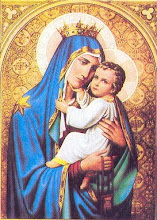
Novena To Mary for Employment

In honor of Our Lady's birthday, let us join in praying for all those who seek employment and deliverance from financial troubles and debt, especially a certain family I know. (Via Esther.)
This novena starts on August 30 and ends on September 7
To be recited everyday:
V. O God, come to my assistance
R. O Lord, make haste to help me
V. Glory be to the Father, and to the Son, and to the Holy Spirit
R. As it was in the beginning, is now and ever shall be, world without end. Amen.

First Day:
Heavenly Child, lovable Mary, the Eternal Father delights in your birth, for He beholds in your coming into this world one of His creatures who is so perfect that she will become the worthy Mother of His divine Son. May your birth give joy to my soul also, by obtaining for me from the heavenly Father, the pardon of my sins, and an abiding sorrow for them.

Hail Mary...
Second Day: O Chosen One among the daughters of Adam, admirable Mary, the Son of God delights in your birth, for He beholds the one chosen to be His Mother, and oh! such a beloved Mother. May your birth give joy to my soul also, by obtaining from your divine Son the grace to be born again spiritually to a holy life, perfectly conformed to yours, so that I may merit to obtain eternal glory.

Hail Mary...

Third Day: O Chosen One among the daughters of Adam, lovable Mary, the Eternal Word takes delight in your birth, for He sees the source of His Immaculate Blood. May your birth give joy to my soul also, by obtaining for me from the Word made Flesh, the grace to find in this Divine Blood the eternal happiness of my soul.

Hail Mary...
Fourth Day: O Chosen One among the daughters of Adam, admirable Mary, the Redeemer, promised to mankind from the beginning of the world, takes delight in your birth, for He sees the one who is destined to become the Co-redemptress of souls by uniting her tears to the Blood shed on the Cross to save mankind.
Hail Mary... 
Fifth Day: Resplendent Lily of Paradise, lovable Mary, the Holy Spirit takes delight in your birth for He sees in you the soul never stained by sin, which would forever be His worthy Temple. May your birth give joy to my soul also, by obtaining for me from the Holy Spirit His divine love and final perseverance.
Hail Mary...


Sixth Day: Most Beautiful Branch of the tree of David, most admirable Mary, whose birth was such a consolation to St. Joachim and St. Anne who were delighted to be the parents of so holy a child, may your birth be the consolation of my soul, by obtaining for me from God, victory over the world and detachment from all the things of this earth.
Hail Mary...

Seventh Day: Resplendent Morning Star, lovable Mary, your birth was the cause of great joy to the angels, for they beheld in you the Mother of the Redeemer of the world, who by His Death would repair the loss sustained by the fall of rebellions angels in paradise. May your birth give joy to my soul also, by obtaining for me from God, victory over the infernal enemy, deliverance from all his snares, and the grace to be associated in glory with the angels in heaven.
Hail Mary...

Eighth Day: Brilliant Aurora of Heaven, lovable Mary, your birth brought great consolation to the souls of the saints detained in limbo, for it announced the approach of the Sun of Justice, Jesus Christ, who would enlighten their darkness and then conduct them to paradise. May your birth give joy to my soul also, and obtain for me from God, patience in all adversities, a perfect and constant conformity to His most holy will.
Hail Mary...
Ninth Day: Mediatrix between God and mankind, admirable Mary, by your birth you perfected the joy of all the children of Adam, who, through you, have received the Author of Grace, for He has made you the treasurer of all the graces which are imparted to us. May your birth be a special cause of joy to my soul by obtaining for me from God, eternal salvation and all the graces necessary to obtain it.
Hail Mary...


The prayer of each day is ended by the following:

Antiphon: Your Nativity, O Virgin Mother of God, was the herald of joy to the whole world; since from you arose the Sun of Justice, Christ our God, who, destroying the curse, bestowed the blessing, and confounding death, rewarded us with life everlasting.
V. Let us celebrate with joy the birth of the Blessed Virgin Mary.
R. That she may intercede for us with Our Lord Jesus Christ.

Let us pray.
Grant to us your servants, we beseech you, O Lord, the gift of Your heavenly grace, that as our salvation was begun in the child-bearing of the Blessed Virgin, so from this solemn festival of her Nativity may we obtain an increase of peace. Through Our Lord Jesus Christ. Amen.


Nihil Obstat: Iacobus P. King, I.C.D. Censor Deputatus. Imprimatur: Bryan Iosephus McEntegart, D.D., LL.D. Episcopus Bruklyniensis.

Monday, August 29, 2011

The Priest in Union with Christ

A quote from Father Garrigou-Lagrange, O.P.:
Every follower of Christ -- but especially His priests ‚-- are invited to worship Him in the Eucharist, but there are some who receive a special vocation to this devotion -- the Eucharistic vocation. "Nobody can come to Me without being attracted towards Me by the Father who sent Me" (John 6, 44). And the Father attracts everyone to salvation but not necessarily along the same path.
What is this Eucharistic vocation, in the opinion of Saint Peter Julien Eymard? It is a special attraction of grace, gentle but compelling -- as if Christ were saying to the soul: Come to my sanctuary. Provided no resistance is offered, this attraction gradually becomes supreme.
The faithful soul responding to this invitation finds peace, as though it had discovered at long last its natural home and spiritual food: "I have found my resting place." Books and conferences no longer give the help required; this can only be found in more intense prayer before the Blessed Sacrament. (Read More.)

Wednesday, August 24, 2011

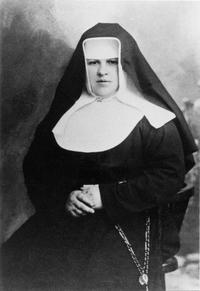
Blessed Maria Restituta Kafka

From the EWTN website:
BL. MARIA RESTITUTA KAFKA was born in Brno (in what is now the Czech Republic) on 10 May 1894, the sixth daughter of a shoemaker, and was given the name Helena at Baptism. She grew up with her family in Vienna and was employed as a salesgirl and later as a nurse. As a nurse she came into contact with the Franciscan Sisters of Christian Charity (known as the "Hartmannschwestern") and entered their congregation in 1914, taking the name of an ancient martyr, Restituta.
 
From 1919 she worked for 20 years as a surgical nurse and soon gained the reputation not only of a devoted and capable nurse but one who was particularly close to the poor, the persecuted and the oppressed. She even protected a Nazi doctor from arrest which she thought was unjustified.

When Hitler took over Austria, Sr Restituta made her total rejection of Nazism quite clear. She called Hitler "a madman" and said of herself: "A Viennese cannot keep her mouth shut". Her reputation spread rapidly when she hung a crucifix in every room of a new hospital wing. The Nazis demanded that the crosses be removed, threatening Sr Restituta's dismissal. The crucifixes were not removed, nor was Sr Restituta, since her community said they could not replace her. Sr Restituta was arrested and accused not only of hanging the crosses but also of having written a poem mocking Hitler.

On 28 October 1942 she was sentenced to death for "aiding and abetting the enemy in the betrayal of the fatherland and for plotting high treason". She was later offered her freedom if she would leave her religious congregation, but she refused. When asked to commute her sentence, Martin Bormann expressly rejected the request, saying: "I think the execution of the death penalty is necessary for effective intimidation.

While in prison she cared for the other prisoners, as even communist prisoners later attested. After various requests for clemency were rejected by the authorities, Sr Restituta was decapitated on 30 March 1943.
Related Posts with Thumbnails