


Sunday, November 13, 2011

Meditation on Death, Part III

Here are more words from St. Alphonsus Liguori, a Doctor of the Church. Gentle and scholarly, the saint did not mince words when it came to warning people about the end of life.
Consider that death is a moment on which eternity depends. Take a view of a man who is on the point of expiring, and reflect that he is just going to enter into one or other of two eternities; his fate is pending but for a moment: when that is expired, he is either saved or condemned forever. O this last breath! O this moment on which depends an eternity!an eternity either of torment or of glory; an eternity either always happy or always miserable; an eternity either of all that is good or of all that is evil; an eternity either of heaven or of hell. If you are then saved, you will be secure from all evils, and at the summit of happiness and content; if you are condemned, you will live in punishment and despair as long as God will be God. In death you will understand the meaning of heaven, hell, sin, an offended God, the contempt of divine laws, sins concealed in confession, ill-gotten goods unrestored, injustices not pardoned. "Unhappy me!" will the dying man say, "in a few moments I must appear in the presence of God. What will my sentence be? Whither shall I go? To heaven or to hell? Shall I be happy with the saints or burned with the damned? Shall I be a child of God or a slave of the devil? Alas! But a minute more and I shall know; and the destiny which I shall then receive will last for all eternity." Then will you detest a thousand times the day on which you had the misfortune to sin. But it will be too late; your sorrow will be fruitless, because it will proceed from the fear and not from the love of God. Ah, my God! from this hour I will turn to thee: I will not delay my repentance until death. I now love thee, I embrace thee, and I wish to die in Thy embraces. O Mary! my true Mother, let me die under thy protection: help me at that critical and decisive moment.
~from Preparation for Death by St. Alphonsus Liguori, p. 396-397

Saturday, November 12, 2011

Meditation on Death, Part II

St. Alphonsus continues to explain why it is important to be prepared for death ahead of time.
Consider that, at the hour of your death, you will be extended on a bed, with your relatives and friends weeping over you, a priest to assist you, a lighted taper by your side, within one step of the terrible passage into eternity. Your head will be oppressed with pain, your eyes will become dim, your tongue parched with heat, your blood cooling in your veins, and your heart in agony: you will see the world passing from before you. No sooner will your soul become separated from your body than you will be stripped of all things, and cast into the earth to rot. There you will become the food of worms, which will gnaw and devour your flesh, and in a short time nothing will remain of your body but a few withered bones and a little dust. Open a grave, and take a view of the state of that rich and avaricious man! of that vain woman! Ah! Such is the termination of human life; such is the end of mortal man, and such will soon be yours. But penetrate with the eyes of faith into the other world, and see the condition in which your soul will be placed. It will instantly be surrounded by the monsters of hell, representing before you all the sins that you have committed from your very childhood. At present the devil hides from you the malice of your crimes: he persuades you that there is little evil in this act of vanity, this indulgence, this resentment, this dangerous company; but in death he will display before your eyes the enormity of your sins, to make you despair. Then you will discover in the light of God himself the evil which you have committed in offending his infinite goodness. Ah! Hasten then, whilst time remains, to make reparation for what is past: at the hour of death it will be too late.

~from Preparation for Death by St. Alphonsus Liguori, p. 395-396

Sunday, November 6, 2011

Praying for the Holy Souls

Some thoughts from Fr. Mark:
The offering of the Precious Blood of Christ for the Holy Souls is a mighty form of intercession on their behalf. Given that I am a firm believer in the value of repetitive prayer, of simple invocations repeated over and over again in the form of a chaplet or rosary, I began to pray for the Holy Souls in this way. Readers of Vultus Christi may want to make this prayer their own during the month of November, even on a daily basis. It is prayed on an ordinary rosary.
On the large beads:
V. Eternal Father,
I offer Thee the Precious Blood of Thy Beloved Son, Our Lord Jesus Christ,
the Lamb without blemish or spot (1 P 1:19) --
R. For the refreshment and deliverance of the souls in Purgatory.

(One can add here, especially those of my family, or of my ancestry, or of priests. The Holy Spirit sometimes moves one to pray for particular groups of Holy Souls.)
Ten times on the small beads:
V. By Thy Precious Blood, O Jesus --
R. Purify and deliver their souls.

After having said five decades, one concludes with:
V. Eternal rest grant unto them, O Lord.
R. And let perpetual light shine upon them.
V. May they rest in peace.
R. Amen.

(Read entire post.)

Saturday, November 5, 2011

To Hope Against All Hope

Some wisdom from Dom Marmion:
Nothing is more pleasing to God than unshaken faith and confidence in the midst of darkness. Make great practice of acts of confidence, even when you feel nothing. It is precisely in these moments of dryness and darkness that these acts are most meritorious, most pleasing to God and most useful to your soul. Ordinary souls, that have not given themselves without reserve to God, find no difficulty in making acts of love and confidence in God during times of consolation and success, but it is the property of those whom God calls to union, to more intimate familiarity with Himself, to persist in hoping in Him in spite of every appearance which might tend to make them doubt the Divine promises. Such as these say with holy Job: ‘Although He should kill me, I will trust in Him.’ (Job 13:15). They say to God: ‘My God you are my Father, Your Son Jesus has said that You are our Father, that you love us, that You never refuse anything we ask in His Name. My God I believe all this, and although the world, the devil and all Hell should tell me the contrary, I believe Your word simply because You have said it.’ Never forget that faith is the beginning, the progress and the consummation of perfection.” (13th January 1895) (Read entire post.)

Friday, November 4, 2011

The Abyss of Death

From a recent homily by Our Holy Father Pope Benedict XVI:
The passage taken from the prophet Hosea turns our thoughts immediately to the resurrection of Jesus, to the mystery of his death and his rising to unending life. This text of Hosea -- the first half of Chapter 6 -- was deeply impressed upon the heart and mind of Jesus. In fact, more than once in the Gospels he repeats Verse 6: "I want love and not sacrifice, the knowledge of God more than holocausts." Jesus does not cite Verse 2 but he makes it his own and he realizes it in the Paschal Mystery: "After two days he will give life back to us and on the third he will raise us up again, and we will live in his presence." In the light of these words the Lord Jesus entered into the passion, he decisively embarked upon the road to the cross; he spoke openly to his disciples of what must happen to him in Jerusalem, and the words of the Prophet Hosea echoed in his own words: "The Son of man will be given over into the hands of men and they will kill him; but, once he is killed, after three days, he will rise again" (Mark 9:31).

The evangelist observes that the disciples "did not understand these words and they were afraid to question him" (9:32). We too, in the face of death, cannot fail to experience the sentiments and thoughts characteristic of our human condition. And we are always surprised and overcome by a God who draws so close to us that he does not even stop before the abyss of death, who rather passes through it, remaining for two days in the tomb. But exactly here the mystery of the "third day" occurs. Christ takes on our mortal flesh completely that it might be invested with the glorious power of God, by the breath of the life-giving Spirit, who transforms and regenerates it. This is the baptism of the passion (Luke 12:50), which Jesus received for us and about which St. Paul writes in the Letter to the Romans. The expression used by the Apostle -- "baptized into his death" -- never ceases to strike us, such is the concision with which he summarizes the dizzying mystery. Christ's death is the font of life, for into it God poured all of his love, as in a great cataract, which makes us think of the image of Psalm 41: "Abyss calls to abyss, in the roar of your torrents; all your billows and waves have passed over me" (8). The abyss of death is filled by another abyss that is greater still, namely, the love of God, which is such that death no longer has power over Jesus Christ (cf. Romans 8:9), nor over them who, by faith and baptism, are associated with him: "If we have died with Christ," says St. Paul, "we believe that we will also live with him" (Romans 8:8). This "living with Jesus" is the fulfillment of the hope prophesied by Hosea: "… and we will live in his presence" (6:2).

In truth, it is only in Christ that such a hope finds its real foundation. Before [Christ] it ran the risk of becoming an illusion, a symbol taken from the rhythm of the seasons: "like the autumn rain, like the spring rain" (Hosea 6:3). At the time of the Prophet Hosea the faith of the Israelites was in danger of being contaminated with the naturalistic religions of the land of Canaan, but this faith is not able to save anyone from death. But God's intervention in the drama of human history does not obey any natural cycle; it only obeys his grace and faithfulness. The new and eternal life is the fruit of the tree of the cross, a tree that blossoms and bears fruit from the light of the sun of God. Without the cross of Christ all the energy of nature remains impotent before the negative force of sin. A beneficent force greater than that which moves the cycles of nature, a Good greater than that of creation itself: a love that proceeds from the "heart" itself of God and that, while it reveals the ultimate meaning of creation, renews it and directs it toward its original and final goal. (Read entire homily.)

Thursday, November 3, 2011

Meditation on Death, Part I

Consider that this life may soon terminate. The sentence is already passed: You must die. Death is certain, but the moment of it is uncertain: we know not when it will come. But to how many casualties and accidents is human life constantly exposed? The bleeding of an artery, a stroke of apoplexy, the bite of a venomous animal, an inundation, an earthquake, a thunderbolt, and numberless other causes that we can neither foresee nor prevent, may deprive you instantly of human life. Death may surprise you when you least expect it. How many have gone to bed at night in apparent good health, and in the morning have been found dead? And may not the same happen to you? Numberless others, who have been visited by sudden death, never expected to die in that manner; and, if they were then found in mortal sin, what is now their fate, and what will it be through all eternity? But, at all events, it is certain that either the night, or the day will come, when you will no more see the night. "I shall come," says Jesus Christ, "like a thief in the night, when I am the least expected." Matt. xxiv.44. Your good master warns you of this beforehand, because he wishes your salvation. O Sinner! Correspond, then, with this mercy, profit by this admonition, hold yourself always in readiness for death. When that moment comes there will be no time for preparation. Consider well that you must certainly die. The scene of this world must soon terminate for you, though you know not when. Who can tell whether it will be within a year, within a month, within a week, or even whether you will be alive tomorrow? Oh my Jesus! Give me light, and pardon me.

~from Preparation for Death by St. Alphonsus Liguori, p. 394

Tuesday, October 25, 2011

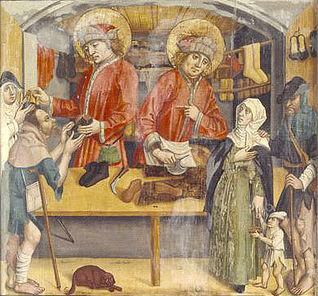
Saints Crispin and Crispianus

Crispin and Crispinian are the patron saints of shoemakers, saddlers, and tanners.
Martyrs of the Early Church who were beheaded during the reign of Diocletian; the date of their execution is given as 25 October, 285 or 286. It is stated that they were brothers, but the fact has not been positively proved. The legend relates that they were Romans of distinguished descent who went as missionaries of the Christian Faith to Gaul and chose Soissons as their field of labour. In imitation of St. Paul they worked with their hands, making shoes, and earned enough by their trade to support themselves and also to aid the poor. During the Diocletian persecution they were brought before Maximianus Herculius whom Diocletian had appointed co-emperor. At first Maximianus sought to turn them from their faith by alternate promises and threats.

But they replied: “Thy threats do not terrify us, for Christ is our life, and death is our gain. Thy rank and possessions are nought to us, for we have long before this sacrificed the like for the sake of Christ and rejoice in what we have done. If thou shouldst acknowledge and love Christ thou wouldst give not only all the treasures of this life, but even the glory of thy crown itself in order through the exercise of compassion to win eternal life.”

When Maximianus saw that his efforts were of no avail, he gave Crispin and Crispinian into the hands of the governor Rictiovarus (Rictius Varus), a most cruel persecutor of the Christians. Under the order of Rictiovarus they were stretched on the rack, thongs were cut from their flesh, and awls were driven under their finger-nails. A millstone was then fastened about the neck of each, and they were thrown into the Aisne, but they were able to swim to the opposite bank of the river. In the same manner they suffered no harm from a great fire in which Rictiovarus, in despair, sought death himself. Afterwards the two saints were beheaded at the command of Maximianus. (Read entire post.)
Related Posts with Thumbnails