Thursday, August 30, 2018

The Confraternity of Priest Adorers of the Eucharistic Face of Jesus

From Fr. Mark:
The crisis that continues to shake the Church and to burden the hearts of priests with sorrow and uncertainty, requires a powerful spiritual antidote. Our Lord is calling His priests to tarry in His presence. He invites them to abide in the radiance of His Eucharistic Face, close to His Heart. There they will recover the joy of their youth and the certainty of being loved by Christ with an everlasting love.

Eucharistic adoration is a wellspring of priestly happiness. It is by daily adoration that the priest begins to say, in all truth, with the psalmist: “To be near God is my happiness” (Psalm 72:28) and, “My happiness lies in Thee alone” (Psalm 15:2). There is a correlation between happiness and holiness. A priest faithful to his daily hour of adoration will, like Saint John the Baptist, be a friend of the Bridegroom, “rejoicing with joy” (John 3:29) because of the Bridegroom’s voice, and capable of winning souls for Christ.
The centrality of the Eucharist should be apparent not only in the worthy celebration of the Sacrifice, but also in the proper adoration of the Sacrament, so that the priest might be the model for the faithful also in devote attention and diligent meditation — whenever possible — done in the presence of our Lord in the tabernacle. It is hoped that the priests entrusted with the guidance of communities dedicate long periods of time for communal adoration and reserve the greatest attention and honour for the Most Blessed Sacrament of the altar, also outside of Holy Mass, over any other rite or gesture. “Faith and love for the Eucharist will not allow Christ to remain alone in his presence in the tabernacle”. (Congregation for the Clergy, Directory on the Ministry and Life of Priests, 31 January 1994)
The 19th and early 20th centuries saw, in fact, the birth of a number of movements for the promotion of Eucharistic adoration, reparation, and priestly holiness. The best known of these is, without doubt, the Association of Priest-Adorers of the Blessed Sacrament, founded by Saint Peter Julian, and canonically erected in Rome on 16 June 1887.

The second half of the last century saw many of these fine movements fall into decline, leaving a void in the spiritual life of new generations of priests. The Year of the Eucharist proclaimed by Saint John Paul II in 2004, and the Year of the Priesthood proclaimed by Pope Benedict XVI in 2009 were an invitation to rediscover and refresh the benefits that accrue to priests who commit themselves to prayer for and with one another, and in particular, to Eucharistic adoration.

In his Encyclical Letter of Holy Thursday, 17 April 2003, Ecclesia de Eucharistia, Saint John Paul II drew the eyes of the Church to the Face of Christ in the Most Holy Eucharist. He coined a new phrase, one not encountered before in his writings or in the teachings of his predecessors, “the Eucharistic Face of Christ.” Thus did Saint John Paul II share with the Church his own experience of seeking, finding, and adoring the Face of Christ in the Most Holy Sacrament of the Altar. The human face is a mysterious icon of the heart. It signifies, among other things, a personal presence open to relationship with another. In the Sacrament of His Love, the Face of Christ, the Human Face of God, is turned towards those who seek Him, ready to draw them into a healing and life-giving communion of love with His Sacred Heart. (Read more.)


Sunday, August 12, 2018

The Current Crisis in the Catholic Church

From Fr. Heilman:
On October 7, 2017, over one million Catholics in Poland rose up and grabbed their rosaries and, mainly on their borders, called out to God with the powerful intercession of Our Lady....This was a grassroots effort that was, in essence, saying, “The demonic secular forces of this world are not welcome on our soil!” While not immune to the infiltration of modernism in Poland’s Catholic Church, they remain one of the strongest on the planet. In St. Faustina’s diary, she relates how our Lord told her,
“I bear a special love for Poland, and if she will be obedient to My will, I will exalt her in might and holiness. From her will come forth the spark that will prepare the world for My final coming” (Diary, 1732)
Inspired by Poland — Ireland, the British Isles and Australia followed suit in praying for their respective countries with rosaries in hand (all “grassroots” efforts of the laity). The United States has been praying this way since 2016 (and the lead up to the Presidential election), with Novena for Our Nation, with over 40,000 USA Catholics praying the miraculous 54 Day Rosary Novena from August 15 (Feast of the Assumption) to October 7 (Our Lady of the Rosary). With the inspiration of Poland, we (USA) have reframed the concluding October 7 prayer campaign with the new title of “Rosary Coast to Coast” (Go to rosarycoasttocoast.com). Now, many nations have accepted the clarion call, and will be praying together on October 7, 2018 in what we now call the “Holy League of Nations” (Go to holyleagueofnations.com).
In the lead up to our launch of this 2018 enormous “Rosary Coast to Coast” nation-wide (now worldwide) prayer campaign (We launched on March 31, 2018), our planning team sought the support of all of the USA bishops. I warned the team that we would not get many to respond, much less support. And, as I predicted, only a handful responded and what support we received was timid (barring a few, including my own Bishop Morlino, Bishop Conley and Cardinal Burke). Why did I accurately predict this? Because I knew full well the “condition of our prelates in America.” I knew we would be received as more “dangerous” than “beneficial” to the Church in America. Why? Let me explain …
There was one reply, in particular, that still rings (stings) in my mind and heart, nearly on a daily basis, that, sadly, truly expressed this “condition of our prelates.” It came from a very prominent prelate who will remain nameless. Here was his reply …
“Father, I’m not fond of these national campaigns.  I don’t know that they accomplish a whole lot and because of that, I just haven’t been willing to offer endorsements.”
Yes, you read that correctly. Tens of thousands of people joined together in prayer to call out to God, through the powerful intercession of our Lady, to protect and heal our nation does not “accomplish a whole lot.” St. Louis de Montfort once wrote:
“When people say the Rosary together, it is far more formidable to the devil, than one said privately. Because in this public prayer, it is an army that is attacking him. He can often overcome the prayer of an individual, but if this prayer is joined to other Christians, the devil has much more trouble in getting the best of it.” -St Louis de Montfort.
You see? This is the “problem” … this is the “condition” of the vast majority of our prelates. To them, St. Louis de Montfort and all of those crazy saints were just that … “crazy.” You see? WE have arrived on the scene and, thank God, WE are here now to take the “crazy” out of Catholicism. No more of this silly hocus pocus superstitious nonsense, under our watch. No more of this ridiculous belief in the supernatural power of God and the power of prayer, as long as we are here. In fact, those who advocate “the supernatural” are to be considered “dangerous” in our Church. Also, anyone who would actually defend the teachings of the Church is to be considered “dangerous.”
(Read more.)

Monday, July 23, 2018

A Brief Reflection on Mortal Sin

From Monsignor Charles Pope:
It says that in mortal sin we set our will upon something we know to be incompatible with our ultimate end. Although our first thought may not be that we are rejecting God, we set our will on something incompatible with God. In so doing, we are preferring something or someone to God.

This poisons our heart if we do not repent because we feed a desire in our heart for what is not God and we starve our heart from Him and what He offers. Soon enough we prefer the darkness to the light. We prefer the trinkets of this world to God and come to regard Him as a thief who comes to take what we want and keeps us from doing what we want to do. God becomes our enemy.

If we die in this state, the warmth of God and Heaven seem overwhelming, wrathful, and like a consuming fire. We cannot endure and so we turn away finally and permanently to a place that we strangely prefer, but which is hellacious because it is not that for which we were made. It lacks the one thing necessary: God. (Read more.)

Friday, July 20, 2018

On Carmel's Height

From Vultus Christi:
We are compelled to ponder today what can only be called a core text of the liturgical and spiritual tradition of Carmel. I refer, of course, to the lesson from the Third Book of Kings. This is a text — no, more than a text, a living word — that has, over the centuries, captured the heart of those called to live on Carmel’s heights.
Elias went up to the top of Carmel, and casting himself down upon the earth put his face between his knees, And he said to his servant: Go up, and look towards the sea. And he went up, and looked, and said: There is nothing. And again he said to him: Return seven times. And at the seventh time, behold, a little cloud arose out of the sea like a man’s foot. And he said: Go up and say to Achab: Prepare thy chariot and go down, lest the rain prevent thee. And while he turned himself this way and that way, behold the heavens grew dark, with clouds, and wind, and there fell a great rain. (3 Kings 18:42–45)
Its context is important.  First of all, a terrible drought has come over the land; God withholds his life–giving rain. Over the land ruled by Achab, a weak king, influenced by his wife’s devotion to the great sky–god, Baal, the heavens are closed. Elias determines that this state of affairs must be resolved. The true God, the God of Israel must be glorified in the sight of all. «And Elias coming to all the people, said: How long do you halt between two sides? If the Lord be God, follow him: but if Baal, then follow him. And the people did not answer him a word» (3 Kings 18:21).
Elias summons the prophets of Baal, favourites of the wicked Queen Jezebel, to a public showdown on Mount Carmel. A holocaust is prepared. By the sign of fire from heaven the true God will make Himself known. The prophets of Baal were the first to begin the dreadful rite. The heavens were not moved by their frantic entreaties; Baal was distant and deaf to their cries, even though they cut themselves with swords and lances, joining blood to their futile ravings. (Read more.)

Friday, July 6, 2018

In the Cleft of the Rock

It is the First Friday of the month, when we honor the Sacred Heart of Jesus. The open side of Jesus Crucified has long inspired the great mystics. To quote:
Look at this remarkable painting of Jesus Crucified. The focus of the composition is the wound in His Sacred Side. An angel holding a chalice is hovering just beneath it to receive the outpouring of His Blood. There are also angels stationed beneath His wounded hands. A fourth angel stricken with astonishment and grief looks on. (Read more.)

Tuesday, July 3, 2018

St. Gregory of Nyssa’s Amazing Explanation for the Eucharist

From Catholic Exchange:
Gregory begins by reframing this as a question of how: How can the bread and wine be Christ? Gregory of Nyssa responds by saying that the bread is a kind of prototypical food, just as wine was, in the ancient world, a fundamental source of fluids for all men. And, because of this characteristic bread and wine are a type of the human body. As he puts it:
Some animals feed on roots which they dig up. Of others grass is the food, of others different kinds of flesh, but for man above all things bread; and, in order to continue and preserve the moisture of his body, drink, not simply water, but water frequently sweetened with wine, to join forces with our internal heat. He, therefore, who thinks of these things, thinks by implication of the particular bulk of our body. For those things by being within me became my blood and flesh, the corresponding nutriment by its power of adaptation being changed into the form of my body (Great Catechism, 37).
Actually, all Gregory has done here is address how the Eucharistic bread and wine can represent the body and blood of Christ. This is a helpful answer in so far as it is a necessary step towards understanding how the bread and wine could be God Incarnate. Now he turns to this second question:
[W]hen He came in a body such as ours did not innovate on man’s physical constitution so as to make it other than it was, but secured continuance for His own body by the customary and proper means, and controlled its subsistence by meat and drink (Great Catechism, 37).
Put simply, the Eucharist can be the body and blood, soul and divinity of Christ because that’s similar to what happened on a daily basis during Christ’s life on earth: all the food and drink He consumed became part of His Sacred body, just as food and drink does for us. To build on Gregory’s point, this process is intensified in the Eucharist, in which bread and wine are not only transformed into the body and blood of Christ, but also into His soul and divinity. Gregory concludes,
For that Body was once, by implication, bread, but has been consecrated by the inhabitation of the Word that tabernacled in the flesh. Therefore, from the same cause as that by which the bread that was transformed in that Body was changed to a Divine potency, a similar result takes place now. For as in that case, too, the grace of the Word used to make holy the Body, the substance of which came of the bread, and in a manner was itself bread, so also in this case the bread (Great Catechism, 37).
In effect, Gregory is saying that Christ is transforming the Eucharist into Himself in much the same way that He absorbed food and drink into His body during His earthly life. (Read more.)

Eucharistic Adoration can save the Church. From The Catholic Herald:
There has been in recent times a discernible increase in those drawn to Eucharistic adoration in parishes and communities, and particularly among young people. Adoration stands as an antidote to the noise and busyness of our world.

As we hear from the account of Elijah at Horeb, the Lord was not in the mighty wind, fire or earthquakes but in “the gentle breeze” (1 Kings 19: 9a, 11-16). After encountering that “gentle breeze”, Elijah covered his face with his cloak and stood at the entrance of the cave. “The gentle breeze” might be the Lord calling us from the Blessed Sacrament, and the cloak the call to humble and prostrate ourselves in Adoration. (Read more.)

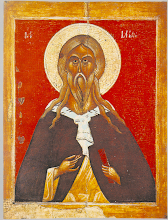
The Holy Prophet Elias

Monday, July 2, 2018

Time to Decide – A Reflection on a Question from Elijah

The Holy Prophet Elias calling down fire from Heaven in the contest with the prophets of Baal
From Monsignor Charles Pope:
At Mass for Wednesday of the 10th Week in Ordinary Time, we read a crucial question from Elijah. It came at a time of widespread apostasy among the Jewish people. Elijah summoned a multitude to Mt. Carmel in the far north of Israel:

Elijah appealed to all the people and said, “How long will you straddle the issue? If the Lord is God, follow him; if Baal, follow him.” The people, however, did not answer him (1 Kings 18:21).

The Baals were the gods of the Canaanites. It had become expedient and popular to worship them because the ruling political leaders, the apostate King Ahab and his wicked wife Jezebel, had set forth the worship of the Baals by erecting altars and sacred columns. All who wished their life to go well and to have access to the levers of prosperity were surely “encouraged” to comply. Jezebel funded hundreds of prophets of Baal and the goddess Asherah. She had many of the prophets of Israel killed and forced others into hiding. Through a policy of favoritism and fear, the true faith was suppressed, and false ideologies were promoted.

At this critical moment, Elijah asked his question. In effect he told them that they needed to decide whether to serve the Lord God out of courageous fidelity or the Baals out of cowardly fear. We, too, must decide. In our times, the true faith has been undermined in the hearts of many by plausible liars, cultural war, and political correctness. Those who strive to hold to the true faith are called hateful, bigoted, and intolerant. A legal framework is growing that seeks to force compliance to the moral revolution and abandonment of the biblical worldview. Social pressures are at work as well, seeking to compel compliance through political correctness, through suppression of speech and ideas, and through the influence of music, cinema, and art.

The same question must be asked of us: How long will you straddle the issue? If the Lord is God, follow him at any cost. If Baal is your god, follow him! If you prefer what is popular, politically correct, and safe, go for it; but understand that if you do so, your decision is increasingly for Baal, not the Lord. In a culture that insists you celebrate fornication, homosexual acts, transgenderism, abortion, euthanasia, and all sorts of intemperance, realize that your decision to comply amounts to a choice for Baal.

Some claim that they are not really making a fundamental choice against God and for the modern Baals. Rather, they prefer to think that they are being “tolerant,” that they are pleasant moderates seeking to “build bridges” and keep the faith “mainstream.” (Read more.)
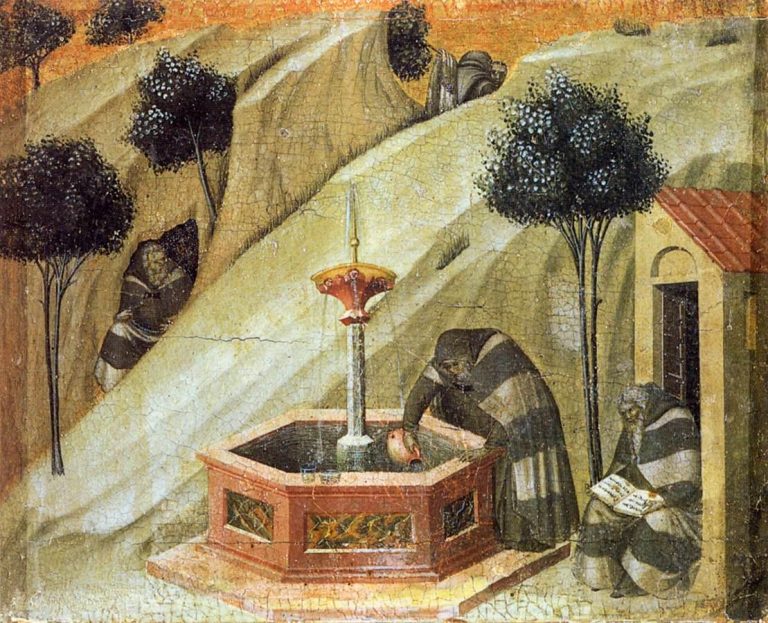
Elias ascends in the fiery chariot
Ascension of Elias


Related Posts with Thumbnails