
Saturday, March 14, 2020

Love Is a Liturgical Act

From Francis Etheredge at Homiletic and Pastoral Review:
Prayer, like marriage and family life, needs the whole Christian life to live it; and, therefore, whatever our state in life, in a certain sense the whole Catechism is for each of us: single; married; religious, and ordained. Moreover, given the immense range of conversation that is possible between any two people, never mind the various members of a particular family, it is a wonderful resource in terms of stimulating all kinds of discussions. What is an angel? (cf. CCC, 325-336) How are we to understand the opening chapters of Genesis? (cf. CCC, 286, 289, 337, 375 etc.) How do we help or hinder the “Holy Spirit as the interior Teacher of Christian prayer”? (CCC, 2681) Why is it, for example, if prayer is an instantaneous communication with God, are we infatuated with the speed and complexity of human devices? If prayer is a powerful help in daily life, why do people prefer to write and dream about being superheroes, semi-mechanistic, and magicians? If prayer can reach across the universe in one immeasurably generous leap, then why not send a “prayer-gram”? It is not a matter, however, of being other than we are; and, if our reality is that we are “very little a family”36, then let that be the beginning, or point of renewal, and not a terminus of hope and help. There are two, if not three, particular times of family prayer: meal-times; bed-times; and Sunday lauds, or the morning prayer of the Church. (Read more.)
And here is a podcast by Mr. Etheredge at the Catholic Current on the Stations of the Cross.

More articles by Francis Etheredge, HERE and HERE. And his books are HERE.

Friday, March 13, 2020

Some Churches in Rome Re-open

"Many shall be chosen, and made white, and shall be tried as fire: and the wicked shall deal wickedly, and none of the wicked shall understand, but the learned shall understand. And from the time when the continual sacrifice shall be taken away, and the abomination unto desolation shall be set up, there shall be a thousand two hundred ninety days." Daniel 12: 10-11
"When therefore you shall see the abomination of desolation, which was spoken of by Daniel the prophet, standing in the holy place: he that readeth let him understand. Then they that are in Judea, let them flee to the mountains: And he that is on the housetop, let him not come down to take any thing out of his house: And he that is in the field, let him not go back to take his coat. And woe to them that are with child, and that give suck in those days. But pray that your flight be not in the winter, or on the sabbath." Matthew 24:15-20
The Holy Father is re-opening some churches in Rome. This is good, since people were starting to talk about the prophecy of the "abomination of desolation" which can be defined thus:
The abomination of desolation, abomination that makes desolate, or desolating sacrilege (Hebrew: הַשִּׁקּוּץ מְשׁוֹמֵֽם, ha-shikkuts meshomem, Latin: abominatio desolationis) is a term found in the Book of Daniel and the Gospels of Matthew and Mark, which means literally "an abomination that desolates" or "an abomination that depopulates."
 We will continue to watch and wait, as churches close and mass is suspended around the world. But not in Rome. From RTE:
The Pope has re-opened some churches in Rome, defying political pressure to close all public buildings in the battle to curb the spread of coronavirus. The rare standoff between the 83-year-old pontiff and Prime Minister Giuseppe Conte's government came as Italy's death toll topped 1,000. Some of Rome's Catholic churches have now re-opened after Pope Francis voiced displeasure with the Italian authorities' push to shut them because of the coronavirus pandemic. Italians have been told to avoid going outside without a good reason and machine-gun toting soldiers now patrol city streets. But churches had stayed opened in the overwhelmingly Catholic country throughout what many now see as Italy's biggest crisis since World War II. 
That changed yesterday when the vicar of Rome Angelo De Donatis said he could no longer withstand government pressure and was closing all Catholic places of worship across the Italian capital, about 900 in total. Pope Francis' response was unusually swift and blunt. 
"Drastic measures are not always good," the Argentine-born pope said in his live streamed morning prayer on Friday morning. (Read more.)

Wednesday, March 11, 2020

"God Gives Holy Communion"

Taken at St. Peter's Basilica in Rome yesterday, the first day of the St. Joseph novena. Via Sr. Mary Joseph Calore.

Monday, March 9, 2020

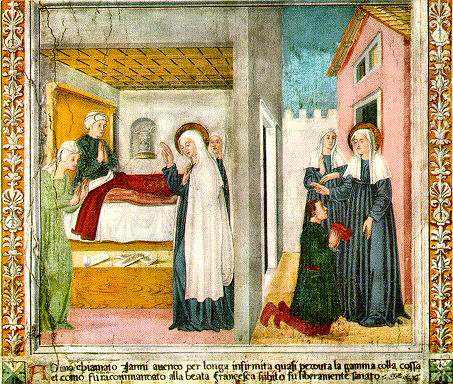
St. Frances of Rome

She could detect diabolical plots.
Her visions often assumed the form of drama enacted for her by heavenly personages. She had the gift of miracles and ecstasy, we well as the bodily vision of her guardian angel, had revelations concerning purgatory and hell, and foretold the ending of the Western Schism. She could read the secrets of consciences and detect plots of diabolical origin. She was remarkable for her humility and detachment, her obedience and patience, exemplified on the occasion of her husband’s banishment, the captivity of Battista, her sons’ death, and the loss of all her property. (Read entire post.)

The Book of Esther and the Secrets of Fatima

Catholic author Marianna Bartold recently posted an article about the Jewish feast of Purim from Breaking Israel News as well as her own article on The Star of Esther and the Secrets of Fatima. To quote Mrs.Bartold:
When Sr. Lucia, the last Fatima visionary, was called into eternity on February 13, 2005, both the Catholic and mainstream media sought the significance of the date. Most sources tied-in to May 13, noting the “13” in the anniversary date of the Fatima apparitions (1917), the papal assassination attempt (1981), and the late pope’s world consecration to the Immaculate Heart (1982). Ultimately, the mainstream efforts implied that Sr. Lucia’s death was a sign that Fatima is finished. Yet when an incredible Scriptural connection to February 13th and Fatima is examined as a whole, the opposite conclusion is made: While the date of Lucia’s death is definitely a sign, it is one alerting the world that we have reached the most critical chapter of the Fatima revelations.

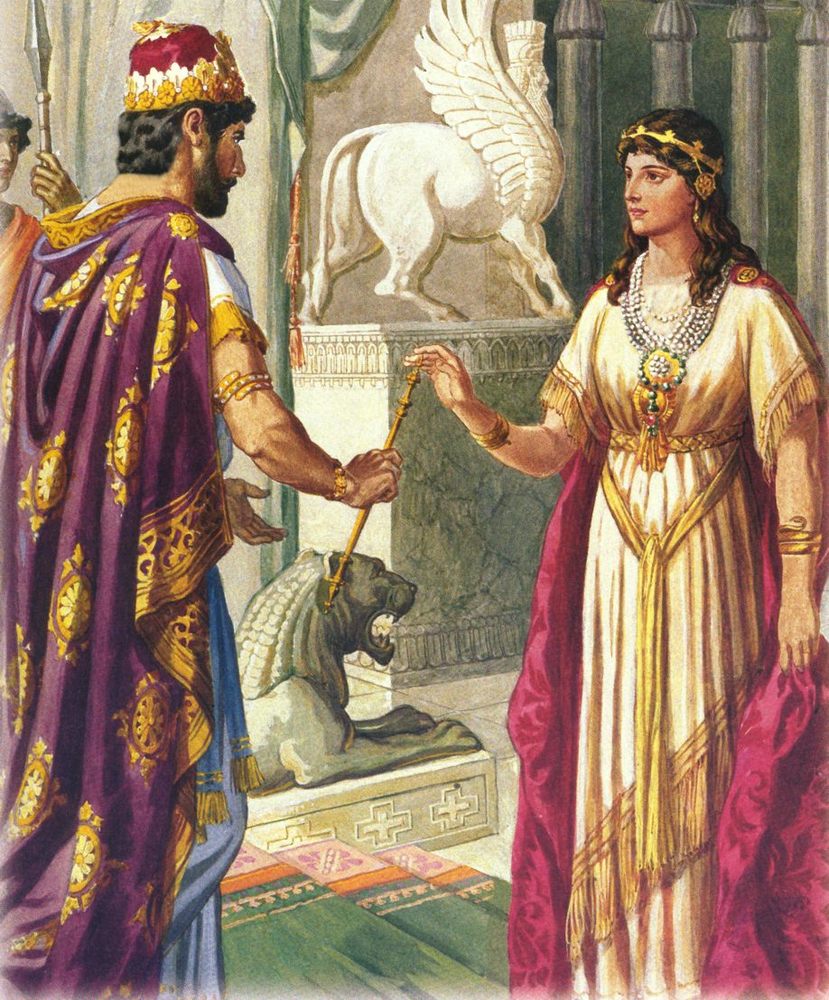
Heretofore, it was never noticed that the date of Sr. Lucia’s passing links to a small yellow star, worn by Our Lady of Fatima. This star is a profound symbol long recognized by tradition as the “Star of Esther.” It points to an Old Testament history called The Book of Esther, which relates the story of a Jewish queen whose intercession saved her people from annihilation. Queen Esther’s mediation allowed the ancient Hebrews “to gather themselves together, and to stand for their lives” on “the 13th day of Adar.” [1]

Until Lucia’s passing, the magnitude of “the 13th of Adar” could not be realized, even by Fatima scholars. Her death signals that, like the Jews who stood for their lives on the 13th of Adar, our own great battle against annihilation is begun. The secret significance of Lucia’s date of death has been right before our eyes all the time: It occurred exactly 40 minutes before sunset,[2] on the 13th of February[3] – in the Hebrew month of Adar.[4]

P.S. to the Message of Fatima 

Thus it seems that even Lucia’s death accentuated the entire Fatima message, manifesting a kind of heavenly post-script: “Hear, O foolish people, and without understanding: who have eyes, and see not: and ears, and hear not.”[5]

In the Scriptures, the 13th day of Adar is one with historical portent. It marks the Machabees’ liberation of the Holy Land after a four-year combat; the battle throughout the Persian Empire during the reign of Esther; and the day warriors fasted before going out to war. [6] The theme becomes obvious: An epic battle of God’s ecclesia against her enemies.

Because there are no insignificancies in God’s designs, there are great reasons for the Star of Esther adorning Our Lady of Fatima. Only three years ago, its purpose was again emphasized when God willed that Lucia should leave this world on a date directing our attention to both Esther and Our Lady of Fatima.

Of Mary, There is Never Enough

Just as the star adorning Our Lady of Fatima points to The Book of Esther, so does The Book of Esther point to all of the Fatima revelations. Esther’s theme centers on secrets and revelations, suggesting that The Book of Esther is a figure type for The Apocalypse (Greek for Revelations).

The Book of Esther appears to encapsulate what Fatima highlights about both the Virgin’s and the Church’s singular office in salvation history. Esther’s Star on Our Lady’s gown directs the Church to “the history of Queen Esther, who was herself a great [figure] type of our Queen Mary!”[7]

But first, what is meant by a figure type? In its application to the whole of Scripture, an Old Testament figure type is a person, place, thing or event foreshadowing a New Testament archetype (a perfect model or type). The New Testament archetype is always greater than its Old Testament figure type.[8]

Our Lord Himself plainly alluded to Scriptural figure types when, after His Resurrection, he appeared to two disciples on the road to Emmaus. “And beginning at Moses and all the prophets, he expounded to them in all the scriptures the things that were concerning him.” Our Lord used similar words when He subsequently appeared to the apostles.[9]

(Read more.)

More HERE. And HERE.


Friday, February 28, 2020

A Physician’s Analysis of the Crucifixion

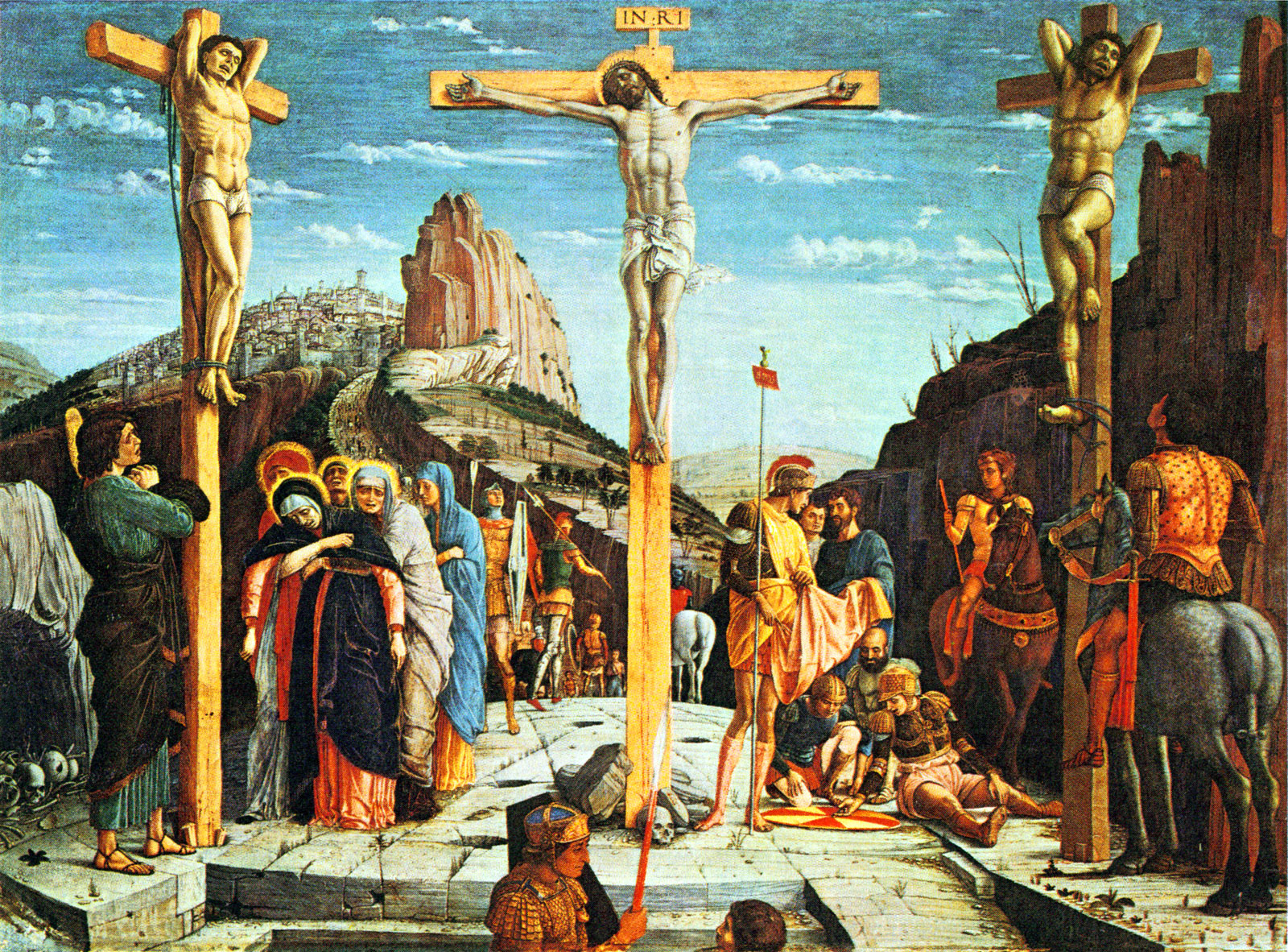
The Crucifixion of Christ by Andrea Mantegna
From YWAM:
Several years ago I became interested in the physical aspects of the passion, or suffering, of Jesus Christ when I read an account of the crucifixion in Jim Bishop’s book, The Day Christ Died. I suddenly realized that I had taken the crucifixion more or less for granted all these years – that I had grown callous to its horror by a too-easy familiarity with the grim details. It finally occurred to me that, as a physician, I did not even know the actual immediate cause of Christ’s death. The gospel writers do not help much on this point.
Since crucifixion and scourging were so common during their lifetimes, they undoubtedly considered a detailed description superfluous. For that reason we have only the concise words of the evangelists: “Pilate, having scourged Jesus, delivered Him to them to be crucified … and they crucified Him.”
Despite the gospel accounts’ silence on the details of Christ’s crucifixion, many have looked into this subject in the past. In my personal study of the event from a medical viewpoint, I am indebted especially to Dr. Pierre Barbet, a French surgeon who did exhaustive historical and experimental research and wrote extensively on the topic.
An attempt to examine the infinite psychic and spiritual suffering of the Incarnate God in atonement for the sins of fallen man is beyond the scope of this article. However, the physiological and anatomical aspects of our Lord’s passion we can examine in some detail. What did the body of Jesus of Nazareth actually endure during those hours of torture? (Read more.)

Monday, February 24, 2020

Preparing for Lent

Adam and Eve by Lucas Cranach the Elder
Here is a meditation by a Carmelite tertiary who shall be known on this blog as Mi Amigo:
Our first parents ate, against the will of our Father, the forbidden fruit. What is the fruit? We might consider, "Is the 'fruit' of the Tree of Knowledge of Good and Evil the birth of “conscience”? Prior to eating the fruit, Adam and Eve did not have any knowledge of evil in their nakedness. Was their realization of “something wrong” in their self-exposure the birth of human conscience?
The Banishment of Adam and Eve by Masaccio 
The Catechism of the Catholic Church, Section 1776, states, "Deep within his conscience man discovers a law which he has not laid upon himself but which he must obey. Its voice ever calling him to love and to do what is good and to avoid evil, sounds in his heart at the right moment….For man has in his heart a law inscribed by God….His conscience is man’s most secret core and his sanctuary. There he is alone with God whose voice echoes in his depths."

In the human heart, God inscribes his Law. In the heart, we are either single-minded toward the will, the law, of God, or we are double-minded, divided in ourselves between God and the world. The season of Lent is upon us, a time of reflection, to turn within to our most secret core and sanctuary, our conscience, and listen to the voice of God echoing in our depths, a time to repent from our double-mindedness and, a time of conversion, to re-commit ourselves with single-mindedness to the will and love of God in those areas of our life to which our conscience directs us.

This Lenten season, let us turn within and from our hearts pray as Thomas a Kempis, "O God my Truth, make me one with you in eternal love. Often I become weary with reading and hearing many things. You are all that I want and desire. Let all teachers be mute and all creation keep silence before you. Speak to me, You and You alone."
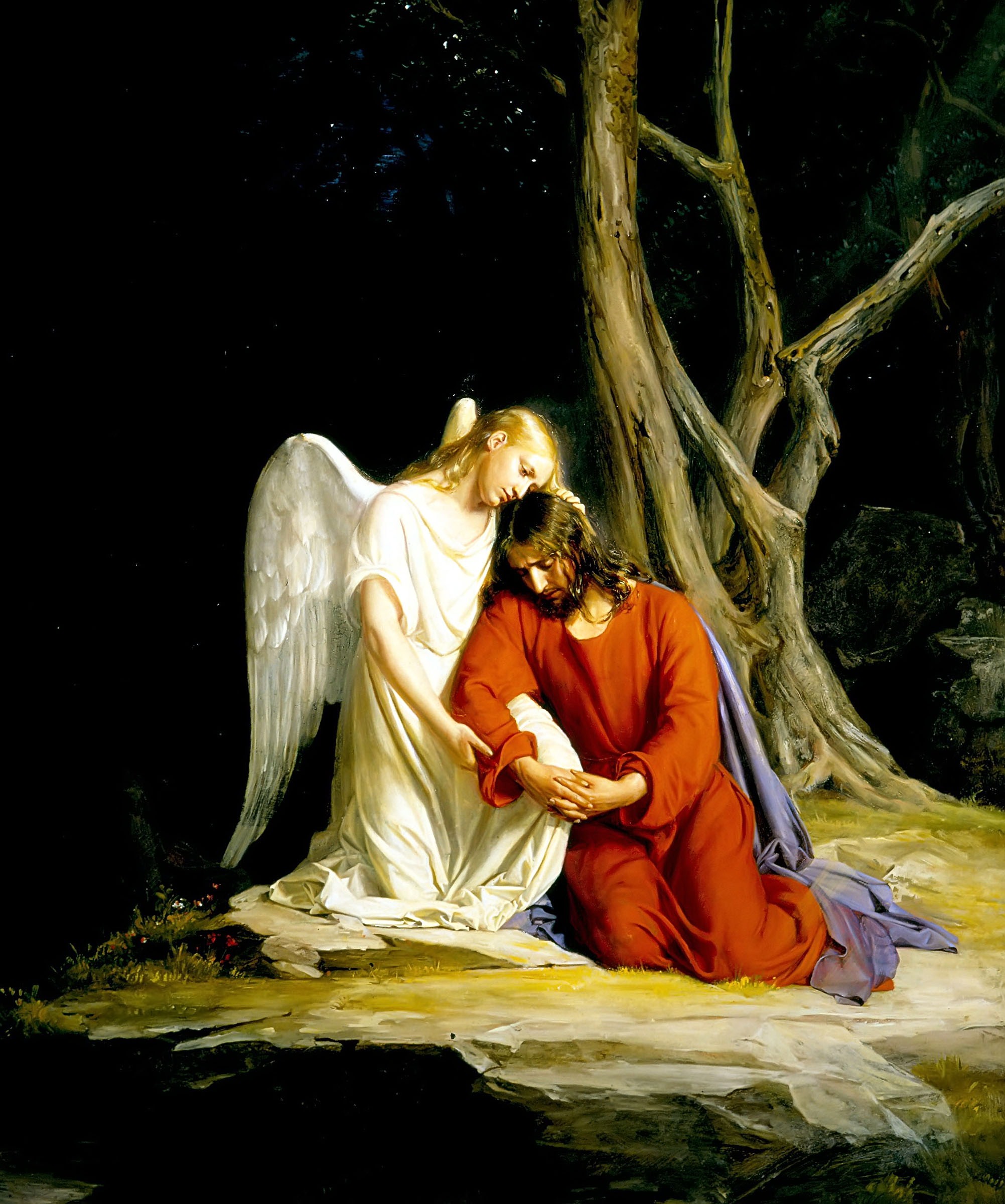
Jesus in Gethsemane by Carl Bloch

Related Posts with Thumbnails