Saturday, February 25, 2023

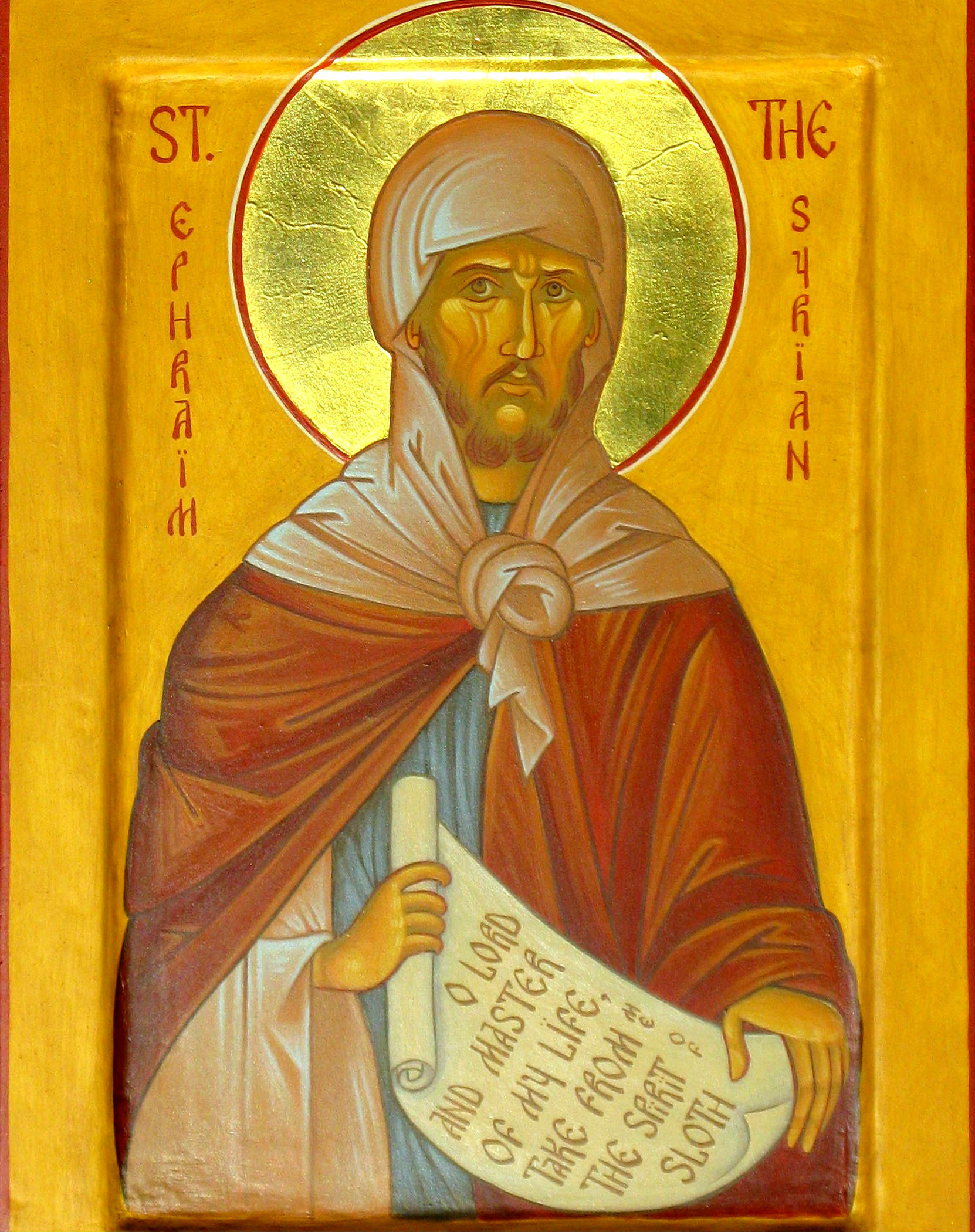
Lenten Prayer of St. Ephrem

Some thoughts from Irenikon:
Oh Lord and Master of my life, give to me not the spirit of sloth...” In this striking and powerful opening to the prayer above, St. Ephrem does two things:

He surrenders all of himself to Christ by calling on him as Lord and as Master, but not just as Lord and Master at a distance, but as Lord and Master of
my life!! A Lord and Master intimately and personally engaged with each of us, from the very beginning of our life.
And then he implores of Him, this divine ruler and teacher, author of life, to protect him from all temptations of the spirit of sloth. He begs to be relieved from this one great debilitating weakness, from even the least temptation toward doubt, or lameness of spirit. He begs freedom from spiritual lassitude and apathy that deadens the heart and the intellect equally leaving one open to all the rest of what comes when we convince ourselves we cannot ever become truly holy, when we kill in ourselves all hope and thus all faith, and thereby all our capacity to truly love selflessly.
The Greek text here translates as acedia, or sloth prompted by spiritual despondency, which is the self-delusion of the impossibility of ever achieving sanctity. Acedia is the great scourge of the monastic, and of all lay men and women who choose to follow the royal way of contemplative prayer and ascetic living, and even of those who watch from a distance but still try to lead a life influenced by the gospels and by liturgy and liturgical prayer.
To pray this prayer aloud and with open heart, it cannot help but plunge us into the depths of humility. St. Ephrem declares emphatically, from the very first moment, that none but Christ is Master of Life, Master of each individual life, whether we offer ourselves to Him or not.
None of the rest of the prayer can be prayed without this initial surrender and the humble petition for the spiritual freedom, the graced freedom necessary to fulfill the rest of the prayer. (Read more.)

Thursday, February 23, 2023

The Trial of St. Joan

Here is link to the first interrogation of St. Joan's trial, with the other sessions following. She was tormented and betrayed by those who should have been her spiritual fathers. She answered firmly and boldly, even as had her beloved St. Catherine of Alexandria before her. As another excellent article says:
The story of her prison life is a record of shame to her goalers. Chained, mocked at, threatened, and insulted, her serenity never failed. She was in God's hand, and she bowed to His will. Months of suffering and anxiety passed over her before her captors made up their minds as to the course they would take to bring about her death under the semblance of legal execution. If she could be convicted by an ecclesiastical court of crimes against the faith, her condemnation would redound to the fair fame of England and of the pious House of Lancaster, while covering the French and their sovereign with confusion as the allies and associates of a minister of hell. (3).... ( The House of Lancaster was fervently orthodox. Persecution of heretics begins with Henry IV. The "Cardinal of England" (Beaufort Bishop of Winchester) was the malicious attacker of heretics at home and abroad. He spoke against the Hussites at the Council of Basle, and he planned Crusades against both heretics and "Saracens.")
Pliant churchmen were at hand to give countenance and help in this undertaking bishops full of zeal and loyalty for our sovereign lord Henry VI, by the grace of God King of France and England.The worst of these servile churchmen was the wretched Bishop of Beauvais, Pierre Cauchon. Many other prelates were Caesar's friends, but he sits exalted in solitary infamy. He came to the Burgundian camp and claimed his victim in the name of Bedford, Regent of France for the English King. Had Jeanne been detained by the Burgundians, it is impossible to believe that Charles VII would not have procured her release. Had she been held as a prisoner of war by the English, it is very likely that the shame of holding a woman captive in their hands would have made it possible to arrange for her ransom. But once charged with heresy and taken out of the hands of the Burgundians such hopes and chances were closed. Still, as an ecclesiastical prisoner she would have been entitled to counsel and guidance by religious persons, the Church offering admonition before preferring grave charges of rebellion against any of her children. But this would render her punishment uncertain. Grave doctors of the law and eminent churchmen had at Poitiers, after long inquiry, declared her worthy of trust and they might do so again. 
Therefore it was determined that she should be held in a lay prison though charged with an ecclesiastical offense. Cut off in this way from all spiritual help and instruction, she was to be brought, when the process was ripe, before a well-chosen court bent on her destruction, and ready to entangle her in questions which might entrap her into erroneous or heretical statements. And once more we are confronted, if we try to rationalize her life and put away all belief in inspiration, with the amazing problem as to where and how this untutored girl drew her stores of logic, law, and theology.
Hallowed Ground has some rare images of St. Joan and her beatification.


Sunday, January 8, 2023

Mysteries of the Epiphany

The Wedding at Cana
From Fr. Mark:
The Five Mysteries of the Epiphany correspond to the five great Epiphany Gospels given us by the Church (in the traditional calendar and Liturgy) on the day of the Epiphany, 6 January; on the feast of the Baptism of the Lord, 13 January; and on the Second, Third, and Fourth Sundays after Epiphany. Each of these Gospels presents a particular manifestation of the Divinity of Our Lord Jesus Christ.
1. Matthew 2:1-12, Our Lord makes himself known to the Magi by means of a star, and receives their adoration in Bethlehem.
And behold the star which they had seen in the east, went before them, until it came and stood over where the child was. And seeing the star they rejoiced with exceeding great joy. And entering into the house, they found the child with Mary his mother, and falling down they adored him. (Mt 2:9-11)
2. John 1:29-34 — At His Baptism in the Jordan by John, the Holy Ghost descends in the form of a dove, and the voice of the Father reveals Jesus as His Beloved Son, in whom He is well pleased.
Now it came to pass, when all the people were baptized, that Jesus also being baptized and praying, heaven was opened; And the Holy Ghost descended in a bodily shape, as a dove upon him; and a voice came from heaven: Thou art my beloved Son; in thee I am well pleased. (Lk 3:21-22)
3. John 2:1-11 — At the wedding feast in Cana of Galilee, Jesus, at His Mother’s bidding, changes water into wine.
And the wine failing, the mother of Jesus saith to him: They have no wine. And Jesus saith to her: Woman, what is that to me and to thee? my hour is not yet come. His mother saith to the waiters: Whatsoever he shall say to you, do ye. (Jn 2:3-5)
4. Matthew 8:1-13 — Jesus, with a word, cleanses a leper.
And behold a leper came and adored him, saying: Lord, if thou wilt, thou canst make me clean. And Jesus stretching forth his hand, touched him, saying: I will, be thou made clean. And forthwith his leprosy was cleansed. (Mt 8:2-3)
5. Matthew 8:23-27 — Jesus calms the raging sea.
And behold a great tempest arose in the sea, so that the boat was covered with waves, but he was asleep. And they came to him, and awaked him, saying: Lord, save us, we perish. And Jesus saith to them: Why are you fearful, O ye of little faith? Then rising up he commanded the winds, and the sea, and there came a great calm. (Mt 8:24-25)
 (Read more.)

More HERE.

Saturday, December 24, 2022

The Miraculous Birth of Christ

An explanation of the ancient and constant teaching of the Church of Our Lady's painless delivery of Christ. To quote:
...There have questions about whether Mary’s delivery of Christ was: A) painless, and B) left her physical virginity intact. Some have felt that it somehow undermines the humanity of Christ to assert these Catholic beliefs. We must recall that Christ walked on water, was transfigured on Mount Tabor, exited the sepulcher before it was opened, and walked through locked doors. None of these facts undermine the humanity of Christ. Consequently, to believe that Christ exited the womb of the Blessed Mother in a mysterious way is neither credulous or impious. Rather, it is the conviction of the holiest and brightest saints of the Catholic Church. For anyone who would deny the painless and intact nativity of Christ, let us challenge you to produce a citation from any saint or pope who teaches otherwise – that is a text that affirms that the nativity of the Christ Child caused pain to Mary and broke her physical virginity.

After a little research I discovered that of the 33 Doctors of the Church, none deny the painless and intact nativity of Christ. Moreover, at least 20 of the Doctors of the Church explicitly affirm that the birth of Christ was painless and miraculously left Mary’s physical virginity intact. Again, it all goes back to Isaiah 66:7: “before her pain came, she was delivered of a man child.” This prophecy refers to Christ plain and simple.
I have assembled the most important texts from the Sacred Scriptures, Fathers, Doctors, Councils, and Popes below. (Read more.)

Thursday, December 1, 2022

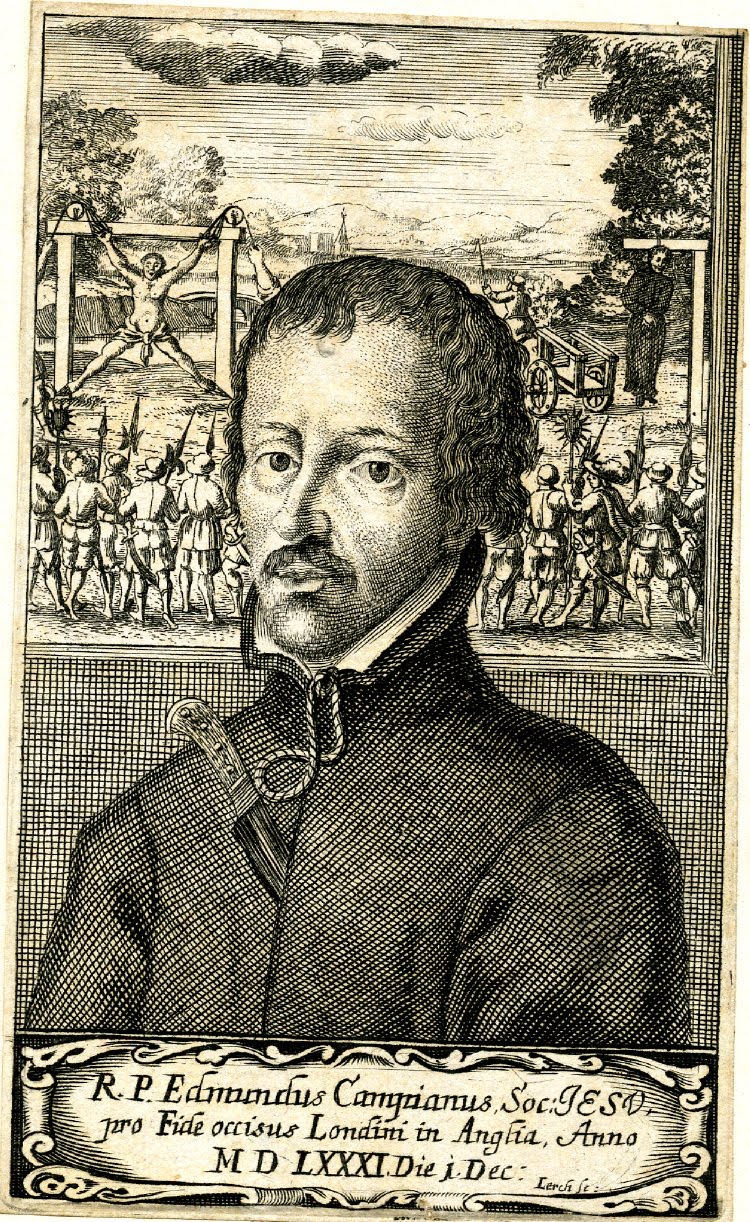
St. Edmund Campion

Here is the Agnus Dei of the English Jesuit and martyr St. Edmund Campion, whose feast is today. To quote:
....The Agnus Dei [was] carried by St. Edmund Campion on his clandestine missions, and a gift of Pope Gregory VIII. Campion was found hiding in Lynford Grange, Berkshire on July 17, 1581, and was hanged, drawn, and quartered five months later. The Agnus Dei was found wrapped in a list of indulgences stuffed in the rafters of Lynford Grange when the roof underwent renovation in 1959. Fr. Nicholas Schofield has blogged of Stonyhurst's collection here.


Monday, November 28, 2022

Of Relics

Incorrupt Body of St. John Vianney in Ars, France

 From Catholicism:

It is no surprise that in [St. John Damascene's] other masterpiece, On the Orthodox Faith , this eighth-century apologist gives us a beautiful defense of saints’ relics based on the fact that “through their minds God has also dwelt in their bodies.”

What’s the common thread uniting icons and relics? It is that God has sanctified stuff — matter, as we call it — and has chosen to give us divine assistance through its use. In his defense of relics, St. John goes on to cite the same passage from First Corinthians that the fathers of the Council of Trent did, in this excerpt from the Council’s 25th session: “the holy bodies of holy martyrs and of others now living with Christ — which bodies were the living members of Christ and ‘the temple of the Holy Ghost’ (I Cor., vi, 19), and which are by Him to be raised to eternal life and to be glorified, are to be venerated by the faithful85”

Like St. John, who points out miracles worked through the relics of the saints, the Council goes on to state a reason why the relics are to be honored: “for through these [bodies] many benefits are bestowed by God on men85” The fact that relics were used by God to bestow benefits on men is clearly to be seen in the inspired history of the Bible.

In the Fourth Book of Kings (or Second Kings, in Protestant Bibles), the story is told of Elias (Elijah) the Prophet being taken up to heaven in a fiery chariot. Eliseus (Elisha) the Prophet, who inherited his spiritual father’s “double spirit” — the legal prerogatives of firstborn son — took up the mantle of Elias which had fallen in the violence of the whirlwind. “And he took up the mantle of Elias, that fell from him: and going back, he stood on the bank of the Jordan; and he struck the waters with the mantle of Elias, that had fallen from him, and they were not divided. And he said: Where is now the God of Elias? And he struck the waters, and they were divided hither and thither, and Eliseus passed over” (4 Kings 2:13-14 / KJV: 2 Kings 2:13-14 ).

Elias had, previous to his being taken up, worked the same miracle using his mantle (2:8). This is how the two prophets ended up on the side of the Jordan they were on when the fiery chariot came. After Elias’ prodigious departure, the relic of his mantle became Eliseus’ “passport” to get back to the other side. Here is a concrete instance of God bestowing a benefit on men through a relic.

The next Old Testament relic apologetic also involves Eliseus. Here, the relic is not a garment, but the prophet’s dead body: “And Eliseus died, and they buried him. And the rovers from Moab came into the land the same year. And some that were burying a man, saw the rovers, and cast the body into the sepulchre of Eliseus. And when it had touched the bones of Eliseus, the man came to life and stood upon his feet” (4 [KJV:2] Kings 13:20-21).

There is no denying that the inspired history relates a cause-and-effect relationship between the dead man’s body touching the corpse of Eliseus, and that man’s resurrection.

Before proceeding to the New Testament, we cite one more B.C. proof: God chose to work many and great miracles through the Ark of the Covenant. What did the Ark contain? Relics. In it were found the tablets of the Law, the Rod of Aaron, and a jar of manna from the Israelites’ wandering in the desert. (Read more.)

Friday, November 18, 2022

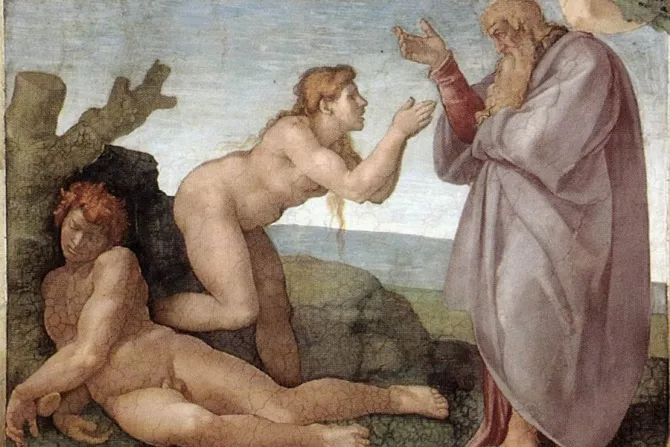
The Creation of Adam and Eve

From CNA:

The ceiling frescoes show the creation of the heavens and the earth, the creation of Adam and Eve, their expulsion from the Garden of Eden, the great flood, and the rebirth of humankind through Noah. Lev cited St. John Paul II’s description of Michelangelo’s work in his poem “Meditations on the Book of Genesis at the Threshold of the Sistine Chapel.”

“It is the book of the origins — Genesis,” the pope said. “Here, in this chapel, Michelangelo penned it, not with words, but with the richness of piled-up colors. We enter in order to read it again, going from wonder to wonder.”

Lev reflected on the first three panels depicting the creation of the world. These show “the mighty dynamic figure of God the Father at work.”

“It’s not what God creates, it’s that God creates,” she said. Michelangelo broke ground in portraying God as “physically engaged in creation.” For Lev, this offers “a preview of the Incarnation.”

Turning to Michelangelo’s famous depiction of the Creation of Adam, Lev noted that the artist depicts “just God and the creature formed in his likeness.” Adam is shown as “somewhat listless” in contrast with God’s energy. Adam is “sentient and awake but he has no will or strength or purpose to rise,” she said. “He looks completely passive and dependent despite that incredibly beautiful form.”

“It’s God who reaches towards man,” she continued. For Lev, the outstretched finger of God makes the viewer “almost lean forward in his seat waiting for that final Act of Creation, the divine spark, the Breath of Life that will release that latent energy and allow Adam to take his place as the greatest of creations.”

“This is the joy in humanity that permeates the Renaissance,” Lev said. (Read more.)

Related Posts with Thumbnails