Sunday, October 8, 2023

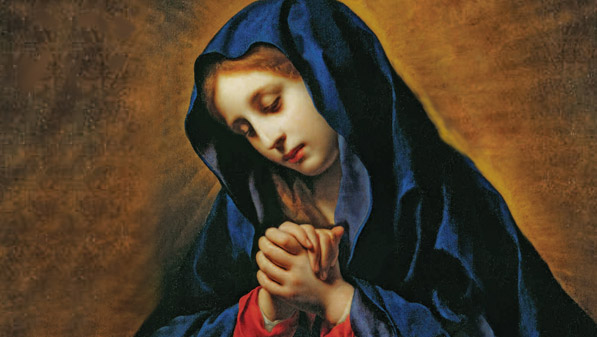
Life is Easier with Mary as Our Spiritual Mother

 
From Ray Sullivan at Catholic Stand:

Spiritual reading led me to the wonderful writings of St. Louis de Montfort. This great French saint of the 18th century wrote several great books concerning the Mother of God, like “The Secret of the Rosary,” “The Secret of Mary,” and “True Devotion to Mary.” The common thread through them all is that if you adopt Mary as your mother, as Jesus said to His beloved disciple (we are ALL beloved disciples of Jesus) from the cross in John 19:27, then the road to find Jesus is faster, smoother, and always infallible. Why? Because Mary’s last recorded words in the Bible were, “Do whatever He tells you.” The ultimate meek and humble Mary, whom God exalted over every other human being ever created to be His earthly mother, will never lead you astray. She will always, always, always, lead you to Jesus faster and better than any of your own human efforts. Her supernatural guidance and protection from the devil are the ultimate flak jacket to protect you from his satanic wiles and temptations. Genesis 3:15 says that “The Woman” is at enmity with satan, which means a lifelong hatred. This enmity between Mary and the devil can be ours as well, if and only if we adopt Mary as our spiritual mother. Otherwise, the devil has a much easier time of it when it comes to leading us astray. Been there, done that. (Read more.)

Saturday, October 7, 2023

The Name of the Rosary

While editing and rewriting sections of my novel about medieval France I researched the development of the rosary. I came across a fascinating blog called Paternosters which was a name given to prayer beads in the medieval period. Here is an article about the origins of the the word "rosary" which I found quite interesting. To quote:
To get back to beads, however, traces of the earlier meaning of bid/bede as "a prayer" still remain. For instance, a wealthy patron in the Middle Ages may have supported poor bedesmen, who had promised to pray for the patron, and may have provided a bedehouse for bedesmen or bedeswomen to live in. Likewise, “bidding one’s bedes” in the Middle Ages does not so much mean praying with a literal string of beads, as it means praying for one’s bedes, that is, the people or requests one is obliged to pray for.
The word “rosary” originally meant a garden devoted to the growing of roses (c1440, “This mone is eke rosaries to make, with setes [seats]”)....Probably both the rose-garden concept and the book title contributed to the idea of referring to a collection of written prayers and devotions as a (metaphorical) rosary, such as the 1526 Rosary of Our Savyour Jesu or the 1533 Mystik sweet Rosary of the faytheful soule.

From here it was a short step to applying the term “rosary” to the specific prayer practice we have been discussing, including its string of beads.

Other European languages also call the rosary by a name referring to roses. In German it is a rosenkranz, in French a rosaire, in Italian and Spanish a rosario, and in Hungarian it is a rózsafüzért (literally a “rose string”). However in Austria it is more commonly a betschnur (“prayer string”) and in France, often a chapelet.

Friday, September 29, 2023

Michaelmas

Happy Michaelmas Day!

To St. Michael in Time of Peace

Michael of the Morning,
Michael of the Army of the Lord,
Stiffen thou the hand upon the still sword, Michael,
Folded and shut upon the sheathed sword, Michael,
Under the fullness of the white robes falling,
Gird us with the secret of the sword.
When the world cracked because of a sneer in Heaven,
Leaving out for all time a scar upon the sky,
Thou didst rise up against the Horror in the highest,
Dragging down the highest that looked down on the Most High:
Rending from the seventh heaven the hell of exaltation
Down the seven heavens till the dark seas burn:
Thou that in thunder threwest down the Dragon
Knowest in what silence the Serpent can return.

Down through the universe the vast night falling
(Michael, Michael: Michael of the Morning!)
Far down the universe the deep calms calling
(Michael, Michael: Michael of the Sword!)
Bid us not forget in the baths of all forgetfulness,
In the sigh long drawn from the frenzy and the fretfulness
In the huge holy sempiternal silence
In the beginning was the Word.

When from the deeps of dying God astounded
Angels and devils who do all but die
Seeing Him fallen where thou couldst not follow,
Seeing Him mounted where thou couldst not fly,
Hand on the hilt, thou hast halted all thy legions
Waiting the Tetelestai and the acclaim,
Swords that salute Him dead and everlasting
God beyond God and greater than His Name.

Round us and over us the cold thoughts creeping
(Michael, Michael: Michael of the battle-cry!)
Round us and under us the thronged world sleeping
(Michael, Michael: Michael of the Charge!)
Guard us the Word; the trysting and the trusting
Edge upon the honour and the blade unrusting
Fine as the hair and tauter than the harpstring
Ready as when it rang upon the targe.

He that giveth peace unto us; not as the world giveth:
He that giveth law unto us; not as the scribes:
Shall he be softened for the softening of the cities
Patient in usury; delicate in bribes?
They that come to quiet us, saying the sword is broken,
Break man with famine, fetter them with gold,
Sell them as sheep; and He shall know the selling
For He was more than murdered. He was sold.

Michael, Michael: Michael of the Mustering,
Michael of the marching on the mountains of the Lord,
Marshal the world and purge of rot and riot
Rule through the world till all the world be quiet:
Only establish when the world is broken
What is unbroken is the Word.

Saturday, September 23, 2023

Martyrs


From Catholicism:

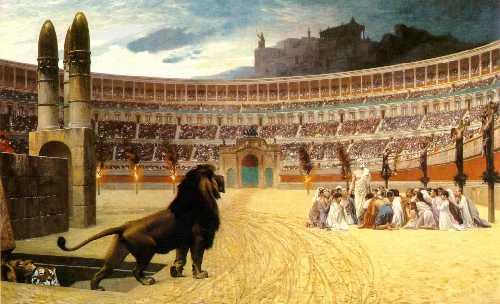
The Church was born out of blood and persecution. As the traditional saying credited to Tertullian went: “The blood of the martyrs is the seed of Christians.” All of the Apostles were martyrs, including Saint John, who, although submerged into boiling oil during the persecution of Emperor Domitian, was miraculously preserved from death and bodily harm. The fact that he was willing to die for Christ (tradition has it that he also felt the pain) merited for him the martyr’s crown. All of the saints named in the canon of the Mass were martyrs, except for Our Lady, whose unique, un-bloody martyrdom was like a sword piercing her soul. The first thirty-three popes were martyrs. It was revealed to Saint Alphonsus Maria de Liguori that in the first three centuries of persecution, from the Edict of Nero (which began the persecutions) in the year 66 to the Edict of Milan (which ended them) in 313 eleven million of the faithful were martyred for their Faith in Christ. Finally, in the last days, during the reign of antichrist, the faithful will endure the worst of all persecutions, and martyrs will usher in the final triumph of the Church, which will precede the end of the world.

Truly, then, we belong to a Church of martyrs. Every age has contributed its share, some ages many more than others, but there have been martyrs at all times, some of whom are known only to God, His angels, and His saints. We have our martyrs today and we shall surely have them tomorrow.

Some of the victims of Communism who were spared the shedding of blood unto death suffered more than the martyrs, even thirty years of prison or in labor camps, under the most inhuman of conditions. In Communist China, to be a bishop loyal to the pope, guaranteed a prison sentence with at least mental torture, or death.

Why does God require so much blood from His servants? Why such a price? Why so much suffering?

Could it be that God wishes to exact from His closest disciples that greatest of all acts of love which Jesus was Himself to manifest for all men: “Greater love than this no man hath, that a man lay down his life for his friends” (John 15:13)?

At the Last Supper, in anticipation of His Passion and Death, Our Lord was very anxious to assure His Apostles that they were now His intimate friends: “I will not now call you servants: for the servant knoweth not what his lord doth. But I have called you friends: because all things whatsoever I have heard of my Father, I have made known to you” (John 15:15).

It was in His Passion and Death that Christ manifested how great was His love for men. “In this we have known the charity of God, because he hath laid down his life for us: and we ought to lay down our lives for the brethren” (1John 3:16). So, too, with the martyrs, in their passion and death they manifest how great a love they have for their Savior.

Nevertheless, many of the holiest of saints, even though they desired the crown of martyrdom, were not asked to make that sacrifice. Rather their whole lives were continual oblations of self-sacrifice. Think of Saints Francis of Assisi or Teresa of Avila. Then, there are the stigmatists, such as Saint Padre Pio, who suffered a martyrdom in his hands, feet, and side, on the cross every day, but without death, for fifty years. (Read more.)
Tuesday, September 19, 2023

The Great Monarch, the "Warning" and the Duration of the Period of Peace


 From Unveiling the Apocalypse:

One of the oldest prophecies of the Great Monarch is found in the Apocalypse of Methodius, which also foretells the appearance of the sign of the cross before the Last Judgement. Ironically, this prophecy is also related to the central subject matter of Christine Watkins' book The Warning: Testimonies and Prophecies of the Illumination of Consciences, which has recently popularised Mallett and O'Connor's writings due to her endorsement of the Countdown to the Kingdom website:
…the Cross on which our Lord Jesus Christ hung for the common salvation of all will begin to appear before him at his coming to convict the lack of faith of unbelievers… When the Cross has been lifted up on high to heaven, the king of the Romans will directly give up his spirit. Then every principality and power will be destroyed that the Son of Perdition may be manifest.
According to Church Tradition, the Great Monarch will bring about the restoration the Church after a period of desolation, which I argue in my book Unveiling the Apocalypse: The Final Passover of the Church, is related to the current apostasy we are experiencing due to the period of the unbinding of Satan at the end of the "thousand years". After the Great Monarch brings about the renovation of the Church, the prophetic tradition tells us that he will lay down his crown on the Mount of Olives just immediately before the appearance of the Antichrist:
Some of our teachers say that a King of the Franks will possess the entire Roman Empire. He will be the greatest and last of all Monarchs. After having wisely governed his kingdom, he will go into Jerusalem and will lay his sceptre and his crown upon the Mount of Olives. Immediately afterwards, Antichrist will come. (Adso of Montier-en-Der, De ortu et tempore Antichristi)                                        
The only Church approved private revelation to give some indication of the duration of the period of peace is Melanie's 1849 version of the Secret of La Salette, which explicitly states that this period of renewal will not last long before the appearance of the Antichrist, and similarly connects the period of the restoration of the Church with the reign of the Great Monarch...(Read more.)

More HERE.

 Here is a really interesting interview with author Charles Coulombe in  which the Great Monarch is mentioned.

Wednesday, September 13, 2023

The First Sign in September: the Golden Orb

 Today is the anniversary of the Fifth Apparition of Fatima, HERE

And here is a fascinating discussion from Marianna Bartold:

Saturday, September 2, 2023

Secret of the Devotion to the Immaculate Heart

 From Marianna Bartold.

Related Posts with Thumbnails