Monday, November 17, 2025

St. Elizabeth of Hungary

On November 17 the Church gives us the feast of Saint Elizabeth of Hungary (1207-1231) who in her twenty-four years on earth embodied virtues which in today's world have almost ceased to exist: honesty, modesty, courage, chastity, self-denial and fidelity. She was not queen of Hungary, as many people think, but a princess. Her parents were the king and queen. Being royal in those days meant that your life was not your own. Marriages between two ruling families would form an alliance between countries and keep two countries from going to war. So from her infancy, Elizabeth was a living pledge of peace, since she was promised in marriage to the heir of Thuringia.

Elizabeth was sent to Germany at the age of four to be raised in the household of her betrothed, Louis of Thuringia, as was the practice of the time. It was heartbreaking for her parents to separate from their lively, dark-haired little girl, but they commended her to God and Our Lady. Louis' family disliked her, as was often the case with foreign royal brides, but he always cherished and protected his little fiancée. Elizabeth, although far from home, was a Magyar princess, and there was an intensity in her commitment to God and her husband which was repugnant to the placid Thuringians. They were married when Elizabeth was fourteen and Louis was about seventeen; he had inherited the dukedom of Thuringia from his father by then. Thuringia is roughly where Hesse-Darmstadt is now. In the thirteenth century it was a prosperous and powerful territory, although Louis was a duke, not a king.

Elizabeth had always shown a strong inclination toward piety as well as a great love of helping the needy and downtrodden. She opened a hospital for the poor in one of her castles and ran a soup kitchen. She was passionately in love with her husband, which is one of her most appealing aspects - she was a saint but she was also very much a woman. Louis truly loved his wife and sought for a fervent priest to guide her spiritual life. Unfortunately, her later confessor, the overzealous Conrad of Marburg, was excessively harsh with Elizabeth.

As Duchess, she established the Franciscan order in Thuringia and became herself a tertiary (with St. Louis of France, she is the patroness of tertiaries.) . Louis and Elizabeth had three children.

When Elizabeth was twenty, her husband died while on crusade. She ran shrieking through the castle, as if she had lost her mind. Her brother-in-law coveted the inheritance; he evicted Elizabeth and her three small children from their home. He forbade everyone in Thuringia to give them shelter. The little family had to hide in a pig pen from the rain. Poverty, loss and persecution did not embitter Elizabeth, as it would have embittered others, especially when it involved the suffering of her small children. She accepted everything from the hand of God.

Finally, someone got word to Elizabeth's father the King of Hungary, and he prevailed upon the Holy Roman Emperor to intervene. Elizabeth's lands were restored to her but she voluntarily chose holy poverty. After securing her children's welfare, she lived in a small room in the hospital she had founded and cared for the sick and the lepers. That would be like someone going to live with AIDS patients today.

Emperor Frederick begged for Elizabeth's hand in marriage but she refused. She died at the age of twenty-four and as she passed from this world a great light filled the room. Many miraculous cures were reported at her grave site. She was buried wearing the imperial crown which she had refused in life.

Thinking of St Elizabeth can help us when ever we feel afraid of poverty, or of being alone. Her spirit of humility and the renunciation of worldly honors can be imitated by all.

Sunday, November 16, 2025

St. Margaret of Scotland

St. Margaret (1045-1092) was a royal Saxon princess. From a dethroned and exiled family, riches and power meant nothing to her, for she saw how quickly such things can pass away. Consequently, she was deeply drawn to the monastic life. However, the Scottish King Malcolm Canmore sought her hand in marriage, so attracted was he by her beauty and virtue. They were married. Malcolm was on the wild side, but he and Margaret loved each other completely, and died three days apart.

As Queen of Scots, St. Margaret bore eight children, was devoted to the poor, and helped to reform the liturgy. As one article states:
Under Queen Margaret's leadership Church councils promoted Easter communion and, much to joy of the working-class, abstinence from servile work on a Sunday. Margaret founded churches, monasteries and pilgrimage hostels and established the Royal Mausoleum at Dunfermline Abbey with monks from Canterbury. She was especially fond of Scottish saints and instigated the Queen's Ferry over the Forth so that pilgrims could more easily reach the Shrine of St. Andrew.
Mass was changed from the many dialects of Gaelic spoken throughout Scotland to the unifying Latin. By adopting Latin to celebrate the Mass she believed that all Scots could worship together in unity, along with the other Christians of Western Europe. Many people believe that in doing this, it was not only Queen Margaret's goals to unite the Scots, but also Scotland and England in an attempt to end the bloody warfare between the two countries.
In setting the agenda for the church in Scotland Queen Margaret also ensured the dominance of the Roman Church over the native Celtic Church in the north of the country.
It is interesting how St Margaret championed the practices of the Roman rite over the Celtic traditions, although I have no doubt that the Celtic liturgy and devotions were quite beautiful. St. Margaret, however, saw the importance of harmony of worship for the people of her country, especially after the upheavals of their century.

Saturday, November 15, 2025

All Carmelite Souls

On the Carmelite calendar to day is the feast of All Carmelite Souls. We pray for all those united in the Order of Carmel who have passed from this world. Here is a meditation on purgatory by Fr. Angelo, based on the writings of St. Catherine of Genoa. To quote:
Remembrance of the holy souls is self-forgetfulness. It is the cure . . . for them, and for us. Unless, God forbid, we go to hell, someday we will forget ourselves and remember the ultimate realities: God and our obligations toward one another. We can do it now or we can do it later. The souls in Purgatory would have us do it now.
They remember us. Do we remember them? This is no time to sleep. Rest will come, but until now, we have not toiled for God nearly enough.
The good men we have canonized at their funerals will not thank us for the kind and laudatory eulogies. We forget the sufferings of others so as to console our families, and ourselves and in this no one is served, not ourselves, not our families, and certainly not the souls of the departed. Oh, sweet sleep. How we crave rest, yet we will not find it unless we give it. During this November we would do well to do more than a casual visit to a cemetery or a write a check and conveniently hand it to our pastor for yearly masses, though both of these we should do. Indeed, nothing can be more efficacious than the Mass, except a Mass that is dedicated by the stipend of our own hearts.
The apostles slept through Our Lord’s agony and we sleep through the agony of the poor souls. It is so easy to do. Perhaps we could offer time with Our Lord in the Blessed Sacrament, or more frequent communions for the grace to understand better the extremity of the situation and how the deliverance of the poor souls from their suffering will help protect us against our own peril, and how our imitation of their selfless desire for purity may save us from their present distress.
Love is not loved. But it need not be that way. Now is not the time for us to rest. (Read more.)


Friday, November 14, 2025

All Carmelite Saints

"With zeal have I been zealous for the Lord God of Hosts." ~3 Kings 19:10

Today the Carmelite Order commemorates the members of our Order who have ascended the mountain of perfection to their heavenly home. They sought God alone, conversing with Him in the depths of their hearts. Our Lord once said to the Holy Mother St. Teresa: "I desire that you no longer hold conversation with men, but with angels," and in many ways those words can be applied to all who follow the Carmelite way. The habits of the interior life, of recollection and mortification, must be cultivated amid our daily duties in order to create an atmosphere conducive to contemplation. In the Rule of St. Albert, the medieval hermits were told: "In silence and hope shall your strength be." (Isaias 30:15) During the theophany on Mt. Horeb, Elias the prophet experienced the Lord God, not in the earthquake, or in the fire, but in a "whistling of gentle air." (3 Kings 19:12) It is in silence and solitude that generations of Carmelites have sought to live in imitation of Elias, "meditating day and night on the law of the Lord and watching in prayer." (Rule of St. Albert)

The primary example of the saints and blessed of the Order has been Our Lady, the Queen and Beauty of Carmel, both in her hidden life at Nazareth and in her anguish at the foot of the Cross. St. Teresa enjoined her nuns to meditate on the lives of Christ's Mother, and His saints. "We need to cultivate and think upon and seek the companionship of those who, though living on earth like ourselves, have accomplished such great deeds for God." (The Interior Castle, p.172)

Speaking particularly of the hermits of old, the Holy Mother exhorts her daughters in The Way of Perfection:
Let us remember our holy fathers of the past, those hermits whose lives we aim to imitate. What sufferings they endured! What solitude, cold, hunger, and what sun and heat, without anyone to complain to but God! Do you think that they were made of steel? Well, they were as delicate as we. (The Way of Perfection, p.81)

Wednesday, November 12, 2025

St. Josaphat, Martyr

St Josaphat Saint of Ruthenia.jpg

 It is the feast of St. Josaphat the Martyr. There is a fascinating passage in Dom Gueranger's The Liturgical Year, Vol XV for his feast, dealing with the conversion of the Russian Empire. The Liturgical Year was written long before the apparitions at Fatima in 1917, and so the mention of the "conversion of Russia," that is, the return of Russia and the East to the union with the Holy See, is remarkable. (No offense to my many dear Orthodox friends, but I hope our churches are truly united someday.) Here is what Dom Gueranger said over a hundred and fifty years ago, in the days of the tsars:

Russia becoming Catholic would mean an end to Islamism, and the definitive triumph of the cross on the Bosphorus, without any danger to Europe; the Christian empire in the East restored with a glory and a power hitherto unknown; Asia evangelized, not by a few poor isolated priests, but with the help of an authority greater than Charlemagne; and lastly, the Slavonic race brought into unity of faith and aspirations, for its own greater glory. This transformation will be the greatest event of the century that shall see its accomplishment; it will change the face of the world.
One might say the old monk was dreaming, but I thought it interesting in light of what followed.

More HERE.

Tuesday, November 11, 2025

Martinmas


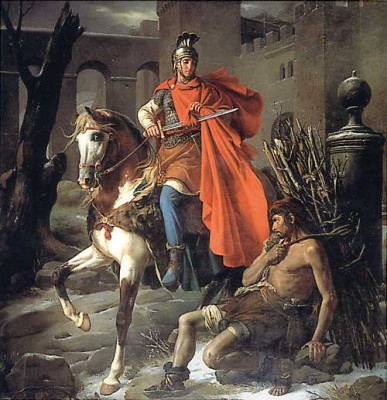
It is the feast of St. Martin of Tours, the great thaumaturgus who converted large parts of France. The cloak of St Martin was one of the most precious relics of France, borne before her armies, hence the word chape gave rise to our English words "chaplain" and "chapel." St. Martin spoke out against capital punishment for heretics. The shrine of St. Martin at Tours was one of the holiest of French pilgrimage sites; he is considered one of the patrons of the Holy Face devotion which also originated there. According to New Advent:
The Church of France has always considered Martin one of her greatest saints, and hagiographers have recorded a great number of miracles due to his intercession while he was living and after his death. His cult was very popular throughout the Middle Ages, a multitude of churches and chapels were dedicated to him, and a great number of places have been called by his name. His body, taken to Tours, was enclosed in a stone sarcophagus, above which his successors, St. Britius and St. Perpetuus, built first a simple chapel, and later a basilica (470). St. Euphronius, Bishop of Autun and a friend of St. Perpetuus, sent a sculptured tablet of marble to cover the tomb. A larger basilica was constructed in 1014 which was burned down in 1230 to be rebuilt soon on a still larger scale This sanctuary was the centre of great national pilgrimages until 1562, the fatal year when the Protestants sacked it from top to bottom, destroying the sepulchre and the relics of the great wonder-worker, the object of their hatred. The ill-fated collegiate church was restored by its canons, but a new and more terrible misfortune awaited it. The revolutionary hammer of 1793 was to subject it to a last devastation. It was entirely demolished with the exception of the two towers which are still standing and, so that its reconstruction might be impossible, the atheistic municipality caused two streets to be opened up on its site. In December, 1860, skilfully executed excavations located the site of St. Martin's tomb, of which some fragments were discovered. These precious remains are at present sheltered in a basilica built by Mgr Meignan, Archbishop of Tours which is unfortunately of very small dimensions and recalls only faintly the ancient and magnificent cloister of St. Martin. On 11 November each year the feast of St. Martin is solemnly celebrated in this church in the presence of a large number of the faithful of Tours and other cities and villages of the diocese.

Monday, November 10, 2025

St. Leo the Great

From Nobility:
Leo’s pontificate, next to that of St. Gregory I, is the most significant and important in Christian antiquity. At a time when the Church was experiencing the greatest obstacles to her progress in consequence of the hastening disintegration of the Western Empire, while the Orient was profoundly agitated over dogmatic controversies, this great pope, with far-seeing sagacity and powerful hand, guided the destiny of the Roman and Universal Church.

Leo was descended of a noble Tuscan family, but born at Rome. His father’s name was Quintianus. Our earliest certain historical information about Leo reveals him a deacon of the Roman Church under Pope Celestine I (422-32). Even during this period he was known outside of Rome, and had some relations with Gaul, since Cassianus in 430 or 431 wrote at Leo’s suggestion his work “De Incarnatione Domini contra Nestorium” (Migne, P.L., L, 9 sqq.), prefacing it with a letter of dedication to Leo.

During the pontificate of Sixtus III (422-40), Leo was sent to Gaul by Emperor Valentinian III to settle a dispute and bring about a reconciliation between Aëtius, the chief military commander of the province, and the chief magistrate, Albinus. This commission is a proof of the great confidence placed in the clever and able deacon by the Imperial Court. Sixtus III died on 19 August, 440, while Leo was in Gaul, and the latter was chosen his successor. Returning to Rome, Leo was consecrated on 29 September of the same year, and governed the Roman Church for the next twenty-one years.

Whilst the Eastern empire was distracted by heretical factions, the Western was harassed by barbarians. Attila the Hun, enriched with the plunder of many nations and cities, marched against Rome. The Huns, a savage nation from that part of Scythia which now lies in Muscovy, had passed the Palus Mæotis, in 276, and made their first inroads upon the coasts of the Caspian Sea, and as far as Mount Taurus in the East. Almost two hundred years after this, Attila, the most powerful and barbarous of all the kings of that nation, in 433, had marched first into the East, then subject to Theodosius the Younger, and having amassed a vast booty in Asia, returned into Pannonia, where he was already master of a large territory. (Read entire article.)
Related Posts with Thumbnails