

Friday, November 28, 2025

Saint Thérèse of the Child Jesus on Purgatory


 On June 9, 1895, at the Carmel of Lisieux, Saint Thérèse made the Act of Oblation to Merciful Love. In her autobiography she said: "I received the grace to understand, more than ever, how much Jesus desires to be loved." Instead of offering herself as victim to the justice of God, as did other religious, taking upon themselves the "punishment reserved for sinners," Saint Thérèse decided to offer herself as a victim to the Merciful Love of God. She asked to be consumed as a holocaust in the fire of the Sacred Heart, in order to console that Heart and save souls. "Fire transforms all things into itself, " the saint wrote in her Act of Oblation. "I know that the fire of love is more sanctifying than the fire of Purgatory."
 

 From Help the Holy Souls:

The common teaching within the Church is that Purgatory can hardly be avoided. While still only a novice, the saint commented about this with one of the sisters,  Sr. Maria Philomena, who believed in the near impossibility of going to heaven without passing through purgatory:

You do not have enough trust. You have too much fear before the good God. I can assure you that He is grieved over this. You should not fear Purgatory because of the suffering there, but should instead ask that you not deserve to go there in order to please God, Who so reluctantly imposes this punishment. As soon as you try to please Him in everything and have an unshakable trust He purifies you every moment in His love and He lets no sin remain. And then you can be sure that you will not have to go to Purgatory.5

She even said that we would offend God if we didn’t trust enough that we would get to heaven right after dying. When she found out that her novices talked occasionally that they would probably have to expect to be in Purgatory, she corrected them saying: “Oh! How you grieve me! You do a great injury to God in believing you’re going to Purgatory. When we love, we can’t go there.”6 Now, this is a new doctrine, but only for those who don’t know God, who are not childlike, who don’t trust. It is so correct to see things this way. It is true that God will judge us at one point, but He is always and first our Father Who… suffers when He has to punish His child and sees its suffering. The child should do His will just out of love, and not to avoid punishment. And this really means that God does not want Purgatory! He allows that His children suffer, but only as if He had to look away.7 (Read more.)


It has come to my attention from perusing Facebook that there is a great deal of confusion about purgatory, especially among Catholics. The EWTN website offers excellent catechesis. To quote St. John Paul II:

According to Old Testament religious law, what is destined for God must be perfect. As a result, physical integrity is also specifically required for the realities which come into contact with God at the sacrificial level such as, for example, sacrificial animals (cf. Lv 22: 22) or at the institutional level, as in the case of priests or ministers of worship (cf. Lv 21: 17-23). Total dedication to the God of the Covenant, along the lines of the great teachings found in Deuteronomy (cf. 6: 5), and which must correspond to this physical integrity, is required of individuals and society as a whole (cf. 1 Kgs 8: 61). It is a matter of loving God with all one's being, with purity of heart and the witness of deeds (cf. ibid., 10: 12f.)

The need for integrity obviously becomes necessary after death, for entering into perfect and complete communion with God. Those who do not possess this integrity must undergo purification. This is suggested by a text of St Paul. The Apostle speaks of the value of each person's work which will be revealed on the day of judgement and says:  "If the work which any man has built on the foundation [which is Christ] survives, he will receive a reward. If any man's work is burned up, he will suffer loss, though he himself will be saved, but only as through fire" (1 Cor 3: 14-15).

3. At times, to reach a state of perfect integrity a person's intercession or mediation is needed. For example, Moses obtains pardon for the people with a prayer in which he recalls the saving work done by God in the past, and prays for God's fidelity to the oath made to his ancestors (cf. Ex 32: 30, 11-13). The figure of the Servant of the Lord, outlined in the Book of Isaiah, is also portrayed by his role of intercession and expiation for many; at the end of his suffering he "will see the light" and "will justify many", bearing their iniquities (cf. Is 52: 13-53, 12, especially vv. 53: 11).

Psalm 51 can be considered, according to the perspective of the Old Testament, as a synthesis of the process of reintegration:  the sinner confesses and recognizes his guilt (v. 3), asking insistently to be purified or "cleansed" (vv. 2, 9, 10, 17) so as to proclaim the divine praise (v. 15).

Purgatory is not a place but a condition of existence

4. In the New Testament Christ is presented as the intercessor who assumes the functions of high priest on the day of expiation (cf. Heb 5: 7; 7: 25). But in him the priesthood is presented in a new and definitive form. He enters the heavenly shrine once and for all, to intercede with God on our behalf (cf. Heb 9: 23-26, especially, v. 24). He is both priest and "victim of expiation" for the sins of the whole world (cf. 1 Jn 2: 2).

Jesus, as the great intercessor who atones for us, will fully reveal himself at the end of our life when he will express himself with the offer of mercy, but also with the inevitable judgement for those who refuse the Father's love and forgiveness.

This offer of mercy does not exclude the duty to present ourselves to God, pure and whole, rich in that love which Paul calls a "[bond] of perfect harmony" (Col 3: 14).

5. In following the Gospel exhortation to be perfect like the heavenly Father (cf. Mt 5: 48) during our earthly life, we are called to grow in love, to be sound and flawless before God the Father "at the coming of our Lord Jesus with all his saints" (1 Thes 3: 12f.). Moreover, we are invited to "cleanse ourselves from every defilement of body and spirit" (2 Cor 7: 1; cf. 1 Jn 3: 3), because the encounter with God requires absolute purity.

Every trace of attachment to evil must be eliminated, every imperfection of the soul corrected. Purification must be complete, and indeed this is precisely what is meant by the Church's teaching on purgatory. The term does not indicate a place, but a condition of existence. Those who, after death, exist in a state of purification, are already in the love of Christ who removes from them the remnants of imperfection (cf. Ecumenical Council of Florence, Decretum pro Graecis:  DS 1304; Ecumenical Council of Trent, Decretum de iustificatione:  DS 1580; Decretum de purgatorio:  DS 1820).

It is necessary to explain that the state of purification is not a prolongation of the earthly condition, almost as if after death one were given another possibility to change one's destiny. The Church's teaching in this regard is unequivocal and was reaffirmed by the Second Vatican Council which teaches:  "Since we know neither the day nor the hour, we should follow the advice of the Lord and watch constantly so that, when the single course of our earthly life is completed (cf. Heb 9: 27), we may merit to enter with him into the marriage feast and be numbered among the blessed, and not, like the wicked and slothful servants, be ordered to depart into the eternal fire, into the outer darkness where "men will weep and gnash their teeth' (Mt 22: 13 and 25: 30)" (Lumen gentium, n. 48).

6. One last important aspect which the Church's tradition has always pointed out should be reproposed today:  the dimension of "communio". Those, in fact, who find themselves in the state of purification are united both with the blessed who already enjoy the fullness of eternal life, and with us on this earth on our way towards the Father's house (cf. CCC, n. 1032).

Just as in their earthly life believers are united in the one Mystical Body, so after death those who live in a state of purification experience the same ecclesial solidarity which works through prayer, prayers for suffrage and love for their other brothers and sisters in the faith. Purification is lived in the essential bond created between those who live in this world and those who enjoy eternal beatitude. (Read more.)


There can be children in purgatory, if they have committed any actual sins after reaching the age of reason and not expiated them on earth. From The New Theological Movement:
Is purgatory in the Bible?
While the word “purgatory” never appears in the Bible, the concept is present both implicitly and explicitly. Implicitly, the idea of praying for the dead – as when Job prays for his sons and daughters, or in Maccabees, or when St. Paul encourages the Corinthians to pray for the dead (cf. 1 Corinthians 15) – necessitates belief in purgatory. If the dead are in hell, our prayers could do no good; if they are in heaven, then they have no need of prayer. Therefore, there must be some third place (neither in heaven nor in hell) where the souls of the dead can benefit from our prayers.
The concept of purgatory is also explicitly presented in the Bible. Consider when Jesus says that the sin of blasphemy against the Holy Spirit cannot be forgiven in this life or in the next (cf. Matthew 12:31) – thus, it is clear that some sins can be forgiven in the next life (we mean the punishment of sin, not the guilt of sin). Likewise, St. Paul states that some who have died will be purified as by fire: If any man's work burn, he shall suffer loss; but he himself shall be saved, yet so as by fire. (1 Corinthians 3:15)
Must I believe in purgatory in order to be saved?
Yes, purgatory has been taught by the Catholic Church as de fide. To deny the existence of purgatory is to deny the authority of Christ Jesus who has revealed this doctrine to us through the Church. Hence, belief in purgatory is as necessary for salvation as the other truths of the Faith.
What is purgatory?
Purgatory is that purification which they must undergo who have died in God’s grace and friendship, but are still imperfect. Purgatory is “this final purification of the elect, which is entirely different from the punishment of the damned.” (CCC 1031) Purgatory is a great and most generous gift from the Lord.
How is purgatory different from hell?
Purgatory is essentially different from hell insofar as the souls there still possess grace. The souls in purgatory have faith, hope and love. Their punishment and suffering is of a purifying nature and prepares them for heaven. Moreover, purgatory is only a temporary purgation and all the souls in purgatory will eventually gain entrance to heaven.
Hell, on the other hand, is eternal. The sufferings of hell do not purify but only torture and punish. The souls in hell have no grace, neither have they any (true) faith, hope or love. The souls in hell will never attain to salvation.
How is purgatory different from heaven?
Purgatory is a sort of ante-chamber to heaven, a preparatory purgation for heaven. The souls in purgatory suffer intensely and are not yet perfectly happy. The souls in purgatory still have hope (rather than the fulfillment of hope in heaven), since they are not yet perfectly possessed by God. Likewise they still have faith, since they do not yet see God.
Do the souls in purgatory become holier?
Essentially, the souls in purgatory cannot grow in holiness. They cannot merit more grace or glory. Neither can they grow in charity. Rather, purgatory is a cleansing which purifies the holiness that they already possess.
Do the souls in purgatory want to get out?
This is a difficult question. On the one hand, they certainly desire heaven (this desire is cause of their chief pain, since they are not yet where they want to be). On the other hand, they would not want to move ahead without being purified. Hence, they love the sufferings insofar as they are purified by them. None are angry or upset about being in purgatory, but they do very much desire the assistance of our prayers so as to swiftly attain to the joy of heaven.
Are there any young children in purgatory?
No, there are most certainly no children who died before the age of reason in purgatory. Purgatory is a punishment for actual sin (either direct sins or sins of omission). Hence, since a child cannot sin until it has attained to the use of reason, it is not possible for any children to be in purgatory.
If the child has been baptized, it most certainly goes directly to heaven. If the child has not been baptized, it either goes to limbo (which is a state of perfect natural happiness, on the fringe of hell) or to heaven.
In any case, young children who die before gaining the use of reason are very happy, indeed they are perfectly happy. They are either supernaturally happy in heaven, or naturally happy in limbo – but they certainly do not suffer any subjective pains (as do the souls in hell and in purgatory).
Will purgatory go on forever?
No. Purgatory will be completed at the time of the final judgment. All the souls in purgatory at that time will be purified instantaneously and will be caught up with the saints in glory.
Is there really fire in purgatory?
Yes. There is real, physical fire in purgatory. This is the best and safest opinion which is nearly unanimous among the Latin theologians (especially the Fathers and Doctors), also it enjoys the favor of several prominent Eastern Doctors (including St. Basil the Great). Additionally, the mystics of the Church speak of physical fires.
It is in this sense only that purgatory can be called a “place”.
How can I help the souls in purgatory?
You can help the poor souls by praying for them, offering up works of mercy, gaining indulgences for them, mortifying yourself in their behalf, and completing other spiritual works for their sake. [Be sure that no prayer will go to waste; since, if the soul is not in purgatory (for one reason or another), Our Blessed Mother will certainly make good use of the graces for another]
Most especially, we consider the importance of praying for the holy souls when at Mass (especially during the Eucharistic prayer), and having Masses offered for the deceased.
Can the souls in purgatory help me?
This is a very complicated question. Generally we would say, no. The main point of purgatory is that the souls cannot help themselves or anyone else, but are in a passive state of purification. They are powerless, hence they rely greatly upon our prayers.
However, it is possible that God may (in exceptional circumstances) allow those in purgatory to pray for or assist in some manner those who are on earth and who implore their aid. Still, this does not seem to be the norm – however, there are most certainly cases in the lives of the saints (e.g. St. Pio) where this did occur. (Read more.)

Thursday, November 27, 2025

In Thanksgiving to God

Catholic-Traditional-Latin-Mass
From a homily by Fr. Mark:
   The Mayflower Puritans, you will remember, fled Europe to put far behind them, once and for all, altar and priest, chalice and paten, saints, feast-days, and every Popish trapping and Romish invention.  The Puritans of Plymouth and of New Haven deemed the Mass an abomination.  They judged even the Protestantized Communion Service of the Church of England by far too Catholic.  The Puritans grasped the link between thanksgiving and fruitfulness but, having rejected the Mass, they had no way to express it sacramentally.  The Thanksgiving festival emerged in a Eucharistic void, in a culture bereft of altar and of priest.  The Puritans of Plymouth and of the New Haven Colony would be horrified to see their “Thanksgiving” observed today in a Papist nunnery with the Romish Sacrifice of the Mass!

     For our part, being incurably Papist and given to everything Romish, Thanksgiving Day falls within the greater Catholic rhythm of a life measured by thy Holy Sacrifice.  We live from Mass to Mass, from one Great Thanksgiving to another.  To be Catholic is “always and everywhere to give thanks.”  To be Catholic is to live eucharistically, drawn into the prayer of Christ to the Father and the fruitfulness that comes from the Holy Spirit.

     The Eucharistic life is a ceaseless thanksgiving; it is thanksgiving, semper et ubique, always and everywhere.  Saint Benedict teaches us the same thing: to bless always giving primacy to the praise of God, to forswear grumbling and murmuring, so as to enter, day after day, into the thanksgiving of Christ to the Father.

     We go the altar today, as we did yesterday and as we will tomorrow: to enter into the Great Thanksgiving of Christ our Eternal High Priest.  We go to the altar because there is no other way for us to be fruitful, no other way to bear “fruit that will abide” (Jn 15:16).  May he take us to himself, and draw us after him, beyond the veil (cf. Heb 6:19), into the presence of the Father.  There it is always Thanksgiving; there is made ready for us a feasting that “no eye has seen, nor ear heard, nor the heart of man conceived” (1 Cor 2:9), the wedding feast of the Lamb (cf. Rev 19:9). (Read entire homily.)

The Miraculous Medal

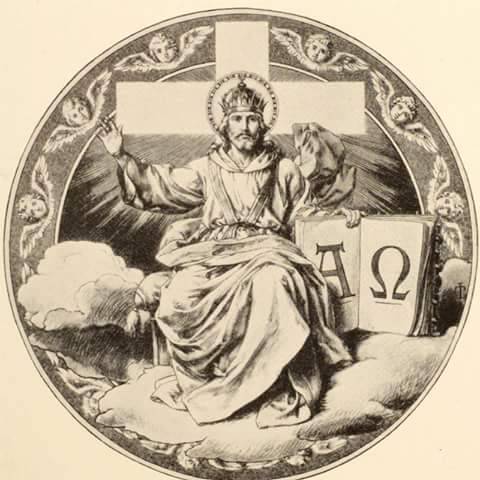
Today is the feast of the Miraculous Medal. The apparitions of Our Lady to Saint Catherine Labouré at the convent of the Daughters of Charity on the Rue de Bac in Paris are quite famous. Many people are unaware that the novice from Burgundy also experienced a vision of Christ the King, which foretold to her the July Revolution of 1830, and the final fall of the House of Bourbon. The July Revolution sent the Duchesse d'Angoulême and her family into permanent exile, as is told in the novel Madame Royale.

Fr. Joseph Dirvin describes the vision of June 6, 1830 in detail in his biography of St. Catherine.
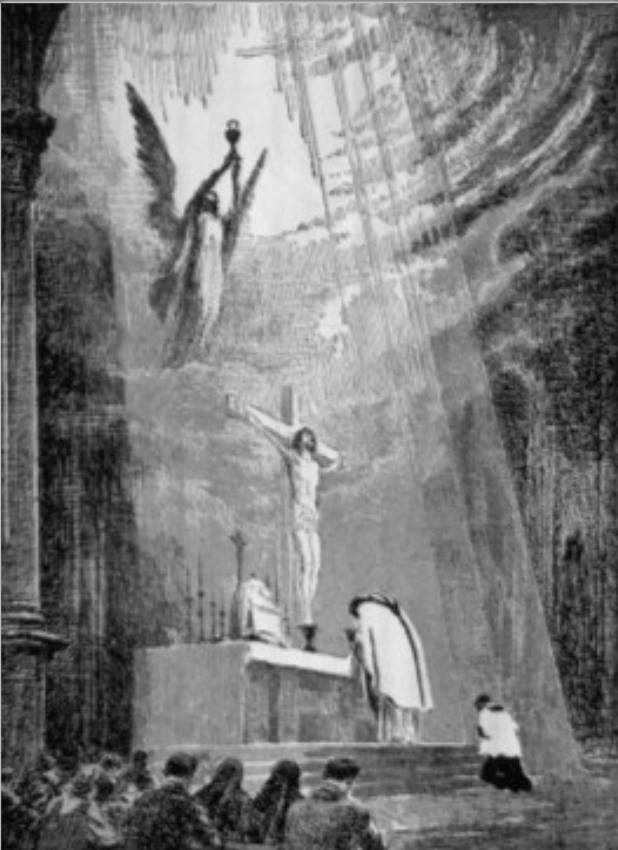
On Trinity Sunday, June 6, 1830, Sister Laboure was given a special vision of Jesus in the Blessed Sacrament, or more specifically of Christ as King. This time she is precise as to the moment of the vision. Our Lord appeared to her, robed as a king, with a cross at His breast, during the Gospel of the Mass. Suddenly, all His kingly ornaments fell from Him to the ground—even the cross, which tumbled beneath His feet. Immediately her thoughts and her heart fell, too, and were plunged into that chasm of gloom that she had known before, gloom that portended a change in government. This time, however, she understood clearly that the change in government involved the person of the King, and that, just as Christ was divested of His royal trappings before her, so would Charles X be divested of his throne. 
It is a startling thing, this sacred vision of God Himself coming in majesty to foretell the fall of an earthly monarch, and the vision of Christ the King to Catherine Laboure seems to have had no other purpose than to foretell the fall of Charles X of France. The mystery of it will never be fully solved; yet here and there the mind may mull over certain clues. 
The greatest of these clues is the nature of the French monarchy itself, which, as Hilaire Belloc understood so well, was a holy thing, wedded to the people it ruled, and the prototype of all the monarchies of Europe. This ancient royalty had its roots in Rome and had received its Christian mandate in the crowning of Charlemagne by the Pope on Christmas Day, 800 A.D. It had lived for more than a thousand years in one line of men. 
No matter how great the goodness or wickedness of these royal men—and there was an ample supply of both—the sanctity of the monarchy itself and its mystical espousal to the French people is not to be questioned. In its institutions, its duties, its relationship to those it governed, its elaborate ritual, it was an imitation on a much lower plane of the Church of God. The French, kings and subjects alike, knew this well. Jeanne d'Arc was in an agony until the Dauphin should be crowned at Rheims and his body anointed and consecrated in the sacred rite which was so essential to this kingly religion; in a sense, it was her sole mission, and it is significant that her fortunes declined afterward. Louis XI had the Ampulla of holy oil brought from Rheims that his dying eyes might rest on it. 
Napoleon III sought to sanctify his usurpation by having himself anointed with the small, hard lump that was all that remained of the holy oil in 1853. The Kings of France, no matter how absolute their rule, had to be born and to die, had to eat and drink, take their recreation, and pray in the sight of the people. At the birth of her ill-fated Dauphin, Marie Antoinette almost died of suffocation, because of the press of the common people in her chamber, witnessing her lying-in; only the quick-witted action of a bystander, breaking a window to let in the fresh air, saved her. 
The double religious family to which Catherine belonged had had official relationships with the French monarchy. Louis XIII had died in the arms of Vincent de Paul. The Founder continued to serve his widow, Anne of Austria, during the early part of her Regency, both as her confessor and as an important member of the royal Council of Conscience, a body established for the reform of the Church. Under Louis XV and Louis XVI, the Vincentian Fathers had been royal chaplains at Versailles, and, after the restoration, had been privileged to form a guard of honor about the bier of Louis XVIII. 
That the vision of Christ the King had some intimate relationship with the end of the Bourbon dynasty seems evident, for Charles X was the last of the royal Bourbons; his cousin Louis Philippe, who succeeded him, belonged to a lateral line. Again we are confronted with the astonishing preoccupation of Heaven with the fortunes of France. 
Before leaving this vision, we must point out the noteworthy fact that Catherine Laboure was the first saint in modern times to be vouchsafed a vision of Christ as King. In the light of the great present-day devotion to the Kingship of Christ, we would seem justified in questioning whether the vision might not have a mystical meaning. In announcing the end of the oldest of monarchies, might not Christ have meant to point up the passing quality of all earthly authority, and to foretell present-day devotion to His Kingship as the index of the eternal quality of His own Reign? 
Certainly, however, Sister Laboure did not ponder thus in her heart. She knew only, as the common people know, that there was to be "a change in government," and that, as inevitably came to pass, "many miseries would follow." She knew only, as the common people know, that there had been too many changes of government in France over the last forty years, too many miseries following, and, with this instinctive knowledge of the people, she grew sad and feared. 
The statesmen and politicians of the land would have laughed at the long, prophetic thoughts of the little Sister, for national order seemed well established and peace reigned. Indeed, the government was enjoying the flush of esteem that had come with the brilliant victory of the French troops in Algiers, a victory which the nation had asked through the intercession of St. Vincent. In certain coffee houses and wine shops of Paris, however, there would have been no laughter. The brutal men assembled there would merely have smiled with grim satisfaction at this forecast of success for the revolution they were plotting.
(~from St. Catherine Laboure of the Miraculous Medal by Fr. Joseph Dirvin)

Tuesday, November 25, 2025

St. Catherine of Alexandria

Today is traditionally the feast of the virgin martyr St. Catherine of Alexandria, one of the saints who spoke to St. Joan of Arc.
From the tenth century onwards veneration for St. Catherine of Alexandria has been widespread in the Church of the East, and from the time of the Crusades this saint has been popular in the West, where many churches have been dedicated to her and her feast day kept with great solemnity, sometimes as a holy-day of obligation. She is listed as one of the Fourteen Holy Helpers of mankind among the saints in Heaven; she is the patroness of young women, philosophers, preachers, theologians, wheelwrights, millers, and other workingmen. She was said to have appeared with Our Lady to St. Dominic and to Blessed Reginald of Orleans; the Dominicans adopted her as their special protectress. Hers was one of the heavenly voices heard by St. Joan of Arc. Artists have painted her with her chief emblem, the wheel, on which by tradition she was tortured; other emblems are a lamb and a sword. Her name continues to be cherished today by the young unmarried women of Paris.
Fr. Mark had a magnificent post about this great saint, who was removed from the Roman Calendar but has been put back again. To quote:
Saint Catherine of Alexandria vanished from the reformed Roman Calendar in the reform of 1969 and, Deo gratias, reappeared in 2002. Why? Part of the answer can be found, I think, by comparing the lovely old Collect for Saint Catherine with the one newly composed for the 2002 edition of the Roman Missal. In the traditional liturgy, which we celebrate here at Silverstream Priory, on November 25th the Church prays:

O God Who gavest the Law to Moses on the summit of Mount Sinai,
and didst miraculously place the body of Thy blessed virgin-martyr Catherine in the selfsame spot by the ministry of Thy holy angels,
grant, we beseech Thee, that her merits and pleadings
may enable us to reach the mountain which is Christ.


The Collect focuses on the image of Mount Sinai, the sacred mountain which prefigures Christ himself. The first phrase of the prayer takes up Exodus 31:18, the inspiration of the Great O Antiphon that we will be singing on December 18th:
O ADONAI, and Ruler of the House of Israel, who appeared unto Moses in the burning bush and gave him the Law on the summit of Sinai: come to redeem us with an outstretched arm!


 Here is an article on the historicity of the life of St. Catherine, Virgin and Martyr.

Sunday, November 23, 2025

Solemnity of Christ the King


It would be a grave error, on the other hand, to say that Christ has no authority whatever in civil affairs, since, by virtue of the absolute empire over all creatures committed to him by the Father, all things are in his power. Nevertheless, during his life on earth he refrained from the exercise of such authority, and although he himself disdained to possess or to care for earthly goods, he did not, nor does he today, interfere with those who possess them.
Non eripit mortalia qui regna dat caelestia.[27]
Thus the empire of our Redeemer embraces all men. To use the words of Our immortal predecessor, Pope Leo XIII: "His empire includes not only Catholic nations, not only baptized persons who, though of right belonging to the Church, have been led astray by error, or have been cut off from her by schism, but also all those who are outside the Christian faith; so that truly the whole of mankind is subject to the power of Jesus Christ."[28] Nor is there any difference in this matter between the individual and the family or the State; for all men, whether collectively or individually, are under the dominion of Christ. In him is the salvation of the individual, in him is the salvation of society. "Neither is there salvation in any other, for there is no other name under heaven given to men whereby we must be saved."[29] He is the author of happiness and true prosperity for every man and for every nation. "For a nation is happy when its citizens are happy. What else is a nation but a number of men living in concord?"[30] If, therefore, the rulers of nations wish to preserve their authority, to promote and increase the prosperity of their countries, they will not neglect the public duty of reverence and obedience to the rule of Christ. What We said at the beginning of Our Pontificate concerning the decline of public authority, and the lack of respect for the same, is equally true at the present day. "With God and Jesus Christ," we said, "excluded from political life, with authority derived not from God but from man, the very basis of that authority has been taken away, because the chief reason of the distinction between ruler and subject has been eliminated. The result is that human society is tottering to its fall, because it has no longer a secure and solid foundation."[31]
~Pope Pius XI "Quas Primas"


From Crisis:

 The feast of Christ the King trumpets a robust and sanguine Catholicism that brooks no compromise. It presents Christ as triumphant over the world, sin, and death. It proclaims Christ, Who mandates: “Go ye therefore and teach all nations” (Matthew 28:19) and, “So then because thou art lukewarm, and neither cold nor hot, I will spew thee out of my mouth” (Revelation 3:16). 

It is a feast that does not sit well with dialogue, equivocation, and “respecting the process.” Or with those who would like to finesse the Faith with more “nuance.” Even the word “triumph” makes a certain kind of Catholic bristle. After all, Catholics have been solemnly taught for decades to fit in and embrace a carefully massaged Catholicism that makes no demands except to prescribe (in Maritain’s arresting phrase) “kneeling before the world.” (Read more.)


And you shall see the Son of man sitting on the right hand of the power of God, and coming with the clouds of heaven.
- Saint Mark 14:62

Saturday, November 22, 2025

St. Cecilia


While in Rome, my mother bought me a small statue of Saint Cecilia, the Roman martyr from the turn of the early third century. It is based on the life-size one in her basilica, sculpted after her incorrupt body was exhumed in the sixteenth century. She is lying on her side in her dressing gown with her neck half-severed. Cecilia was killed in her bathroom, and the executioner who hacked at her neck was put off by her calm dignity. It took her three days to die. The prelude to her ordeal was an attempt to scald her, which was why she was found near the bath - one of those huge Roman baths. For Cecilia belonged to one of the ancient Roman families and possessed great wealth. She was young, beautiful, and desired, but she died because she refused to renounce her Savior.

While journeying through life it is easy to understand why so many of the martyrs were very young. When people are young they do not understand what it is to lose life. Sacrifices are easier when you do not fully grasp what is being renounced. There is a special valor, a reckless courage, possessed by young soldiers which old soldiers do not always have. And yet Christians of every age are called to be soldiers of Christ and martyrs in spirit if not in body. The fortitude that seemed so effortless in my grandparents in their old age I see now was no small thing.

As Abbot Gueranger wrote in The Liturgical Year, Vol XV :
The lesson will not be lost if we come to understand this much: had the first Christians feared, they would have betrayed us, and the word of life would never have come down to us; if we fear, we shall betray future generations, for we are expected to transmit to them the deposit we have received from our fathers.
Those who had faith and courage, whether it was Saint Cecilia in her agony, or my grandmothers in their nursing homes, where they spent many years before they died, have passed on to me a priceless gift.

Friday, November 21, 2025

Presentation of Mary

Presentation of Mary by Titian

Father Mark offers some history and thoughts to ponder on the feast commemorating Our Lady being taken to the Temple at the age of three by her parents.
In the hidden recesses of the old Temple, the Holy Ghost prepares the new Temple, the all-holy Virgin, to become the Mother of God . Destined to be the living Temple of the Word, Mary dwells in the Temple of the Old Dispensation. She hears the chanting of the psalms, the prophets, and the Law. Was it there that the Most Holy Virgin learned Psalm 118, the long litany of loving surrender to the Word? And was it from Psalm 118, held in her heart from so tender an age, that she drew her response to the message of the Angel, “Be it done unto me according to Thy Word” (Luke 1:38)?
There planted in the Lord, the dew of His Spirit made her flourish in the courts of her God, and like a green olive she became a tree, so that all the doves of grace came and lodged in her branches. (Saint John Damascene, Upon the Orthodox Faith, Book IV, ch. 15)
Virgin Mother of the Lamb
There Mary smells the fragrance of incense and burnt offerings. There she observes the faithful of Israel streaming towards Zion, filling the Temple, seeking the Face of the Lord. Priest, altar, and oblation are not unfamiliar to the Virgin who, gazing upon her Son, will recognize in Him the Eternal priest, the Altar of the New Covenant, the pure Victim, the holy Victim, the spotless Victim offered in unending sacrifice.
To Belong to God
In the seventeenth century — the age of France’s “mystical invasion” — the mystery of the Presentation of the Virgin in the Temple captivated the hearts of Monsieur Olier and of others on fire with zeal for the holiness of the priesthood, for the beauty of the consecrated life, and for the worthy praise of God. The so-called French School of spirituality, marked above all by the imperative of adoration and the virtue of religion, gravitated to the feast of November 21st as to the purest liturgical expression of the desire to be offered to God, to belong to God, and to abide in God’s house.
Virgo Sacerdos
When, in 1641, Jean-Jacques Olier (1608 – 1657) established the seminary of Saint-Sulpice, he placed it under the patronage of the Virgin Mary in the mystery of her Presentation in the Temple. The Child Mary, hidden in the Temple, learns the meaning of sacrifice and oblation; she is the sacerdotal Virgin, prepared by the Holy Spirit to stand at the altar of the Cross united to her Son, High Priest and immolated Lamb. Under the influence of the French Sulpicians, many religious congregations, established after the horrors of the French revolution, chose the feast of the Presentation of the Virgin Mary as their foundation day, the day of religious profession, and of the renewal of vows. (Read more.)

This feast is a wonderful prelude to Advent. According to Dom Gueranger:
Mary, led to the Temple in order to prepare in retirement, humility, and love for her incomparable destiny, had also the mission of perfecting at the foot of the figurative altar the prayer of the human race, of itself ineffectual to draw down the savior from heaven. (From Abbot Gueranger's The Liturgical Year, Vol XV )

"For better is one day in thy courts above thousands. I have chosen to be an abject in the house of my God, rather than to dwell in the tabernacles of sinners." Psalm 83:11 (The Vulgate)

Related Posts with Thumbnails