Sunday, December 7, 2025

The Virgin Mary in the Writings of Our Holy Mother St. Teresa

Here is an article which pulls it all together.
St Teresa's whole Marian experience is found scattered throughout her writings, from which we can put together a lovely mosaic of Mary. We will make use of three important traits of Teresian doctrine. a) Devotion to Mary and Marian mystical experience  From the first page of Teresa's writings the Virgin Mary appears among the most important memories of her childhood. She recalls the devotion taught her by her mother Beatriz, which found expression in the recitation of the Rosary(8). The episode of her prayer to Our Lady after the loss of her mother at the age of 13 is very moving: "in my affliction I went to an image of our Lady and begged her with many tears to be a mother to me. It seems to me that though I did this in simplicity, it has been of much help to me; for I know that I have always found favour with this sovereign lady when I have commended myself to her and in the end, she has drawn me to herself"(9). Teresa then attributes to the Virgin the grace of a constant protection and in a special way the grace of her conversion: "She has drawn me to herself." Other texts from the autobiography reveal to us the permanence of the devotion to Mary: when she turns to the Virgin in her sufferings(10), when she remembers her feasts of the Assumption and the Immaculate Conception(11) or the Holy Family(12) or her devotion to the Rosary(13). 
Very quickly the devotion to the Virgin, like other aspects of the Saint's life, passed into an experience of her mysteries, when God made Teresa enter into contact with the mystery of Christ and all that pertains to it. In Teresa's mystical experience of the mystery of Our Lady there is, as it were, a progressive penetration into the most important moments of the Virgin's life, as we find it in the Gospels. Thus, for example, we have an intuition of the mystery of the overshadowing of the Virgin and of her humble and wise attitude at the Annunciation(14). We know of at least two mystical experiences Teresa enjoyed connected with the first words of Mary's canticle, the Magnificat(15) which, according to the testimony of Mary of St Joseph, Teresa used to repeat frequently "softly, in Castilian"(16). 
She contemplates with amazement the mystery of the Incarnation: "The Lord wills to enter into the womb of his most holy Mother. Such is the Lord, he brings liberty with him, and thus he loves to make himself like us"(17). She contemplates the presentation of Jesus in the temple and finds the meaning of Simeon's words to the Virgin(18): "Do not think that when you see my Mother holding me in her arms, she enjoyed this happiness without grave torment. From the time that Simeon spoke these words to her, My Father gave her clear light whereby to see what I would have to suffer"(19). She thinks about the flight into Egypt and the hidden life of the Holy Family(20). 
She had a special intuition of the presence of Mary in the paschal mystery of her Son, on the pain of her desolation and the joy in the Lord's resurrection. Teresa loved to contemplate Mary's fortitude and her communion with Christ at the foot of the Cross(21). In Concepts of the Love of God she describes the Virgin's attitude: "She was up, and not sleeping, but suffering in her most holy soul, dying a cruel death"(22). She had entered mystically into the sorrow of the Virgin when the Lord was placed in her arms "as it is portrayed in the fifth sorrow"(23) and had experience at Easter in Salamanca in 1571 of desolation and anguish (a dark night of the spirit) which made her remember the loneliness of the Virgin at the foot of the Cross(24). On this same occasion the Lord said to her, "On my resurrection I went to our Lady who was in great need.... and I stayed long with her for she was in very great need of consolation"(25). 
On various occasions it was given to her to contemplate the glorification of the Virgin on the feast of her Assumption(26). She was conscious that the Virgin always accompanied the community at prayer with her constant intercession, as happened at St Joseph's in Avila(27) and at the Incarnation(28). 
When it was given to her to know the mystery of the Trinity she perceived the closeness of the Virgin to this mystery, and the fact that the Virgin, along with Christ and the Holy Spirit, are the ineffable gifts of the Father: "I have given you my Son and the Holy Spirit and this Virgin. What can you give to me?"(29) It can be stated that the Holy Mother had a profound mystical experience of Mary, that she enjoyed her presence. Teresa also experienced the mysteries of Mary's life. Consequently in Teresa's doctrine there runs a deep conviction that the mysteries of the Humanity of Christ and those of his Virgin Mother form part of the mystical experience of those tending to perfection(30). (Read More)
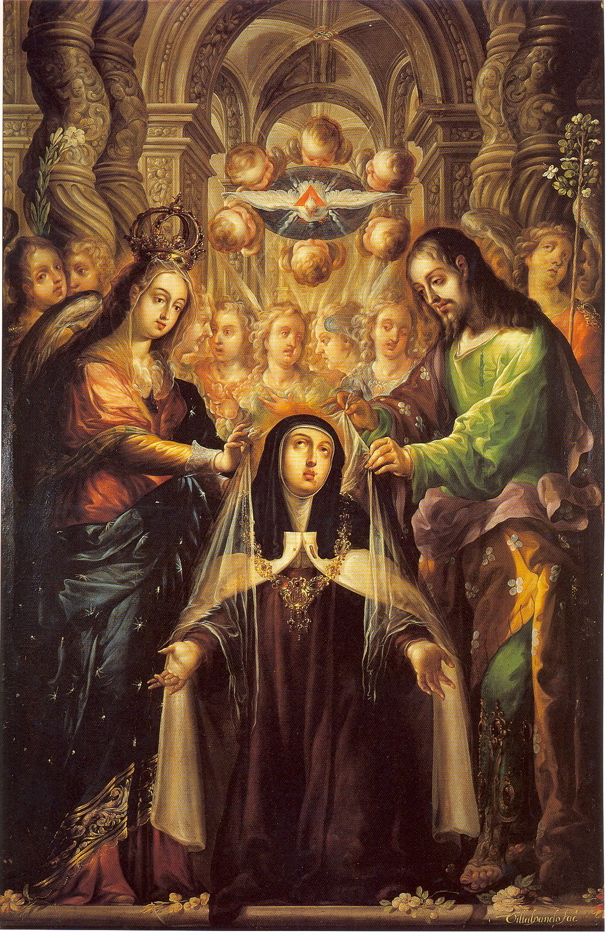
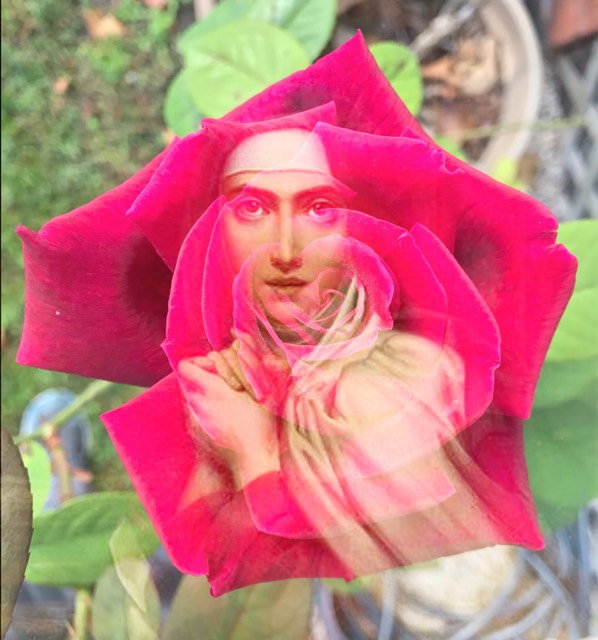
The Holy Mother St. Teresa receives a veil and necklace from Our Lady and St. Joseph

Saturday, December 6, 2025

St. Nicholas the Wonder-Worker

 Russian artist Ilya Repin shows St. Nicholas delivering an innocent man from execution.
Saint Nicholas of Myra, the "Wonder-worker," was in some ways the Padre Pio of the fourth century. If people of some distant century were to read of the extraordinary miracles of Saint Pio, they would surely think them to be legendary, except that so many of his healings are documented. Saint Nicholas did not have the advantage of modern medical science to affirm the healings worked by God through him, but he has the devotion of the Church of the East and the West, and has long been venerated as patron of children, mariners, prisoners, miners and brides. He is the patron saint of brides because he gave dowries to poor girls to save them from prostitution. St. Nicholas is an Advent guide, leading us to the Christ Child. According to Don Marco:
To my mind, the most important thing to remember about Saint Nicholas is the spirit of godly fear and adoration with which he stood before the Holy Altar at the moment of the Divine Liturgy. Everything else in his life — including the countless miracles attributed to him — flowed from the Holy Mysteries. The Divine Liturgy served by Saint Nicholas must have been like the Mass of Padre Pio. While the holy gifts were being carried in procession to the altar, the people sang of Our Lord’s Eucharistic advent among them: “We who mystically represent the Cherubim, who sing to the life-giving Trinity the thrice holy hymn, let us now lay aside all earthly cares, that we may receive the King of all who comes escorted invisibly by Angelic hosts. alleluia, alleluia, alleluia.”

Saint Nicholas and the other saints of Advent surround the Eucharistic Advent of the Lord just as they will surround Him with the angels in the glory of His Advent at the end of time. How important it is to acknowledge the saints of Advent, to seek their intercession, to rejoice in their lives. Those who would banish the saints from the celebration of the Advent liturgy are misled and mistaken. The mission of the saints of Advent is to prepare us for the coming of Christ: for His final advent as King and Judge, yes, but also for His humble daily advent hidden under the species of bread and wine. In no way do the saints detract from the intensity of the Advent season. Each of them is given us as a companion and intercessor, charged with making ready our hearts for the advent of the Bridegroom-King.
Here is one of the earliest paintings of St. Nicholas in flight, by Bicci di Lorenzo, in which the saint is giving guidance and aid to sailors on a stormy sea. A mermaid, symbol of the pagan and preternatural world, swims in the opposite direction.


Friday, December 5, 2025

The Perpetual Virginity of Mary

During Advent we contemplate the mysteries surrounding the Birth of the Savior. We await His coming with the Virgin Mary, whose journey to Bethlehem becomes our own. We will never fully comprehend the mystery of the Incarnation and yet through faith we may grasp the unfathomable. So much of what the Church teaches has been distorted in our times. The teaching on Our Lady's perpetual virginity is often misunderstood, as Fr. Mark explains:
Even in the minds of many of the faithful, enfeebled by a forty year dearth of popular orthodox catechesis, a tragic confusion holds sway concerning the privileges of the Blessed Virgin Mary and, in particular, her virginity before, during, and after childbirth. There are many, alas, who, affected by various mutations of creeping Nestorianism and Arianism, have no grasp of what it means to call the Blessed Virgin Mary, Mother of God. Those who do not confess the privileges of the Blessed Virgin Mary, honouring them and celebrating them, fall inevitably into one or another of the classic Christological heresies.
Fr. Mark further discusses this beautiful and ancient teaching, as follows:
Ever since the Council of Ephesus in 431, icons of the Mother of God have been marked by three stars: one on her forehead, and one on each shoulder, The three stars signify her perpetual virginity: before, during, and after the birth of her Son....

Ancient liturgical texts reflect the language of the first great Christological councils of the Church. It was crucial, in the context of the prevailing heresies, to invoke Mary as Theotokos, Mother of God, or as Ever-Virgin. It was feared that by referring to Mary as a woman called simply by her ordinary name, something of the mystery of Christ, True God and True Man, might be obscured or compromised. The liturgy in both East and West reflects this ancient preference. While, in preaching and in works of devotion, we often hear the name of Mary without her theological titles, the liturgy calls her Sancta Dei Genetrix (Holy God-bearer) and Semper Virgo (Ever-Virgin).

The most ancient prayer to the Virgin Mother is the Sub tuum praesidium, found on an Egyptian papyrus from the 3rd century. It does not include the name “Mary,” but invokes her as Holy God-bearer (Sancta Dei Genetrix) and Virgin glorious and blessed, (Virgo gloriosa et benedicta).

The liturgy through the ages is consistent in confessing that God Himself is the author of Mary’s perpetual virginity. The same thought is carried over into the ancient rites for the Consecration of Virgins. Virginity, before being something offered to God, is a gift received from Him. It is a gift wholly ordered to union with Christ. Christ is the Spouse of Virgins; He is, at the same time, the blessed Fruit of a virginity received from God and offered back to Him. The liturgy does not separate virginity from motherhood. The virginity given by God is characterized not by sterility, but by an astonishing fecundity.

More on this de fide teaching in the Catechism:
The deepening of faith in the virginal motherhood led the Church to confess Mary's real and perpetual virginity even in the act of giving birth to the Son of God made man. In fact, Christ's birth "did not diminish his mother's virginal integrity but sanctified it." And so the liturgy of the Church celebrates Mary as Aeiparthenos, the "Ever-virgin."
Here are some beautiful quotes from Fathers of Church:
Believe in the Son of God, the Word before all the ages, who was...in these last days, for your sake, made son of Man, born of the Virgin Mary in an indescribable and stainless way, -for there is no stain where God is and whence salvation comes.... (St. Gregory of Nazianzen, Oration on Holy Baptism, 40:45; 381 AD)
According to the condition of the body (Jesus) was in the womb, He nursed at His mother's breast, He lay in the manger, but superior to that condition, the Virgin conceived and the Virgin bore, so that you might believe that He was God who restored nature, though He was man who, in accord with nature, was born of a human being. (St. Ambrose of Milan, Mystery of the Lord's Incarnation, 6:54; 382 AD)
Who is this gate (Ezekiel 44:1-4), if not Mary? Is it not closed because she is a virgin? Mary is the gate through which Christ entered this world, when He was brought forth in the virginal birth and the manner of His birth did not break the seals of virginity. (St. Ambrose of Milan, The Consecration of a Virgin and the Perpetual Virginity of Mary, 8:52; c. 391 AD)
Thursday, December 4, 2025

St. Barbara, Virgin and Martyr

She is venerated in both the east and the west.
Barbara was the daughter of a rich heathen named Dioscorus. She was carefully guarded by her father who kept her shut up in a tower in order to preserve her from the outside world. An offer of marriage which was received through him she rejected. Before going on a journey her father commanded that a bath-house be erected for her use near her dwelling, and during his absence Barbara had three windows put in it, as a symbol of the Holy Trinity, instead of the two originally intended. When her father returned she acknowledged herself to be a Christian; upon this she was ill-treated by him and dragged before the prefect of the province, Martinianus, who had her cruelly tortured and finally condemned her to death by beheading. The father himself carried out the death-sentence, but in punishment for this he was struck by lightning on the way home and his body consumed. Another Christian named Juliana suffered the death of a martyr along with Barbara. A pious man called Valentinus buried the bodies of the saints; at this grave the sick were healed and the pilgrims who came to pray received aid and consolation. The emperor in whose reign the martyrdom is placed is sometimes called Maximinus and sometimes Maximianus; owing to the purely legendary character of the accounts of the martyrdom, there is no good basis for the investigations made at an earlier date in order to ascertain whether Maximinus Thrax (235-238) or Maximinus Daza (of the Diocletian persecutions), is meant. The traditions vary as to the place of martyrdom, two different opinions being expressed: Symeon Metaphrastes and the Latin legend given by Mombritius makes Heliopolis in Egypt the site of the martyrdom, while other accounts, to which Baronius ascribes more weight, give Nicomedia. In the "Martyrologium Romanum parvum" (about 700), the oldest martyrology of the Latin Church in which her name occurs, it is said: "In Tuscia Barbarae virginis et martyris", a statement repeated by Ado and others, while later additions of the martyrologies of St. Jerome and Bede say "Romae Barbarae virginis" or "apud Antiochiam passio S. Barbarae virg.". These various statement prove, however, only the local adaptation of the veneration of the saintly martyr concerning whom there is no genuine historical tradition. It is certain that before the ninth century she was publicly venerated both in the East and in the West, and that she was very popular with the Christian populace. The legend that her father was struck by lightning caused her, probably, to be regarded by the common people as the patron saint in time of danger from thunder-storms and fire, and later by analogy, as the protector of artillerymen and miners. She was also called upon as intercessor to assure the receiving of the Sacraments of Penance and Holy Eucharist at the hour of death.
St. Barbara is also regarded as one of the Fourteen Holy Helpers, very popular in the Middle Ages.

Wednesday, December 3, 2025

St. Francis Xavier

From New Advent: 

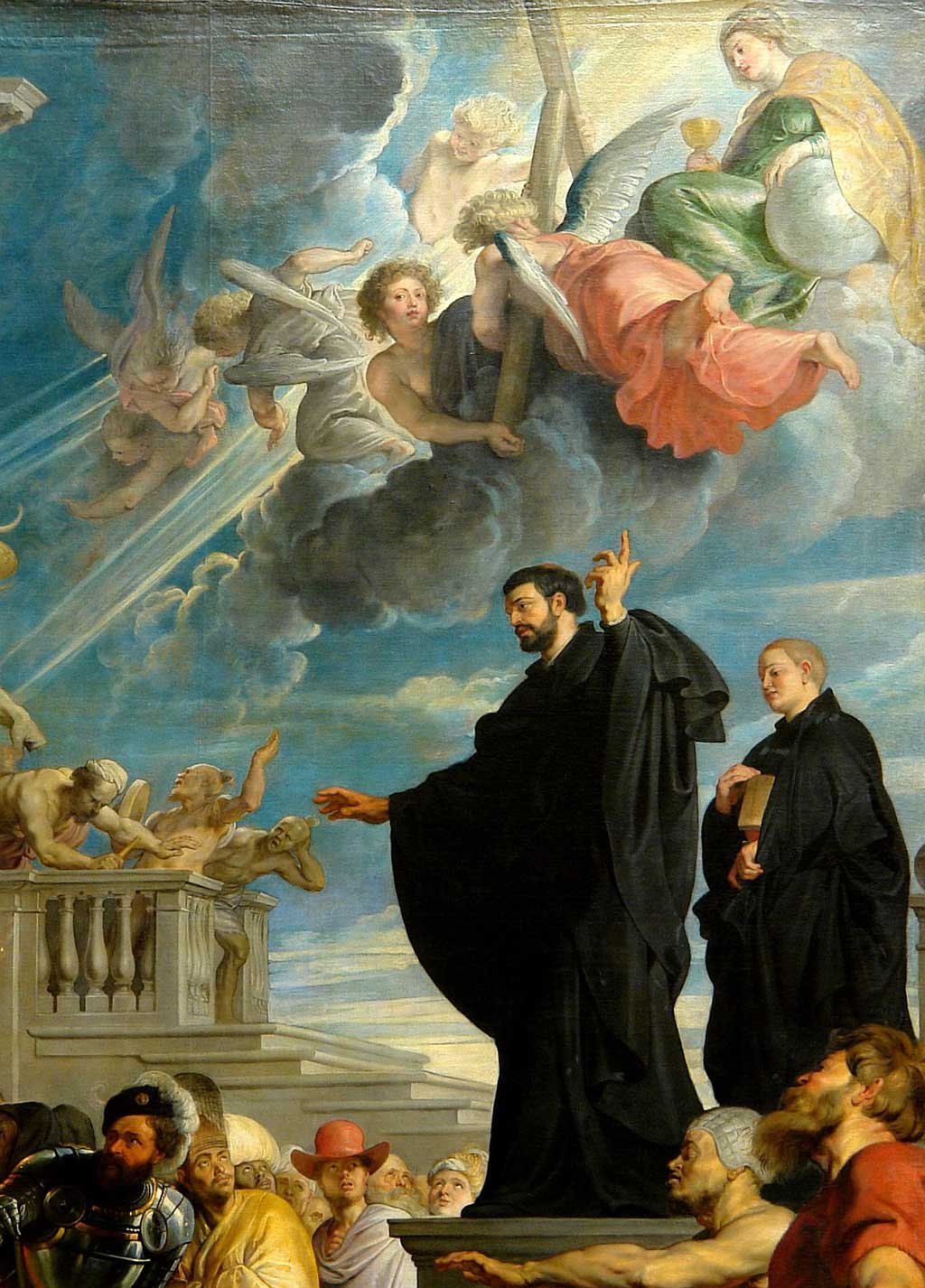
 Born in the Castle of Xavier near Sanguesa, in Navarre, 7 April, 1506; died on the Island of Sancian near the coast of China, 2 December, 1552. In 1525, having completed a preliminary course of studies in his own country, Francis Xavier went to Paris, where he entered the Collège de Sainte-Barbe. Here he met the Savoyard, Pierre Favre, and a warm personal friendship sprang up between them. It was at this same college that St. Ignatius Loyola, who was already planning the foundation of the Society of Jesus, resided for a time as a guest in 1529. He soon won the confidence of the two young men; first Favre and later Xavier offered themselves with him in the formation of the Society. Four others, Lainez, Salmerón, Rodríguez, and Bobadilla, having joined them, the seven made the famous vow of Montmartre, 15 Aug., 1534. (Read more.)

Tuesday, December 2, 2025

History of Advent

 We must look upon Advent in two different lights: first, as a time of preparation, properly so called, for the birth of our Saviour, by works of penance; and secondly, as a series of ecclesiastical Offices drawn up for the same purpose. We find, as far back as the fifth century, the custom of giving exhortations to the people in order to prepare them for the feast of Christmas. We have two sermons of Saint Maximus of Turin on this subject, not to speak of several others which were formerly attributed to St. Ambrose and St. Augustine, but which were probably written by St. Cesarius of Aries. If these documents do not tell us what was the duration and what the exercises of this holy season, they at least show us how ancient was the practice of distinguishing the time of Advent by special sermons. Saint Ivo of Chartres, St. Bernard, and several other doctors of the eleventh and twelfth centuries, have left us set sermons de Adventu Domini, quite distinct from their Sunday homilies on the Gospels of that season. In the capitularia of Charles the Bald, in 846, the bishops admonish that prince not to call them away from their Churches during Lent or Advent, under pretext of affairs of the State or the necessities of war, seeing that they have special duties to fulfill, and particularly that of preaching during those sacred times.
The oldest document in which we find the length and exercises of Advent mentioned with anything like clearness, is a passage in the second book of the History of the Franks by St. Gregory of Tours, where he says that St. Perpetuus, one of his predecessors, who held that see about the year 480, had decreed a fast three times a week, from the feast of St. Martin until Christmas. It would be impossible to decide whether St. Perpetuus, by his regulations, established a new custom, or merely enforced an already existing law. Let us, however, note this interval of forty, or rather of forty-three days, so expressly mentioned, and consecrated to penance, as though it were a second Lent, though less strict and severe than that which precedes Easter.
~from Dom Gueranger's The Liturgical Year, Vol. I

Monday, December 1, 2025

Saint Charles of Jesus

Born the Vicomte de Foucauld, of a wealthy and illustrious family, Saint Charles died alone in poverty and obscurity, a monk in the desert. He was martyred by marauders on December 1, 1916. In 1899 he wrote:
Bona crux. It is through the cross that we achieve union with him who was nailed there, our Heavenly Spouse. We should accept, as we would a favor, every moment of our lives and whatever they may bring, whether it is good or bad, but the crosses with even greater gratitude than the rest. Crosses release us from this world and by doing so bind us to God.
Related Posts with Thumbnails