







 Posts
Posts


Sunday, April 17, 2011


Saturday, April 16, 2011
Learning How to Pray
The Spanish Ambassador to the Vatican speaks of the teaching of Our Holy Mother Saint Teresa. To quote:
My dear mother's name was Teresa, and celebrated her saint’s day October 15th under her Saint Teresa of Jesus. She felt towards her patroness a very special devotion, that wasn’t only fruit of her faith but also had a very important intellectual component, because my mother admired Teresa of Avila also as a woman do to her writings and her attitude towards life.
Not only she considered her poems and prayers as the most brilliant pages of our literature, but also, and above all, she understood that Teresa of Avila was a model and example of a liberated woman and of a character worthy of being followed by all women.
When my mother passed away in her night table she had the complete works...of Saint Teresa BAC edition. The book was completely underlined, filled with marginal notes and, among the pages, there were many articles of the press and magazines related, not only with Saint Teresa, but also with women that my mother admired, such as Madame Curie, Golda Meir or more recently Oriana Fallaci. With that book in my hands I understood perfectly that Saint Teresa was always a light bold in my mother’s life, not only in love and quest for God, but also as a point of reference in her life.
These intimate experiences helped me to understand better the true dimension of the book of Saint Teresa “Way of Perfection” that is, simply (and none the less), a perfect prayer manual but, as my mother would say, written not only for the cloistered nuns of the Saint’s time, but addressed possibly to all men and women of modern days.
It is not just a matter of knowing how to pray, but also to get acquainted with prayer and ever more in a world like ours, in which Catholics, within the walls of a convent or in everyday life, have lost the custom of small gestures: a sign of the cross when passing along a church, a visit to the most Sacred Sacrament, small prayers when working… and I am not talking about the rosary prayed in family or in community, simple attitudes that we consider proper of old times, in the desire of not recognizing that, or we either feel embarrassed of them for considering them naïve, or that they express that sad reality of modern times of not having time for God.
Saint Teresa shows us how to pray taking as a guideline the prayer of prayers, the same one taught by Jesus: the Our Father, the only gospel prayer, apparently brief and simple, but to which Teresa dedicates 22 chapters of her book, showing us the profound depths that the dialog with Jesus can reach and the wonderful way that we can express God’s love.
When I was a child and my mother showed me how to read and pray she always told me “vocalize well as Saint Teresa ordered her nuns”; thanks to that a person like me who, along life has to talk in pubic many times, may that be in big meetings or in conferences, can’t thank enough that, through Saint Teresa, had learned ever since a boy the principles of speaking in public, and to let oneself be understood with clearness, just as the Saint explained to her nuns when she was defining the requirements of mental prayer.
And I finish by giving thanks once again to my mother’s Teresian testimony that the faith is, besides many other considerations, the ground of living joyfully.
In her memory and also in my fathers, a man of strong and firm faith, may these words be addressed as a pondering of the “Way of Perfection”.
Friday, April 15, 2011
Saint Lydwine
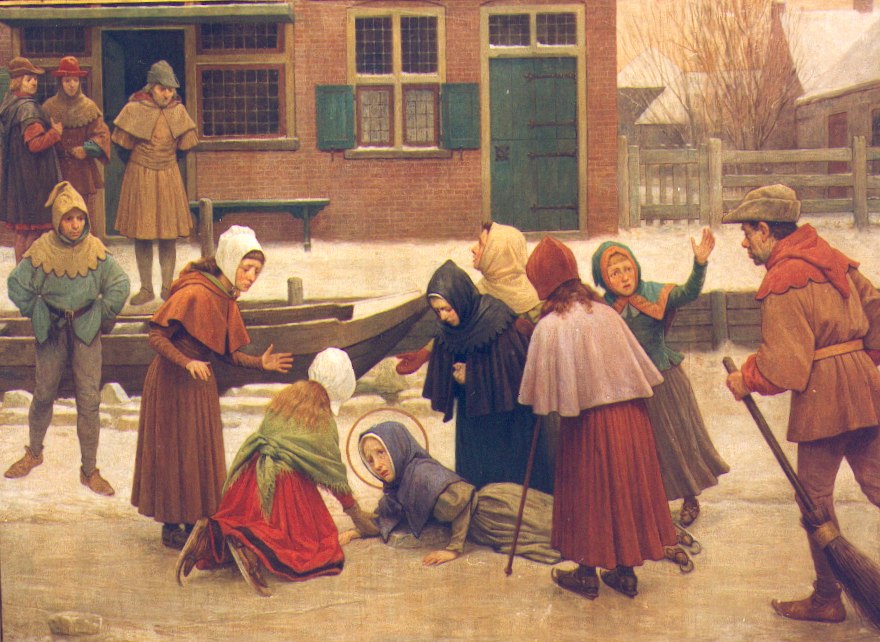
At that time, all of Christendom groaned under the weight and confusion of the Great Schism. At 15, while ice-skating with her friends, Lydwine broke a rib, forcing her into a bed she would never leave.
Over the next 38 years, she would frightfully endure every known ailment of the time with the exception of leprosy. Swollen with liquids, her stomach would expand to such an extent that she appeared to be with child; intolerably sensitive, her eyes would shed blood whenever they were struck by light and transfixed by agony, she bore the side wound of Christ’s passion through the stigmata.
Although in the onset of her sickness, she was given to despair, and rejected this torrent of sufferings, she soon became inflamed with an intense love of God that no pain could extinguish. Then, crippled by the agony of her infirmities, she donned a hair shirt and took to an insufficiently thin mattress of straw strewn on the floor, to augment her already unspeakable pain.
Thursday, April 14, 2011
On True Love
Dr. Alice von Hildebrand explores the nature of true love, saying:
The History of a Soul, from this point of view, is also a spiritual treasure. St. Thérèse of Lisieux clearly suffered much from the lack of education and manners in some of the other nuns. She learned the holy art of using every single irritation for God's glory, including the nerve-racking noise that a sister made in the stall next to hers, which prevented her from praying and being recollected. Still, Thérèse emerged victorious through love.
Surprisingly, this can also bring happiness to the best of marriages, even though the being we love has wounded our hearts. A true lover whose love is baptized will use these insignificant sacrifices as they did in the Middle Ages, when artists used some bits of wool to make superb tapestries.
The true lover always has the word "thank you" on his tongue. It is also easy for him to say "forgive me," for in the best relationship, one inevitably falls into mistakes. If someone imagines that he can find himself in a situation in which he will never make a mistake, that person should not get married, or have children, or enter a convent. The holy art of living is to know that we will make mistakes, to recognize them, to repent, and, with God's grace, to have the readiness to change. Simultaneously, it is important that both lovers recognize their mistakes. We all know cases in which one of the lovers is always critical of the other and easily forgets that "the readiness to change" should be reciprocal, and that he too is affected by original sin.
Wednesday, April 13, 2011
The Invisible World

While we look not at the things which are seen, but at the things which are not seen. For the things which are seen, are temporal; but the things which are not seen, are eternal.
~2 Corinthians 4:18Many people have the experience of a certain book coming along at just the right time. The Invisible World
 by Anthony DeStefano was such a book for me. In bringing me back to the basic truths about God and the supernatural it freshened my perspective about earthly events, helping me to once more view the trials and tragedies of life in a supernatural light. Sometimes going back to the beginning and contemplating on a deeper level the simple truths of faith which we were taught in childhood can be the most worthwhile spiritual exercise. God is pure spirit, Who created us and Who loves us, yet He permits us to have free will because He does not want mindless automatons. Reflecting upon the greatness and power of God, knowing that such a great God sustains our very beings, can be overwhelming as well as humbling.
 Written in a conversational tone, Mr. DeStefano discusses the most profound topics with clarity and insight. The simplicity of the approach reminded me a great deal of C.S. Lewis apologetic works, and yet The Invisible World is unabashedly Catholic, with much taken from the Scriptures and the wisdom of the saints. While it is a book I would feel comfortable handing to an atheist because of the logical explanations used, there is a great deal of depth to plumb so that lifelong practicing Catholics will surely find plenty of inspiration. I found the discussions of the angelic realm and of the battle between the good and evil angels to be particularly intriguing, especially since we are involved whether we want to be or not.
Among the many anecdotes the author shares is one about his paternal grandmother. The poor lady had a particularly tragic life but she never gave up her faith. Her trust in God was unshakable. The power of such blind, powerful faith had enormous repercussions for future generations, although the little grandmother never lived to see it. We do not know what good God will draw out of circumstances which to us are sheer misery. Since we cannot see God's entire plan then there is nothing for us to do but live in trust and abandonment to His love and mercy.
I will end with a quote from The Invisible World:
Nobody likes crosses. Nobody likes to suffer. But oftentimes that's exactly what we need most, because that's what works best. In the end, it's the crosses and trials and tests that are most effective in shaping us into the kind of human beings we're meant to be. Crosses change us. They change us by exposing the invisible truth about life — the truth that the devil wants to keep secret from you, the truth that the devil wants to stay hidden — the truth that we're in the midst of a colossal invisible battle. (p.151)
(*NOTE: The Invisible World
was sent to me by the author's representative in exchange for my honest opinion.)
Tuesday, April 12, 2011
A Carmelite Hermit
A dear sister in Carmel has chosen an eremitical vocation.
The hermitage isn't what you'd expect: a small home in a quiet neighborhood of Essex, Maryland, that was originally built as a one-room fishing shack 100 years ago. But then, the hermit who lives there isn't what you'd expect, either. Mary Zimmerer, now Sr. Maria Veronica of the Holy Face, is a bubbly widow who discerned a call to the contemplative life after her husband passed away five years ago. Having made a public profession of vows last fall, she is now one of only two canonical (or diocesan) hermits in the Archdiocese of Baltimore.
Monday, April 11, 2011
Vexilla Regis
Roman Christendom offers the history of the ancient Vespers hymn for Passiontide. It is sad that most Catholics in the U.S. will not have the benefit of hearing such a jewel of a hymn during Holy Week in their parishes. It is always possible to find a good CD so that the classic hymns can be played and learned at home.
Subscribe to:
Posts (Atom)