Saturday, November 14, 2015

Litany for France

From Vultus Christi:
O God the Father of mercies: — Have mercy upon us.
✢ O God the Son, who wept over Lazarus: — Have mercy upon us.
✢ O God the Holy Ghost, the Comforter: — Have mercy upon us. ✢ Holy Mary, assumed into heaven: — Have mercy upon us.
✢ Mother of Christ, Lady of Sorrows: — Have mercy upon us.
✢ Mary, our Advocate in this vale of tears: — Have mercy upon us.
✢ Saint Michael, heavenly defender of Christians: — Have mercy upon us.
✢ Saint Denis, faithful martyr of the Lamb: — Have mercy upon us.
✢ Saint Martin, merciful Confessor of Christ: — Have mercy upon us.
✢ Saint Genevieve, protector of Paris: — Have mercy upon us.
✢ Saint Remigius, Enlightener of the Franks: — Have mercy upon us.
✢ Saint Francis, Apostle to the Muslims: — Have mercy upon us.
✢ Saint Louis, champion of justice: — Have mercy upon us.
✢ Saint Joan, valiant in battle: — Have mercy upon us.
✢ Saint Vincent de Paul, captive of the Turks: — Have mercy upon us.
✢ Saint Therese, little martyr of love: — Have mercy upon us.
✢ Blessed Charles, brother of Christ and of all men: — Have mercy on us.
✢ All ye Saints of France: — Have mercy upon us.
✢ All ye holy Martyrs and Confessors: — Have mercy upon us.
✢ All ye Saints of God, men and women: — Have mercy upon us.
✢ O Lord, be merciful: — Spare us, O Lord.
✢ From all evil, — Spare us, O Lord.
✢ From all sin, — Spare us, O Lord.
✢ From thy wrath, — Spare us, O Lord.
✢ From a sudden and unprovided death, — Spare us, O Lord.
✢ From anger, hatred, and all ill-will, — Spare us, O Lord.
✢ From plague, famine, and war, — Spare us, O Lord.
✢ From everlasting death, — Spare us, O Lord.
✢ O Lamb of God, that takest away the sins of the world, grant them rest.
✢ O Lamb of God, that takest away the sins of the world, grant them rest eternal.
V. Give peace in our time, O Lord.
R. For it is thou, Lord, only, that makest us dwell in safety.
Let us pray.
Do well, O Lord, unto those that are good and true of heart; grant the rule of thy salvation, watch over thy people’s safety with constant care, and restrain with thy right hand the rage of the enemy. Through Jesus Christ, thy Son our Lord: Who livest and reignest with thee, in the unity of the Holy Ghost, ever one God, world without end. Amen.
✢ Most Sacred Heart of Jesus: — Have mercy upon us, and upon France.

Dom Benedict wrote this litany upon hearing of the terrorist attacks in Paris on Friday, 13 November 2015.

Tuesday, October 27, 2015

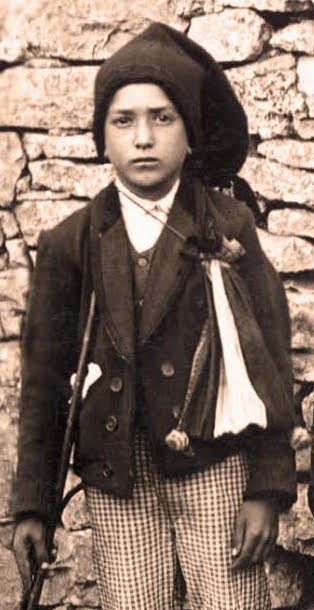
Blessed Francisco Marto

From Fr. Mark:
The words of the Angel of Fatima,  “Console your God”,  engraved themselves in young Francisco’s heart. They became the compelling inspiration of his short life of eleven years (1908–1919). Francisco wanted, more than anything else, to be the Consoler of the Hidden Jesus. He did this by praying rosary after rosary, and by spending hours close to the tabernacle of the parish church.

Readers familiar with the story of Fatima will recall that on 13 May 1917, after hearing the Lady say, “I come from heaven”, Lucia asked if she and her little companions would go to heaven. The Lady replied that both Lucia and Jacinta would go to heaven , but that Francisco would need to say many rosaries first.

This enigmatic utterance concerning Francisco has, over the years, given rise to a certain amount of speculation as to its meaning. Various interpretations have been ascribed to it, but I found none of them satisfying. Some commentators even suggested that Francisco was somehow held back in his spiritual development and, therefore, needed more prayer than his sister Jacinta and his cousin Lucia. (Read more.)

Sunday, October 25, 2015

Praying the Rosary

From Fr. Mark:
In a not so distant past, when the Rosary was prayed aloud, the individual leading the prayers would, invariably, do so while kneeling at a prie–dieu facing the image of the Blessed Virgin Mary. All were united in turning to the representation of Our Lady’s presence. The shift from the prie–dieu to the ambo, and the change in direction, has brought about and continues to foster an altogether unsettling development in the public recitation of the Rosary, analogous to what happens when the Holy Sacrifice of the Mass is celebrated at a forward–facing altar. Inevitably, the Rosary takes on a didactic character, in contrast to the contemplative, supplicatory, and doxological movement that has always been its very soul.

During my pilgrimage I could not help but notice the inflation of a verbose didactic approach to the Rosary. Each decade of the Rosary became an opportunity for someone to hold forth about something. These were not mere meditations on the mysteries but, rather, moralising and exhortatory fervorini stitched together with all the fashionable pastoral buzz words. My sense was that people would have preferred to get on with their prayers, and found all this holding forth wearisome. (Read more.)

Thursday, October 1, 2015

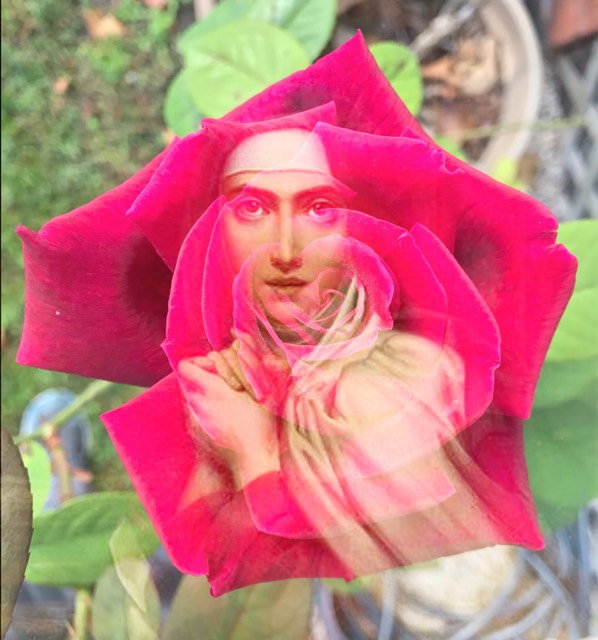
The Passion of Saint Thérèse


In June of 1895, two years before her death, St. Thérèse of the Child Jesus and the Holy Face made an "Act of Oblation to Merciful Love." She expressed her gratitude to God for the grace of suffering: "Since you deigned to give me a share in this very precious Cross, I hope in heaven to resemble You and to see shining in my glorified body the sacred stigmata of Your Passion." (The Story of a Soul, trans. by Fr. John Clarke, OCD, p.277)

In the mental and physical sufferings that St. Thérèse experienced in the weeks preceding her early demise, she came to resemble her Crucified Spouse very much. As the tuberculosis consumed her body, a trial of faith and hope, in which heaven and eternity seemed closed to her, tortured her soul. The coughing of blood and persistent sore throat led to a treatment of painful cauterization with silver nitrate. Eventually, "gangrene ate away her intestines and she lost blood two or three times a day. Drinking only intensified her burning thirst. She had a terrible feeling of suffocation which could not be eliminated by the administration of ether. Finally, her bones protruded through her flesh to such an extent that, when she was made to sit upright to get some relief, it seemed to her that she was seated on iron spikes." (Complete Spiritual Doctrine of St. Therese of Lisieux by Rev. Francois Jamart, pp. 187-188) She confided to her sister, Mother Agnes of Jesus, that her pain was so intense that at times she was tempted to commit suicide: "What a grace it is to have faith! If I had no faith I would have inflicted death on myself without hesitating a moment!" (The Story of a Soul, p. 264)

On the afternoon of September 30, 1897, she entered into her agony. "Everything I have written about my desires for suffering," she gasped. "Oh, it is true just the same. I am not sorry for having surrendered myself to love. Oh, I am not sorry, on the contrary!" (The Story of a Life by Bishop Guy Gaucher, p. 204)

Nevertheless, Mother Agnes was so distressed by her sister's ordeal that she knelt before a statue of the Sacred Heart and begged for the grace of final perseverance for her little Thérèse. When the other nuns of the Carmel were summoned to the infirmary to support their sister with prayers in her dying moments, they saw her purplish hands holding her profession crucifix. Shortly after seven o'clock in the evening, the saint looked at the crucifix and breathed forth her last words: "My God, I love You!" After gazing a few moments with an expression of ecstatic joy at the statue of Our Lady, the beloved "Virgin of the Smile," brought from her childhood home, she died peacefully, her own face transfigured and smiling. On October 4, she was buried in the cemetery of the town of Lisieux. Only a few relatives and friends were present at the burial of the twenty-four year old nun. No one guessed that a storm of glory, a shower of miracles, was about to break forth.
Thursday, September 10, 2015

The Habit of a Cloistered Heart

From The Cloistered Heart: "The habit of a cloistered heart is a habit of seeking God's will. It is a habit of prayer, of virtue, of choosing Our Lord above all. It is a habit of holy actions acquired over time, through repetition." (Read more.)

Sunday, August 9, 2015

Learning from Elijah's Despair

From Catholic Exchange:
In his despair, Elijah takes refuge from the sun in the shade of a broom tree. (Some have suggested that this was the beautiful Retama raetam with white flowers.) Noticeably, in his depressed state, Elijah hides from the light. In fact, another biblical prophet prayed for death in the shade of a plant too (see Jonah 4:8). Shade, of course, is an essential survival tool in a hot desert, but Elijah’s shrinking away from the light might symbolize his shrinking away from God’s calling on his life.
After letting the prophet mope for a bit, the angel of the Lord taps him on the shoulder and commands him to eat. Note how “pro-life” God appears here. He is not willing to let his prophet die through voluntary self-starvation, but actually commands him to eat (1 Kgs 19:5) and provides him with a special meal (19:6). The meal consists of water and a round flat loaf of bread baked on hot coals. This is not an elaborate feast, but a simple affair. Yet this meal miraculously sustains Elijah for a forty-day and forty-night journey.
This meal is truly “bread for the journey,” one of the names for the Eucharist. Indeed, this is why we read this passage in conjunction with John 6, where Jesus describes the new “bread for the journey” which he will provide. Like Elijah’s bread, which took him from black despair to seek out the Lord at Mt. Horeb, the Eucharist can take us from the darkness of sin and empower us for the voyage ahead. If we lose sight of our purpose, get down in the dumps, or find ourselves wallowing in the shade of a broom tree, the Eucharist can bring us back to God’s plan for us. It can sustain us when we feel like giving up. (Read more.)


Sunday, July 26, 2015

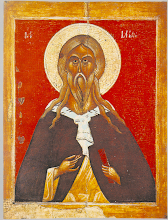
Elias as a Type of Our Savior

From St. Augustine:
Brethren dearly beloved, in the Lessons which are now being read to us day by day, I have warned you that we must not follow the letter which kills, and thereby abandon the quickening spirit.  For it is thus that the Apostle says: “The letter killeth, but the spirit giveth life.”  If we desire to understand only what is in the letter, we shall get little or no edification from our readings in the sacred Scriptures.  All those things whereof we hear were types and images of things to come; and those things which were foreshadowed in the history of the Jews are, by the gift of God, fulfilled in us.
The blessed Elias, for instance, was a type of the Saviour.  Just as Elias was rejected by Jewry, so was the true Elias, even our Lord, rejected and despised by Jewry.  Elias went away out of his own country, and Christ must needs leave the synagogue.  Elias went into the desert, and Christ has come into the world.  Elias, when he was in the desert, was fed by ravens, and Christ in the desert of this world is comforted by the faith of the Gentiles.

For the ravens which, at the command of the Lord, ministered to Elias, may be understood as a type of the flock of the Gentiles.  Wherefore also it is said for the Gentile Church: “I am black, but comely, O ye daughters of Jerusalem.”  Why is the Church black but comely?  She is black in the natural order but comely by grace.  Because she must own this truth: “Behold, I was shapen in iniquity, and in sin did my mother conceive me.”  Why is she comely by grace?  Because she can go on and say: “Thou shalt purge me with hyssop, and I shall be clean; thou shalt wash me, and I shall be whiter than snow.” (Read more.)
Related Posts with Thumbnails