


Friday, June 21, 2019

The Mystic Number of Seven

From Vultus Christi:
The mystic number of seven signifies the fullness that overflows into eternity. The duties of our service, nostrae servitutis officia, are but a foretaste of heaven where our adoration and our praise will never cease. The vocation to perpetual adoration is a vocation to heaven on earth. Rightly did the Venerable Mother Caterina Lavizzari repeat, Gesù–Ostia è il nostro Paradiso in terra. This is the phrase that appears on the mementos printed after her death on Christmas day 1931.
Our obligation to the full Divine Office, by day and by night, though it be demanding of our time, of our best energies, and of our sustained attention, is the sweet duty of love. While all the community may not be present for every Hour of the Divine Office, when even a representative nucleus of the community assemble for the praise of God, they do so in communion of mind and heart with the absent brethren. The labours of the absent brethren, or their infirmity, or the duties that under obedience oblige them to be elsewhere, do not break the “charity that is the bond which makes us complete.” (Colossians 3:14). In the Epistle to the Colossians, the Apostles gives us the context of the Opus Dei. He says:
Put ye on therefore, as the elect of God, holy, and beloved, the bowels of mercy, benignity, humility, modesty, patience: bearing with one another, and forgiving one another, if any have a complaint against another: even as the Lord hath forgiven you, so do you also. But above all these things have charity, which is the bond of perfection: and let the peace of Christ rejoice in your hearts, wherein also you are called in one body: and be ye thankful. Let the word of Christ dwell in you abundantly, in all wisdom: teaching and admonishing one another in psalms, hymns, and spiritual canticles, singing in grace in your hearts to God. All whatsoever you do in word or in work, do all in the name of the Lord Jesus Christ, giving thanks to God and the Father by him. (Colossians 3:12–17)
(Read more.)

Wednesday, May 29, 2019

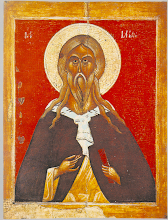
Blessed Elia

From Elijah's Breeze:
Blessed Elia of St. Clement was born in Bari, 17th January 1901, to deeply Christian parents. At her baptism, she was given the name Theodora, gift of God. In the brief course of her life on earth, she lived up to her name. On 8th April 1920 (then Feast of St. Albert, author of the Carmelite Rule), she entered the Carmel of St. Joseph in Bari. She received the habit on 24th November of the same year, the feast of St John of the Cross. On 8th December 1924, she wrote in her own blood her act of total and definitive offering to the Lord with the vow to embrace the “most perfect”. She died on Christmas day 1927. On 19th December 2005, Pope Benedict XVI signed the Decree of Beatification. She was proclaimed Blessed in Bari Cathedral on 18th March 2006. (Read more.)

More HERE.

Friday, April 5, 2019

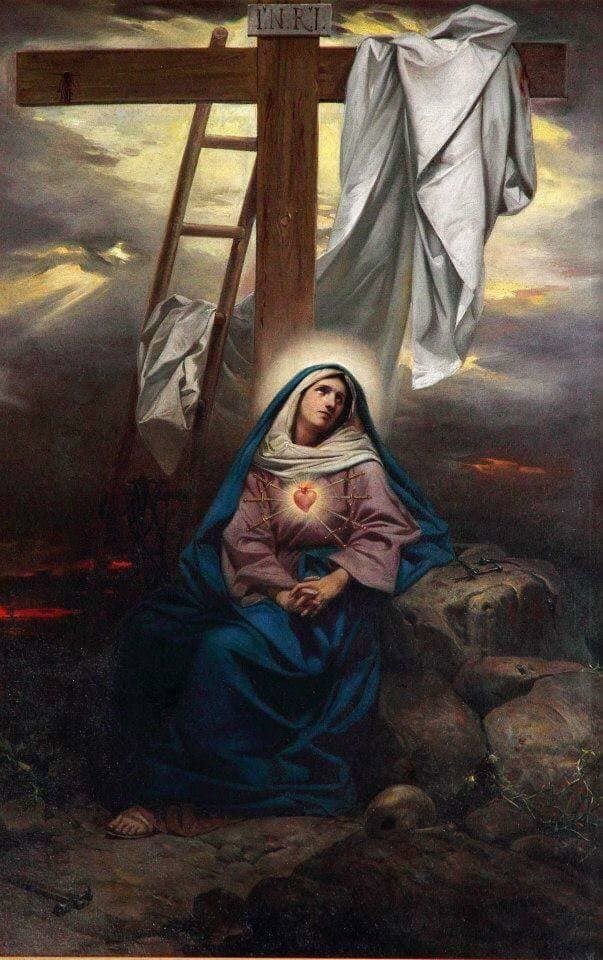
Our Lady of Sorrows

Remembering the Sorrowful Mother. From the Stabat Mater:
Sancta Mater, istud agas,
crucifíxi fige plagas
cordi meo válide.


Wounded with His every wound,
steep my soul till it hath swooned,
in His very Blood away.

Tuesday, April 2, 2019

Jesus Goes Up Alone onto a Mountain to Pray

 James Tissot, 1894. "And it came to pass in those days, that he went out into a mountain to pray, and he passed the whole night in the prayer of God." St. Luke 6:12

Monday, March 18, 2019

The Mature Christian

Gabriel Metsu - Crucifixion

From Monsignor Charles Pope:
The mature Christian is not a perfect Christian but is living a life of hope, a life of confident expectation of God’s help. He has already seen sins put death and new graces coming alive. As a result, he has come to know that this growth will continue if he cooperates with God’s grace. He has a proper sorrow for his sins and humility on account of them—but not despair or humiliation, as if God would leave him forever beset by his sins. A mature Christian cooperates with God’s grace and mercy knowing that through that grace and mercy he will win in the end.

There are, of course, still sufferings to undergo, but they can be endured with greater trust and a lively hope. The mature Christian knows that God has permitted them for a reason, and He will surely release new blessings if he walks in faith. The mature Christian is not easily unsettled by difficulties or trials; he endures them with the courage that faith has. This is because he has come to know and experience that Jesus is risen from the dead and that the final destination for those of faith is victory and glory.

The mature Christian also knows that there is a battle to engage, both personally and in the world; it is a battle for souls. However, since he knows that Jesus has risen form the dead, he knows that the outcome of the battle has already been decided; he knows which army will ultimately win. Therefore, apparent setbacks or losses are not devastating. On Good Friday all seemed lost, but Jesus rose on Sunday morning. So, too, for the Church and all who battle for the truth and choose the Kingdom of God. We preach the gospel and seek to live it both in season and out of season, whether popular or ridiculed. The mature Christian is serene because he knows that Jesus is risen from the dead and that He has already won the final victory. (Read more.)

Friday, January 4, 2019

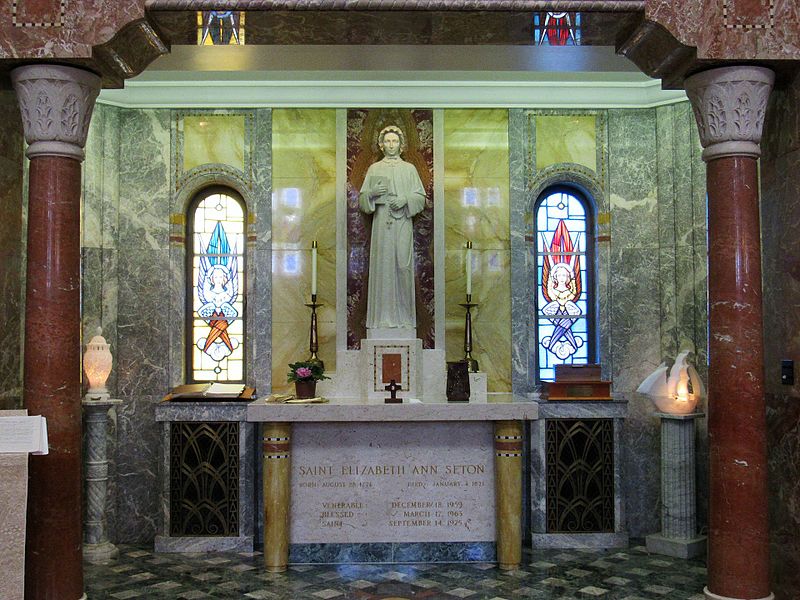
St. Elizabeth Ann Seton

The Tomb of St. Elizabeth at the basilica in Emmitsburg, MD
From Vultus Christi:
Elizabeth Ann Seton was, more than anything else, a Eucharistic soul. She was converted by the Eucharist. Her first instructions in the Catholic faith emanated from the silence of the tabernacle. As she went forward, following the Lamb of God wheresoever it pleased Him to lead her, Eucharistic adoration marked her spiritual journey more and more until, in the final years of her life, she was often seen in ecstatic adoration of the Real Presence.

Paradoxically, it is this thoroughly American saint, who, by her devotion to the Mother of God, her attachment to the Mystery of the Eucharist, and her obedience to the Chair of Peter, offers the antidote to the errors of “Americanism,” condemned by Pope Leo XIII in 1899.
The underlying principle of these new opinions, declared the Pope, is that, in order to more easily attract those who differ from her, the Church should shape her teachings more in accord with the spirit of the age and relax some of her ancient severity and make some concessions to new opinions. Many think that these concessions should be made not only in regard to ways of living, but even in regard to doctrines which belong to the deposit of the faith. They contend that it would be opportune, in order to gain those who differ from us, to omit certain points of her teaching which are of lesser importance, and to tone down the meaning which the Church has always attached to them. It does not need many words, beloved son, to prove the falsity of these ideas if the nature and origin of the doctrine which the Church proposes are recalled to mind.
(Read more.)

Sunday, November 18, 2018

Are You Ready For When the Lord Shall Come?

There are different ways to watch and wait. There is the passive watching and waiting such as one might do when waiting for a bus to come, but there are other more active ways such as a waiter might exhibit as he hovers in the background anticipating the needs of the diners. It is this watchful and waiting spirit that the Lord has in mind here. If we have invited guests to our home, we prepare our house and make sure everything is in order as we await their arrival. In a less literal sense, to set our house in order is to sweep clean our soul of sin and all unrighteousness, by God’s grace, and to remove the clutter of worldliness. Regular confession and daily repentance sweep clean the house of our soul; simplifying our life and minimizing worldly attachments de-clutters the house of our soul. Have you prepared the house of your soul for the Lord’s arrival? If you haven’t, the Lord says that you may experience him as a thief; He is not really a thief, though, because everything belongs to Him. If we have not renounced our worldliness and greed, if we have not de-cluttered our lives worldly attachments, the Lord will come to take back what is His; He will seem a thief to us because we think it is ours. It’s never a good idea to call God, the Lord and owner of all, a thief! (Read more.)
Related Posts with Thumbnails