


Tuesday, March 31, 2026

Tuesday of Holy Week


From Dom Gueranger:

On the road from Bethania to Jerusalem, the Disciples are surprised at seeing the fig-tree, which their Divine Master had yesterday cursed, now dead. Addressing himself to Jesus, Peter says: Rabbi, behold, the fig-tree, which thou didst curse, is withered away. In order to teach us that the whole of material nature is subservient to the spiritual element, when this last is united to God by faith—Jesus replies: Have the faith of God. Amen I say to you, that whosoever shall say to this mountain: Be thou removed and cast into the sea! and shall not stagger in his heart, but believe, that whatsoever he saith shall be done, it shall be done unto him.

Having entered the City, Jesus directs his steps towards the Temple. No sooner has he entered, than the Chief Priests, the Scribes, and the Ancients of the people accost him with these words: By what authority dost thou these things? and who has given thee this authority, that thou shouldst do these things? We shall find our Lord’s answer given in the Gospel. Our object is to mention the leading events of the last days of our Redeemer on earth; the holy Volume will supply the details.

As on the two preceding days, Jesus leaves the City towards evening: he passes over Mount Olivet, and returns to Bethania, where he finds his Blessed Mother and his devoted friends.

In today’s Mass, the Church reads the history of the Passion according to St.Mark, who wrote his Gospel the next after St. Matthew: hence it is that the second place is assigned to him. His account of the Passion is shorter than St. Matthew’s, of which it would often seem to be a summary; and yet certain details are peculiar to this Evangelist, and prove him to have been an eyewitness. Our readers are aware that St. Mark was the disciple of St. Peter, and that his Gospel was written under the very eye of the Prince of the Apostles. (Read more.)

Monday, March 30, 2026

Monday of Holy Week

From Dom Gueranger:

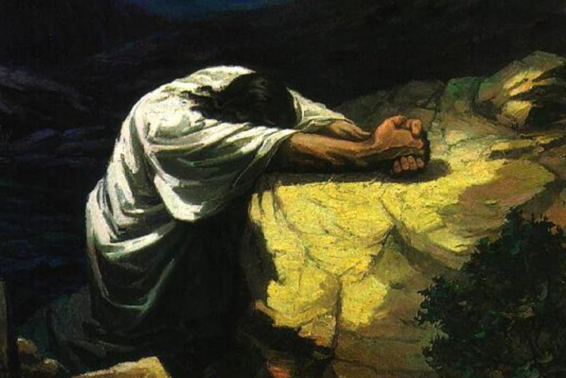
The Sufferings of our Redeemer, and the patience wherewith he is to bear them, are thus prophesied by Isaias, who is always so explicit on the Passion. Jesus has accepted the office of Victim for the world’s salvation; he shrinks from no pain or humiliation: he turns not his Face from them that strike him and spit upon him. What reparation can we make to this Infinite Majesty, who, that he might save us, submitted to such outrages as these? Observe these vile and cruel enemies of our Divine Lord: now that they have him in their power, they fear him not. When they came to seize him in the Garden, he had but to speak, and they fell back upon the ground; but he has now permitted them to bind his hands and lead him to the High Priest. They accuse him; they cry out against him; and he answers but a few words. Jesus of Nazareth, the great Teacher, the wonder-worker, has seemingly lost all his influence; they can do what they will with him. It is thus with the sinner; when the thunder-storm is over, and the lightning has not struck him, he regains his courage. The holy Angels look on with amazement at the treatment shown...to Jesus, and falling down, they adore the Holy Face, which they see thus bruised and defiled: let us, also, prostrate and ask pardon, for our sins have outraged that same Face.

But let us hearken to the last words of our Epistle: He that hath walked in darkness, and hath no light, let him hope in the name of the Lord, and lean upon his God. Who is this but the Gentile, abandoned to sin and idolatry? He knows not what is happening at this very hour in Jerusalem; he knows not that the earth possesses its Savior, and that this Savior is being trampled beneath the feet of his own chosen people: but in a very short time, the light of the Gospel will shine upon this poor Gentile: he will believe; he will obey; he will love his Redeemer, even to the laying down his life for him. Then will be fulfilled the prophecy of the unworthy Pontiff, who prophesied against his will that the death of Jesus would bring salvation to the Gentiles, by gathering into one family the children of God, that hitherto had been dispersed. (Read more.)


Sunday, March 29, 2026

Palm Sunday


After this, I saw a great multitude, which no man could number, of all nations and tribes and peoples and tongues, standing before the throne and in sight of the Lamb, clothed with white robes, and palms in their hands. And they cried with a loud voice, saying: Salvation to our God, who sitteth upon the throne and to the Lamb. Apocalypse 7:9-10
It is the triumphant entry of Our Lord into Jerusalem as He comes there to die. Let us grasp the palms which celebrate His martyrdom and our own. I have always loved Palm Sunday, since I was a small child. There is a sense during this week of weeks of being transported beyond time and space into the Jerusalem of old. All Christians become citizens of Jerusalem during Holy Week as we watch the greatest drama in the history of the world unfold. The Passion of Our Savior is the source and center of all tragedy, of all poetry, of all great art, of all the love, hope, and tears that ever were and that ever will be. We are confronted with our own weakness and sin as we see ourselves not only as helpless but as guilty. It is only in immersing ourselves in the bitter suffering and abandonment of Our Lord Jesus Christ that the chaos, turmoil and useless agony of life and the world make any sense at all.

Wednesday, March 25, 2026

The Annunciation

The solemnity of the Annunciation is today. Here is a reflection from Divine Intimacy by Father Gabriel of Saint Mary Magdalen, OCD:
The Angel's explanation does not prevent future events and circumstances from remaining hidden and obscure to Mary. She finds herself face to face with a mystery, a mystery which she knows intuitively to be rich in suffering; for she has learned from the Sacred Scriptures that the Redeemer will be a man of sorrows, sacrificed for the salvation of mankind. Therefore, the ineffable joy of the divine maternity is presented to her wrapped in a mystery of sorrow: to be willing to be the Mother of the Son of God means consenting to be the Mother of one condemned to death. Yet Mary accepts everything in her fiat: in the joy as well as in the sorrow of the mystery, she has but one simple answer: "Behold the handmaid of the Lord."


Of His Kingdom There Shall Be No End

A meditation on the Annunciation by Father Thomas de Saint-Laurent:
God chose the Archangel Gabriel from among the princes of the celestial court who remained constantly before the throne of the Almighty. He entrusted to him the most important and glorious assignment ever confided to a creature, the mission of announcing to the Virgin the awesome mystery of the Incarnation. All Heaven now looked upon that simple house of Nazareth, where a profound peace reigned. Joseph probably rested from his hard labor. In the adjoining room, his virgin spouse was praying. The angel appeared and respectfully bowed before his Queen. His countenance resplendent with supernatural joy, he said to her, “Hail, Mary, full of grace, the Lord is with thee: blessed art thou among women.”18 Saint Gabriel uttered but the strictest truth. At the moment of Mary’s conception, divine grace flooded her magnificent soul. Ever since then, this grace had grown ceaselessly in proportions far surpassing our feeble understanding. Now, at this moment, the adorable Trinity wanted this already extraordinary holiness to shine with even greater brilliance: Our Lady would shelter in her womb the very Author of grace.

Yet, the Archangel’s salutation troubled the Immaculate Virgin. By divine enlightenment she had long understood the immensity of God and the nothingness of creatures. In her prodigious humility, she considered herself the lowliest of creatures and thus wondered at receiving such praise. She pondered what hidden meaning could be shrouded in such words.

Seeing this most incomparably perfect of all creatures with such a humble opinion of herself, the celestial ambassador exulted with admiration. “Mary,” he said to the trembling Virgin, “fear not, for thou hast found grace with God.”19

Then slowly, majestically, in the name of the Eternal God, he communicated his sublime message: “Behold, thou shalt conceive in thy womb and shalt bring forth a son, and thou shalt call His name Jesus. He shall be great and shall be called the Son of the Most High, and the Lord God shall give unto Him the throne of David His father, and He shall reign in the house of Jacob forever, and of His kingdom there shall be no end.”20
These words were far too clear to Our Lady for any hesitation in grasping them. She immediately understood the incomparable honor reserved for her. It seems that she experienced no hesitation on account of her virginity. Indeed, it would be a gratuitous insult to her intelligence to suspect her of such ignorance. She was aware of the prophecy of Isaias that the Emmanuel would be born of a virgin. Rather, she simply sought to know how God, so rich in miracles, would accomplish such a marvel. “How shall this be done,” she asked the angel, “for I know not man?”21 “The Holy Ghost shall come upon thee, and the power of the Most High shall overshadow thee. Therefore, the child which shall be born of thee shall be called holy, the Son of God. And behold, thy cousin Elizabeth, she also hath conceived a son in her old age; and this is the sixth month with her who is called barren; for nothing shall be impossible with God.”22 Profound silence filled that small room in Nazareth, one of those dramatic silences wherein the world’s destiny hangs in the balance.

The angel had ceased speaking and Mary was quiet. How many thoughts crowded in upon her! In her mind’s eye, she saw the resplendent crown divine motherhood would place on her head, yet she remained too profoundly humble for any complacency about this singular grandeur. She saw the indescribable joys that would surely fill her heart when holding her dear treasure against her bosom, her Jesus, both God and infant. Yet again, her self-mortification would not allow that she be guided by the allure of joy alone, even the most holy of joys.

She also saw the awful martyrdom that would rend her soul. Through Holy Scripture she knew that the Messias would be delivered to His death like a tender lamb to the slaughter. She foresaw and heard the mournful cry: “I am a worm, and no man; the reproach of men, and the outcast of the people.”23 Yet, such was her fortitude that she would not allow future sorrow to dishearten her. Above everything, she saw the extremely lofty, fatherly, and holy will of God. She owed obedience to Him; she did not hesitate.
The Immaculate Virgin at last broke the solemn silence. The angel waited to receive her consent in the name of the Holy Ghost. In accepting, she pronounced one of those sublime expressions that only the genius of humility can find. It was the most simple and modest formula of a soul completely submissive to the will of God: “Behold the handmaid of the Lord; be it done unto me according to thy word.”24 At that, the grandest of all miracles took place. From the very flesh of the Immaculate Virgin, the Holy Ghost formed a small human body. To this body He joined a human soul; to this body and soul He united the Second Person of the Most Holy Trinity, the Word of God. (Read entire post.)

Sunday, March 22, 2026

Vexilla Regis

From A Clerk at Oxford:
This season, from this present day until the holy Eastertide, is called Christ's Passion-tide, and all God's servants in the holy church with their divine liturgies honour and hold in mind his Passion, through which we were all redeemed. Our books say, too, that we should keep this fortnight with great devotion, because of the approach of the holy Passion and the glorious resurrection of our Saviour. In these days we omit in our responses 'Gloria Patri', in mourning for the holy Passion, except if a great feast-day occurs then.

This is the opening of Ælfric's sermon for the Fifth Sunday in Lent. As he explains, the last two weeks before Easter are traditionally Passiontide, Cristes ðrowung-tid, a season with its own customs and character of deepening solemnity for genealæcunge þære halgan ðrowunge 'because of the approach of the holy Passion'. Along with practices such as that mentioned by Ælfric of omitting 'Gloria Patri' in the liturgy, the season has its own hymns, most famously 'Vexilla Regis Prodeunt': (Read more.)

Saturday, March 21, 2026

Passiontide


Today we veil the statues and pictures of our home altar with purple cloth, in observance of Passiontide. Although the Fifth Sunday of Lent is not designated as "Passion Sunday" on the new calendar, it is still permissible to cover the statues and sacred images during this week and the next. It really helps to create a spirit of mourning in honor of the sufferings of Our Lord. The Church offers a treasury of beautiful hymns which draw the soul into the mystery of Christ's passion and death.

As Abbot Gueranger writes in The Liturgical Year, Vol VI:
Let us hope that, by God's mercy, the holy time we are now entering upon will work such a happy change in us, that, on the day of judgment, we may confidently fix our eyes on Him we are now about to contemplate crucified in the hands of sinners. The death of Jesus puts the whole of nature in commotion; the midday sun is darkened, the earth is shaken to its very foundations, the rocks are split; may it be that our hearts, too, be moved and pass from indifference to fear, from fear to hope, and, at length from hope to love; so that having gone down with our Crucified to the very depths of sorrow, we may deserve to rise with Him unto light and joy, beaming with the brightness of His Resurrection, and having within ourselves the pledge of new life, which shall then die no more.
During Passiontide, it is good to reflect upon the nature of envy and jealousy, for it is envy and jealousy which killed Jesus.
Envy disrupts social life generally. It sets the child against the father, brother against brother, neighbor against neighbor, and nation against nation. It kills friendship, undermines business relationships, and hinders reconciliation. It is one of the chief sources of misunderstanding, criticism, hatred, vengeance, calumny, detraction, and perverse attacks upon private life.

Envy and greed, the source of the world's unrest and wars, are sins against charity, because they make us seek what belongs to others. Often, even at the cost of harm to our neighbor, we want what does not belong to us....The envious person becomes distrustful, unjust, suspicious. Envy makes its victims ill-tempered, sad, and unapproachable....

Jealousy implies the fear of being displaced by a rival, or of being deprived of that which is rightfully ours or of that which we think ought to be ours. Jealousy is anther form of envy. Jealousy has to do with our own possessions, whereas envy has to do with the possessions of others. We resent an intrusion upon that which belongs to us, and we are prone to become vengeful at this disregard of our rights and claims.

Jealousy goes a step further than envy; it not only tries to lessen the good opinion others enjoy and criticizes those who are praised and rewarded, but is characterized by an excessive love of our own personal good and brings on a fear that we will be deprived of it. Jealousy prefers to see good left undone rather than lose a single degree of praise.
(Excerpt from The Hidden Power of Kindness by Father Lawrence Lovasik, Sophia Institute Press, 1999, pp.62-63)
Related Posts with Thumbnails