




 Posts
Posts


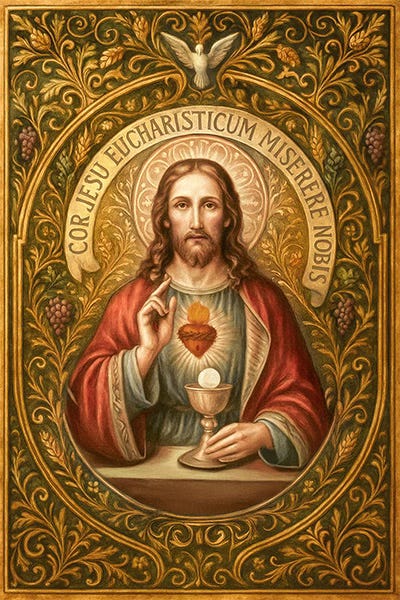
From 1P5:
Starting in the 12th century, there began what I like to call the Eucharistic Revolution. It began with Hildebert of Lavardin coining the word “Transubstantiation.” Then began the penning of stories about the Holy Grail; not very reliable as a source of history, they nevertheless incorporate stories of Eucharistic Miracles that would repeatedly occur in real life down to – especially in – our time. During the period they grew in popularity in the 13th century, Transubstantiation was defined as the best way to describe what happens at the Mass, and St. Juliana of Cornillon had her visions which led to the great feast of Corpus Christi. This turn led to the growth of Eucharistic processions, adoration, and much more. But in 1199, Christ appeared to St. Lutgarde of Saint-Trond. This is the first medieval apparition of the Sacred Heart passed down to us through Tradition.
At the same time, devotion grew to Our Lord’s Five Wounds, and their connection to the Eucharist was not unnoticed – after all, it was the same blood that came down daily upon each Altar, was reappearing in miracles (sometimes bleeding from hosts and at others from images of Our Lord), and relics of which were being brought back along a great many others from the Holy Land and Constantinople, thanks to the Crusades. Ss. Gertrude the Great and Mechtilde – both in the Abbey of Helfta, received visions of the Sacred Heart, and St. Bonaventure, and a great many other preached about this Heart and the Blood that flowed from it.
When the Protestant Revolt broke out, the Pilgrims of Grace in England marched against the King’s men under the banner of the Five Wounds. St. Ignatius of Loyola in his Anima Christi Prayer united all elements of devotion to Christ – and St. Peter Canisius spoke frequently of Christ’s Heart and Blood in defence of His Real Presence in the Eucharist; a theme taken up by many Catholic preachers fighting the new heresies.
[...]
When the French Revolution broke out in 1789, and drowned that word in fire and blood, the imprisoned Louis XVI privately consecrated the country to the Sacred Heart and vowed to do so publicly if restored to power. This did not happen, as we know. But from the Vendée to Spain to Tyrol, the Sacred Heart became the symbol of Catholic resistance to the revolution. Afterwards, it was a big part of the Catholic Restoration. (Read more.)





No comments:
Post a Comment