Thursday, December 28, 2023

Childermas Day

The Feast of the Holy Innocents. From Dr. Eleanor Parker at A Clerk of Oxford:
Medieval writers were honest and clear-eyed about such uncomfortable truths. The idea that thoughts like these are incongruous with the Christmas season (as you often hear people say about the Holy Innocents) is largely a modern scruple, encouraged by the comparatively recent idea that Christmas is primarily a cheery festival for happy children and families. Our images of Christmas joy, both secular and sacred, are all childlike wonder and picture-perfect families gathered round the tree. And this is nice, of course, for those who have children or happy families, but for those who don't - those who have lost children or parents or others dear to them, those who face loneliness or exclusion, those who want but don't have children, family, or home - it can be intensely painful. Not everyone can choose not to think about grief at Christmas; many people will find it intrudes upon them, whether they wish it to or not. 'In sorrow endeth every love but thine, at the last'. The modern version of Christmas tends to sideline and ignore that pain, asking it to at least keep quiet so as not to spoil the 'magic'. But that's not the case with medieval writing about Christmas and the Christ-child. There are, of course, many merry and joyful medieval carols, and the season was celebrated in the Middle Ages with great enthusiasm; but there are also many carols like this which are serious, melancholy, and sad, which acknowledge the fact that the child whose birth is celebrated came to earth to die. Older writings on Christmas, like this lullaby, do not exclude but encompass human pain - it's that pain, they say, which Christ has come to earth to share. The idea is well expressed by John Donne, writing a little later than the medieval period (though only a few decades after the Coventry mystery plays were abolished), in a sermon he preached on Christmas Day 1626:
The whole life of Christ was a continual passion; others die martyrs, but Christ was born a martyr. He found a Golgotha, where he was crucified, even in Bethlehem, where he was born; for, to his tenderness then, the straws were almost as sharp as the thorns after; and the manger as uneasy at first, as his cross at last. His birth and his death were but one continual act, and his Christmas Day and his Good Friday are but the evening and morning of one and the same day.
(Read more.)

Sunday, December 24, 2023

Alma Redemptoris Mater

The Alma Redemptoris Mater is sung after Night Prayer (Compline) throughout Advent until Candlemas on February 2nd.


Loving mother of the Redeemer, gate of heaven, star of the sea, assist your people who have fallen yet strive to rise again, To the wonderment of nature you bore your Creator, yet remained a virgin after as before, You who received Gabriel's joyful greeting, have pity on us poor sinners.


(Image: Virgin of Vladimir)

Saturday, December 9, 2023

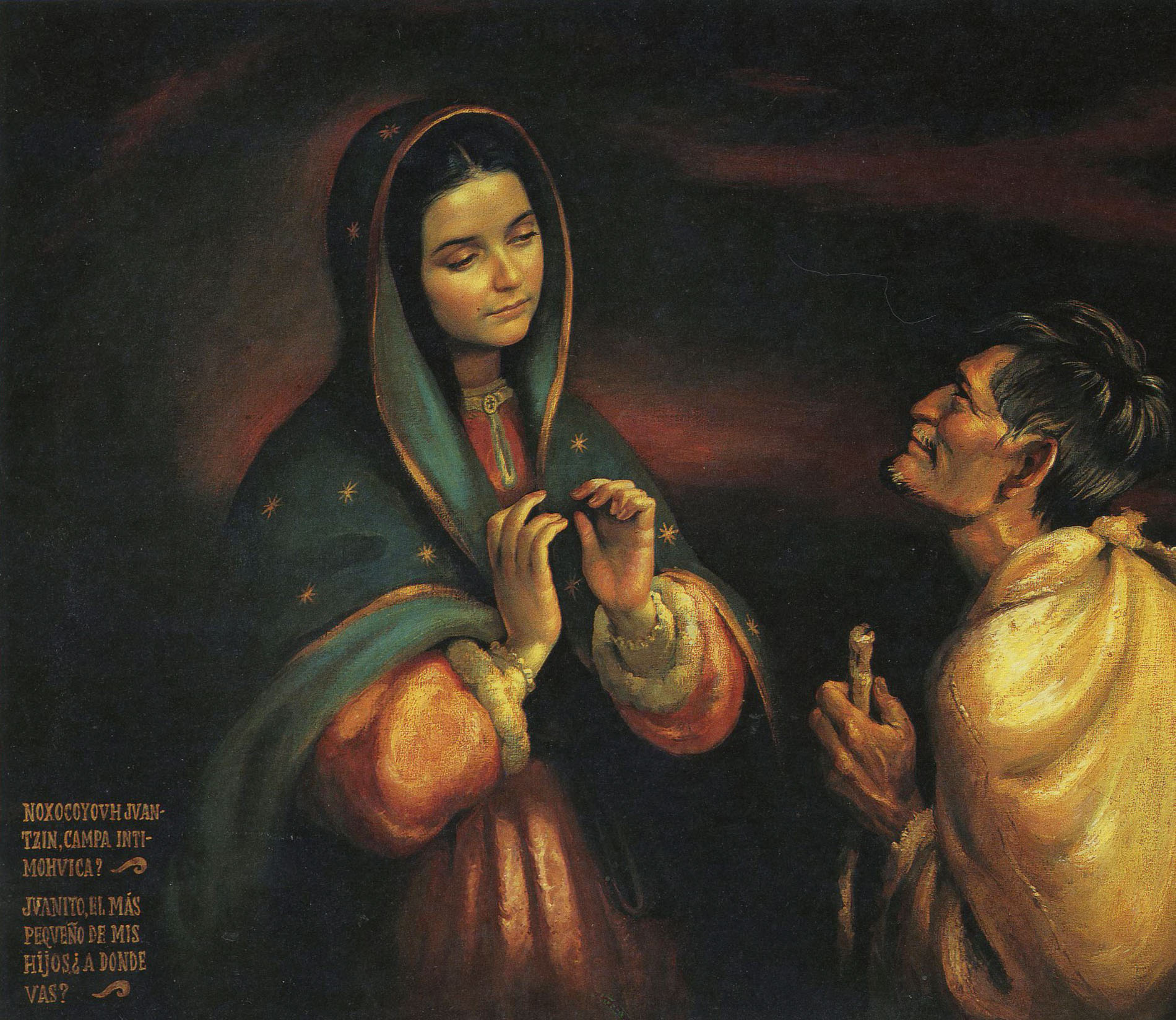
Saint Juan Diego

The Aztec who saw Our Lady.
Most historians agree that Juan Diego was born in 1474 in the calpulli or ward of Tlayacac in Cuauhtitlan, which was established in 1168 by Nahua tribesmen and conquered by the Aztec lord Axayacatl in 1467; and was located 20 kilometers (14 miles) north of Tenochtitlan (now Mexico City).
His native name was Cuauhtlatoatzin, which could be translated as "One who talks like an eagle" or "eagle that talks". The Nican Mopohua describes him as a 'macehualli' or "poor Indian", one who did not belong to any of the social categories of the Empire, as priests, warriors, merchants,...but not a slave; a member of the lowest and largest class in the Aztec Empire. When talking to Our Lady he calls himself "a nobody", and refers to it as the source of his lack of credibility before the Bishop....(Read more.)


Tuesday, December 5, 2023

St. John Damascene and the "Ishmaelites"

When I came upon this post, I wondered at first glance which ultramontane rabble-rouser had authored it, before realizing that it was from the writings of St. John Damascene. He was the last of the Greek Fathers and lived at a time when the ancient Christian communities were falling into Moslem hands. St. John did not mince words. To quote:
They furthermore accuse us of being idolaters, because we venerate the cross, which they abominate. And we answer them: ‘How is it, then, that you rub yourselves against a stone in your Ka’ba [107] and kiss and embrace it?’ Then some of them say that Abraham had relations with Agar upon it, but others say that he tied the camel to it, when he was going to sacrifice Isaac. And we answer them: ‘Since Scripture says that the mountain was wooded and had trees from which Abraham cut wood for the holocaust and laid it upon Isaac, [108] and then he left the asses behind with the two young men, why talk nonsense? For in that place neither is it thick with trees nor is there passage for asses.’ And they are embarrassed, but they still assert that the stone is Abraham’s. Then we say: ‘Let it be Abraham’s, as you so foolishly say. Then, just because Abraham had relations with a woman on it or tied a camel to it, you are not ashamed to kiss it, yet you blame us for venerating the cross of Christ by which the power of the demons and the deceit of the Devil was destroyed.’ This stone that they talk about is a head of that Aphrodite whom they used to worship and whom they called Khabár. Even to the present day, traces of the carving are visible on it to careful observers. (Read more.)

Monday, November 27, 2023

Novena to St. Nicholas the Wonder-worker

Let us pray the novena to St. Nicholas of Myra, the patron saint of children, mariners, prisoners, miners and brides. Our children especially need his prayers to protect their innocence. As the charity of St. Nicholas once saved three young girls from a life of prostitution, so let us pray for his intercession for all those in sexual slavery, as well as for those who choose to live in a state of concubinage. And may he help all women and girls who seek an honorable marriage with a Christian husband. And deliver all those tormented by evil spirits. From the St. Nicholas Center:
St. Nicholas, Glorious Confessor of Christ,
assist us in thy loving kindness.

Glorious St. Nicholas,
my special Patron from thy throne in glory,
thou dost enjoy the presence of God,
turn thine eyes in pity upon me
and attain for me from our Lord
the graces and help that I need
in my spiritual and temporal necessities (and especially this favor provided that it be profitable to my salvation).
Be mindful likewise,
O Glorious and Saintly Bishop,
of our Sovereign Pontiff of our Holy Church
and of all Christian people.
Bring back to the right way of salvation all those who are living steeped in sin,
blinded by darkness of ignorance, error and heresy.
Comfort the afflicted,
provide for the needy.
Strengthen the fearful,
defend the oppressed,
give health to the infirm.
Cause all [people] to experience the effects
of thy powerful intercession
with the supreme giver
of every good and perfect gift. Amen.
Say one Our Father, Hail Mary and Glory Be to the Father.
Pray for us, O Blessed Nicholas,
that we may be worthy of the promises of Christ.
Let us Pray.
O God who has glorified Blessed St. Nicholas,
thine illustrious Confessor and Bishop,
by means of countless signs and wonders,
and who does not cease daily so to glorify him ,
grant we beseech thee,
that we, being assisted by his merits and prayers,
be delivered from the fires of hell
and from all dangers through Christ our Lord.

Amen.
Monday, November 20, 2023

Newman's Dialogues on "Doctrinal Corruption"

 From Stephanie Mann:

Matthew Levering's Newman on Doctrinal Corruption could be considered an alternative interpretation of Newman's Essay on the Development of Christian Doctrine. By exploring Newman's dialogues with the (deceased) historian Edward Gibbon, his friend Richard Hurrell Froude, his own younger brother Francis Newman, his erstwhile Tractarian friend E.B. Pusey, and his German contemporary Ignaz von Döllinger, Levering helps readers understand Newman's search for religious Truth and the moral certainty that he was living in the "one True fold of Christ" (as he wrote on October 8, 1845 before Blessed Dominic Barberi received him in to the Catholic Church the next day).

As the publisher, Word on Fire Academic, describes the book:
Newman on Doctrinal Corruption examines John Henry Newman’s understanding of history and doctrine in his own context, first as an Oxford student and professor reading Edward Gibbon and influenced by his close friend Hurrell Froude, then as a new Catholic convert in dialogue with his brother Francis, and finally as an eminent Catholic during the controversies over the dogmas of the Immaculate Conception (in dialogue with Edward Pusey) and papal infallibility (in dialogue with Ignaz von Döllinger).

Author Matthew Levering argues that Newman’s career is shaped in large part by concerns about doctrinal corruption. Newman’s understanding of doctrinal development can only be understood when we come to share his concerns about the danger of doctrinal corruption—concerns that explain why Newman vigorously opposed religious liberalism. Particularly significant is Newman’s debate with the great German Church historian Döllinger since, in this final debate, Newman brings to bear all that he has learned about the nature of history, the formation of Church doctrine, the problem with private judgment, and the role of historical research.

As Levering notes states in the Introduction, "Whenever Newman thinks about doctrinal development, he always has the threat of doctrinal corruption in view" (p. 5). Furthermore, "one of the Essay's [The Essay on the Development of Christian Doctrine] major subplots has to do with religious liberalism's impact upon all Christian churches and traditions" (pp. 6-7) because by embracing doctrinal corruption--denying the necessity and the fact of authentic doctrinal development--"religious liberalism ultimately leaves little in Christianity worth retaining" (p. 34). So Newman's concern that he find and defend the Church that has through the centuries retained, with true development, the Deposit of the Faith, is essential to all of the following chapters in Levering's book. 

The book fulfills all the claims of the blurb: Levering does justice to each of Newman's correspondents, exploring their own efforts to understand Christian history as they sought to know how to love, worship, and serve God (except perhaps Gibbon, who imposed on his own view on history of Christians in the The Decline and Fall of the Roman Empire as being the source of the corruption of the that fine, humane, and tolerant culture and civilization, with Nero burning Christians like torches in the Colosseum). (Read more.)

Sunday, November 19, 2023

St. Raphael Kalinowski

Today on the Carmelite calendar is commemorated a saint who worked for true ecumenism, without compromising his convictions. His motto was: "Mary, always and in everything." From the Discalced Friars website:
St. Raphael of St. Joseph was born as Joseph Kalinowski on September 1, 1835. In spite of losing his mother early on, Joseph was a happy child and grew up in a very warm and affectionate Christian home. The phrase, “To be a Catholic and to be a Pole,” summed up his youth. 
Because of his many intellectual gifts, Joseph left home to study agronomy in St. Petersburg at the age of sixteen. All around him the spirit of irreligion reigned, so Joseph himself stopped attending Mass and receiving the sacraments. After graduation he joined the Czarist army as an engineering officer. Joseph struggled with poor health and was sent to Warsaw to be treated at a sanitarium. There he became friends with a young woman who was on fire with her faith. Their conversations were so powerful that a process of conversion began in him. In Warsaw, he discovered the terrible plight of his countrymen under Imperialist Russia. When a patriotic cousin was going to be sent into exile in Siberia, Joseph sought to procure a crucifix for him from his sister. She agreed to give it to him on one condition: he must go to confession! He sheepishly agreed, bringing about the final push in his conversion. Afterward, he simply said: “It was an exhilarating experience.” 
Around this time, Joseph was asked to join the secret Polish government behind a plot of insurrection. He knew this was futile and would lead to much bloodshed, but he also saw that it was necessary to make this sacrifice for the sake of his fellow Poles. In very little time he was discovered, arrested, and sentenced to ten years of labor in the salt mines of Siberia. In the camp, 100-200 prisoners shared a barracks with only wooden planks for beds in the freezing cold. He took care of his fellow prisoners, giving money and food to those who needed it, often going hungry himself. He loved to take time alone for quiet prayer and also helped organize prayer services for the men. He said in a letter: “God empties my heart of all natural attachment, probably to fill it with things more pure, of which nothing surpasses the desire to do good to my neighbor.” In Siberia, he also felt a strong attraction toward religious life. 
After serving his sentence, Joseph was released and returned home a changed man. He was hired to tutor a young Polish nobleman, Prince Auguste Czartoryski. In Krakow, he met a cousin of the young prince who had become a Carmelite nun. She gave Joseph a book on the spirituality of St. Teresa of Jesus and St. John of the Cross. Through his reading, he also discovered that Carmel was placed under Mary’s patronage in a unique way. His newfound love for Carmelite spirituality and deep devotion to Our Lady sealed the deal; he knew God was calling him to become a Carmelite. 
While the young Prince Auguste was saddened to be without his tutor, he also went on to religious life. Eventually, he entered the Salesians, receiving the habit from the hands of St. John Bosco. Father Auguste would help bring the Salesians to Poland and was himself beatified by Pope John Paul II in 2004. Joseph entered the Discalced Carmelite Friars on November 26, 1877, at the age of forty-two and took the name Raphael of St. Joseph. He made solemn profession and was ordained a priest on January 15, 1882, in Czerna, Poland. (Read more.)


More HERE.
Related Posts with Thumbnails