Tuesday, April 18, 2023

How True Stories of the Dying Can Help the Living


 From Francis Slobodnik at TFP:

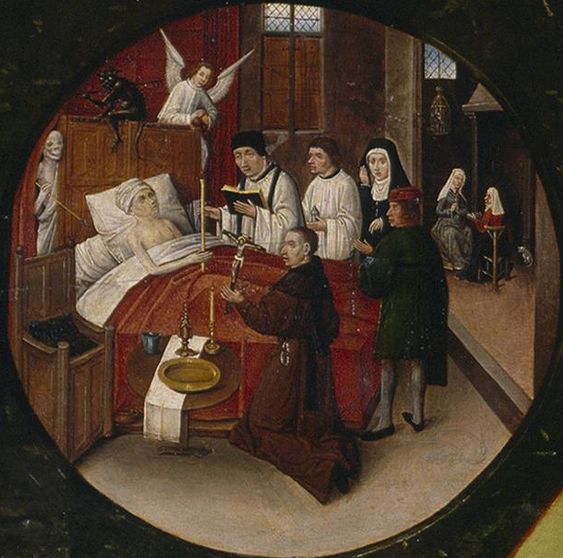
The prism of death often provides an excellent perspective to influence how to live. Thus, the book Life Stories of Dying Penitents or Sick Calls from the Diary of a Missionary Priest invites the reader to make serious, profound, hopeful and tragic reflections. Originally published in the late nineteenth century, the book is a compilation of accounts of sick calls to the dying written by an anonymous Irish priest at a parish in London, England.

In the Litany of the Saints, there is the invocation: “From a sudden and unprovided death, deliver me, O Lord.” After reading this book, the reader can see why the Church makes this plea. Death comes to all, and it is best to be prepared.

The rich descriptions in the book provide a snapshot of how death visits all the social classes. It offers insights into the complex situations priests faced at the time.

Most accounts end happily with the priest hearing the final confession and administering Extreme Unction. However, others are tragic. Some cases involved situations where the family contacted the priest on behalf of a dying relative who had not practiced the Faith for a long time. It is pretty sobering to consider that such dying people often refuse to confess and repent despite the pleadings of the priest and family members. The tragedy contradicts the Hollywood narratives, where everything turns out fine in the end. As Saint Alphonsus Liguori wrote, “most die as they lived.” (Read more.)

Monday, April 17, 2023

Novena to Our Lady of Good Counsel


The feast of Our Lady of Good Counsel is April 26. Let us pray for the Holy Father.


Holy Virgin, moved by the painful uncertainty we experience in seeking and acquiring the true and the good, we cast ourselves at thy feet and invoke thee under the sweet title of  Mother of Good Counsel.  We beseech thee: come to our aid at this moment in our worldly sojourn when the twin darknesses of error and of evil that plots our ruin by leading minds and hearts astray.

Seat of Wisdom and Star of the Sea, enlighten the victims of doubt and of error so that they may not be seduced by evil masquerading as good; strengthen them against the hostile and corrupting forces of passion and of sin.

Mother of Good Counsel, obtain for us from thy Divine Son the love of virtue and the strength to choose, in doubtful and difficult situations, the course agreeable to our salvation. Supported by thy hand we shall thus journey without harm along the paths taught us by the word and example of Jesus our Savior, following the Sun of Truth and Justice in freedom and safety across the battlefield of life under the guidance of thy maternal Star, until we come at length to the harbor of salvation to enjoy with thee unalloyed and everlasting peace. Amen.
(By Pope Pius XII, 23 January 1953)

Litany of Our Lady of Good Counsel
 
Lord, have mercy on us.
Christ, have mercy on us.
Lord, have mercy on us.
Christ, hear us.
Christ, graciously hear us.
God the Father of Heaven, Have mercy on us.
God the Son, Redeemer of the world, Have mercy on us.
God the Holy Ghost, Have mercy on us.
Holy Trinity, One God, Have mercy on us.
Beloved Daughter of the Eternal Father, pray for us.
August Mother of God the Son, pray for us.
Blessed Spouse of God the Holy Ghost, pray for us.
Living temple of the Holy Trinity, pray for us.
Queen of Heaven and earth, pray for us.
Seat of Divine Wisdom, pray for us.
Depositary of the secrets of the Most High, pray for us.
Virgin most prudent, pray for us.
In our doubts and difficulties, pray for us.
In our tribulations and anguish, pray for us.
In our discouragements, pray for us.
In perils and temptations, pray for us.
In all our undertakings, pray for us.
In all our needs, pray for us.
At the hour of death, pray for us.
By thine Immaculate Conception, pray for us.
By thy happy nativity, pray for us.
By thine admirable presentation, pray for us.
By thy glorious Annunciation, pray for us.
By thy charitable Visitation, pray for us.
By thy Divine Maternity, pray for us.
By thy holy Purification, pray for us.
By the sorrows and anguish of thy maternal heart, pray for us.
By thy precious death, pray for us.
By thy triumphant Assumption, pray for us.
Lamb of God, Who takest away the sins of the world, Spare us, O Lord.
Lamb of God, Who takest away the sins of the world, Graciously hear us, O Lord.
Lamb of God, Who takest away the sins of the world, Have mercy on us.
V. Pray for us, O holy Mother of God,
R. And obtain for us the gift of good counsel.

Let Us Pray.
V. Lord Jesus, Author and Dispenser of all good, Who in becoming incarnate in the womb of the Blessed Virgin hast communicated to her lights above those of all the Heavenly intelligences, grant that in honoring her under the title of Our Lady of Good Counsel, we may merit always to receive from her goodness counsels of wisdom and salvation, which will conduct us to the port of a blessed eternity.
R. Amen.
Friday, April 14, 2023

The Angels at the Resurrection

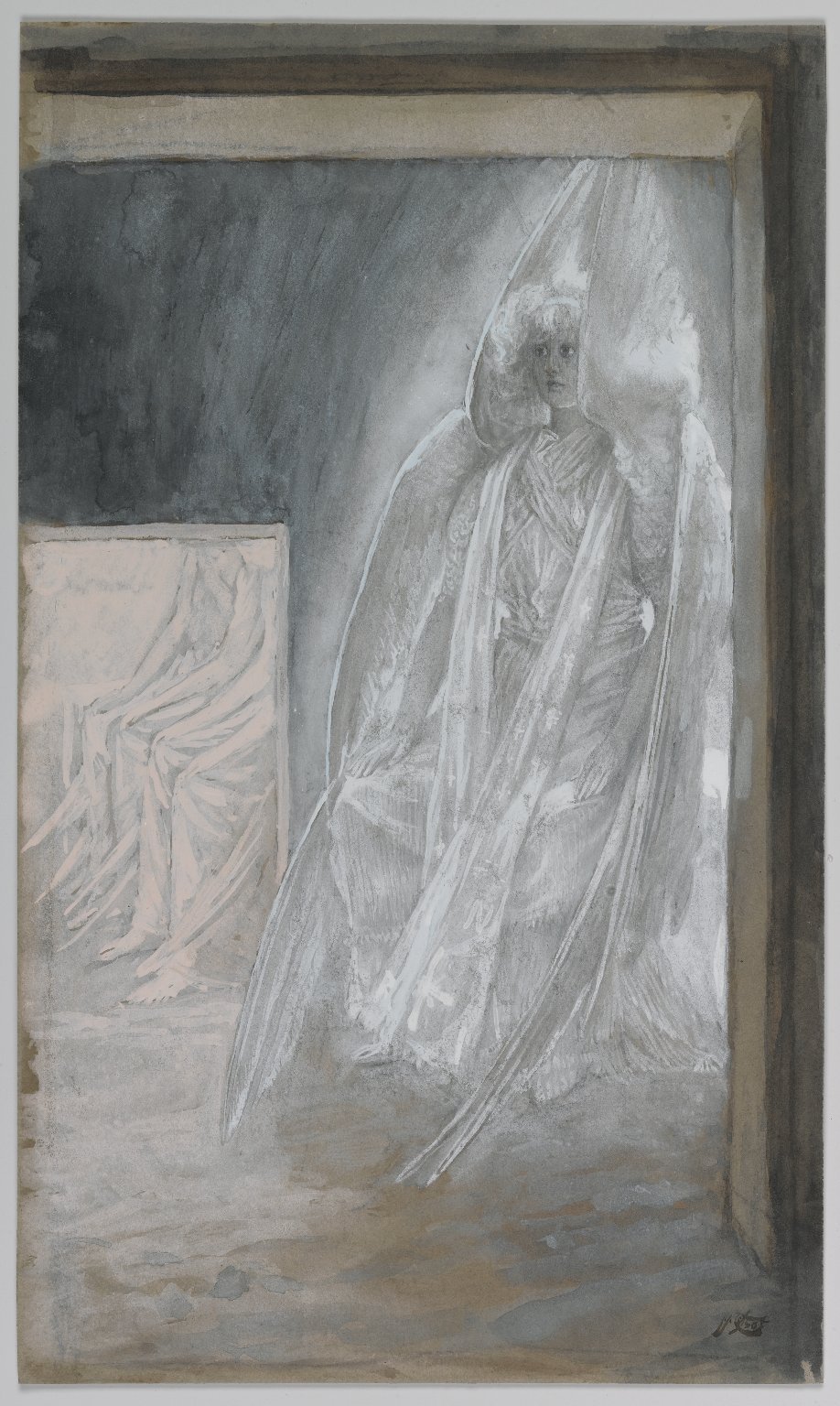
"The Angel Seated on the Stone" by Tissot

 From Catholic Exchange:

Angels have a glorious sense of humor. When the disciples came to find Jesus after hearing of his resurrection, they ran as fast as they could to the tomb where angels greeted them with holy wit. They told them, “Why do you seek the living one among the dead?” One can only imagine the snicker they had to hold back at their statement.

And yet, their comment served as the key that unlocked the greatest realization the world has ever known. For they continued saying, “‘He is not here, but he has been raised. Remember what he said to you while he was still in Galilee, that the Son of Man must be handed over to sinners and be crucified, and rise on the third day.’ And they remembered his words.” (Read more.)


Saturday, April 8, 2023

The Harrowing of Hell

 From The Imaginative Conservative:

Our Lord’s descent into hell is well attested to by divine revelation. For example, Christ says, “as Jonah was three days and three nights in the belly of a whale, so will the Son of man be three days and three nights in the belly of the earth” (Mt. 12:40). Further, in Acts of the Apostles, St. Peter says, “[David] foresaw and spoke of the resurrection of the Christ, that he was not abandoned to Hades, nor did his flesh see corruption” (2:31). Likewise in the Apostles’ Creed we profess, “He descended into hell.”

Besides making clear that the soul of Christ descended into hell, these texts clearly refer the descent into hell to the Person of Christ. And this is supremely fitting. For, since the personal union of the Word of God with both His body and soul remained even after death, whatever could be attributed to either of these principles of His human nature, while they were separated, was also attributable to God the Son. Thus, in the Apostles’ Creed we profess that He (i.e., God the Son) was buried insofar as His body was placed in the tomb. In like manner, we profess that God the Son descended into hell on account of His soul going to the underworld.

Connected with this, St. Thomas Aquinas points out that it is even true to say that “during the three days of His death, the whole Christ was in the tomb, in hell, and in heaven, on account of His Person, which was united to His body lying in the tomb, and to His soul-harrowing hell, and which was subsisting in His divine nature reigning in heaven” (Compendium Theologiae, ch. 229). Indeed, insofar as by His divine immensity the Son of God comprehends or contains all things, we must affirm that the whole Person of Christ is both in every place and in all places put together, yet He is not wholly contained by any one place nor by all places put together (Summa Theologiae, III, q 52, a. 3, ad 3um).

When reflecting on our Lord’s harrowing of hell, it is, of course, necessary to distinguish different meanings of the name “hell.” In its most general meaning, “hell” signifies “the underworld,” which the Hebrews refer to as, Sheol, and the Greeks call by the name, Hades (Catechism of the Catholic Church, #633). Further, as the Roman Catechism teaches, there are three main parts to the underworld. There is gehenna, or hell in the strict sense, which is the abode of the damned. There is also purgatory wherein the punishments, unlike those of gehenna, are cleansing and only temporary in character. Lastly, there is that part of the underworld known as “Abraham’s bosom” (see, Luke 16:22-26). It was in here that “the souls of the just prior to the coming of Christ the Lord were received, and where, without experiencing any sort of pain, but supported by the blessed hope of redemption, they enjoyed peaceful repose” (Roman Catechism, pt. 1, art. 5).

So, into which part or parts of hell did Christ descend and why? Taking St. Thomas Aquinas as our guide, we can affirm both that our Lord descended into all three parts of hell and that He descended into only one part of hell (i.e., into Abraham’s bosom). But to see how both of these statements are true without contradiction, we must distinguish two ways in which something can be somewhere.

Thinking of everyday examples first, it is true that one and the same fire is simultaneously both in the fireplace and in every part of the room which it heats. The fire is in the fireplace as in a proper place, while it is in every part of the room through its effect, that is, through the heat which it produces. Likewise, it is true that one and the same musician is simultaneously both on the stage and in every part of the concert hall. For the musician is on the stage insofar as that is his proper place, yet he is also present in every part of the concert hall through his effect, that is, through the music that he produces.

Applying this distinction to our Lord’s descent into hell, it is true to say that Christ’s soul, through its essence, only entered Abraham’s bosom. Nonetheless, through its effect, Christ’s soul was in some way present in every part of hell. As St. Thomas puts it, “being in one part of hell, his effect in some way spread to every part of hell, just as by suffering in one place on earth, he liberated the whole world by His passion” (Summa Theologiae, III, q. 52, a. 2). More specifically, St. Thomas teaches that the proper effect of Christ in the underworld was the bestowal of the beatific vision on the souls of the just waiting for Him in Abaham’s bosom. This, properly speaking, constitutes the harrowing or despoiling of hell. For, through granting the souls of the just the vision which beatifies, the King of all things “robbed” hell of its most prized possessions. But Christ’s presence in hell also had the effects of giving hope of attaining eternal glory to the souls in purgatory and of confounding and bewildering those in gehenna (Summa Theologiae, III, q. 52, a. 2).

These considerations, in turn, cast some light on the reasons for God the Son’s descent into hell. For one thing, He went there to manifest His power and authority to the underworld. As St. Paul writes, “at Jesus’ name every knee must bend in the heavens, on the earth, and under the earth, and every tongue proclaim to the glory of God the Father: Jesus Christ in Lord!” (Phil. 2:10-11). But secondly, and more importantly, our Lord came to deliver His loved ones from their exile. He came to reward those who, from our first father, Adam, to His own foster-father, St. Joseph, had fought the good fight and had finished the race. The King descended into Hell in order to bring nothing less than His own beatific vision, the very paradise which He promised to Dismas just a few hours before (Lk. 23:43), to these just and holy souls. (Read more.)

Friday, April 7, 2023

Prefigurations of the Crowning with Thorns

 Scholarly and devotional. Worth a listen on Good Friday.

Saturday, March 25, 2023

The Annunciation

By Arthur Hacker

The solemnity of the Annunciation is today. Prayer is not magic. A consecration is not magic. Our Lady is mother, not a high school algebra teacher. Russia has finally been mentioned by name in a consecration to the Immaculate Heart. Let us the Church militant, united with the Church triumphant and Church suffering, keep praying for a shower of grace upon the world. Once the prophet Elias prayed for rain to end Israel's drought, and the rain came. Here is a reflection from Divine Intimacy by Father Gabriel of Saint Mary Magdalen, OCD:
The Angel's explanation does not prevent future events and circumstances from remaining hidden and obscure to Mary. She finds herself face to face with a mystery, a mystery which she knows intuitively to be rich in suffering; for she has learned from the Sacred Scriptures that the Redeemer will be a man of sorrows, sacrificed for the salvation of mankind. Therefore, the ineffable joy of the divine maternity is presented to her wrapped in a mystery of sorrow: to be willing to be the Mother of the Son of God means consenting to be the Mother of one condemned to death. Yet Mary accepts everything in her fiat: in the joy as well as in the sorrow of the mystery, she has but one simple answer: "Behold the handmaid of the Lord."

 Here is the text of the Consecration of Russia to the Immaculate Heart of Mary which the Holy Father made on this day in 2022: 

O Mary, Mother of God and our Mother, in this time of trial we turn to you. As our Mother, you love us and know us: no concern of our hearts is hidden from you. Mother of mercy, how often we have experienced your watchful care and your peaceful presence! You never cease to guide us to Jesus, the Prince of Peace.

Yet we have strayed from that path of peace. We have forgotten the lesson learned from the tragedies of the last century, the sacrifice of the millions who fell in two world wars. We have disregarded the commitments we made as a community of nations. We have betrayed peoples’ dreams of peace and the hopes of the young. We grew sick with greed, we thought only of our own nations and their interests, we grew indifferent and caught up in our selfish needs and concerns. We chose to ignore God, to be satisfied with our illusions, to grow arrogant and aggressive, to suppress innocent lives and to stockpile weapons. We stopped being our neighbour’s keepers and stewards of our common home. We have ravaged the garden of the earth with war and by our sins we have broken the heart of our heavenly Father, who desires us to be brothers and sisters. We grew indifferent to everyone and everything except ourselves. Now with shame we cry out: Forgive us, Lord!

Holy Mother, amid the misery of our sinfulness, amid our struggles and weaknesses, amid the mystery of iniquity that is evil and war, you remind us that God never abandons us, but continues to look upon us with love, ever ready to forgive us and raise us up to new life. He has given you to us and made your Immaculate Heart a refuge for the Church and for all humanity. By God’s gracious will, you are ever with us; even in the most troubled moments of our history, you are there to guide us with tender love.

We now turn to you and knock at the door of your heart. We are your beloved children. In every age you make yourself known to us, calling us to conversion. At this dark hour, help us and grant us your comfort. Say to us once more: “Am I not here, I who am your Mother?” You are able to untie the knots of our hearts and of our times. In you we place our trust. We are confident that, especially in moments of trial, you will not be deaf to our supplication and will come to our aid.

That is what you did at Cana in Galilee, when you interceded with Jesus and he worked the first of his signs. To preserve the joy of the wedding feast, you said to him: “They have no wine” (Jn 2:3). Now, O Mother, repeat those words and that prayer, for in our own day we have run out of the wine of hope, joy has fled, fraternity has faded. We have forgotten our humanity and squandered the gift of peace. We opened our hearts to violence and destructiveness. How greatly we need your maternal help!

Therefore, O Mother, hear our prayer.

Star of the Sea, do not let us be shipwrecked in the tempest of war.

Ark of the New Covenant, inspire projects and paths of reconciliation.

Queen of Heaven, restore God’s peace to the world.

Eliminate hatred and the thirst for revenge, and teach us forgiveness.

Free us from war, protect our world from the menace of nuclear weapons.

Queen of the Rosary, make us realize our need to pray and to love.

Queen of the Human Family, show people the path of fraternity.

Queen of Peace, obtain peace for our world.

O Mother, may your sorrowful plea stir our hardened hearts. May the tears you shed for us make this valley parched by our hatred blossom anew. Amid the thunder of weapons, may your prayer turn our thoughts to peace. May your maternal touch soothe those who suffer and flee from the rain of bombs. May your motherly embrace comfort those forced to leave their homes and their native land. May your Sorrowful Heart move us to compassion and inspire us to open our doors and to care for our brothers and sisters who are injured and cast aside.

Holy Mother of God, as you stood beneath the cross, Jesus, seeing the disciple at your side, said: “Behold your son” (Jn 19:26.) In this way he entrusted each of us to you. To the disciple, and to each of us, he said: “Behold, your Mother” (v. 27). Mother Mary, we now desire to welcome you into our lives and our history. At this hour, a weary and distraught humanity stands with you beneath the cross, needing to entrust itself to you and, through you, to consecrate itself to Christ. The people of Ukraine and Russia, who venerate you with great love, now turn to you, even as your heart beats with compassion for them and for all those peoples decimated by war, hunger, injustice and poverty.

Therefore, Mother of God and our Mother, to your Immaculate Heart we solemnly entrust and consecrate ourselves, the Church and all humanity, especially Russia and Ukraine. Accept this act that we carry out with confidence and love. Grant that war may end and peace spread throughout the world. The “Fiat” that arose from your heart opened the doors of history to the Prince of Peace. We trust that, through your heart, peace will dawn once more. To you we consecrate the future of the whole human family, the needs and expectations of every people, the anxieties and hopes of the world.

Through your intercession, may God’s mercy be poured out on the earth and the gentle rhythm of peace return to mark our days. Our Lady of the “Fiat," on whom the Holy Spirit descended, restore among us the harmony that comes from God. May you, our “living fountain of hope,” water the dryness of our hearts. In your womb Jesus took flesh; help us to foster the growth of communion. You once trod the streets of our world; lead us now on the paths of peace. Amen.

Tuesday, March 21, 2023

The Conditions for Mortal Sin


 From Monsignor Charles Pope:

Recent and public conversations about the nature of mortal sin, the reception of Holy Communion and worthiness to receive the Eucharist have shown how some in our culture, even if they accept the concept that sin could be mortal, so limit the possibility of committing it that it barely exists at all in their moral landscape. This is usually done by distorting or blurring the three conditions under which sin is considered mortal. Briefly stated these conditions are:

Mortal sin is:  

  1. sin whose object is grave matter
  2.  which is also committed with full knowledge 
  3. and deliberate consent. (Catechism of the Catholic Church # 1857)
In all three of these conditions, there is a tendency to endlessly raise questions and doubts as to exactly what each phrase means and demand an exactitude without which we refuse to accept that a mortal sin has been committed. To some degree we humans love to cultivate uncertainty for this helps us remain undecided  and avoid the moral judgement of our actions, which is required of us as free moral agents.  And thus we think, “Well, who’s to say? There are a lot of opinions out there. What exactly do we mean by ‘deliberate consent’ and ‘full knowledge’?” And we forever delay pondering the answers to such things by using our moral reasoning and coming to a mature and adult faith. But God who gave us an intellect and a will is not pleased by this constant shrugging and delaying of the examination of conscience that is our responsibility and dignity to make. (Read more.)

Related Posts with Thumbnails