
Tuesday, July 3, 2018

St. Gregory of Nyssa’s Amazing Explanation for the Eucharist

From Catholic Exchange:
Gregory begins by reframing this as a question of how: How can the bread and wine be Christ? Gregory of Nyssa responds by saying that the bread is a kind of prototypical food, just as wine was, in the ancient world, a fundamental source of fluids for all men. And, because of this characteristic bread and wine are a type of the human body. As he puts it:
Some animals feed on roots which they dig up. Of others grass is the food, of others different kinds of flesh, but for man above all things bread; and, in order to continue and preserve the moisture of his body, drink, not simply water, but water frequently sweetened with wine, to join forces with our internal heat. He, therefore, who thinks of these things, thinks by implication of the particular bulk of our body. For those things by being within me became my blood and flesh, the corresponding nutriment by its power of adaptation being changed into the form of my body (Great Catechism, 37).
Actually, all Gregory has done here is address how the Eucharistic bread and wine can represent the body and blood of Christ. This is a helpful answer in so far as it is a necessary step towards understanding how the bread and wine could be God Incarnate. Now he turns to this second question:
[W]hen He came in a body such as ours did not innovate on man’s physical constitution so as to make it other than it was, but secured continuance for His own body by the customary and proper means, and controlled its subsistence by meat and drink (Great Catechism, 37).
Put simply, the Eucharist can be the body and blood, soul and divinity of Christ because that’s similar to what happened on a daily basis during Christ’s life on earth: all the food and drink He consumed became part of His Sacred body, just as food and drink does for us. To build on Gregory’s point, this process is intensified in the Eucharist, in which bread and wine are not only transformed into the body and blood of Christ, but also into His soul and divinity. Gregory concludes,
For that Body was once, by implication, bread, but has been consecrated by the inhabitation of the Word that tabernacled in the flesh. Therefore, from the same cause as that by which the bread that was transformed in that Body was changed to a Divine potency, a similar result takes place now. For as in that case, too, the grace of the Word used to make holy the Body, the substance of which came of the bread, and in a manner was itself bread, so also in this case the bread (Great Catechism, 37).
In effect, Gregory is saying that Christ is transforming the Eucharist into Himself in much the same way that He absorbed food and drink into His body during His earthly life. (Read more.)

Eucharistic Adoration can save the Church. From The Catholic Herald:
There has been in recent times a discernible increase in those drawn to Eucharistic adoration in parishes and communities, and particularly among young people. Adoration stands as an antidote to the noise and busyness of our world.

As we hear from the account of Elijah at Horeb, the Lord was not in the mighty wind, fire or earthquakes but in “the gentle breeze” (1 Kings 19: 9a, 11-16). After encountering that “gentle breeze”, Elijah covered his face with his cloak and stood at the entrance of the cave. “The gentle breeze” might be the Lord calling us from the Blessed Sacrament, and the cloak the call to humble and prostrate ourselves in Adoration. (Read more.)

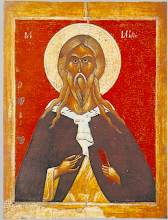
The Holy Prophet Elias

Monday, July 2, 2018

Time to Decide – A Reflection on a Question from Elijah

The Holy Prophet Elias calling down fire from Heaven in the contest with the prophets of Baal
From Monsignor Charles Pope:
At Mass for Wednesday of the 10th Week in Ordinary Time, we read a crucial question from Elijah. It came at a time of widespread apostasy among the Jewish people. Elijah summoned a multitude to Mt. Carmel in the far north of Israel:

Elijah appealed to all the people and said, “How long will you straddle the issue? If the Lord is God, follow him; if Baal, follow him.” The people, however, did not answer him (1 Kings 18:21).

The Baals were the gods of the Canaanites. It had become expedient and popular to worship them because the ruling political leaders, the apostate King Ahab and his wicked wife Jezebel, had set forth the worship of the Baals by erecting altars and sacred columns. All who wished their life to go well and to have access to the levers of prosperity were surely “encouraged” to comply. Jezebel funded hundreds of prophets of Baal and the goddess Asherah. She had many of the prophets of Israel killed and forced others into hiding. Through a policy of favoritism and fear, the true faith was suppressed, and false ideologies were promoted.

At this critical moment, Elijah asked his question. In effect he told them that they needed to decide whether to serve the Lord God out of courageous fidelity or the Baals out of cowardly fear. We, too, must decide. In our times, the true faith has been undermined in the hearts of many by plausible liars, cultural war, and political correctness. Those who strive to hold to the true faith are called hateful, bigoted, and intolerant. A legal framework is growing that seeks to force compliance to the moral revolution and abandonment of the biblical worldview. Social pressures are at work as well, seeking to compel compliance through political correctness, through suppression of speech and ideas, and through the influence of music, cinema, and art.

The same question must be asked of us: How long will you straddle the issue? If the Lord is God, follow him at any cost. If Baal is your god, follow him! If you prefer what is popular, politically correct, and safe, go for it; but understand that if you do so, your decision is increasingly for Baal, not the Lord. In a culture that insists you celebrate fornication, homosexual acts, transgenderism, abortion, euthanasia, and all sorts of intemperance, realize that your decision to comply amounts to a choice for Baal.

Some claim that they are not really making a fundamental choice against God and for the modern Baals. Rather, they prefer to think that they are being “tolerant,” that they are pleasant moderates seeking to “build bridges” and keep the faith “mainstream.” (Read more.)
Elias ascends in the fiery chariot
Ascension of Elias


Monday, June 18, 2018

Catastrophe

How the lack of the interior life has led to catastrophe within the Church. From Toronto Catholic Witness:
Faith is manifested in actions and not words. Words, should be the result of action. For example, it was not the brilliance of St. Bernard's speech, but his disposition, his obvious Faith that attracted. Faith is a supernatural gift and can only be breached by God alone, and not the intellect. It is the holiness (or lack of) coming from the priest or the layman that assists in attracting (or repulsing) the us.

Hope is manifested by a man of prayer. The secret and joy of the Cross must be lived, or all our efforts will fall on stoney ground. This means to embrace suffering joyfully. Difficult, at times seemingly impossible, yet with Christ all is possible.  

Charity is the road to sanctity. The detaching of a soul from sin is best achieved by living and demonstrating the love of Christ. The sinner (me and you) needs to catch a glimpse, a feeling, that they are engaged with a person who really loves Jesus Christ. 

Kindness will come to the soul who is dominated by Christ. Words and actions will be full of kindness. Without kindness zeal is not charitable, and therefore not genuine. Fr. Faber tells us that "kindness shows itself the best pioneer of the Precious Blood..." 

Humility is the living the words of Christ: "without me you can do nothing". St. Vincent de Paul warned his priests to consider themselves more fit for ruining than making success. The modern man, surrounded by individualism and a so-called false "liberty" has great difficulty with being humble. Without humility correct doctrine and good judgment will not preserve us from falling. Without Humility we are at the mercy of our passions. 

Firmness and Gentleness implies that we be - like St. Bernard - pitiless towards errors - but showing great affection for the sinner. St. Francis de Sales astonished Protestants with his firmness and gentleness. Such meekness does not mean weakness. Our Lord excoriated the scribes and pharisees, yet out of love, and charity to prevent the spread of evil.

If we do anything less, we are, as St. Paul wrote: "enemies of the Cross". Catholicism is not social conformity, or a habit of external practices handed down by tradition. Religious practice to have real meaning must be united to the combat of passions, the living of the Gospel in daily life. It is impossible to win disciples for Christ if we have no interior life ourselves. 

The above I drew liberally from the "The Soul of the Apostolate" by Dom Chautard. (Read more.)

Friday, June 1, 2018

The Roots Of Carmel

A beautiful new Carmelite monastery in Fairfield, PA. More HERE.

Monday, May 28, 2018

The Canticle of Simeon and the End of an Era

From The Five Beasts:
Simeon is recalling the prophecy of Isaiah, “I will make you a light to the nations, that my salvation may reach to the ends of the earth” (Is. 49:6). But Simeon adds that the Jews will not accept Jesus, referring to the infant as “…a sign that will be contradicted”. This is the meaning of “the hearts of many will be revealed”, suggesting to Theophilus that the true cause of the rioting at the synagogues is the stubborn refusal of most of the Jews to accept that God’s salvation was to be extended to “all the nations” as taught by their own prophets. Luke’s task was a difficult one; he needed to convince this influential Roman who was sympathetic to Christianity that in it the promises of the Law and the Prophets are fulfilled in spite of its rejection by the Jews. (Read more.)

Sunday, May 20, 2018

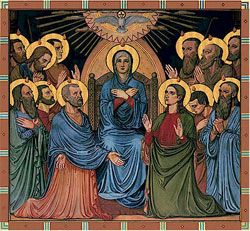
Pentecost: Ireland 2018

A powerful exhortation to the people of Ireland. From Vultus Christi:
The Spirit of the Lord, in ages past, filled Ireland with a mighty wind, sweeping away the idols that held her people in the grip of fear, violence, and superstition; and infusing men, women, and children, rich and poor, powerful and weak, learned and ignorant with a sweet and liberating power that no one could contest or resist. The irrefutable evidence of the Holy Ghost is Ireland’s saints. Wheresoever the Holy Ghost passes, He leaves behind Him a trail of saints. Ireland, long known as the island of saints, was, in ages past, a wholly Pentecostal island, a place ablaze with the fire and light of the Holy Ghost.
The just shall shine, and shall run to and fro like sparks among the reeds. They shall judge nations, and rule over people, and their Lord shall reign for ever. They that trust in him, shall understand the truth: and they that are faithful in love shall rest in him: for grace and peace is to his elect. (Wisdom 3:7–9)
The Holy Ghost, we sang in the introit, “hath knowledge of the voice”. Knowledge of what voice? The voice of whom? The psalmist tells us: “The Lord hath not forgotten the cry of the poor” (Psalm 9:13), and again, “The Lord hath heard the desire of the poor: thy ear hath heard the preparation of their heart.” (Psalm 9:38). Do not listen to those who would want you to think that the Irish have given up on the Holy Ghost or, what is worse, that the Holy Ghost has given up on Ireland. The words of Frank Duff, pronounced in 1997, are today prophetic:
Your ambition [said the great man] is colossal: to conquer with a single blow, to convert a population in a week or so. It is magnificent and fantastic at the same time. But it does become possible if you can make yourselves the outlet point of the Holy Spirit. For He can convert at a stroke, in the twinkling of an eye.
“The Spirit of the Lord hath filled the whole world, alleluia” — this includes Ireland, Ireland today; an Ireland fascinated by glittering images of a new identity; an Ireland seduced by the lying discourses of those who call good what is evil, and evil what is good; an Ireland tempted to give ear to the deception of the age–old serpent. Today’s feast of Pentecost is a magnificent manifestation of the liturgical providence of God. It is an immense ἐπίκλησις, an invocation, a calling–down of the Holy Ghost upon Ireland. The Collect of today’s Mass, becomes, in the context of the this coming week in Ireland, a prayer that one might think crafted in view of what will face us on Friday:

O God, who on this day didst teach the hearts of the faithful by the light of the Holy Ghost: grant unto us, by the same Spirit, to be wise in what is right, and ever to rejoice in His consolation.
To be wise in what is right. Why should Ireland follow nations become foolish in what is wrong? Why should Ireland open her doors to the industry of death that ravages England, The Netherlands, Belgium, France, the United States, and so many other nations? An Ireland enlightened by the Holy Ghost will show the world the consolation that comes from relishing those things that are right — always and everywhere right — and from holding fast to the laws that uphold and protect such things. All of Ireland needs a new Pentecost, a great cleansing as by a mighty wind. All of Ireland needs to be set ablaze again with the fire of the Holy Ghost that blazed up long ago when Saint Patrick enkindled his fire on the Hill of Slane. Take the verse of the First Alleluia and make it today a prayer for Ireland:
Emitte Spiritum tuum, et creabuntur, et renovabis faciem terrae.
Send forth Thy Spirit, and they shall be created, and Thou shalt renew the face of the earth.
Send forth Thy Spirit, and they — sons and daughters quickened in the Holy Faith — shall be created, and Thou shalt renew the face of Ireland. There are, to be sure, naysayers and prophets of doom who declare the death of Catholicism in Ireland. The first error of such people is to assume that the Holy Faith of our Fathers is an “ism”. “Isms” come and go. They are in fashion and out of fashion. They are the subject of debate and of ideological wars. The faith of the Church is not an “ism”. It is fire and light. It cannot be stopped, or consigned to cultural museums, or contained by iniquitous laws. “The Spirit breatheth where He will; and thou hearest His voice, but thou knowest not whence He cometh, and whither He goeth”(John 3:8). (Read more.)

Friday, May 18, 2018

Funeral Homily for Fr. Peter Damian Fehlner

By Fr. James McCurry, OFM, Conv. May 11, 2018.
Related Posts with Thumbnails