skip to main |
skip to sidebar
From
Speramus:
We need
life jackets to persevere and ride out the raging storm. God gave us
many warnings of the current crisis we are passing through. Warnings
with instructions on how to successfully pass over the raging waters.
The first warnings were given in scriptures, the most relevant is the
book of Jude. It is the shortest book of the Bible aptly depicting the
current crisis we are living in. Read and pray over the book to see how
God wants us to live through these days.
Also recall the visions of St John Bosco in the 1840s. Remember the 2 Columns and the ship, representing the church. It was traveling in a fierce storm other ships were bombing it with
canons and it almost capsized. Finally seeing two columns in the
distance it made its way towards them and found safety and anchored
between them. The first column was the Eucharist and the second was Our
Lady. Placing its anchor here the storm could no longer toss them about
in this safe harbor. Let each one of us find that safe harbor!
We must
continually work on our own faults and deepen our personal union with
Jesus. Taking the speck from our own eyes first so we can see clearly
how to help our brethren. Our strength will come from the Eucharist and
Our Lady!
Let us
renew our dedication to Christ and the Church offering our prayers and
sufferings for all the bad priests bishops cardinals who failed us.
Commend them to Our Lord asking God to give them the grace to repent. (Read more.)
From
Monsignor Charles Pope:
We rightly speak of the Church as indefectible, for Christ said to Peter, And
I tell you that you are Peter, and on this rock, I will build my
church, and the gates of Hades will not prevail against it. I will give
you the keys of the kingdom of heaven (Matthew 16:18-19).
Be careful, though: The indefectibility of the Church does not pertain to land, building, power, or glamor.
Consider, by contrast, the Church at her most victorious moment: Good
Friday on an ugly hillside called Golgotha. Only one clergyman, St.
John the Apostle, and four women were there with Christ. The Church was
very small at that moment. There were no marble altars, no stone
churches or basilicas, no papal estates or gold-embroidered vestments.
It was just Jesus, the head of the body, and a few of his members. The
rest of the clergy and disciples, even Peter, were hiding in fear,
disavowing knowledge of him and standing a safe distance away. Yet this
small gathering of the Church saw the greatest victory of all: By dying,
Christ destroyed death and broke Satan’s power.
Yes, sometimes the Church gets small and seems quite
powerless. Sometimes the Gospel is preached from a jail cell or at an
execution site. The blood of martyrs is seed for the Church. So, we ought not to imagine the indefectibility of the Church as
something rooted in external glories such as power, land, buildings,
titles, golden chalices or elaborate vestments. The Liturgy of the Hours has been warning us of the possibility of
disaster if we do not repent. If you think St. Peter’s Basilica could
never be taken or the pope exiled from Rome (or even killed), think
again. Of the first 33 popes, 30 died as martyrs. Two others died in
exile. Only one died in his own bed. The Church had no basilicas or land
until A.D. 313. Popes were exiled numerous times during the Middle
Ages. They also took refuge in Avignon for far too long a time. If you
think St. Peter’s will always be there, consider that the Hagia Sophia
in Constantinople, a basilica arguably as glorious as St. Peter’s,
became a mosque and is now a secular museum.
Yes, God’s warnings are as real today as ever. He is more interested
in our souls than our buildings. Our museums and works of art are
trinkets to Him compared to the holiness of our lives, which he seeks.
We are too easily mesmerized by the worldly splendor of such things and
think it can substitute for the holiness and truth to which it points. During this painful crisis of clergy sexual abuse, vague leadership,
and lack of accountability, the call goes out with an urgency that
rivals the greatest cries of biblical times: the Church must repent.
This cry is addressed to all, from the laity and the lowliest of clergy
to the Pope himself. Serious sins must be acknowledged and repented of.
The Church must accept a deep purification that, though sure to be
painful, is necessary.
For too long we have tolerated sin and toyed with compromise and
heresy. Too many Catholics, even high-ranking bishops, have sought to
excuse sin and have even tried to alter the very words of Christ. Some
have stayed silent or turned a blind eye to sin and dissent. Still
others have “majored in the minors,” focusing on matters of lesser
importance.
Reform in the Church does not usually begin at the top. That is why
it is so important for the hierarchy to listen, as never before, to the
cries of the lay faithful, who plead with the United States Conference
of Catholic Bishops (USCCB) and the Vatican to take reform seriously,
reassert the truth of the Gospel with clarity, and rebuke dissent. While
no one in the Church lives the gospel perfectly, the outright denial of
central truths of our faith without any reproof from the Church
hierarchy has been a source of great scandal and confusion. Silence from
shepherds, who should be chasing the wolves away, is malpractice of the
worst kind. There is simply no acceptable excuse for the deafening
silence that has come from too many in the hierarchy in the face of
dissent and even outright heresy. It is being taught routinely, openly,
and ever more boldly by renegade theologians, wandering clerics, and
even certain conferences of bishops. The faithful are bewildered,
saddened, and justifiably angry. (Read more.)
From
Fr. Mark:
The crisis that continues to shake the Church and to burden the
hearts of priests with sorrow and uncertainty, requires a powerful
spiritual antidote. Our Lord is calling His priests to tarry in His
presence. He invites them to abide in the radiance of His Eucharistic
Face, close to His Heart. There they will recover the joy of their youth
and the certainty of being loved by Christ with an everlasting love.
Eucharistic adoration is a wellspring of priestly happiness. It is by
daily adoration that the priest begins to say, in all truth, with the
psalmist: “To be near God is my happiness” (Psalm 72:28) and, “My
happiness lies in Thee alone” (Psalm 15:2). There is a correlation
between happiness and holiness. A priest faithful to his daily hour of
adoration will, like Saint John the Baptist, be a friend of the
Bridegroom, “rejoicing with joy” (John 3:29) because of the Bridegroom’s
voice, and capable of winning souls for Christ.
The centrality of the Eucharist should be apparent
not only in the worthy celebration of the Sacrifice, but also in the
proper adoration of the Sacrament, so that the priest might be the model
for the faithful also in devote attention and diligent meditation —
whenever possible — done in the presence of our Lord in the tabernacle.
It is hoped that the priests entrusted with the guidance of communities
dedicate long periods of time for communal adoration and reserve the
greatest attention and honour for the Most Blessed Sacrament of the
altar, also outside of Holy Mass, over any other rite or gesture. “Faith
and love for the Eucharist will not allow Christ to remain alone in his
presence in the tabernacle”. (Congregation for the Clergy, Directory on the Ministry and Life of Priests, 31 January 1994)
The 19th and early 20th centuries saw, in fact, the birth of a number of
movements for the promotion of Eucharistic adoration, reparation, and
priestly holiness. The best known of these is, without doubt, the
Association of Priest-Adorers of the Blessed Sacrament, founded by Saint
Peter Julian, and canonically erected in Rome on 16 June 1887.
The second half of the last century saw many of these fine movements
fall into decline, leaving a void in the spiritual life of new
generations of priests. The Year of the Eucharist proclaimed by Saint
John Paul II in 2004, and the Year of the Priesthood proclaimed by Pope
Benedict XVI in 2009 were an invitation to rediscover and refresh the
benefits that accrue to priests who commit themselves to prayer for and
with one another, and in particular, to Eucharistic adoration.
In his Encyclical Letter of Holy Thursday, 17 April 2003, Ecclesia de Eucharistia,
Saint John Paul II drew the eyes of the Church to the Face of Christ in
the Most Holy Eucharist. He coined a new phrase, one not encountered
before in his writings or in the teachings of his predecessors, “the
Eucharistic Face of Christ.” Thus did Saint John Paul II share with the
Church his own experience of seeking, finding, and adoring the Face of
Christ in the Most Holy Sacrament of the Altar. The human face is a
mysterious icon of the heart. It signifies, among other things, a
personal presence open to relationship with another. In the Sacrament of
His Love, the Face of Christ, the Human Face of God, is turned towards
those who seek Him, ready to draw them into a healing and life-giving
communion of love with His Sacred Heart. (Read more.)

From
Fr. Heilman:
On October 7, 2017, over one million Catholics in Poland rose up
and grabbed their rosaries and, mainly on their borders, called out to
God with the powerful intercession of Our Lady....This was a
grassroots effort that was, in essence, saying, “The demonic secular
forces of this world are not welcome on our soil!” While not immune to
the infiltration of modernism in Poland’s Catholic Church, they remain
one of the strongest on the planet. In St. Faustina’s diary, she relates how our Lord told her,
“I bear a special love for Poland, and if she will be
obedient to My will, I will exalt her in might and holiness. From her
will come forth the spark that will prepare the world for My final
coming” (Diary, 1732)
Inspired by Poland — Ireland, the British Isles and Australia
followed suit in praying for their respective countries with rosaries in
hand (all “grassroots” efforts of the laity). The United States has
been praying this way since 2016 (and the lead up to the Presidential
election), with Novena for Our Nation,
with over 40,000 USA Catholics praying the miraculous 54 Day Rosary
Novena from August 15 (Feast of the Assumption) to October 7 (Our Lady
of the Rosary). With the inspiration of Poland, we (USA) have reframed
the concluding October 7 prayer campaign with the new title of “Rosary
Coast to Coast” (Go to rosarycoasttocoast.com).
Now, many nations have accepted the clarion call, and will be praying
together on October 7, 2018 in what we now call the “Holy League of
Nations” (Go to holyleagueofnations.com).
In the lead up to our launch of this 2018 enormous
“Rosary Coast to Coast” nation-wide (now worldwide) prayer campaign (We
launched on March 31, 2018), our planning team sought the support of all
of the USA bishops. I warned the team that we would not get many to
respond, much less support. And, as I predicted, only a handful
responded and what support we received was timid (barring a few,
including my own Bishop Morlino, Bishop Conley and Cardinal Burke). Why
did I accurately predict this? Because I knew full well the “condition of our prelates in America.” I knew we would be received as more “dangerous” than “beneficial” to the Church in America. Why? Let me explain …
There was one reply, in particular, that still rings (stings) in my
mind and heart, nearly on a daily basis, that, sadly, truly expressed
this “condition of our prelates.” It came from a very prominent prelate who will remain nameless. Here was his reply …
“Father, I’m not fond of these national campaigns. I don’t know that they accomplish a whole lot and because of that, I just haven’t been willing to offer endorsements.”
Yes, you read that correctly. Tens of thousands of people joined
together in prayer to call out to God, through the powerful intercession
of our Lady, to protect and heal our nation does not “accomplish a
whole lot.” St. Louis de Montfort once wrote:
“When people say the Rosary together, it is far more
formidable to the devil, than one said privately. Because in this public
prayer, it is an army that is attacking him. He can often overcome the
prayer of an individual, but if this prayer is joined to other
Christians, the devil has much more trouble in getting the best of
it.” -St Louis de Montfort.
You see? This is the “problem” … this is the “condition” of the vast
majority of our prelates. To them, St. Louis de Montfort and all of
those crazy saints were just that … “crazy.” You see? WE have arrived on the scene and, thank God, WE
are here now to take the “crazy” out of Catholicism. No more of this
silly hocus pocus superstitious nonsense, under our watch. No more of
this ridiculous belief in the supernatural power of God and the power of
prayer, as long as we are here. In fact, those who advocate “the supernatural” are to be considered
“dangerous” in our Church. Also, anyone who would actually defend the
teachings of the Church is to be considered “dangerous.”
(Read more.)
From
Monsignor Charles Pope:
It says that in mortal sin we set our will upon something we know to be incompatible with our ultimate end.
Although our first thought may not be that we are rejecting God, we set
our will on something incompatible with God. In so doing, we are
preferring something or someone to God.
This poisons our heart
if we do not repent because we feed a desire in our heart for what is
not God and we starve our heart from Him and what He offers. Soon enough
we prefer the darkness to the light. We prefer the trinkets of this
world to God and come to regard Him as a thief who comes to take what we
want and keeps us from doing what we want to do. God becomes our enemy.
If we die in this state, the warmth of God and Heaven seem overwhelming, wrathful, and like a consuming fire.
We cannot endure and so we turn away finally and permanently to a place
that we strangely prefer, but which is hellacious because it is not
that for which we were made. It lacks the one thing necessary: God. (Read more.)
From
Vultus Christi:
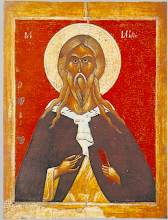
We are compelled to ponder today what can only be called a core text
of the liturgical and spiritual tradition of Carmel. I refer, of course,
to the lesson from the Third Book of Kings. This is a text — no, more
than a text, a living word — that has, over the centuries, captured the
heart of those called to live on Carmel’s heights.
Elias went up to the top of Carmel, and casting himself
down upon the earth put his face between his knees, And he said to his
servant: Go up, and look towards the sea. And he went up, and looked,
and said: There is nothing. And again he said to him: Return seven
times. And at the seventh time, behold, a little cloud arose out of the
sea like a man’s foot. And he said: Go up and say to Achab: Prepare thy
chariot and go down, lest the rain prevent thee. And while he turned
himself this way and that way, behold the heavens grew dark, with
clouds, and wind, and there fell a great rain. (3 Kings 18:42–45)
Its context is important. First of all, a terrible drought has come
over the land; God withholds his life–giving rain. Over the land ruled
by Achab, a weak king, influenced by his wife’s devotion to the great
sky–god, Baal, the heavens are closed. Elias determines that this state
of affairs must be resolved. The true God, the God of Israel must be
glorified in the sight of all. «And Elias coming to all the people,
said: How long do you halt between two sides? If the Lord be God, follow
him: but if Baal, then follow him. And the people did not answer him a
word» (3 Kings 18:21).
Elias summons the prophets of Baal, favourites of the wicked Queen
Jezebel, to a public showdown on Mount Carmel. A holocaust is prepared.
By the sign of fire from heaven the true God will make Himself known.
The prophets of Baal were the first to begin the dreadful rite. The
heavens were not moved by their frantic entreaties; Baal was distant and
deaf to their cries, even though they cut themselves with swords and
lances, joining blood to their futile ravings. (Read more.)







 Posts