

Sunday, November 14, 2021

The Word of the Lord Remains Forever!

From Monsignor Charles Pope:

Yes, we know very well that the Day of Judgment is coming. Too easily, though, we dream on and do not follow the prescribed priority. Wealth, fame, and glory are all uncertain and  passing, but death, judgment, Heaven, and Hell are certain and remain forever. We too easy fiddle on with things that are uncertain and passing while neglecting what is certain and eternal. Ridiculous!

It would be foolish to book passage on a sinking ship. Similarly, it is imprudent to make this world and its demands our fundamental priority. It is wise to set our sights on, and lay hold of, the Kingdom that lasts forever. It is sad that so many spend people their time “rearranging the deck chairs on the Titanic” of this world. What are our priorities? Frankly, most of our priorities are not things that matter to God. Even if we attain the passing things for which we strive, they will all ultimately slip through our fingers. We obsess over passing things like our physical health while neglecting enduring things like our spiritual health. We should care for our bodies, but even more should we care for our souls. If we would expend as much effort looking for a time and place to pray as we do searching for a restaurant for dinner, we would be spiritual heavyweights rather than physically overweight.

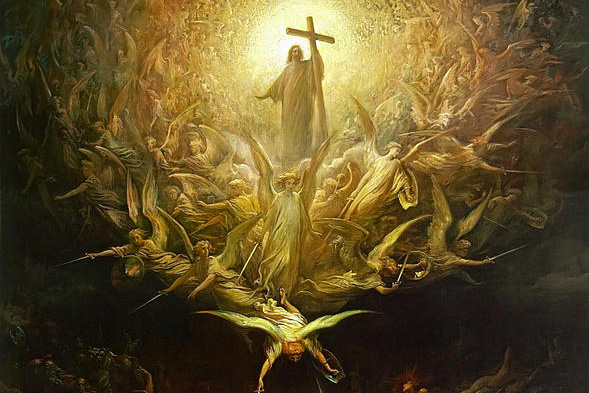
In today’s Gospel the Lord stands before the Temple: an impressive building, a symbol of power and of worldly glories. Impressed by it though the Apostles are, the Lord is not impressed with passing things. He counsels us to get our priorities straight and to focus on things that last: His Word, which never passes away, and our ultimate destiny, where we will spend eternity. (Read more.)

Saturday, October 16, 2021

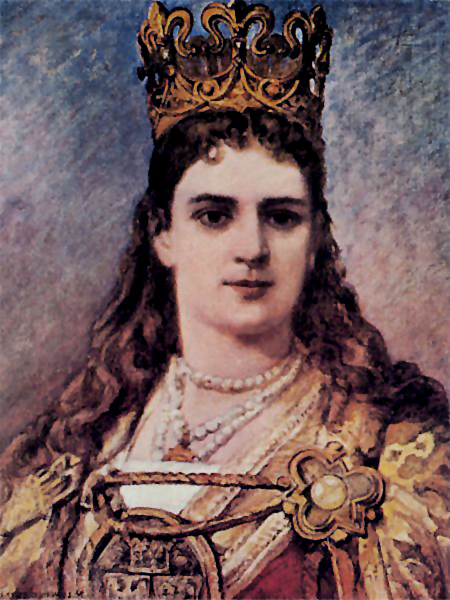
St. Hedwig

So young a queen.
Born, 1371. Died, 17 July 1399 during child birth. Hedwig was the youngest daughter of King Louis I of Hungary. Because she was great-niece to King Casimir III of Poland, she became Queen of Poland in 1382 upon her father‘s death. She was engaged to William, Duke of Austria, whom she loved, but broke off the relationship in order to marry Jagiello, non-Christian Prince of Lithuania, for political reasons.

In 1384, upon the death of Louis I of Hungary and Poland, the Polish nobles, having crowned his daughter Hedwig, decided that as the new queen was but fifteen years old, she must be provided with a consort capable of protecting her dominions. Their choice fell upon Jagiello, or Jagello, the Prince of Lithuania, whose hostility to the Teutonic Order made him their natural ally. (Read entire post.)

Thursday, September 23, 2021

Cumbre Vieja and Sr. Lucia's 1944 Tuy Apparition

 From Unveiling the Apocalypse:

A lot of people have been contacting me recently, to ask my thoughts on the recent eruption of Cumbre Vieja in the Canary Islands, on 19th Sept, 2021 - the feast of Our Lady of La Salette. Some are worried that this could potentially result in the cataclysm that Sr. Lucia seen in a vision, during an apparition of Our Lady in 1944. It was during this apparition that the Blessed Virgin instructed Sr. Lucia to write down the contents of the Third Secret of Fatima. During a recent podcast with Fr. Richard Heilman and Doug Barry, I tried to explain how I'm not expecting the catastrophe seen in Sr. Lucia's 1944 apparition anytime soon, because of the significance of the katēchon of 2Thes 2:6-7 - the "restraining force" which holds back the appearance of the Antichrist. See around the 41 minute at this link: The Katechon and the Binding of Satan .

In my book Unveiling the Apocalypse: The Final Passover of the Church, I argue that Sr. Lucia's vision of the angel touching the earth with a flaming lance is connected with the eschatological earthquake described in Rev 16:

The seventh angel poured out his bowl into the air, and out of the temple came a loud voice from the throne, saying, “It is done!” Then there came flashes of lightning, rumblings, peals of thunder and a severe earthquake. No earthquake like it has ever occurred since mankind has been on earth, so tremendous was the quake. The great city split into three parts, and the cities of the nations collapsed. God remembered Babylon the Great and gave her the cup filled with the wine of the fury of his wrath. (Rev 16:17-19)
I felt my spirit flooded by a light-filled mystery which is God and in Him I saw and heard: the point of the flame-like lance which detaches, touches the axis of the earth and it [the earth] shakes: mountains, cities, towns and villages with their inhabitants are buried. The sea, rivers and clouds leave their bounds, they overflow, flood and drag with them into a whirlpool, houses and people in a number unable to be counted; it is the purification of the world from the sin it is immersed in. Hatred, ambition, cause destructive wars 
(Sr. Lucia, Tuy, 1944. See Sr. Lucia's official biography by the Carmelites of Coimbra - A Pathway Under the Gaze of Mary)
The event seen by Sr. Lucia in her 1944 Tuy apparition is specifically connected with the fall of "Babylon", which is symbolized by an angel throwing a millstone into the sea in Rev 18:21:
Then a mighty angel picked up a boulder the size of a large millstone and threw it into the sea, and said: "With such violence the great city of Babylon will be thrown down, never to be found again."
This scriptural passage is in turn associated with the "great mountain, burning with fire" which St. John seen being thrown into the sea in Rev 8:8. In my book, I attempt to demonstrate that this burning mountain is closely associated with the seven burning mountains described in the Book of Enoch, which are identified with the Canary Islands. (See the blog post The Seven Burning Mountains of Enoch and the Canary Islands for further details).

As I state in the above podcast, I don't think that the events described in Sr. Lucia's 1944 vision will happen anytime soon, since they are concerned with the very end time itself. In the Book of Revelation, the fall of "Babylon" is directly connected with the rise to power of the Antichrist, who ascends to world dominance as a result of the power vacuum created by the downfall of the world's leading superpower. (Read more.)


More HERE.

Sunday, August 8, 2021

Our Holy Mother St. Teresa and Fr. Domingo Bañez

On St. Dominic's day we cannot forget how much his spiritual sons helped Our Holy Mother St. Teresa in her spiritual struggles, in her writings and in her foundations of monasteries. The friar who perhaps helped St. Teresa the most was Fr. Domingo Bañez. According to the Catholic Encyclopedia:
In another way, Bañez in his prime was rendering memorable service to the Church as director and confessor of St. Teresa (1515-82). Her own words mark him as the spiritual adviser who was most relied upon as a guide and helper, both in her interior life and in her heroic work of the Carmelite reform. "To the Father Master Fra Dominie Bañez, who is now in Valladolid as Rector of the College of St. Gregory, I confessed for six years, and, whenever I had occasion to do so, communicated with him by letter. . . . All that is written and told, she communicated to him, who is the person with whom she has had, and still has, the most frequent communications." (See "Life of St. Teresa of Jesus, by herself", tr. by David Lewis, 3d ed., London, 1904, Relation VII, 448, 450.) Of the first foundation of the reform, St. Joseph's Monastery at Avila, she wrote that Bañez alone saved it from the destruction resolved upon in an assembly of civil and religious authorities (op. cit., ch. xxxvi, 336 sqq.). He did not then know the saint, but "from that time forth he was one of her most faithful friends, strict and even severe, as became a wise director who had a great saint for his penitent." He testifies, in the process of her beatification that he was firm and sharp with her, while she herself was the more desirous of his counsel the more he humbled her, and the less he seemed to esteem her (op. cit., p., xxxvi). He looked for the proof of her love of God in her truthfulness, obedience, mortification, patience, and charity towards her persecutors, while he avowed that no one was more incredulous than himself as to her visions and revelations. In this his mastery of the spiritual life was shown to be as scientific as it was wholesome and practical. "It was easy enough to praise the writings of St. Teresa and to admit her sanctity after her death. Fra Bañez had no external help in the applause of the many, and he had to judge her book as a theologian and the saint as one of his ordinary penitents. When he wrote, he wrote like a man whose whole life was spent, as he himself tells us, in lecturing and disputing" (ibid.).
The Holy Mother had earlier gone through a great deal of persecution and calumnies from certain religious who did not understand her gifts and accused her of being either crazy or possessed by the devil. The sound judgment and discernment of directors such as Fr. Bañez helped her not only to grow in sanctity but probably saved her as a person.

Of the Saint's Autobiography, Fr. Bañez penned the following words:
Of one of her books, namely, the one in which she recorded her life and the manner of prayer whereby God had led her, I can say that she composed it to the end that her confessors might know her the better and instruct her, and also that it might encourage and animate those who learn from it the great mercy God had shown her, a great sinner as she humbly acknowledged herself to be.
Then as now, there is no replacement for a learned and holy priest. Let us pray for those priests who persevere in their vocation to shepherd and guide us.

Thursday, April 22, 2021

Peace of Mind


 From The Missive:

Our Lord’s first appearance to the Apostles manifests these two elements of the one true Church: Christ stands triumphant amidst this motley crew of failures and the word Peace rings out. Breathing upon them, He then says Receive ye the Holy Ghost, giving them all the real power to forgive sins; that is, to restore a soul to grace and establish peace within it, a power continued in the Church through Confession until the end of the world. And it is noteworthy that the word for breath is the same as when God breathed life into Adam – both these instances deal with a life established by and rooted in God.

Therefore, in this first meeting of the Risen Lord with His Apostles do we see the harmonization of the Church’s doctrine and morality: the belief required in the absolute truth of Christ’s teachings and commandments as indicated in the presence of the risen Lord, the conduct of life demanded from belief in those teaching as indicated by the power to forgive sin, thus the establishing of a complete and perfect order for a plan of true peace.

It should be no wonder then that the response for one who claims belief in Christ must be a true interior assent to all the Church proposes for belief as summed up in the Creed, together with a loving submission to the Church’s lawful moral authority which alone has its origin in Christ. No one has any authority to isolate any teaching of Christ and then say peace can be based upon that alone. (Read more.)

Monday, April 19, 2021

The Future of the Liturgy


From The Missive:

We attend the Latin Mass because it is, to us, where Holy Mother Church feels most alive and most like Herself: a wise Mater et Magistra unaffected by passing fads and cheap, trendy gimmicks but beautiful and wonderful and complicated as life itself.

I am not a child or young person, so I’m not sure how I would fare under Fr. Reese’s proposal. But I suspect he wouldn’t appreciate that my registering at an FSSP parish is not out of nostalgia. I was born in the early 1970s after the liturgical change. I have no memory whatsoever of the traditional Mass. In fact, I was initially quite resistant to it and once argued the superiority of the new liturgy to my future wife–quite unsuccessfully, I might add.

My love for the Mass of the Ages came by lived experience, by attending it and then sorting out in my own mind whether the Missal of 1962 or the Missal of 1970 was best suited to my Catholic life.  Nor am I the only one that had this transformative experience; at every traditional community one will find people and families who could tell very similar stories.

We laity of the traditional movement have gotten used to being the black sheep of the larger Catholic world. On a personal level that may be a frustrating space to inhabit, yes, but it seems a small price to pay for the spiritual treasures we have discovered in our parishes. Think us weird all you like–just let us sing the Asperges and sit in quiet reverence during the Roman Canon.

Apparently, though, the “live and let live” philosophy we hear bandied about ad nauseam nowadays can’t quite suffer us to continue existing.

To some, we are more than an oddity: we are a constant irritation. It is not enough that many traditionalists are walled off into dedicated liturgical ghettos, separated from our fellow Catholics by whispers, suspicions, and distrust of those crazy people who go that church. It is not enough that we have, effectively, a grand total of 3 FSSP parishes that can adequately serve us in the entirety of eastern Pennsylvania–and we’re even lucky to have that many.

Apparently, the ghettos need to be dismantled, and the 3 parishes need to be zero.

Perhaps Fr. Reese is not aware of the depth of the laity’s commitment to the traditional liturgy. So let me state it quite directly. As for my wife and I, we plan on attending the traditional Latin Mass until we lie in repose under the solemn tones of the Requiem and the Dies Irae. Moreover, as long as our own “children and young people” are under our parental care, they will be at every Latin Mass with us: serving at the altar, wearing veils, and learning the language that is their liturgical birthright and that my wife is diligently teaching them. I am not sure why anyone thinks they are capable of not “allowing” my children to do all this. But as an indication of our familial resolve, permit me to quote another character from the Narnia series:

“My own plans are made….While I can, I sail east in the Dawn Treader. When she fails me, I paddle east in my coracle. When she sinks, I shall swim east with my four paws. And when I can swim no longer, if I have not reached Aslan’s country, or shot over the edge of the world into some vast cataract, I shall sink with my nose to the sunrise.”

(Read more.)

Friday, April 16, 2021

The Song of Bernadette (1943)


The Song of Bernadette is one of my favorite films. The bleak poverty, the depth of winter, the chilling remoteness of the Pyrenean village are captured magnificently, so that Lourdes appears as the most unlikely spot for miracles that would shake the world. There are few more majestic moments in cinema than when the dying baby is plunged into the newly dug spring at the grotto of Massabielle, to come forth with a hearty, healthy cry. (Such a miracle did happen at Lourdes. I always cry at that scene.) Jennifer Jones becomes St. Bernadette; she resembles her a great deal, other than the divergence in height. The tall Jennifer communicates quite masterfully the littleness of the petite Bernadette, as well as her purity and simplicity. Charles Bickford's portrayal of the crusty, skeptical Abbé Peyramale, who becomes Bernadette's indefatigable champion, inspired me to visit the Abbé's tomb in the crypt of the parish church of Lourdes. The Abbé died two years before Bernadette, and so was not at her deathbed as shown in the movie.

The film was based upon the novel by Franz Werfel, one of the greatest Catholic novels written by a non-Catholic. When Werfel, who was Jewish, was escaping the Nazis, he and his wife (the notorious Alma Mahler) stopped in Lourdes on their way to Spain. Werfel found a great deal of spiritual consolation in Lourdes, and promised the long dead Bernadette that he would write down her story. The novel and film romanticize some aspects of Bernadette's life; a few historical liberties are taken. But the portrayal of Bernadette and her family, particularly her horrified parents, already overwhelmed by trials, is fairly accurate, as is the recounting of the amazing events at the grotto.

Remarkably, both the book and film emphasize that it was not the apparitions that made Bernadette into a saint. Rather, it was how she accepted the trials sent by God, from the humiliations in the convent to the debilitating and agonizing health problems that killed her. In the final scene, the faith of a dying nun illuminates a darkening world. I rejoice that her moment of light is artistically captured on film for posterity.
Related Posts with Thumbnails